Tibor Baráth (2020). Who Forms You Competent? Defining and Developing a Competency Framework for HE Lecturers. In: Advances in Science, Technology, Higher Education and Society in the Conceptual Age: STHESCA. AHFE Open Access, vol. 10. https://doi.org/10.54941/ahfe100382
There is quite a distance between the actionable knowledge, the actually developed skills and competences, and the formally defined aims of most kinds of training. This conflict inspired the business sector to formulate new approaches that promote a better development of working skills instead of merely having a certificate. All these led to the need of the reformulation of education, and, as a consequence of that, to redefine HE lecturers’ competences. The skill policy in the EU as well as the OECD skill strategy both provide a firm background to renewing the competence requirements in HE, targeting the improvement of teaching quality. The RDI project conducted by the author’s team focused on identifying the relevant competences of lecturers. This paper gives an insight to what kind of differences were identified among the views of students, lecturers and the representatives of the labour market regarding the content and the importance of HE lecturers’ competences. It also provides a method for how these competences were measured with the application of a professional HR model (RDA, Role Diagrammatic Approach). Finally, the paper provides an overview of the main conclusions drawn from the experiences of the development process as well as from a survey; also, it provides recommendations that were formed on the basis of the RDI project.
THE AGE OF COMPETENCES – UNDERSTANDING THE DEMANDS OF THE WORLD OF WORK This study endeavours to reveal what impact our rapidly changing world has on schooling and higher education, and how our turbulent environment influences the relation between the world of work and higher education. What kind of knowledge and competences are required for lecturers to have so that they can prepare the graduates of the future, in our specific case, engineers, to work in their profession in the 21 st century? Can the competences necessary for a successful lecturer career be identified, if so, how? What differences can be observed between the way lecturers perceive themselves and the way students as well as employers view the competences that are required from a successful lecturer? The possible answers to the above questions will be given on the basis of a project conducted at a Hungarian university faculty with the aim of defining the lecturers’ competence profiles and competence requirements.
The rapid and turbulent changes in our world fundamentally changed the roles learning and knowledge play in the life of an individual as well as the life of the entire society. Let us just think of how personal contacts and business meetings have changed together with online communication and how virtual meetings of people and organizations that are located at large distances from one another both in space and time have changed, and what kind of shift can be experienced in the online space when it comes to exchanging experiences, events, and work activities.
Two major features of these socio-economic changes, i.e. exponentiality and complexity, demonstrate the necessity of a new way of adapting to changes and the demand for a new type of knowledge. For instance, in the field of economy, we may mention the financial and related socio-economical crisis that emerged in 2008, in the US, when securities on the secondary property market devalued. The complexity and pace of the changes that occurred as a result of this crisis require new approaches and coping techniques. 50 years ago, such a crisis would have been impossible to imagine. By now, however, complex networks of relationships have been created in the global money market (as well), in which such domino effects can easily happen, and their consequences are more unpredictable than experienced before during global crisis situations.
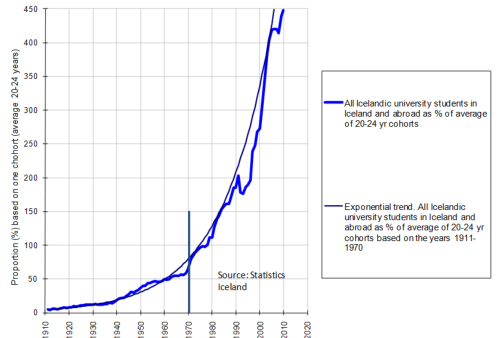
We can find examples of the exponential nature of changes in many fields of our life. Considering our topic, i.e. higher education, the Icelander case seems to be relevant. A study was conducted to examine the proportion of students in higher education compared to the total population of 20-24 year olds. From the 1911-1970 figures, they predicted an exponential rise, which was confirmed. See Figure 1. (Jónasson, 2012).
Figure 1. Higher education: Enrolment in Iceland 1911-1970-2010
Understanding the demands of the world of work Education – the source of the world of work
Education, which led to providing learners with a degree and/or other certificates served as an evidence for a person being able to fulfil the requirements of a certain job or profession. This was true in the industrial economy, however, it is not valid any longer in our age of knowledge society. The mismatch of a traditional school system (based on the needs of the industrial economy) and the changing needs of knowledge economy redefine the meaning of learning (Sawyer, 2008). This new interpretation of learning is in harmony with Recommendation 2006/962/EC of the European Parliament and of the Council, which defined eight key competences for lifelong learning.
The emergence of knowledge-based societies resulted in lifelong learning becoming an integral part of everyday life. The speed of knowledge becoming outdated and new knowledge coming to light (see exponentiality), the pace of new professions being born together with the knowledge necessary for these, as well as the rate and pace of technological, social and organizational changes all require learning new things and adapting to the changes in our environment. The socio-economic changes are reflected in the skills, competences, and attitudes that are demanded by the labour market. There is an increasing importance given to high quality cognitive abilities, interpersonal skills, as well as general skills possessed by an individual, whilst there is a reverse trend to be observed in routine cognitive skills and skills related to simple working activities (OECD, 2013, 23, 49, 50). The society, and within this, the players of the world of education therefore demand a profound change concerning the types and the content of the above skills and competences as well as the way we view them.
When talking about complexity, it is worth mentioning the content and concept of learning. Previously, we interpreted learning as an individual activity, while nowadays, besides individual learning, intra-group learning is becoming increasingly prominent. Joining the processes that take place within the individual and within the group creates a more complex way of learning than we were used to before. This is reflected by the fact that, according to our current knowledge, besides formal learning, non-formal and informal learning are becoming more valued, and a demand rises for joining these systematically (OECD, 2013, 40).
The relation between competences and qualifications There are two conflicts we wish to shed light on here. Firstly, there has always been a considerable distance between the actionable knowledge, the actually developed skills and competences, and the formally defined aims of most kinds of training at all levels of education. This conflict inspired the business sector to formulate new approaches that promote a better development of working skills instead of merely having a certificate. One good example for this system development is the establishment of the Sector Skill Councils in the UK (see: http://www.ukces.org.uk/), which was built on the Leitch Review of Skills (2006). Secondly, only actively used skills can function well, therefore formal graduation can have a prognostic role at the time of graduation, however, later, after some years, it is more important what activities and tasks are performed by the workers, i.e. what kind of knowledge, skills and attitudes are held by them with the help of which they can perform successfully in a specific sphere of activity, and what the future demands and learning tasks are for further development.
As a consequence, the relationship between one’s competences and the demands of work is a dynamic link. It means that the workers’ competences are changing, while s/he is working or practising various activities, or takes part in courses, or develops via non-formal and informal learning. The demands of work/job are also changing as a consequence of competition between workplaces, technological development (see how the internet, or the mobile devices reformed jobs and work conditions, etc.) At this point, we should refer to one of the key statements of the OECD Skill Strategy: they identified their inter-related policy levels which influence how better skills can result in higher economic growth and social inclusion. These are a) the development of relevant skills (dynamic interaction between demands and education); b) the activation of skills (making possible and attractive working opportunities for those who are outside the labour force); c) an active use of skills (making skills effective and keeping them on a developing curve) (OECD, 2012, 13-14).
Skill policy in the EU The European Union is undergoing serious changes while it has to face great challenges taking part in a world-wide economic competition. The socio-economic crisis and fast changes that characterize our exponential time create a new situation for the effective skill policy as well. There is no possibility to provide an in-depth analysis for this policy, however, here, we wish select and introduce some important events which – mostly indirectly but quite strongly – influence higher education, and as a consequence, the demands towards lecturers in the HE system.
There are some important EU level developments that support a better matching of workforce to the world of work. One of them is the so-called European Qualification Framework1, which served as a basis for the elaboration of the National Qualification Frameworks in the EU countries. The EQF focuses on the description of qualifications at eight levels, and it is based on learning outcomes (what learners should know and understand and also able to do).
ESCO2 – the European Skills, Competences and Occupations – is also a new development which is aimed at increasing the possibilities to fit job-seekers’ competences and the concrete demands of a certain sphere of activities at a certain company. While the previous system focused on qualifications for different jobs, this system can provide a deeper understanding of the personal level competences and the real demands of work. It is mirrored by the approach of the ESCO, according to which employers should consider more important what employees know, 1 http://ec.europa.eu/eqf 2 http://ec.europa.eu/social/main.jsp?langId=en&catId=89&newsId=852 understand and are able to do in practice than their formal qualifications.
The DISCO3 (Dictionary of Skills and Competences) as an online tool – in line with the EQF – provides assistance to understand and accurately describe skills and competences applying the peer-reviewed terminology for the classification, description and translation of skills and competences. This tool is actually available in 11 languages in the EU, and it is aimed at providing a common understanding between education/training and the world of work.
Last but not least, we should mention the idea of setting up Sector Councils on employment and skills at a European level (EU level Sector Councils). This idea was based on the decision of the European Commission about enhancing the matching of skills and jobs in the EU, and it published its Communication4 on ‘New Skills for New Jobs, Anticipating and matching labour market and skills needs’ in 2008. As a background to this Communication, a comprehensive assessment was performed regarding the labour market and the skill requirements up to 2020 (European Communities, 2009). Forming an EU level Sector Council can contribute to finding answers to the old concerns present in the European knowledge-based society and economy regarding how to improve transparency on labour markets, how to increase the skill levels of the work force while decreasing mismatches between skills and the demands of the world of work. This kind of development seems essential in order to foster European lifelong learning strategies (Ecorys, 2010, 9-10).
HIGHER EDUCATION AND QUALITY Higher education is also pressed to provide applicable knowledge to their students. There are two important investigations we wish to refer to here; these are REFLEX5 (Research into Employment and Professional FLEXibility) which supports HEGESCO6 (Higher Education as a Generator of Strategic Competences). The REFLEX project funded by the European Union was a large-sample international comparative research study involving 16 countries. The study analyzing empirical examinations describes the results of a survey conducted in 2005 amongst professionals graduating in 1999/2000. The project defined five focus points: (1) the expectations of our knowledge society from those graduated in higher education, with special regard to professional experience, flexibility, innovation and knowledge management; (2) evaluating how much higher education prepares students for entering the world of work, and to what extent the competences necessary for work can be attained during the students’ training; (3) the impact of how work is organized at workplaces alongside expectations and attained competences; (4) graduates’ objectives and motivation that point beyond work; (5) the impact the transition from higher education to work has on graduates’ characteristics, on training institutions, on the institutional structure in general, and on the cultural context in which the relevant people function (Allen, J., van der Velden, R, 2007, (Ed.), 2). The wide-scope and in-depth analysis contained several conclusions that can be linked with higher education lecturers’ competences, of which competences those are of special importance that articulate recommendations for the institutions, because these often contain statements and recommendations related to education and the success of learning (Allen, J., van der Velden, R, 2007, (Ed.), xxvi, 20-21, 276).
The HEGESCO project is closely linked with REFLEX. There are many similarities in their objectives, as well: in our knowledge society and knowledge economy there is an increased attention paid to higher education due to its growing socio-economic impact and the expectations from higher education. Therefore, we are seeking answers to the questions as to: (1) what competences are necessary for entering the world of work; what competences assist the individual in his/her employability and active role-raking in society; (2) what is the relationship between these competences and the requirements needed for certain positions and the demands of businesses; (3) to what extent do graduates attain these competences; (4) to what extent does higher education focus on the development of these competences (Allen, Velden, 2009, Ed., 7). We may stress again, that from our topic’s point of view, these questions are relevant since the development of training programmes, i.e. what competences students can attain during their training, depends largely on to what extent higher educational institutions involve their stakeholders in this development process. Furthermore, it is important what competences training projects really develop, and it is subject to the methods applied by lecturers fundamentally. As for this latter, there is a change necessary to take 3 http://disco-tools.eu/disco2_portal/index.php 4 http://eur-lex.europa.eu/LexUriServ/LexUriServ.do?uri=COM:2008:0868:FIN:EN:PDF 5 http://ec.europa.eu/research/social-sciences/projects/307_en.html 6 http://www.hegesco.org/ place, and this is well demonstrated by a quote cited from the analysis: “In terms of teaching style, higher education is still very traditional. There is a strong emphasis on lectures, and few graduates participate in innovative student- centred methods such as project- and problem-based learning. In most countries there is little emphasis on learning facts and practical knowledge, and few graduates participate in research projects during higher education.” (Allen, Velden, 2009, Ed., 26-27)
The OECD’s IMHE (Institutional Management in Higher Education) study can be linked to the above-mentioned two programmes. In this programme, 20 countries (mostly OECD members) participated with 29 higher educational institutions. The aim of the project was to explore the characteristic features of quality teaching, defining benchmarks, which eventually contributed to better specifying the output indicators of higher education. The IMHE analysis highlighted that the quality of teaching has an increasing significance in higher education, which is also fostered by economic expectations and the – by now global – competition among institutions. The study provides the reader with a wide-scope analysis into the lecturer-level, the organizational and the system-level characteristics of quality teaching as well as its support forms. For this latter, there are three main guidelines mentioned in the study, which are as follows: a quality policy that affects the entire organization, the monitoring of training programmes and the support of teaching and learning (Henard, 2010, 9-14).
A NEW WAY OF IDENTIFYING COMPETENCE REQUIREMENTS FOR LECTURERS The development model and methods
The development objective Based on discussions with the leaders of the university’s engineer training faculty, the basic objective of the development project was to increase the faculty’s competitiveness. More precisely, the objective was to define the competence profiles of lecturers’ teaching at a university that is competitive in the 21 st century, and on the basis of the competence profiles, to measure the competences of a group of lecturers, to support their individual development, furthermore to create a ground for applying and using the findings at an organizational level.
The demand-driven development of the lecturers’ competence requirements When defining the lecturers’ competence requirements, we applied the so-called demand-driven development model. The model used in Great Britain to define the required competences of people working in the lifelong learning sector served as a basis for our work. The procedure used there is based on the following:
the analysis of wide-scope literature;
the identification and analysis of existing standards and sector-specific data sources;
discussions and interviews held with the key stakeholders of the sector;
wide-scope questionnaire study amongst service providers and employers working in the sector;
conducting future planning workshops. (LLUK, 16-26) The demand-driven development model has been adapted, and the actually applied RDI model is described in Figure 2.
The demand-driven development model and the research methods were built on the following: o the involvement of participants (lecturers and employers, students, representatives of companies that employ graduates, i.e. the users of the knowledge transferred by the university) o the application of a mixed research method, which is based on an intelligent mixture of qualitative and quantitative methods, and during this, the content and target group triangularisation.
Input
o desk research: analyzing the international literature on competence requirements, and including national experiences accumulated by the development team in the past years in the field of the development of the higher education competence requirement system; o analyzing the effective higher educational law, highlighting the relevant stipulations for requirements towards lecturers; o analyzing the rules and regulations of the University and the Faculty, identifying lecturer requirements; o taking the Faculty’s previous competence and organization development findings into consideration.
Process o Organizing workshops with representatives of stakeholders (lecturers and their employers); o Interview with the students; o Questionnaire studies conducted among the entire circle of stakeholders (lecturers, students, company representatives); o Defining the lecturer competence profile – requirements, in the focus of which stood behaviour, activities, and a way of thinking (the descriptors of competence descriptions were: knowledge, skills and competences, attitudes and motivation); o Finalizing competence requirements; o Examining and measuring lecturer competences, development consultancy, recommendations.
Output
o Defining and detailing competence profiles for the positions specified by the Faculty, from assistant lecturer to professor; o Personal feedback to the lecturers: the matching rate with the required competence profile, recommendations for development; o An organization-level summary based on the competence measurement findings, i.e. how the Faculty can build on the strengths of its lecturers; o Summarizing recommendations as to how the project findings can be used.
Demand-driven approach Mixed research method
Qualitative methods
Final competency
profile for the lecturers Individual
PROCE
OUTCOM
WS 1-2, interview: identifying Profile 1
feedback
demands
INPUT
*Desk research *Internation al, national knowledge, experiences
E
SS
and developmen
t plan
*Higher Educational
Organization al summary
Law *Competenc e and organization
WS 3: decision about the final profile
Utilization plan for the
al developmen
Faculty
t on the Faculty
Figure 2: The model of the RDI project The lecturer competence defining workshops and their results
Figure available in the original PDF paper.
During the RDI project, we held three workshops in which leaders with employer rights (dean or vice dean), a faculty representative responsible for the training, a methodology expert and the training leader took part. This group fulfilled two functions: in the development process, their expertise, experiences and professional knowledge played vital roles; and at the same time, they functioned as a scene for decision-making because of the positions held in the Faculty’s life.
For the first workshop, we prepared with analyzing the information, the materials and the data that served as our input. The needs articulated by the Faculty and the complexity of the process necessary for achieving our objectives required that – based on the analysis of relevant international and national literature – we recommend using the demand-driven development model to our partner as this would enable us to explore real but changing and stakeholder-specific expectations. On the other hand, the complexity of the process demanded the application of the mixed research technique so that we could ensure that lecturer competences are based on facts as much as possible. During the research and development process, we attempted to validate our findings via triangularisation. As part of our preparation for our first workshop, we explored the prevailing legal environment, i.e. what kind of requirements are stipulated by law regarding lecturers, and also, we familiarized ourselves with the University’s and within this, the Faculty’s specific requirements. Considering that the Faculty had dealt with defining the competences of lecturers prior to this current project, we found it important to learn about the previous development project and its findings.
In the course of the first workshop, we realized that – contrary to our original plans and agreements – we would not come up with competence profiles but rather with lecturer requirements (profiles) for each position that can be linked with the promotion ladder of the Hungarian higher educational hierarchy, i.e. assistant lecturer, assistant professor, associate professor, university professor. In the workshop, first we agreed on the project objectives, we introduced the development model and shared additional information deriving from the input factors; then we encouraged the Faculty representatives to think over what type of context they could put the competence profile of a successful lecturer who contributes to the competitiveness of the university. The questions did not serve as a basis for specific debates, they rather functioned as guidelines for our discussion.
a. What do you think of learning? Does a common interpretation of the concept exist at a Faculty or organizational level; if so, what does it say? b. What is necessary for a student to be successful at the Faculty? How is this supported by lecturers? c. What is necessary for a lecturer to be successful at the Faculty? How is this supported by the leadership and the organization itself? d. The Faculty trains workforce for an environment that is a leader in development and innovation. Does innovation appear in learning and in the management of learning; if so, how? e. What role does knowledge management play in education and training? How can this role be identified in the work of lecturers and the activities? f. What is the role of training and course development that is built on learning outcomes? How does this appear in the operation of the Faculty? g. What learning management methods, i.e. educational and training methods, are deemed suitable and typical in the training projects taking place at the Faculty? h. What organizational culture supports quality learning? To what extent is this represented at the Faculty?
The aim of the intensive debate was to create a possibility for the participants to get to know each others’ views, priorities and to make them focus on the facts that support their approaches. Following the opening, we asked the lecturers and their employers to articulate what – on the basis of the preceding discussion - characterizes a successful lecturer of the Faculty. We requested them to identify forms of behaviour, activities, ways of thinking and approaches when giving their characterization. The reason why we focused on behaviour was because in our approach, competences are reflected in behaviour (i.e. activities, way of thinking, way of speaking, etc.); in other words, behaviour can be defined as the active representation of competences. This is important as behaviour can be observed, its characteristic features can be identified, and, with conscious attention, its orientation can be changed and developed. Thus eventually, we manage to achieve the development of competences.
As a result (product) of the workshop, we drafted a list of sentences, the elements of which, i.e. the sentences, identified a typical way of behaviour, a factor that was typical for the lecturer’s work. We conducted a focus group interview with a group of students in order to supplement the list, in which we tried to assess what kind of expectations they had regarding the lecturers. The interview results were incorporated in the recommendations received from the group of lecturers and the leaders. The group consisting of employers and leading lecturers already on the first occasion had to face the fact that it was not easy to identify the differences in the expectations along the lines of various positions. The second workshop produced sentence lists that reflected optimally the expectations for all four positions. The workshop participants evaluated the sentences matched to each position according to two criteria:
The competence expectation expressed by a sentence was defined by an objective, i.e. a future expectation; or a demand, i.e. a form of behaviour that can be expected from each person working in a given position.
The sentences had to be ranked on a 4-grade scale according to their importance (1 – not at all important, 4 – very important).
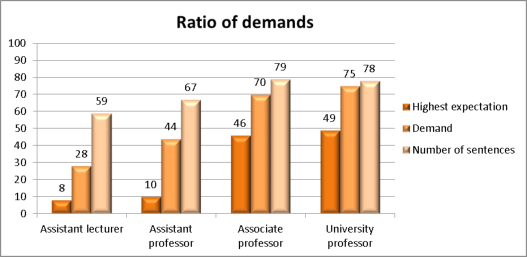
Figure 3 shows that the Faculty leaders and the leading lecturers managed to create an appropriate differentiation between the expectations. This is reflected by the fact that there were significantly fewer sentences (59) for the assistant lecturer expectations than for the university professor expectations (78). Furthermore, whilst in the case of associate professors and university professors, the majority of the expectations were actually demands (70, 75), in the case of assistant lecturers and assistant professors, the figures were much lower (28, 44), i.e. most of the expectations appeared as objectives.
Figure 3: Ratio of demands based on the status of the lecturers
Finally, while in the case of associate professors and university professors, the majority of the expectations (46, 49) were ranked by the respondents among the most important ones, this was true for much fewer sentences (8, 10) about those who held lower positions in the university’s lecturer.
Five expectations received a maximum score for each lecturer status, and these were as follows:
Holds lectures, practice sessions and seminars.
Takes responsibility for his/her own work.
Prepares for his/her lessons.
Can articulate his/her ideas clearly.
Demonstrates his/her explanations.
Questionnaire examination – the fine-tuning of competence expectations The sentence lists prepared for each position, which actually contained several identical elements, for professional and technical reasons, were joined for the purpose of the questionnaire study, which eventually produced us 84 expectations (statements). Therefore, the participants needed to fill in one questionnaire only, so they did not have to do the same for four different positions. The company representatives and the students were not interested anyway in linking the expectations to university positions, in fact, it would have been rather difficult for them to do so. The members of the three target groups – lecturers (91), students (34), the HR leaders of the most important company partners (4) – were invited to rank the expectations on a 4-grade scale according to how typical they deemed the characteristics to be for the lecturers and how typical they deemed the characteristics to be necessary for the lecturers (1 – not at all important; 4 – very important). The questionnaire examination aided the fine-tuning of the expectations. The individual analyses explored the differences between the stakeholder groups’ opinions. Although the opinion of the company representatives needs to be treated with some kind of reservation due to the very low number of their participants, the difference between the opinion of the students and the lecturers is quite significant.
We ranked the expectations on the basis of the lecturers’ responses in a decreasing order, according to which we could state the students had only six, while the company representatives only had seven statements that were ranked among the 20 most important ones out of 84 expectations in total. The preference rank stood by the lecturers obviously differed from those of the other two groups. The difference in the preference ranking is also reflected by the fact that in the case of the students, four statements, and in the case of the company representatives, three statements are on the list of the top 20 of the lecturers that were ranked as the least important 20 by the students and the company representatives. At the same time, however, it is worth highlighting which were the cases where the groups managed to reach a consensus. There were four statements (expectations) that all three groups ranked among the 20 most important ones.
Can express his/her ideas clearly.
Can hold a logically structured lecture, which is easy to follow and can motivate the students.
Is a reliable worker (for the employer).
Builds his/her relations consciously.
It is also worth mentioning to what extent the three groups used differentiation when evaluating the statements. The theoretical borders of the averages were 1 and 4. The lowest average of the lecturers was 3.50, the highest 3.87, which means that, when evaluating the importance of the 84 statements, the difference between the least important and the most important statements was only 0.37 for them. The lecturers deemed the characteristics listed all very important with hardly any differentiation. The evaluation given by the students is more differentiated, i.e. there are sharper differences between the important and the not important things. Their lowest average is 2.97, and the highest is 3.97. The sharpest differentiation was given by the company representatives, in their case, the lowest value was 2.25, while the highest 4. This, however, could have been the result of the low number of respondents, as we mentioned before.
In all, we can say that the preferences regarding the expectations from the lecturers were shaped by those values and interests that originated from the given group’s specific features.
In the lecturers’ preferences, besides general human and education-related expectations, those characteristics also appear important that can be linked to research activities (e.g.: performs high quality publication activity) together with a special academic approach that emphasizes the university lecturers’ academic activities and not only their teaching work. This is obviously supported by the system of requirements that needs to be fulfilled by university lecturers (e.g.: obtaining a PhD degree, habilitation, or possibly, writing an academic paper for Doctor of Science degree), which all require being active in academic research, as well.
The students’ preferences are clearly influenced by the expectations linked to the quality of teaching. In their preferences, they expressed the importance of motivating students, project approach teaching methods and the development of the educational environment.
The company representatives’ preferences were characterized by a kind of “employer” attitude, which means that they consider a lecturer outstanding if their graduates are well prepared for the world of work. They find the following important: the ability to adapt to changes, to handle conflicts, to demonstrate a link between theory and practice, and the ability to understand and solve problems.
All these prove that the triangularisation by target groups was necessary in order to end up with a balanced lecturer competence profile that reflects the expectations of all stakeholders.
It is worth examining the differences between the opinions of the lecturers and those of the students separately. From the students’ average values, we deducted the average values of the lecturers’ self-assessment. The differences were mainly negative ones, which means that the lecturers found the statements more typical for themselves than the students. Out of the 84 statements, in the case of 54, the difference was significant, of which in 6 instances in total there was a difference pointing in the opposite direction.
Lecturer Student
Lecturer Student
4
3
2.5
3 3.5
2
2.5
2
1.5
1.5
1
1
0.5
0.5
0
0
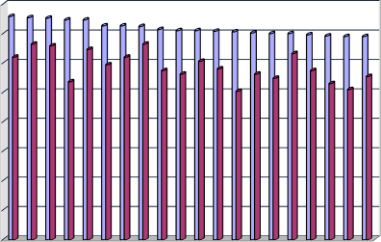
Figure 4: Top20 average of lecturers and students Figure 5: Last20 average of lecturers and students Figures 4 and 5 show the differences between the top20 and the last 20 expectations based on the lecturers’ self- assessment ranking. In all, we can conclude that these differences are larger at the front of the list than at the end, i.e. the differences are greater where the lecturers – according to their self-assessment – produced better results. This is not supported by the students’ ranking. The largest negative differences appeared in two areas:
On the one hand, in the area of general human characteristics deemed necessary for teaching: o empathy (the lecturer is capable of seeing the world with the eyes of a student, and can see the point of view of his/her colleague (including students as well); o flexibility (the lecturer is open to changes, and can adapt to changes); o tolerance (the lecturer respects other people’s way of thinking and their points of view, can accept observations from his/her colleagues and the students, and can adequately react to them); o self-awareness (the lecturer knows his/her own strengths and weaknesses as well as his/her fields to develop, and is predictable in his/her operation and behaviour).
On the other hand, in the area of activities closely linked with teaching: o Evaluation of students (the lecturer sets realistic expectations towards the students, can apply various evaluation methods most suitable to the students and their groups, applies the fundamental evaluation principles of students’ assignments); o Teaching activity (the lecturer can hold logically structured lectures that are easy to follow and that motivate the students, demonstrates his/her explanations, can give good presentations, and attempts to demonstrate the link between practice and theory when teaching a given subject); o The development of teaching (the lecturer develops teaching materials and continuously develops and updates these)
Out of 84 statements there were 16 where the students gave better evaluation than the lecturers’ self-assessment; however, there are only 6 of these that have significant differences regarding the averages of the two groups. These statements are not closely related to teaching and learning from the students’ point of view, instead they are related to science organizational and faculty-level education organizational activities.
Finalizing the competence profiles of lecturers The third workshop served as a forum for finalizing the lecturer competence profile. During this workshop, we took into account the results of the questionnaire survey, and in collaboration with the university representatives’ group we examined the following:
What corrections are justified to make on the basis of the questionnaire survey?
Are there any expectations that are necessary but have not yet been covered?
Are there any further special expectations that need to be taken into consideration for certain positions?
Based on the questions formed here, we finalized the sentence lists representing the expectations and we formed a structure in which the competences were described. For this, we used the experiences of the Tuning project7, with special regard to what we understand by competence. (This concept does not have a single correct and widely accepted interpretation; therefore what we did was to create a specific interpretation and definition based on international research experiences). The Tuning project defined the concept of competence as follows: “competences and skills are understood as including knowing and understanding (theoretical knowledge of an academic field, the capacity to know and understand), knowing how to act (practical and operational application of knowledge to certain situations), knowing how to be (values as an integral element of the way of perceiving and living with others and in a social context). Competences represent a combination of attributes (with respect to knowledge and its application, attitudes, skills and responsibilities) that describe the level or degree to which a person is capable of performing them.” (González, Wagenaar, eds., 2003, 69). We also took into consideration the definition provided by the Common European Principles for Teacher Competences and Qualifications8, primarily when identifying the content areas of competences. Finally, based on international and national experiences, we formed the following content categories and areas of a two-dimensional system:
Technology and knowledge management, R+D+I;
Professional cooperation and communication, and leadership;
Committednes, responsibility and professional ethics.
On the content areas, the descriptors of the competence elements were the following:
Knowledge
Skills and abilities
Attitude, motivation.
The integrity of the development process is ensured by the fact that the formation of the competence profile for each lecturer position was done by the team of Faculty leaders (employers) and leading lecturers alongside the development model involving stakeholders, with full expert support. During the finalization phase, this team examined the following in the context of the two-dimensional competence matrix:
The appropriateness of the profile descriptions (applying the target group’s aspects);
The correction of the profiles drafted by the workshops (this was based on the questionnaire survey ensuring triangulation);
The horizontal examination of the profiles (the presence of justified identities and differences in the competence expectations of various lecturer positions).
In the competence profile finalizing workshops, the final decisions were made by the leaders of the Faculty and the lecturers. The final content of the competence expectations and profiles were based in an at least 60% agreement of the group members.
Finally, it is worth reflecting briefly on what relation the expectations for the various positions have with the international studies and programmes described previously. In the HEGESCO and the OECD IMHE projects both, quality teaching, the training methods and the evaluation procedure used by the lecturers played vital roles. We can deem it as a clearly positive outcome that when analyzing the expectations (sentence lists) for each position, we could conclude that in the case of assistant lecturers and assistant professors, 67% of the total number of expectations was linked to teaching and learning (e.g.: decisiveness, responsibility for one’s work), while 46% of them was markedly related to instruction (the lecturer uses improvement-centred evaluation, he/she plans and organizes the educational process with the understanding of the students and their special attributes). The same ratios applied in the case of assistant professors and university professor were 65% and 42%. Clearly, quality teaching is expressed as an expectation from each lecturer position, and their ratios are similar in all the relevant groups. If these expectations are realized at a high quality in practice, then the differences between lecturer and student behaviour will hopefully be mitigated as well.
7 http://www.unideusto.org/tuningeu/ 8 Draft. 15.12.2004. European Commission Directorate-General for Education and Culture
Measuring Competences, Consultancy and Development From a development point of view, it was vital to know how the presence of lecturer competences be measured and developed if the Faculty already had its clear and straightforward description of these competences. In the world of HR, there are several models and tools that are suitable for examining the characteristics and behaviour of employees. We applied a model that is capable of describing the characteristic features of an individual’s behaviour and at the same time, it can serve as a basis for development, which will make it possible to present job profiles within the same system. Comparing the two will function as a basis for targeted development. We must notice that the assessment does not examine and identify the competences in a direct manner but it enables us to grasp the behavioural characteristics tangible, behind which are the competences to be found. (See example: Barath, 2014.)
The model selected was the so-called RDA model (Role Diagrammatic Approach), which – according to its creators – is an integrated tool, built on the holistic approach and the structured description of human behaviour (van Harten & Wolbers, 2005). It enables the user to identify an individual’s effective and non-effective behaviour features against a relation point, i.e. the job profile, and to identify development possibilities. A detailed description of the model goes beyond the limitations of this present paper, but further information on the model and some of its application possibilities can be found in the following professional literature: (RDA description: Baráth, 2010, 37- 40; Baráth, 2013, 219-225; RDA application: Baráth, 2010, 67-95; Cseh-Kígyós, 2013; 110-120; Baráth-Cseh, 2013, 151-169,).
The 25 lecturers taking part in the survey were invited to fill in two online questionnaires. The “Behaviour” questionnaire showed the main features of their operation; their strengths (effective behaviour) and weaknesses (non-effective behaviour) could be identified. The “Values” questionnaire enabled us to identify the long-term, tendency type of features that characterized their behaviour. By comparing the behaviour and the job profile, we could make conclusions regarding the development needs, while by comparing the behaviour and value profiles, we could conclude what kind of development possibilities existed for the individual. By comparing these two, we received a development guideline, which was necessary for increasing the efficiency and the success of work as much as possible. During the personal interviews, basically all the lecturers reinforced that the feedback they received after the questionnaire survey was accurate and reflected well their behaviour features and drives. Most of them were inquisitive and open to the suggestions and recommendation that were raised in order to approximate their operation to the job profile.
We had the opportunity to write a summary report to the Faculty, which was based on the individual assessments and the interview experiences, with and to the extent of the authorization of the lecturers (i.e. we only used those parts of the individual feedback reports that we received written authorizations for from the lecturer in question). We highlighted the features that could be considered as general ones, and which could assist the organization in increasing its transparency and conscious operation.
Almost 50%-50% is the ratio of the respondent lecturers who fall into the category of relation-oriented and content- oriented individuals. Thus, we can conclude that there is no significant difference between them in this respect. At the same time, 72% of them were stable, 28% of them were dynamic persons, 64% of them falling into the category of leadership and 36% of them of the operative type. Therefore, for a “typical” lecturer, relations and the work itself are similarly important, and they are characterized rather by leadership competences and stability. This way of operation can affect the organization and, indirectly, the quality of education.
The high rate of stability suggests a less open attitude towards changes, and the need for clear, understandable and easy to follow structure of work processes. The dominance of leadership competences can be interpreted as positive, knowing the work of the lecturers and the expectations from them, as it means that the lecturers are capable of putting their work into perspectives, lead the students and colleagues under their guidance in a target-oriented manner, and correct the mistakes arising accordingly.
Typically, the lecturers are cooperative and good organisers, as 72% of the lecturers fall into these two quadrants. This supports the idea that the organization has the potential to assists accurate and target-oriented work as there is a need for cooperation, providing assistance, performing accurate engineer work and a operating in a sophisticated way.
CONCLUSIONS
At the end of our paper, we wish to list some examples of recommendations that were articulated for the Faculty on the basis of the development process, and then, we shall summarise what we found when defining lecturer competences. Finally, we will briefly evaluate the development model applied.
Recommendations made for the Faculty As we learnt from the questionnaire survey, there were significant differences between the opinions of the lecturers and those of the students in certain questions. These were the following: the relation between the materials taught during the courses and the material tested; and holding lectures that are easy to follow and motivating for the students. This difference can stem from simply a communicational problem, or, in fact, it can be a real difference. Firstly, it is worth exploring the reason behind the difference with quantitative methods, and then decide whether it is necessary to make methodological or training changes, or judge if a more effective and understandable communication of the applied methods and objectives can lead to aligning the opinions of the lecturers and the students.
The RDA assessments suggest that the strengths of the lecturers are being practical and loyal. On the one hand, being practical enables them to reach an optimal performance using the resources. Loyalty, on the other hand, means a bonding force to their profession, loyalty to the organization and motivation for them to act in order to reach success. Loyalty in itself is an important signal that can increase an organisation’s immunity from external forces.
Based on the RDI project, several development and application possibilities can be identified for the lecturers, the leader as well as the entire organization. The following examples illustrate this:
Using the results at the level of the lecturers: o A possibility to build a personal development/career plan; increasing the consciousness in the development process; harmonizing the lecturers’ training needs with their possibilities; o Increasing reflexivity on one’s own activities (iinstruction, research), its integration in the organization; o Learning development, the methodological development of courses in order to realize learning outcome-based training programmes; o Supporting the university’s operations as a competence centre; increasing the emphasis on learning management;
Using the results at the level of the Faculty leadership:
o Career planning, supporting the lecturer evaluation and incentive system; o Introducing the success and the efficiency of the training programmes run by the Faculty to its environment; o Increasing competitiveness.
Using the results at a Faculty (organizational) level: o Awareness-raising of the organization’s bonding values, the communication of this (external, internal); o A common way of thinking that shapes the organizational culture: what requirements do lecturers entering the Faculty have to meet (Who can teach at our Faculty?); o The impact of professional expectations – job profile – on daily work, how can these become reflection points, increasing the emphasis on (self) assessment.
The model applied for identifying lecturer competences The application of the model revealed that the expectations from lecturers, and as a result, their activities as well as the focus of these expectations, are interpreted differently by various stakeholders. Making visible and empirically tangible what differences there are between the self-perception of lecturers and students as well as perception of the players of the world of work, enables the Faculty to effectively react to the expectations they accept, the expectations that are feasible and the conditions of which can be provided, in a targeted manner and upon the basis of mutual agreement.
The world of universities is built on a traditionally strong hierarchy in Hungary (too). The results of the surveys conducted with the help of the RDA tool also reveal the rigidness of the organizational hierarchy as well as the university’s internal relations. At the same time, the interviews prove that at the Faculty, there exists a great deal of openness, a clever judgement of changes, readiness to change, and a need to foster intense relations with the world of work. The organizational possibilities explored from the personal characteristics can be optimised with the help of targeted leadership, which prove that the results of an RDI project can be utilized. In all, we can conclude that the model applied contributed to an increased self-awareness of the Faculty, a deeper understanding of the stakeholders’ needs built on facts, and the exploration of the fine intertwining links between personal knowledge and motivation. In essence, it was a suitable tool to support the harmonization of personal and organizational objectives.
REFERENCES
Baráth (2014): “New ways of defining teacher competences. Demand-driven competence definition and development”, in: Human Factors of a Global Society: A System of Systems Perspective. Taylor&Francis, Boca Raton, USA. pp. 973-984 (to be published) Baráth, T. (2010): “Defining and analysing leader competence profiles”, in: Improving school leadership in Central Europe,
Abari-Ibolya, Baráth (Ed.). pp. 67-95 Baráth, T. (2010): “Methodology applied in the project”, in: Improving school leadership in Central Europe, Abari-Ibolya-Baráth (Ed.). pp. 33-40 Baráth, T. (2013): “The Role Diagrammatic Approach”, in: The art and science of leading school – Central5: Central-European
view on competencies for school leaders, Glynn, Révai (Ed.). pp. 219-225 Baráth, T., Cseh, Gy. (2013): “Case study on highly effective school leaders”, in: The art and science of leading school – Central5: Central-European view on competencies for school leaders, Glynn, Révai (Ed.). pp. 151-169 Cseh, Gy., Kígyós, T. (2013): “Adaptation in HUNSEM”, in: The art and science of leading school – Central5: Central-European
view on competencies for school leaders, Glynn, Révai (Ed.). pp. 110-120 Ecorys (2010), “Sector Councils on Employment and Skills at EU level. A study into their feasibility and potential impact”.
ECORYS Nederland BV in cooperation with KBA. European Communities (2009), “New Skills for New Jobs: Anticipating and matching labour market and skills needs”. Office for Official Publications of the European Communities. González, J., Wagenaar, R. (2003), (Ed.) “Tuning Educational Structures in Europe. Final Report Phase One” González, J., Wagenaar, R. (2003), “Tuning Educational Structures in Europe. Final Report Phase One”. Universidad de Deusto,
Bilbao. Hénard, F. (2010): “Learning our Lesson: Review of quality teaching in higher education”, OECD Publishing. Jónasson, J. T. (2012): “The future and education: Where do we go from here?”. ENIRDELM/CoRk symposium, Is a sustainable future science fiction?, Poland. Leitch Review of Skills (2006), “Prosperity for all in the global economy - world class skills”. HMSO, Norwich, UK. LLUK (2006): “A sector skills agreement for the life long learning sector. Stage 1 – skills needs assessment”. OECD (2013), “OECD Skills Outlook 2013: First Results from the Survey of Adult Skills”. OECD Publishing. Sawyer, K. (2008): Optimising “Learning: Implications of Learning Sciences Research”, in: OECD (2008): Innovating to learn,
learning to innovate. OECD Publishing. pp. 45-66. van Harten & Wolbers 2005, “Syllabus; RDA basics certification course.” Con7, Utrecht.
LISTED IN THE AHFE DIGITAL BOOKSTORE CATALOGUE
Explore the complete digital volume
Advances in Science, Technology, Higher Education and Society in the Conceptual Age: STHESCA
Read this individual research paper free through the original publisher, or explore the full digital proceedings book.
ISBN 978-1-4951-2110-4
Explore this ISBN in the AHFE Bookstore ↗Listed in the July 2026 bookstore catalogue; search by ISBN to confirm current availability · Digital book purchase optional