Georgii Kupriianov, Remir Solnitsev (2022). A CAD toolset for modeling and synthesis of technosphere safety systems using blockchain technology. In: Intelligent Human Systems Integration (IHSI 2022): Integrating People and Intelligent Systems. AHFE Open Access, vol. 22. https://doi.org/10.54941/ahfe1001011
How to solve the problem of timely prevention of technological disasters, in example?My solution: An integrated system of technosphere security with the registration of events in theblockchain.Data from vibration sensors, deformation sensors, position and displacement sensors relative to afixed reference point (as well as humidity, gas, fire and burglar alarm sensors, etc.) mustconstantly fall into the public blockchain. Society should always be aware of the status ofsignificant objects, that is, 24/7.The maximum permissible values of the readings of all systems must also be known and remainunchanged, so that it is possible to make decentralized conclusions about the condition ofstructures, the operation of which is associated with risks in the field of technosphere and othersafety.Accordingly, events should be recorded and short videos should also be recorded, the recordingof which is carried out by the operation of motion sensors that record any environmental changenear the protected object.Verification and certification data of measuring instruments should also be included in theblockchain as separate transactions.The information system based on the blockchain, where monitoring data will be delivered in atimely manner, will not only prevent technogenic disasters, it will determine the responsibilitiesof officials and prevent the implementation of corruption scenarios.Earlier in my publications I already suggested using blockchain to register events of anintegrated system of environmental safety and campaigning.The design of integrated technosphere security system with event logging based on the blockchain is a complex task. And then a special CAD/CAE will come to the rescue. Specifically, a suite of CAD tools for modeling and synthesizing a recycling infrastructure for waste management systems and solutions development in order to prevent the global waste catastrophe.Here I propose the concept of such a computer-aided design toolset.
Intelligent Human Systems Integration (IHSI 2022): Integrating People and Intelligent Systems https://openaccess.cms-conferences.org/#/publications/book/978-1-7923-8988-7
INTRODUCTION
Saving the planet is seen in the transition to sustainable development and, among other things, in the avoidance of global and local disasters, including slow-onset disasters, that are associated with environmental degradation such as excessive pollution and poisoning of biosphere.
So, the question is: how to solve the problem of timely prevention of technogenic, man-made disasters, in example? Our solution is an integrated system of techno-sphere security with the registration of events in the blockchain. Society should al-ways be aware of the status of significant objects, that is, 24/7. Data from any security, chemical, vibration, deformation sensors, position and displacement sensors relative to a fixed reference point (as well as humidity, gas, fire and burglar alarm sensors, etc.) must constantly fall into the public blockchain. The maximum permissible values of the readings of all systems must also be known and remain unchanged, so that it is possible to make decentralized conclusions about the condition of structures, the operation of which is associated with risks in the field of technosphere and other safe-ty. Accordingly, events should be recorded and short videos should also be recorded, the recording of which is carried out by the operation of motion sensors that record any environmental change near the protected object. Verification and certification data of measuring instruments should also be included in the blockchain as separate transactions. The information system based on the blockchain, where monitoring data will be delivered in a timely manner, will not only prevent technogenic disasters, it will determine the responsibilities of officials and prevent the implementation of corruption scenarios. Earlier in our publications (Kupriianov and Solnitsev, 2018 – 2021) we already suggested using blockchain to register events of an integrated system of environmental safety and campaigning.
The design of integrated technosphere security system with event logging based on the blockchain is a complex task. And then a special CAD/CAE will come to the res-cue. Specifically, a suite of CAD tools for modeling and synthesizing a recycling infra-structure (RI) for waste management systems and solutions development in order to prevent the global waste catastrophe. Here we propose the concept of such a computer-aided design toolset.
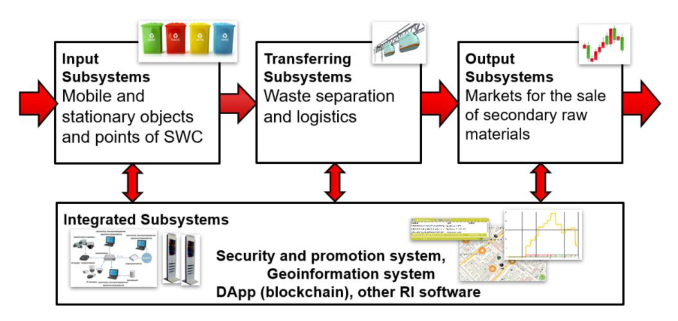
THE CASE OF TECHNOSPHERE SAFETY SUBSYSTEM: A RECYCLING INFRASTRUCTURE AS DESIGN OBJECT RI as a design object (Kupriianov and Solnitsev, 2018) contains input, transferring, output and associated (integrated) subsystems (Figure 1).
Intelligent Human Systems Integration (IHSI 2022): Integrating People and Intelligent Systems https://openaccess.cms-conferences.org/#/publications/book/978-1-7923-8988-7
Figure 1. Recycling infrastructure as a design object.
To build the RI CAD system (Kupriianov and Solnitsev, 2019, 2020), first of all, it is necessary to describe the mathematical model of RI. We basically use the control theory approach (Solnitsev, 1991). The metamodels are:
Equation reproduced from the original PDF.
ˆ ( , ) ( ( , ), ( )) ˆ ˆ { , ,...}
Λ = Ψ μ ij ij
Equations and mathematical formulas are available in the original paper PDF.
Afterwards macromodels are transfer function matrices: p p [Equation or mathematical symbol available in the original paper PDF][Equation or mathematical symbol available in the original paper PDF] μ μ N
1 11
Ψ Ψ
p e p e
ˆ ˆ 11 1 N
(2)
ˆˆ ( )
p
μ μ W
Equations and mathematical formulas are available in the original paper PDF.
1
Q QN
ˆ ˆ ( ) ... ( ) ... ... ... ˆ ˆ ( ) ... ( )
Ψ Ψ
p e p e
ˆ ˆ 1
p p Q QN
[Equation or mathematical symbol available in the original paper PDF]
[Equation or mathematical symbol available in the original paper PDF][Equation or mathematical symbol available in the original paper PDF][Equation or mathematical symbol available in the original paper PDF][Equation or mathematical symbol available in the original paper PDF][Equation or mathematical symbol available in the original paper PDF][Equation or mathematical symbol available in the original paper PDF][Equation or mathematical symbol available in the original paper PDF][Equation or mathematical symbol available in the original paper PDF][Equation or mathematical symbol available in the original paper PDF][Equation or mathematical symbol available in the original paper PDF][Equation or mathematical symbol available in the original paper PDF][Equation or mathematical symbol available in the original paper PDF][Equation or mathematical symbol available in the original paper PDF][Equation or mathematical symbol available in the original paper PDF][Equation or mathematical symbol available in the original paper PDF][Equation or mathematical symbol available in the original paper PDF] ˆ ˆ [Equation or mathematical symbol available in the original paper PDF][Equation or mathematical symbol available in the original paper PDF][Equation or mathematical symbol available in the original paper PDF][Equation or mathematical symbol available in the original paper PDF][Equation or mathematical symbol available in the original paper PDF][Equation or mathematical symbol available in the original paper PDF][Equation or mathematical symbol available in the original paper PDF] μ τ W Ψ w (3)
1 1 ( ) ˆ ˆ ˆ ( ) ( )
ij ij ij nq Q N p p ij ij nq n q p p e p e [Equation or mathematical symbol available in the original paper PDF][Equation or mathematical symbol available in the original paper PDF]
And finally, at the lowest level, micromodels are models of storages and separators of material resources:
[Equation or mathematical symbol available in the original paper PDF]
Equations and mathematical formulas are available in the original paper PDF.
τ Y w ω r r
w p e x p e
ˆ ( ) ( )
Equations and mathematical formulas are available in the original paper PDF.
ij Q Q V V p p ij i i j [Equation or mathematical symbol available in the original paper PDF][Equation or mathematical symbol available in the original paper PDF]
1 1
(4)
QV w p U i Q [Equation or mathematical symbol available in the original paper PDF] ( ) (1), 1... ε ij w V j [Equation or mathematical symbol available in the original paper PDF]
1
Equations and mathematical formulas are available in the original paper PDF.
Following an approach proposed to the mathematical modeling of RI as transfer functions with delays (Kupriianov and Solnitsev, 2019, 2020), we previously expressed the material resources flow through the RI as follows:
Intelligent Human Systems Integration (IHSI 2022): Integrating People and Intelligent Systems https://openaccess.cms-conferences.org/#/publications/book/978-1-7923-8988-7
(5)
ˆ ( ) ( ) ( ) p p p [Equation or mathematical symbol available in the original paper PDF] R W ω r r t d t t t d dt [Equation or mathematical symbol available in the original paper PDF][Equation or mathematical symbol available in the original paper PDF][Equation or mathematical symbol available in the original paper PDF][Equation or mathematical symbol available in the original paper PDF][Equation or mathematical symbol available in the original paper PDF][Equation or mathematical symbol available in the original paper PDF][Equation or mathematical symbol available in the original paper PDF][Equation or mathematical symbol available in the original paper PDF][Equation or mathematical symbol available in the original paper PDF][Equation or mathematical symbol available in the original paper PDF] R W ω W ω ur ur ur (6)
0 ˆ ˆ ( ) ( ) (0) ( ) ( )
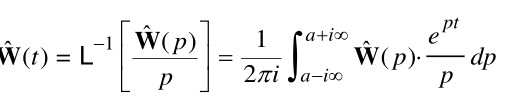
pt a i [Equation or mathematical symbol available in the original paper PDF][Equation or mathematical symbol available in the original paper PDF]
Equations and mathematical formulas are available in the original paper PDF.
1 ˆ 1 ( ) ˆ ˆ ( ) ( ) 2
Equation reproduced from the original PDF.
[Equation or mathematical symbol available in the original paper PDF][Equation or mathematical symbol available in the original paper PDF][Equation or mathematical symbol available in the original paper PDF][Equation or mathematical symbol available in the original paper PDF][Equation or mathematical symbol available in the original paper PDF][Equation or mathematical symbol available in the original paper PDF][Equation or mathematical symbol available in the original paper PDF] W W W L (7) The task of RI synthesis as an optimization of resource flow through the RI can proposed with the following expression:
T RI t J t t dt
0 min ( ) ( , ) ( , , )
Equations and mathematical formulas are available in the original paper PDF.
[Equation or mathematical symbol available in the original paper PDF][Equation or mathematical symbol available in the original paper PDF][Equation or mathematical symbol available in the original paper PDF][Equation or mathematical symbol available in the original paper PDF][Equation or mathematical symbol available in the original paper PDF][Equation or mathematical symbol available in the original paper PDF][Equation or mathematical symbol available in the original paper PDF][Equation or mathematical symbol available in the original paper PDF][Equation or mathematical symbol available in the original paper PDF][Equation or mathematical symbol available in the original paper PDF][Equation or mathematical symbol available in the original paper PDF] Λ Λ R Λ Λ R € r r r (8) This means that the flow of non-recyclable waste should be minimal for a given expenses vector function (€), in which the corresponding components tend to increase.
Also of interest is the place of RI in a circular economy and the assessment of the RI CAD application economic impact. Here we will imagine a model of the contour of a circular economy associated with the flows of material resources through RI and get the indicator of its economic efficiency. To begin with, let's try to define a circular economy using the approach of control theory (Figure 2). Let us designate the current income of the RI as the difference between the current proceeds from the sales of secondary resources at its output and all involved current expenses for the functioning of the RI (payment for products and services, taxes, rent, etc.). It can be obtained by solving the following system of matrix- vector equations:
r r r s R f ( , ) ( , , , ) R R R M f R M f r r (9)
1 LA R Lf
R
ˆ ˆ ˆ ˆ ( ) ˆ ˆ ˆ ˆ
L WUM
I E F I I F E E E [Equation or mathematical symbol available in the original paper PDF][Equation or mathematical symbol available in the original paper PDF][Equation or mathematical symbol available in the original paper PDF][Equation or mathematical symbol available in the original paper PDF][Equation or mathematical symbol available in the original paper PDF][Equation or mathematical symbol available in the original paper PDF][Equation or mathematical symbol available in the original paper PDF][Equation or mathematical symbol available in the original paper PDF][Equation or mathematical symbol available in the original paper PDF][Equation or mathematical symbol available in the original paper PDF][Equation or mathematical symbol available in the original paper PDF][Equation or mathematical symbol available in the original paper PDF][Equation or mathematical symbol available in the original paper PDF] Here, the transfer matrix of the life cycle of resources (L) describes their movement through production (M), use of goods and services (U) and recycling of products and waste from their use (W). At the same time, it is important to express the corresponding volume of secondary raw materials supplied back to the manufacturer:
r r r . (10)
ˆ R R [Equation or mathematical symbol available in the original paper PDF][Equation or mathematical symbol available in the original paper PDF] v v A R
Intelligent Human Systems Integration (IHSI 2022): Integrating People and Intelligent Systems https://openaccess.cms-conferences.org/#/publications/book/978-1-7923-8988-7 r ˆ
R A R
R [Equation or mathematical symbol available in the original paper PDF]vr r G
ωr
mrr f r
r r ˆU ˆM
ˆW Rs R R S
r r
r r
Us ω r r
fs f
M s G
R E [Equation or mathematical symbol available in the original paper PDF]
U S[Equation or mathematical symbol available in the original paper PDF][Equation or mathematical symbol available in the original paper PDF]
RI
fI
U S M S F S
M S[Equation or mathematical symbol available in the original paper PDF][Equation or mathematical symbol available in the original paper PDF]
M E [Equation or mathematical symbol available in the original paper PDF]
F
f E [Equation or mathematical symbol available in the original paper PDF] U E [Equation or mathematical symbol available in the original paper PDF]
UI M I W= waste recycling infrastructure (RI) R = recyclables ω = waste f = fossils M = Manufacturing; F = responsibilities G = Goods and services U = Usage of Goods and services I = Income S = Sales E = Expenses
Figure 2. The place of RI in the circular economy and estimation of the RI CAD economic impact.
Figure available in the original PDF paper.
Automatic control system approach.
This volume will reduce the purchase of equivalent primary "fossil" material re-sources, which are the components of all necessary resources (f), including energy, for the production of goods: m [Equation or mathematical symbol available in the original paper PDF][Equation or mathematical symbol available in the original paper PDF] r f v r r r . (11)
Using a criteria of RI resource flow optimization (4) and the assessment of the RI CAD application economic impact as the solution of (5) can lead us to the task of circular economy optimal control. Therefore, the maximum RI CAD application economic impact will correspond to the maximum recycling efficiency.
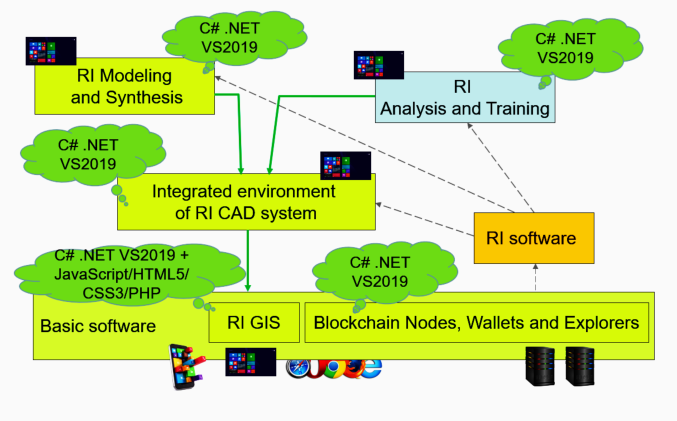
DEVELOPMENT OF RECYCLING INFRASTRUCTURE CAD TOOLSET The RI CAD software composition is shown in Figure 3.
Intelligent Human Systems Integration (IHSI 2022): Integrating People and Intelligent Systems https://openaccess.cms-conferences.org/#/publications/book/978-1-7923-8988-7
Figure 3. RI CAD software composition Tasks of creating RI CAD toolset are: • Analysis of the problems of recycling infrastructure as an object of design and requirements for the development of RI CAD toolset • Formulation of algorithms for the implementation of design procedures in RI CAD • Development of information support and software of RI CAD • Development of a distributed, blockchain based data storage system of RI CAD and RI itself • Application of RI CAD toolset within the framework of the closed-loop control system "Nature-Technogenics" (Solnitsev and Korshunov, 2013)
THE BLOCKCHAIN TECHNOLOGY FOR RI CAD AND OPERATION The GEO blockchain, the software and whitepaper of which is likely to be published soon, is based on the proof-of-stake blockchain technology (NEO Smart Economy, 2018). Using the Remark transaction attribute, RI CAD or RI can use this distributed ledger to store the important information. As an example, Figure 4. shows the block #1834987 in GEOXplore, our original blockchain explorer website (An example of a blockchain explorer 2021), containing a transaction with added and removed input sub-system objects of RI, which can be viewed on the interactive map (RecycleMap Lite, 2021). Added and removed points are linked to object geo-data (Kupriianov and Solnitsev, 2021).
Intelligent Human Systems Integration (IHSI 2022): Integrating People and Intelligent Systems https://openaccess.cms-conferences.org/#/publications/book/978-1-7923-8988-7
Figure 4. RI CAD blockchain explorer with saved transaction. In the same manner the RI CAD (and RI itself) software can store most important information about their subsystems state in the blockchain. The most improved way is to use decentralized applications (smart contracts) because NEO Smart Economy provides the specialized key-value data storage that can be accessed with it. An example of user interaction with the recycling infrastructure is shown in Figure. 5.
Figure available in the original PDF paper.
Figure 5. RI / blockchain software interaction on reverse vending machine usage.
Figure available in the original PDF paper.
Intelligent Human Systems Integration (IHSI 2022): Integrating People and Intelligent Systems https://openaccess.cms-conferences.org/#/publications/book/978-1-7923-8988-7
Imagine the user puts waste from the use of goods (packaging, cans, bottles) as a source of recyclables in the reverse vending machine (RVM). Accepted ones can be converted to the user's income using current price from recyclables market. Authentified users can choose to mint (to emit) some tokens instead of barcode receipt paper, once the transaction successfully registered in the blockchain. This will not only help save RVM cheque paper, such tokens can be an ESG-investment which will improve sustainability. Note that extended producer responsibility works in this case, so the user is refunded the container deposit.
CONCLUSION AND FURTHER INTENTIONS An original mathematical model of RI has been developed in the form of meta-, macro- and micromodels (Kupriianov and Solnitsev, 2019, 2020). And here are proposed a micro-model of a storage and a separator, as well as a macro-model for assessing the economic impact of RI CAD. The RI geoinformation system is previously proposed, which will allow users to navigate in the geography of recycling (Kupriianov and Solnitsev, 2021; Recyclemap Lite, 2021). Its data is stored in GEO blockchain based on NEO Smart Economy. And here is what should be developed completely: 1. The methods and algorithms for the synthesis of RI using proposed optimization tasks for RI and circular economy. 2. Original structure and components of RI CAD subsystems 3. Structures and components of information support RI CAD 4. The structure and components of the RI CAD software both at the initial stage of RI design and in the process of specifying its characteristics. 5. Blockchain software to store RI CAD, RI and its components data to securely store and track changes, including decentralized applications. An example of a blockchain explorer can be found in (An example of a blockchain explorer 2021).
REFERENCES
An example of a blockchain explorer (2021). <https://xn--1-otblt.xn--p1ai/bridge>, (сми1.рф/bridge) Kupriianov, G.A., Solnitsev, R. I. (2018) Problems of designing and operating an
environmental infrastructure as a single complex system // Ecological Information Systems // Soft computing and measurement. SPb.: Publishing house ETU «LETI». Vol. 2 Section 6. pp. 195–198 Kupriianov, G.A., Solnitsev, R. I. (2018) Designing the infrastructure for the separate collection and recycling of secondary raw materials. // Proc. of the 2018 IEEE International Conference «Management of Municipal Waste as an Important Factor of Sustainable Urban Development» (WASTE’2018). SPb.: Publishing house ETU «LETI». 2018. pp. 42–45 Kupriianov G.A., Solnitsev R.I. Approaches to mathematical modeling of the infrastructure
for separate collection and recycling of secondary raw materials // Soft computing and
Intelligent Human Systems Integration (IHSI 2022): Integrating People and Intelligent Systems https://openaccess.cms-conferences.org/#/publications/book/978-1-7923-8988-7 measurement. SPb.: Publishing house ETU «LETI». 2019. Vol. 1 Section 6. pp. 321– 322 Kupriianov G.A., Solnitsev R.I. Approaches to mathematical modeling of the infrastructure for separate collection and recycling of secondary raw materials // Soft computing and measurement. SPb.: Publishing house ETU «LETI». 2019. Vol. 1 Section 6. pp. 321– 322 Kupriianov G.A., Solnitsev R.I. On Software and Information Support for the Design and
Operation of the Recycling Infrastructure // Soft computing and measurement. SPb.: Publishing house ETU «LETI». 2021., pp. 221–224, DOI: 10.1109/SCM52931.2021.9507188 NEO Smart Economy 2018. https://neo.org/ Recyclemap Lite, The Interactive Recycling Infrastructure Map, 2021.
<https://xn--1-otblt.xn--p1ai/map>, <сми1.рф/map> Solnitsev R.I., Kupriianov G.A. Computer-aided Design Issues for Recycling Infrastructure. // Soft computing and measurement. SPb.: Publishing house ETU «LETI». 2020. pp. 186–189, DOI: 10.1109/SCM50615.2020.9198788 Solnitsev R. I. Automation of the design of automatic control systems: a textbook for
universities. Moscow: High. School, 1991 – 335 p.
Intelligent Human Systems Integration (IHSI 2022): Integrating People and Intelligent Systems https://openaccess.cms-conferences.org/#/publications/book/978-1-7923-8988-7
LISTED IN THE AHFE DIGITAL BOOKSTORE CATALOGUE
Explore the complete digital volume
Intelligent Human Systems Integration (IHSI 2022): Integrating People and Intelligent Systems
Read this individual research paper free through the original publisher, or explore the full digital proceedings book.
ISBN 978-1-7923-8988-7
Explore this ISBN in the AHFE Bookstore ↗Listed in the July 2026 bookstore catalogue; search by ISBN to confirm current availability · Digital book purchase optional