Dietmar Jakob, Sebastian Wilhelm (2022). Voice Controlled Devices: Awareness, Usage, and Reservations of Young Adults. In: Human Interaction & Emerging Technologies (IHIET-AI 2022): Artificial Intelligence & Future Applications. AHFE Open Access, vol. 23. https://doi.org/10.54941/ahfe100840
Voice Controlled Devices (VCDs) are becoming increasingly popular, both as integrated voice control functionality in mobile and stationary devices and in the form of devices that can be controlled primarily by voice, such as smart speakers.Young adults have already grown up with digital technologies that can be operated via peripherals or touchscreens. It is particularly interesting whether this younger generation, familiar with conventional human-computer interfaces, will accept the voice control function. In this context, however, there is a lack of studies that address awareness, usage, and reservations of voice-controlled interfaces among young adults.This paper presents a quantitative study (n=246) that shows that while 96% of young adults are aware of VCDs, only 18% regularly use the voice control feature. However, 77% expressed concerns that their data would not be safe by using VCDs.
More and more people are talking to Alexa, Siri, Cortana, and Co. (Arnold & Schneider, 2019). These systems are characterized by the fact that interaction essentially takes place through the use of natural language. While smartphones, tablets, PCs, and other technical devices are currently mainly controlled using touchscreens or peripherals such as a mouse or keyboard, Alexa, Siri, Cortana, and Co. adopt natural human communication to communicate between humans and machines (Berdasco et al., 2019). Voice Controlled Devices (VCDs), often also known in the form of a smart speaker, have a user interface that can be controlled via natural speech. Nowadays, almost every modern smartphone, tablet, or PC has an integrated voice control function as a fixed component of the respective operating system. Other mobile and stationary devices such as cars, navigation systems, televisions, or smart-home devices are also increasingly integrating voice control functions. Searching for information on the web, sending messages, using media services, or managing appointments or calendar entries are just a few examples of the use of voice control functions.
Young adults from Generation Y1 and Generation Z2 have already grown up with digital technologies that can be operated via peripherals or touchscreens. For these groups, a high affinity for technology and familiarity with these technologies’ interfaces can be assumed (Tapscott, 2008).
The main contribution of this work is to investigate to what extent young adults from Generation Y and Generation Z are familiar with VCDs, what proportion of them knowingly own a VCD, for what purposes VCDs are used, and what reservations they have about VCDs. Thus, we extend related work (Section 2) by further specifying the focus by considering only a particular target group for which a high technical affinity is assumed. Furthermore, we do not only consider specific devices such as smart speakers but rather address VCDs in general.
This work provides information on how people with a basic affinity for technology perceive the voice interface and can serve as a basis for future qualitative research to improve the user experience and reduce reservations about such interfaces.
Within this paper, we conduct a qualitative survey (n=246) to answer the following research question (RQ): RQ1: What proportion of young adults knows a VCD? RQ2: What proportion of young adults can name a VCD (specific product or brand)?
RQ3: What proportion of young adults knowingly own a VCD? RQ4: What proportion of young adults claims to use a VCD frequently (once a week)? RQ5: What proportion of young adults claims to have used VCDs at least once? RQ6: What reservations do young adults express about VCDs?
The remaining paper is structured as follows: With Section 2, we present related surveys on the awareness, usage, and reservations about VCDs. Next, in Section 3, we describe the methodology used in our survey before presenting the results in Section 4. We use Section 5 to compare our results with those of related work and discuss limitations before finally summarizing our findings in Section 6 and providing an outlook for further research.
2. RELATED WORK
In our literature review, we investigate both integrated voice control functions in mobile and stationary devices as well as devices that can be controlled exclusively by voice, such as smart-speakers in terms of awareness, ownership, and usage (Section 2.1), as well as reservations (Section 2.2) that prevent use.
2.1. Awareness, Ownership, Usage
The market and opinion research institute Splendid Research GmbH conducted an online survey using an aided recall test among people aged 18-69 (n=1006) using an aided recall test on brand names in Germany. Of respondents, 78% stated that they were familiar with Amazon’s Alexa, and 14% stated that they also use the voice assistant. Apple’s Siri, according to the study, is known by 63% and used by 14%, while Google Assistant is known by 59% and also used by 17%. Microsoft’s Cortana as part of the Windows operating system is known by 43% (SPLENDID RESEARCH GmbH, 2019).
Arnold & Schneider found in their online survey of 3184 people aged 18+ that 85% of the respondents own a device with an integrated voice assistant. Of these, 69% use Amazon Alexa, 29% Apple’s Siri, and 28% Google Assistant. Microsoft’s Cortana is used by only 7% of the respondents. The study found that the age group of 18-34 uses the voice assistant function of the devices rather less frequently than the age group of 35-44 (Arnold & Schneider, 2019).
In the ARD/ZDF Online Study 2020, in which 3003 German people aged 14+ were surveyed, 25% stated they use the voice assistant function on smartphones, and of these, 16% use Apple’s Siri. 9% of respondents use the function on smart speakers (ARD, 2020).
In an online survey on smart-speakers conducted by the market research company Beyto (n=2002, age 18+, Germany), 12% of respondents stated that they owned at least one smart-speaker (Beyto GmbH, 2020).
When assessing awareness and ownership, the studies mentioned above can only be compared with each other to a limited extent due to the different study objectives and ethnographic characteristics and the different device types (voice assistant as an integrated component in mobile devices or as a stationary device). Nevertheless, it can be determined that only a small proportion of respondents use the voice control functionalities among owners of mobile devices. In contrast, the proportion of use for smart speakers is much higher.
However, the studies are identical when outlining the most frequently used services. The most frequently mentioned applications include listening to music, retrieving information and news (e.g., weather, traffic), controlling smart-home components, creating shopping lists, calendar entries, reminders, alarms, and use for entertainment (e.g., games, jokes) (Ammari et al., 2019; Arnold & Schneider, 2019; Beyto GmbH, 2020; Bodendörfer, 2017; Gao et al.; Klöß et al., 2019; Lau et al., 2018; Lopatovska et al., 2018; Purington et al., 2017; SPLENDID RESEARCH GmbH, 2019).
2.2. Reservations
Reservations in acquiring or not using VCDs are mainly due to privacy concerns. Splendid Research GmbH found that 35% do not use the functionality or the devices due to data privacy concerns (SPLENDID RESEARCH GmbH, 2019). For Arnold & Schneider, 19% of respondents claimed they were afraid of data being shared with third parties (Arnold & Schneider, 2019). The authors also described privacy concerns that devices are always listening as a barrier to use (Beyto GmbH, 2020; Gao et al.; Lau et al., 2018).
Some authors report in their studies that the technology is not yet mature because the lack of speech recognition is an obstacle to its use (Berdasco et al., 2019; Beyto GmbH, 2020; Bodendörfer, 2017; Gao et al.; Krol & Boßow-Thies, 2020; SPLENDID RESEARCH GmbH, 2019).
Other obstacles reported by various authors are that people feel uncomfortable talking to machines (Arnold & Schneider, 2019; SPLENDID RESEARCH GmbH, 2019). People do not perceive the interaction as natural or would like to have a more natural communication with the devices (Berdasco et al., 2019; Bodendörfer, 2017; Porcheron et al., 2018).
Splendid Research GmbH and Lau et al. conclude their studies that the participants would not see a meaningful benefit in the usage (Lau et al., 2018; SPLENDID RESEARCH GmbH, 2019).
In summary, we note that there are no studies yet, specifically of the young adults’
Human Interaction & Emerging Technologies (IHIET-AI 2022) Artificial Intelligence & Future Applications https://openaccess.cms-conferences.org/#/publications/book/978-1-7923-8989-4 population, that have fundamentally addressed awareness, ownership, usage, and reservations. We want to close this gap with our work.
3. METHODOLOGY
In order to determine awareness, usage, and reservations of VCDs among young adults, we conducted a quantitative cross-sectional study using a fully standardized online questionnaire. This method ensures reliable, objective, and valid data (Diekmann, 2004; Döring & Bortz, 2016).
The target population of our study includes young adults, i.e., people from Generation Y and Generation Z. Since this population is typically encountered at universities, we conduct our research at a Bavarian University of Applied Sciences for Civil Servants (Germany). The data collection takes place once by sending an online questionnaire (field study) via an e-mail distribution list to students of the selected university.
Participation in the survey is voluntary and anonymous. Technical mechanisms are used to prevent duplicate voting by a single student. Furthermore, the online questionnaire software ensures that only completed questionnaires can be submitted. Since not all students submit the questionnaire, although they would have the opportunity, the sampling corresponds to an inference population (Döring & Bortz, 2016).
Our questionnaire instrument contains four questions, is stringent, and does not include filter questions, so that all participants can answer all questions. It is structured according to the elements of Döring & Bortz as follows: A short title outlines the main topic; an introductory text informs about the underlying research project as well as the implementing institution, but does not specify the exact research objective in order to obtain unbiased, neutral answers; the actual questions (see below); and finally a word of thanks (Döring & Bortz, 2016).
In order to prevent possible refusals to answer (item non-response), we avoided using open questions (except the semi-open question Q1). The individual questions are detailed below: Q1: Do you know a device that you can control with your voice? Answer options: (i) Yes, namely <free text> (ii) No Explanation: This question follows the method of the’ unaided recall test’ used in market research to receive an unbiased picture of how well known a product is (‘folder test’) (Magerhans, 2016; Wübbenhorst & Esch, 2018).
Q2: Have you ever used the voice control function of devices for: (a) Search for information (e.g., weather forecast, traffic jam reports, news) (b) Entertainment (e.g., games, radio, movies, audiobooks) (c) Device control in the house (e.g., TV, lights, heating, shutters, Smart Home) (d) Services and applications (e.g., reminders, alarm clocks, navigation, orders, garbage collection appointments) (e) Automated telephone hotlines (e.g., telecom3 fault service, order hotline, customer services) Answer options: (i) never (ii) at least once (iii) frequently (more than once a week) Explanation: The options follow frequently mentioned answers from a previous study by Splendid Research GmbH (SPLENDID RESEARCH GmbH, 2019). We use an ordinal scale to differentiate the intensity of use (Döring & Bortz, 2016). There was a frequent request for examples for the individual categories in a questionnaire pre-test, so these were added.
Q3: Do you have any device that you can control with your voice? Answer options: (i) Yes (ii) No (iii) I don’t know Explanation: Due to the large number of integrated VCDs (e.g., in smartphones or cars), the answer option ‘No’ indicates that people believe they do not own such a device. With the option ‘Don’t know,’ the individuals state that they are unaware of having a VCD. We assume that these individuals are the opinion not owning VCD but are not sure that one of their devices does have this functionality.
Q4: How do you agree with the following statements about devices that respond to voice commands: (a) I see no benefit for me (b) I have concerns about being monitored (c) I am not sure if I can operate these devices (d) I am afraid of fraudsters (e) I am concerned that my data is not safe Answer options: (i) I agree (ii) I disagree Explanation: The options follow frequently mentioned answers from a previous market research survey by Splendid Research GmbH (SPLENDID RESEARCH GmbH, 2019). Since the participants should make clear and unambiguous decisions, we use a ‘Likert Scale’ (Diekmann, 2004).
The actual data collection took place in July / August 2020. For this purpose, 1722 students of the selected university were contacted via an e-mail distribution list and asked to participate in the survey. The response period was four weeks. 246 students
3 Well known telecommunications company in Germany and Europe
Human Interaction & Emerging Technologies (IHIET-AI 2022) Artificial Intelligence & Future Applications https://openaccess.cms-conferences.org/#/publications/book/978-1-7923-8989-4 submitted the questionnaire within the deadline (gross response rate: 14%). Due to the technical validation measures, all submitted questionnaires are valid, so the net response rate is also 14%.
4. SURVEY RESULTS
In this Section, the results of the survey are presented. For reasons of simplification, all values have been rounded to the nearest integer.
In the following, we first outline the results regarding the awareness of VCDs among young adults in Section 4.1 before presenting the usage of VCDs in Section 4.2 and reservations in Section 4.3.
4.1. Awareness of VCD
Using an unaided-recall-test, a method from market research, the young adults were asked if they knew any devices they could control with their voice (Q1). 96% of respondents claimed to know such a device, 93% could even name at least one VCD, only 4% stated not to know any VCD (n=246).
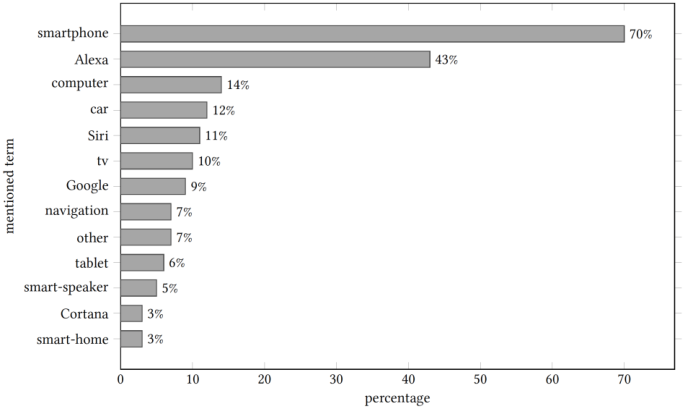
In a free text field to question Q1, respondents could specify one or more devices/brands they know can be operated by voice control. We standardize and cluster the responses for a more straightforward overview and present the answers in Figure 1. Rarely mentioned options (e.g., Xbox, Bixby, smartwatch) are summarized in the group other. Since Alexa and/or Echo were mentioned over-proportionately often, they are not grouped in the smart-speaker category but are considered separately.
We observe that most young adults are familiar with the smartphone (70%) as a VCD, followed by the voice assistant Alexa (43%). The frequent mention of Alexa, in particular, is surprising since the test was an unaided-recall test, and therefore no answer options were given. The name of voice assistants from other manufacturers such as Siri (11%), Google [Assistant] (9%), or Cortana (3%) was mentioned much less frequently.
Figure 1. Proportionate frequency of standardized and clustered product or brand names in Q1. Multiple answers were possible. (n=231)
4.2. Usage of VCD
With question Q2, we asked the young adults about the purposes for which they have at least once used a VCD or frequently use a VCD. The response options are ‘never,’ ’at least once,’ and ‘frequently’ (i.e., at least once a week). The purposes surveyed are derived from a related study by Splendid Research GmbH (SPLENDID RESEARCH GmbH, 2019).
The analysis4 of the answers shows that 18% of the respondents indicate to use a VCD for at least one purpose frequently, whereas 32% have never used a VCD for any of the purposes (n=246). The results broken down by the individual purposes are shown in Table 1.
Table 1. Frequency of using VCDs for predefined purposes by young adults.
Table available in the original PDF paper.
Purpose never at least once frequently Search for information (n=246) 47% 53% 9% Entertainment (n=245) 65% 35% 11% Device control in the house (n=243) 84% 16% 5% Services and applications (n=245) 62% 38% 10% Automated telephone hotlines (n=245) 64% 36% 4%
4 We exclude the purpose automated telephone hotlines for this analysis, since here in general voluntary use cannot be assumed.
When interpreting the data, it should be noted that the category ’at least once’ also includes those respondents who use a VCD ‘frequently.’
Table 1 shows that respondents most frequently stated using a VCD for ‘entertainment’ (11%), for ‘services and applications’ (10%), or to ‘search for information’ (9%) regularly. More than half (53%) of the respondents have also used a VCD at least once to search for information. Very few (5%) young adults use a VCD to ‘control devices in a smart home;’ 84% have never used this function.
In the context of usage, we also asked with question Q3 what proportion of respondents knowingly own a device that can be operated by voice control. We offered the response options ‘Yes,’ ‘No,’ and ‘Don’t know.’ However, due to the high number of integrated voice control functions in various devices (e.g., car, television), it cannot be assumed without reservation that the answer option ‘No’ conclusively means that the participant actually does not own a VCD. However, we may assert that those persons at least do not knowingly own a VCD.
From the surveyed young adults, 87% stated to own a device that can be operated by voice, 10% indicated not to own such a device, and 3% answered ‘Don’t know’ (n=246).
In the combination of the questions Q2 and Q3, it is particularly worth mentioning that while 84% claim to own a VCD, only 68% have used a VCD at least once, and only 18% use a VCD regularly. Specifically, among those who knowingly own a VCD, 27% have never used the voice control function for any purpose, and only 20% use voice control for at least one function frequently (n=215). Possible reservations that prevent non-users from using the voice control feature are outlined in Section 4.3 below.
4.3. Reservations of VCD
With question Q4, we asked what reservations the target group has towards VCDs. The selection of the items was again based on a previous study by Splendid Research GmbH (SPLENDID RESEARCH GmbH, 2019). The results are summarized in Table 2.
Table 2. Reservations about VCDs by young adults.
Table available in the original PDF paper.
7%
Option never I see no benefit for me (n=244) 54% I have concerns about being monitored (n=246) 76% I am not sure if I can operate these devices (n=244) I am afraid of fraudsters (n=245) 32% I am concerned that my data is not safe (n=190) 77%
More than three-quarters of respondents have concerns about VCDs that their data is not safe (77%) or are afraid of being monitored (76%). More than half (54%) also report that they see no benefit in VCDs. Only 7% of the young adults surveyed expressed that they were not sure if they could operate VCDs.
5. DISCUSSION
We discuss the survey results presented in Section 4 and compare our findings to related work in the following. The Section ends by critically reviewing the limitations of our study.
In the first part of our study, we examined the awareness of VCDs among young adults. Using an unaided recall test, i.e., without providing the participants a brand or product name, 96% of respondents claimed to know at least one device that can be controlled by voice. In addition, 93% of respondents were even able to name at least one product or brand. The general, brand- and product-independent awareness of VCDs has not been considered in any related work. Splendid Research GmbH used an aided-recall test to investigate the awareness of familiar voice assistants (including Alexa, Siri, Google, and Cortana) among people aged between 18 and 69. They provided the brand names and asked the participants if they knew those. In the study by Splendid Research GmbH, most people claimed to know Alexa (78%), followed by Siri (63%), Google (59%), and Cortana (43%) (SPLENDID RESEARCH GmbH, 2019). In order to prominence these systems, this study agrees with our results. The difference in the relative percentages results from the different measurement methods (aided vs. unaided).
In terms of ownership, we found that 87% of respondents own a device that can be controlled by voice. This result is consistent with Arnold & Schneider, who reported 85% ownership in a survey of 3148 people aged 18+ (Arnold & Schneider, 2019).
A key aspect of our study is to consider the purposes for which young adults use VCDs. In this context, the findings of Arnold & Schneider and Beyto indicate that listening to music, searching for information or news, and controlling smart-home components are the most frequently used applications of VCDs or smart-speakers (Arnold & Schneider, 2019; Beyto GmbH, 2020). Our study shows a significant deviation in the control of smart-home components. 84% of the young adults surveyed stated they had never used this function.
Concerns about data safety prevent the use of VCDs. In the study by Splendid Research GmbH, 35% of the respondents named this issue (SPLENDID RESEARCH GmbH, 2019). Arnold & Schneider noted data safety concerns for 19% of the respondents (Arnold & Schneider, 2019). In our study, 77% of respondents expressed concerns that their data would not be safe.
A further reason for study participants in related work for not using VCDs is the
Human Interaction & Emerging Technologies (IHIET-AI 2022) Artificial Intelligence & Future Applications https://openaccess.cms-conferences.org/#/publications/book/978-1-7923-8989-4 intrusion of their privacy, as they would feel monitored by the VCDs (Arnold & Schneider, 2019; Beyto GmbH, 2020; Gao et al.; Lau et al., 2018). This concern is mentioned by 77% of our participants.
Splendid Research GmbH reports that 61% of study participants see no benefit in using VCDs (SPLENDID RESEARCH GmbH, 2019). The results are similar to those of our study, in which 54% of young adults stated that they did not see any benefit in it.
Our survey’s empirical results are critically assessed according to their limitations.
We only considered students of a Bavarian University of Applied Sciences for Civil Servants. Therefore, the selection of the participants is not probabilistic and does not represent the entirety of all young adults. A feature-specific representative is not considered, and therefore, the sampling does not qualify as a quota sample (Döring & Bortz, 2016). Furthermore, we entirely exclude non-students.
A further limitation of our survey is that we did not consider specific age groups.
The questionnaire used in our study already provided the respondents’ fields of application for VCDs and possible reservations. Thus, not all possible fields of application and possible reservations were queried.
6. CONCLUSION AND FUTURE WORK
This quantitative study (n=256) shows that almost all young adults (96%) own at least one device that can be controlled by voice, but only 18% use this function regularly (at least once a week). Most of the respondents named the smartphone a VCD (70%). The second most frequently named device in the unaided recall test was Alexa (43%).
The focus of our study relates to the reservations young adults have about VCDs. Here, more than two-thirds expressed concerns that their data would not be safe (77%), and 76% expressed they felt monitored by the devices. More than half (54%) see no benefit in using the voice control function, and only 7% expressed concerns about being able to use voice control.
This work made it possible to fully answer the research questions introduced in Section 1, as shown in Table 3.
Table 3. Summarized answers to the research questions.
Table available in the original PDF paper.
96%
Research Question Answer RQ1: What proportion of young adults know a VCD?
93%
RQ1: What proportion of young adults can name a VCD (specific product or brand?
87%
RQ3: What proportion of young adults knowingly own a VCD?
18%
RQ4: What proportion of young adults claim to use a VCD frequently?
68%
RQ5: What proportion of young adults claim to have used VCDs at least once?
RQ6: What reservations do young adults express about VCDs?
77% are concerned their data is not safe 76% are concerned about being monitored 54% see no benefit 32% are afraid of fraudsters 7% are concerned about operating VCDs?
A comparison of the surveyed subjects with other groups of individuals (e.g., older adults) should be carried out in further work. In this way, any discrepancies concerning awareness, usage, and reservations of VCDs can be analyzed. Further studies should also clarify how existing reservations can be reduced, especially concerning privacy, and identify the reasons for a negative image of the devices.
ACKNOWLEDGMENTS
This work was funded by the Bavarian State Ministry of Family Affairs, Labor, and Social Affairs.
REFERENCES
Ammari, T., Kaye, J., Tsai, J. Y. & Bentley, F. (2019). Music, Search, and IoT.
ACM Transactions on Computer-Human Interaction, 26(3), 1–28. https://doi.org/10.1145/3311956 ARD. (2020). Ergebnisse der ARD/ZDF-Onlinestudie 2020. ARD, ZDF.
https://www.ard-zdf-onlinestudie.de/files/2020/2020-10- 12_Onlinestudie2020_Publikationscharts.pdf Arnold & Schneider (2019). Intelligenz aus der Konserve - Sprachassistenten in Deutschland. https://www.hs-fresenius.de/wp- content/uploads/WIK_HSFresenius_Kurzstudie_Sprachassistenten_August _2019-1.pdf
Berdasco, López, Diaz, Quesada & Guerrero (2019). User Experience Comparison of Intelligent Personal Assistants: Alexa, Google Assistant, Siri and Cortana. Proceedings, 31(1), 51. https://doi.org/10.3390/proceedings2019031051 Beyto GmbH (2020). Beyto Smart Speaker Studie 2020 | Deutschland.
https://mcusercontent.com/cab8c0a7e9a3fef590fd49ce1/files/3cf2966b- 5b46-4f79-a597- 80fcdb04fcff/Beyto_Smart_Speaker_Studie_2020_Studienreport.pdf Bodendörfer, X. (2017). Digitale Sprachassistenten als intelligente Helfer im Alltag. https://www.eresult.de/ux- wissen/forschungsbeitraege/einzelansicht/news/digitale-sprachassistenten- als-intelligente-helfer-im-alltag/ Diekmann, A. (2004). Empirische Sozialforschung: Grundlagen, Methoden,
Anwendungen. Rowohlt-Taschenbuch-Verl. Döring & Bortz. (2016). Forschungsmethoden und Evaluation in den Sozial- und Humanwissenschaften. Springer Berlin Heidelberg. https://doi.org/10.1007/978-3-642-41089-5 Gao, Y., Pan, Z., Wang, H. & Chen, G. Alexa, My Love: Analyzing Reviews of
Amazon Echo. In IEEE SmartWorld (S. 372–380). https://doi.org/10.1109/SmartWorld.2018.00094 Klöß, S., Tropf, T., Böhm, K. & Esser, R. (2019). Zukunft der Consumer Technology- 2019, Marktentwicklung, Trends, Mediennutzung, Technologien, Geschäftsmodelle. Bitkom, Berlin. Krol, B. & Boßow-Thies, S. (2020). Akzeptanz von Sprachassistenten zur
Steuerung von Smart Home Services. In Künstliche Intelligenz in Wirtschaft & Gesellschaft (S. 517–541). Springer Gabler. https://doi.org/10.1007/978-3-658-29550-9\textunderscore Lau, J., Zimmerman, B. & Schaub, F. (2018). Alexa, Are You Listening?
Proceedings of the ACM on Human-Computer Interaction, 2(CSCW), 1– 31. https://doi.org/10.1145/3274371 Lopatovska, I., Rink, K., Knight Ian, Raines Kieran, Cosenza, K., Williams, H., Sorsche, P., Hirsch, D., Li, Q. & Martinez, A. (2018). Talk to me: Exploring user interactions with the Amazon Alexa. Journal of Librarianship and Information Science, 51(4), 984–997. https://doi.org/10.1177/0961000618759414 Magerhans, A. (2016). Marktforschung. Springer Fachmedien Wiesbaden.
https://doi.org/10.1007/978-3-658-00891-8 Porcheron, M., Fischer, J. E., Reeves, S. & Sharples, S. (2018). Voice Interfaces in Everyday Life. In. Purington, A., Taft, J. G., Sannon, S., Bazarova, N. N. & Taylor, S. H. (2017).
“Alexa is my new BFF.” In G. Mark, S. Fussell, C. Lampe, m. schraefel, J. P. Hourcade, C. Appert & D. Wigdor (Hrsg.), Proceedings of the 2017 CHI Conference Extended Abstracts on Human Factors in Computing Systems - CHI EA ’17 (S. 2853–2859). ACM Press. https://doi.org/10.1145/3027063.3053246 SPLENDID RESEARCH GmbH. (2019). DIGITALE SPRACHASSISTENTEN Eine repräsentative Umfrage unter 1.006 Deutschen zum Thema digitale
Sprachassistenten und Smartspeaker. https://www.splendid- research.com/studie-digitale- sprachassistenten.html Tapscott, D. (2008). Grown up digital. McGraw-Hill Education Boston. Wübbenhorst, K. & Esch, F.- R. (2018). Definition: Recalltest.
Read this individual research paper free through the original publisher, or explore the full digital proceedings book.
ISBN 978-1-7923-8989-4
Explore this ISBN in the AHFE Bookstore ↗Listed in the July 2026 bookstore catalogue; search by ISBN to confirm current availability · Digital book purchase optional