1 Chief Medical Officer and Co-Founder, LAAF Inc., Graduate Student, Department of Medical Ethics and Health Policy, University of Pennsylvania, Perelman School of Medicine, Philadelphia, USA ↗
2 Senior Embedded Systems Design Engineer, LAAF Inc ↗
3 Junior Embedded Systems Design Engineer, LAAF Inc., . 4 Chief Operating Officer and Co-Founder, LAAF Inc., Data Analyst, CyberVision, Islamabad, Pakistan ↗
4 Chief Executive Officer and Co-Founder, LAAF Inc., Accounting and Finance, Leiden, The Netherlands ↗
Ongoing lower body pain is a pervasive problem around the world. If untreated, these issues may develop into more serious injuries and chronic pain. Furthermore, physical inactivity due to chronic pain is associated with a cluster of metabolic diseases. Current affordable solutions only address symptoms of pain without tackling the underlying root causes. By connecting users to caregivers, literature, and exercises, the LAAF - Live Active and Agony Free - platform aims to enhance the connected strategy in each user’s healthcare journey by emphasizing a holistic and complete approach to chronic pain management and prevention. The updated version of LAAF insoles brings a dynamic design, which supports multiple shoe sizes on a single flexible PCB. With the new multi-row flexible PCB design, the same circuitry is utilized to create shoe sizes ranging between US Men’s sizes 7 to 10 (Women’s 8.5 to 11.5). This eliminates the need for separate circuit designing for each shoe size, making the overall product cost-effective. Working with industrial design and engineering teams, LAAF aims to optimally place sensors to collect the most relevant data to manage chronic pain. In the updated version of the LAAF mobile app on iOS and Android, new parameters, such as double support, symmetry, weight distribution, walking duration, load, foot clearance, and fall risk have been added. These added parameters assist caregivers in diagnosing and prescribing personalized corrective measures. Detailed insights in the gait cycle encourage physical activity. Data collected from the LAAF insoles is compared to normative gait cycle data using algorithms to generate user-specific reports. Compared to current methods, the updated LAAF insoles provide the most relevant data for a new, effective, and affordable way to encourage physical activity while managing and preventing chronic pain across the world.
According to the Institute for Health Metrics and Evaluation US healthcare spending in 2016 musculoskeletal disorders cost an estimated $380 billion in lost wages, reduced quality of life, and ultimately workers’ mental health . It is the second most common reason for people calling in sick to work. Employers offering corporate wellness support are valued by employees. Digital care solutions offer an innovative comprehensive approach to chronic pain in employees and have been shown to decrease employer healthcare costs. More than 80% of employees feel their employers should offer more support to address physical and emotional pain 2, especially as more than 90% of respondents to a Harvard Business Review Analytics Services survey concur that pain takes a toll on people’s ability to be highly productive and engaged at work (Scott Wooldridge, 2021). Data from the National Health Interview Survey (NHIS) to examine the prevalence of chronic pain and its impact among adults in the United States found that 50.2 million adults (20.5 percent) reported pain on most days, or every day based on a chronic pain module introduced into the 2019 edition of the NHIS (Yong et al., 2021). Back pain and hip, knee, or foot pain were the most common pain locations. These findings point to a gap in the health care benefits and wellness resources that are available to help employees treat their pain, whether to alleviate chronic conditions or to prevent one from developing.
Human Interaction & Emerging Technologies (IHIET-AI 2022) Artificial Intelligence & Future Applications https://openaccess.cms-conferences.org/#/publications/book/978-1-7923-8989-4 measurements that the systems produce classifying users’ exercise quality, there are few users’ evaluation studies and clinical trials in this field (Cottrell et al., 2018).
LAAF smart insoles and mobile app technology analyzes gait metrics with pressure heat maps, supports virtual visits with providers, helps patients complete their exercises at home, and tracks treatment progress. LAAF digital solutions can guide physical therapy and coaching to help patients make long-lasting alignment and behavioral changes that are accessible to more people, at a lower cost with better outcomes than current care options. As LAAF proceeds with experimental validation, the engineering research team continues to iterate new cost-effective circuitry for LAAF smart insoles.
MATERIALS AND METHODOLOGY We performed an extensive literature review as well as a detailed analysis of existing products. We designed the new LAAF insole system using multiple softwares. Printed Circuit Boards (PCBs) are designed using the Altium design suite while processor coding is completed on the Arduino SDK environment. LAAF validated the adjustments with leading embedded and biomechanical engineers, product developers, and industrial designers. We evaluated sensors for accuracy and compared data collection findings to the 1000 Norms Project, which defined ‘normal’ ambulatory and musculoskeletal health (McKay et al., 2016). The LAAF insole uses a set of seven Force Sensitive Resistors (FSRs) and a 6-axis IMU. The updated version includes a barometer as well in order to calculate an additional gait cycle parameter. System Development Multi Row Flex Printed Circuit Board (PCB) Design
One of the most challenging aspects of the LAAF insole was placing the pressure sensors in their exact locations within the insole. The pressure distribution in different sections of the foot is important in identifying the root causes of unhealthy gait. Previously, LAAF and other manufacturers designed Flex PCBs that covered the important sections of the foot using an exact number of sensor connection points. However, this was not a cost-effective solution. The limitation of the previous design is that for every insole size, the manufacturer needed a new design of Flex PCBs with a new position of pressure sensors based on the adjusted sensor connection points. Due to the flex PCB production cost, especially in smaller quantities, LAAF created a
Human Interaction & Emerging Technologies (IHIET-AI 2022) Artificial Intelligence & Future Applications https://openaccess.cms-conferences.org/#/publications/book/978-1-7923-8989-4 generic design of Flex PCBs that can be used for insoles based on multiple foot sizes during assembly.
By doing research on multiple foot size layouts and anatomy, the team concluded that the distance between the heel and arch sensors remains the same between US male foot size 7 to 11, and the only difference is the distance between the arch and midfoot sensors. Altering the distance between the arch and midfoot sensors allows LAAF to build varying sized insoles with one Flex PCB. In this paper, LAAF proposes and designs a new generic multi-row design of Flex PCB that can cover five different foot sizes ranging from US 7 to 11 in men (US 8.5 to 12.5 in women).
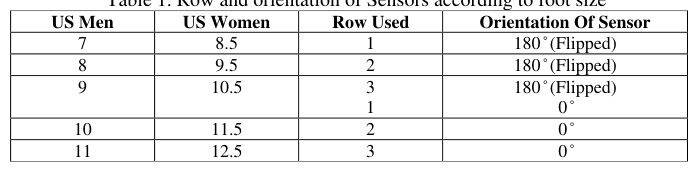
The multi-row design shown in Figure 1 consists of three rows of solder pads in the mid-foot section where pressure sensors can be soldered in any location and orientation. It will be easier to alter the insole size with one design. Using rows 1 through 3 with an unflipped orientation (0° rotation) allows US Men’s size 9, 10, and 11 to be achieved. US Men’s size 7, 8, and 9 can be obtained with a flipped orientation (180° rotation) of sensors, as shown in Table 1.
Table 1. Row and orientation of Sensors according to foot size US Men US Women Row Used Orientation Of Sensor 7 8.5 1 180 ̊ (Flipped) 8 9.5 2 180 ̊ (Flipped) 9 10.5 3 1 180 ̊ (Flipped) 0 ̊ 10 11.5 2 0 ̊ 11 12.5 3 0 ̊ Circuit Updates The first and foremost aim of an assistive device keeping track of gait pattern anomalies, is for timely diagnosis to mitigate fall risk. In order to adequately keep track of the biomechanics of the gait cycle, a few circuit updates were required. Our previous system captured the raw data required for calculating various parameters using a set of seven Force Sensitive Resistors (FSRs) and a 6-axis IMU. In the new LAAF insole, a barometer has been added on the rigid board for calculating a new parameter: step clearance. The module added on board is the BMP280. Application Updates The LAAF App is the face of the insole which brings all the calculated parameters to life. These parameters give an insight into the gait pattern and help in diagnosis and analysis of the root causes of pain. In the initial version of the App, fourteen different parameters were being displayed through the Application to shed light on the gait pattern. In the new LAAF App, seven more parameters have been added. Each new parameter helps to delve in deeper into the gait pattern analysis and results in a targeted diagnosis of an issue. With a more refined data set for diagnosis, a caregiver is better equipped for providing a customized corrective solution. The new parameters added in this version of the App are as follows: Step Clearance. Step clearance is the height of foot above ground during the swing phase. Insufficient foot clearance during walking can result in a fall and cause long term damage. Moreover, this specific parameter also helps in diagnosis of knee and ankle joint pains or deformities. Thus, monitoring and correction of this parameter is of prime importance in maintaining a healthy lower body routine. Raw data from the barometer is processed into two types of output parameters, “instantaneous Foot Height above ground in Swing Phase” and “Average Foot Height above ground in Swing Phase”. These parameters are displayed on the application end by calling their respective, predefined function calls.
Single Leg Support and Double Leg Support. During the phases of the gait cycle, there are times when one foot is in contact with the ground and other times when both feet are in contact with the ground. It is common for
Human Interaction & Emerging Technologies (IHIET-AI 2022) Artificial Intelligence & Future Applications https://openaccess.cms-conferences.org/#/publications/book/978-1-7923-8989-4 the gait cycle to exhibit 60% contact time, where the first 10% and the last 10% of this contact time involves double leg support (Perry et al., 2010; Silva & Stergiou, 2020). Variations of single and double support time may indicate issues with balance. Existing raw data is utilized to calculate the instantaneous and average values of both single and double leg support durations in percentage. These parameters are calculated at the hardware end and displayed on the application end by calling their respective, predefined function calls. Symmetry. Symmetry or gait symmetry is the identical gait cycle pattern for both bilateral limbs. It is one of the simplest analyses of gait pattern where asymmetry in each undistributed gait is the indicator of the presence of some pain or an underlying deformity. Symmetry is calculated at the application end since it requires the comparison of available data from both the right and left feet. Since the insoles do not communicate with each other, calculating symmetry at the hardware end is not possible. There is no need to call any function from the hardware side. Weight Distribution. This parameter is a measure of whether the weight distribution on each foot is equal or not. Weight exerted by each foot is calculated in a percentage and then compared to keep a check on their uniform distribution. An imbalanced weight distribution serves as a key marker of pain, injury, or postural imbalance. This parameter is calculated at the application end since it requires comparison of left and right insole data. Calories Burnt. This parameter simply tells the number of calories burnt while the user is walking. The calculations are done at the hardware end and are displayed on the application in Kilocalories (Kcal) by accessing the respective function.
DISCUSSION
Gait metrics are useful for better understanding human biomechanics. However, existing products are cost prohibitive as manufacturers need to modify the length of flex PCBs based on FSR positions for different shoe sizes. We identified a novel design for Flex PCBs to provide better cost-efficiency.
Corporate wellness programs have become the norm for many US-based companies. A report sponsored by the U.S. Department of Labor and the U.S. Department of Health and Human Services and produced by The RAND Corporation found that over 80% of companies in the US with over fifty employees offered some sort of corporate wellness benefit. A report from Harvard Business School found that, for American-based companies, medical expenses fell by $3.27 for every dollar spent on wellness programs, and that employee absenteeism expenses fell by $2.73 (Rajiv Kumar, 2014).
With the new updates to the LAAF insole and mobile app, we are better able to understand the gait cycle in order to assist in diagnosis of the root causes of pain.
Analyzing the root causes of pain and the gait patterns of different users, we can enable a connected healthcare strategy between caregivers and users. By incorporating digital care and providing instant feedback, we hope to modernize the healthcare approach in the United States. Through partnerships with corporations and small businesses, we can reduce healthcare costs and improve worker engagement and productivity by addressing employee pain management needs.
LIMITATION AND FUTURE STUDIES One of the limitations of our study is the high cost of skill and expertise needed to assess the accurate performance of the sensors and validate the data. Other studies, including our own, face a price limitation as the prices of smart insoles are several times higher than regular insoles. Furthermore, with the current chip shortage around the world making multiple iterations more costly, we were unable to make several iterations.
CONCLUSION
In this updated proof-of-concept study, we used seven force sensitive resistors, 6-axis IMU, and a barometer to better calculate gait cycle parameters. In addition, we identified a novel design for Flex PCBs to provide better cost-efficiency. Our improved LAAF insole device, paired with our LAAF mobile app, empowers comprehensive pain management and injury prevention. Internal assessments of this updated device show accurate data collection with real-time transmission to the mobile app. The goal of this study, and of this new Flex PCB design, is to validate a cost-effective approach to manufacturing the LAAF smart insole. We emphasized user-experience in our testing of our updated insoles. With a proven concept, we now need to ensure a product-market fit for the LAAF insoles and mobile app. Studying and improving the user-experience is key to addressing the root causes of pain and encouraging a healthy and active lifestyle in communities across the world. This study was based off of the first proof-of-concept study conducted by LAAF, Inc., as published in 2021 (Khan et al., 2021).
Cottrell, M. A., Galea, O. A., O’Leary, S. P., Hill, A. J., & Russell, T. G. (2017).
Real-time telerehabilitation for the treatment of musculoskeletal conditions is effective and comparable to standard practice: a systematic review and meta-analysis. Clinical Rehabilitation, 31(5), 625–638. https://doi.org/10.1177/0269215516645148 Cottrell, M. A., O’Leary, S. P., Swete-Kelly, P., Elwell, B., Hess, S., Litchfield,
M. A., McLoughlin, I., Tweedy, R., Raymer, M., Hill, A. J., & Russell, T. G. (2018). Agreement between telehealth and in-person assessment of patients with chronic musculoskeletal conditions presenting to an advanced- practice physiotherapy screening clinic. Musculoskeletal Science and Practice, 38, 99–105. https://doi.org/10.1016/J.MSKSP.2018.09.014 Crea, S., Donati, M., de Rossi, S., Oddo, C., & Vitiello, N. (2014). A Wireless
Flexible Sensorized Insole for Gait Analysis. Sensors, 14(1), 1073–1093. https://doi.org/10.3390/s140101073 GBD 2016 Disease and Injury Incidence and Prevalence Collaborators. (2017).
Global, regional, and national incidence, prevalence, and years lived with disability for 328 diseases and injuries for 195 countries, 1990-2016: a systematic analysis for the Global Burden of Disease Study 2016. Lancet (London, England), 390(10100), 1211–1259. https://doi.org/10.1016/S0140- 6736(17)32154-2 Khan, M., Hussain, Z., & Khan, F. (2021). Improving Physical Activity with a
Data-Analyzing Smart Insole that Assesses Root Causes of Chronic Pain and Physical Inactivity (pp. 337–349). https://doi.org/10.1007/978-3-030- 80285-1_40 McKay, M. J., Baldwin, J. N., Ferreira, P., Simic, M., Vanicek, N., Hiller, C. E.,
Nightingale, E. J., Moloney, N. A., Quinlan, K. G., Pourkazemi, F., Sman, A. D., Nicholson, L. L., Mousavi, S. J., Rose, K., Raymond, J., Mackey, M. G., Chard, A., Hübscher, M., Wegener, C., … Burns, J. (2016). 1000 Norms Project: protocol of a cross-sectional study cataloging human variation. Physiotherapy, 102(1), 50–56. https://doi.org/10.1016/j.physio.2014.12.002 O’Reilly, M., Caulfield, B., Ward, T., Johnston, W., & Doherty, C. (2018).
Wearable Inertial Sensor Systems for Lower Limb Exercise Detection and Evaluation: A Systematic Review. Sports Medicine (Auckland, N.Z.), 48(5), 1221–1246. https://doi.org/10.1007/S40279-018-0878-4 Perry, Jacquelin., Burnfield, J. M., & Cabico, L. M. (2010). Gait Analysis:
Normal and Pathological Function. Journal of Sports Science & Medicine, 9(2), 353. /pmc/articles/PMC3761742/
Rajiv Kumar. (2014, February 21). In Defense of Corporate Wellness Programs.
Harvard Business Review. https://hbr.org/2014/02/in-defense-of-corporate- wellness-programs Scott Wooldridge. (2021). Chronic pain: The next digital health frontier?
https://www.benefitspro.com/2021/04/20/chronic-pain-the-next-digital- heatlh-frontier/?amp=1 Silva, L. M., & Stergiou, N. (2020). The basics of gait analysis. In Biomechanics
and Gait Analysis (pp. 225–250). Elsevier. https://doi.org/10.1016/B978-0- 12-813372-9.00007-5 Winiarski, S., Pietraszewska, J., & Pietraszewski, B. (2019). Three-Dimensional
Human Gait Pattern: Reference Data for Young, Active Women Walking with Low, Preferred, and High Speeds. BioMed Research International, 2019, 1–7. https://doi.org/10.1155/2019/9232430 Yong, R. J., Mullins, P. M., & Bhattacharyya, N. (2021). Prevalence of chronic
pain among adults in the United States. Pain. https://doi.org/10.1097/j.pain.0000000000002291
Read this individual research paper free through the original publisher, or explore the full digital proceedings book.
ISBN 978-1-7923-8989-4
Explore this ISBN in the AHFE Bookstore ↗Listed in the July 2026 bookstore catalogue; search by ISBN to confirm current availability · Digital book purchase optional