Stephan Raimer, Peter Weiss (2022). Evolution of Chatbots for public services: how to get to the next level?. In: Human Interaction & Emerging Technologies (IHIET-AI 2022): Artificial Intelligence & Future Applications. AHFE Open Access, vol. 23. https://doi.org/10.54941/ahfe100877
Chatbots have been increasingly used in the context of public administration in recent years and months. Using the example of the German state of Schleswig-Holstein, it can be shown that chatbots are part of the current overall IT and digitalisation plan as well as the state's AI strategy. At the same time, the use scenarios and the functional scope of the first application examples are still quite limited (i.e. Corona information or information on the Integration Office). We would like to contribute to how the next step can be approached, from a “talking FAQ” to value-adding service systems.The aim of this paper is to present a conceptual framework for the design (and further evolution) of public services supported by chabots. Our conceptual framework draws from three knowledge areas: namely (1) actor engagement and multilevel service systems design, (2) conversational design (for chatbots), and (3) human-centered design.The design and operation of value-adding service systems (configuration of resources, people, etc.) is rooted in the framework of service-dominant logic and thus focus is laid on the aspect of value creation. Generally, Service platforms offer value propositions and maintain as well as operate various public service offerings. Following this consideration, the value proposition (learning about actor needs and requirements) must be placed in the foreground when planning and developing chatbots. We argue service systems design requires a multi-level design approach and framework.Hence, we start with the value proposition and existing institutional settings (i.e. legal basis and organisational constraints, data protection issues etc.) and configurations the actor is used to and guides actor behaviour. Central use case consists of a chatbot to support personalized dialogue and to support the customer along the service process. We will combine two important knowledge areas: systems design knowledge (technical requirements, usability and user requirements) and service systems design (institutional set-up and actor engagement design). Design and implementation comprises the value proposition itself and the technical realization (e.g. service system, engagement platform, service platform). A Use case based design is a valuable approach to design value propositions. In real practice, approaches such as Domain Driven Design (in order to clarify requirements). Digital services are thus identified and designed. Human centred design for interactive systems (cf. ISO 9241-210) then starts with a system vision and runs through the phases “understand & specify context of use”, “specify user requirements”, (iteratively) “produce design solutions to meet user requirements” and “evaluate design against requirements”. In the last step of the process, two evaluation methods are often used: heuristic evaluation and testing. In the paper we want to look in particular at heuristics for chatbot design (in analogy to Nielsens “Heuristics for Interface Design”).Hence, we see two particular design areas for service systems, namely institutional design (macro level) and engagement design (micro level). Design of the engagement platform represents an important next step (meso level), as it addresses mobilization of actors and resources required and resource integration pattern (e.g. business process, or customer process, supporting workflow of a chatbot). We will conclude our contribution with an evaluation as well as an outlook to what extent new research areas arise in the field of chatbots (i.e. chatbots can support identifying actor's intent and resource mobilization and allocation within administrative bodies).
Digital technologies are currently transforming all parts of economy and society. Digital technologies offer public administrations new unprecedented ways to interact and communicate with citizens and other entities. Digital transformation and changing behaviours and preferences of citizens results in new strategic imperative for public service organizations (Grönroos et. al. 2013, Grönroos 2019, Osborne 2018, Price and Broderick 2001). Digital technologies offer easier and more efficient ways for value co-creation. Chatbots are a solution element and application of systems of engagement. Systems of engagement implement required mechanisms to enhance co-creation activities and foster actor engagement.
To master the challenges of digital transformation, public sector organizations have to build and introduce new generation of information systems that introduce required new capabilities summarized under the umbrella term “systems of engagement”. Sys- tem of engagement are more flexible and responsive to changing citizen behaviour and needs and implement platform related capabilities. They offer new opportunities to interact and communicate with actors for example through chatbots, mobile apps, social media, etc.
Developing service innovations comes along with introducing new practices, routines and competences (Lusch and Nambisan 2015). In the following, we shed light on new practices and routines to develop systems of engagement following a multilevel design approach. In a first step public service organisations start augmenting established service offerings with digital service elements and providing new channels to access public services.
From our experience, design and operation of digital service offerings and related service systems suffer from insights and absence of related competences in service design and development. Subsequently, we argue that development of digital service offerings requires comprehensive understanding of service systems and the foundations of service innovation. Hence, we argue that a service lens yields salient insights of underlying logics and related mechanisms at work to operate successfully digital services.
Based on chatbots we illustrate how new emerging digital technologies can be in- corporated in new innovative service offerings and value propositions following a multilevel design approach allows systematic development and roll out of digital services (Grotherr et.al 2018).
The remainder of the paper is structured as follows: In Section 2 we will describe our research approach and objectives. Section 3 takes focus on relevant dimension to innovate public services with chatbots. Next Section 4 presents demonstration and evaluation actives of respective IT artifacts. Finally we conclude on yielded results and provide a short outlook on next activities.
RESEARCH APPROACH AND OBJECTIVES The aim of this paper is to present a conceptual framework for the design (and fur- ther evolution) of public services supported by chabots. Our conceptual framework draws from three knowledge areas: namely (1) actor engagement and multilevel ser- vice systems design, (2) conversational design (for chatbots), and (3) human-centered design. We try to integrate Action Design Research, Design Science Research (Hevner et. al. 2004, Peffers et. al. 2007) Service Systems Engineering and Information systems development (Nunamaker et. al. 1990).
Lusch and Nambisan (2015) motivate a broadened view on service innovation by conceptualizing service in-novation based on a tripartite framework with following constituent elements, namely service ecosystems, service platform and co-creation. Value co-creation is a rather abstract concept which is difficult to be implemented. Thus, subsequently, we motivate to analyse micro, meso and macro level for implementing value co-creation. Value co-creation enable interactions with customers and achieve from a service perspective increased resource density by responding to actor’s context and actual needs for resource integration. From a Service-Dominant Logic perspective, chatbots implement logics and patterns of interaction that are summarized as resource integration patterns. To effectively implement resource integration patterns is vital to understand and explore actor behaviour and preferences at the micro level.
Actor Engagement and multilevel service systems design Innovative services today can build on almost universal connectivity. Business processes and workflows can be interlinked via a wide variety of interfaces and systems. Systems of engagement as a key element of a digital transformation strategy based on SD-Logic can thus be planned, developed and operated in a wide variety of configurations (Weiss et. al. 2021).
Multilevel service system design aims to make complex issues manageable. In addition, it focuses on a deep understanding of the applied social mechanisms of co- creation. Especially in relation to the engagement of actors, what needs to be analysed using a multi-level design perspective to explore relevant transformative social mechanisms that promote emergent properties of service systems.
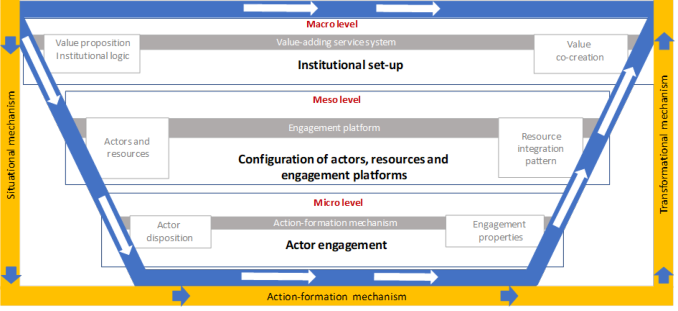
Hence, we see two particular design areas for service systems (Weiss et. al. 2021), namely institutional design (macro level) and engagement design (micro level) (Fig. 1). Designing engagement platform represents an important next step (meso level), as it addresses mobilization of actors and resources required and resource integration pattern (e.g. business process, or customer process, supporting workflow of a chatbot).
Figure 1. Multilevel Design-Approach for Service Systems and Actor Engagement (based on Nunamaker et. al. 1990, Storbacka et. al. 2016, Hedström and Swedberg 2006) Conversational design for Chatbots and Digital Voice Assistants
Conversational design is not simply an extension of a graphical user interface but a discipline in its own right. Conversation is inherently multimodal and users expect a certain naturalness in dialogues, whether human, dialogue system or chatbot.
“The role of a conversation designer is like that of an architect, mapping out what users can do in a space, while considering both the user’s needs and the technological constraints. They curate the conversation, defining the flow and its underlying logic in a detailed design specification that represents the complete user experience. They part-ner with stakeholders and developers to iterate on the designs and bring the experience to life.” (Google Assistant Developer Platform) Good conversational design does not simply require dialogues, but also logical and coherent dialogue structures and an iteratively optimised user experience that takes into account the respective context of the user. At the core of this is Natural Language Processing (Identification of intent and entities, so correctly interpreting user queries) and Dialogue Management (delivering the right content and answers). As general principles of a dialogue structure we have to consider the cooperation principle (how do dialogue partners behave), a change of speaker (turn-taking) as well as the context (relative context of a conversation).
Key challenges for good conversational design (and at the same time benchmarks) are navigability (can users navigate easily?) discoverability (can users easily explore and use the functions?) and Usability (can users achieve their goals?).
Human centred-design for Chatbots The origins of human centred design lie in the ergonomic design of technical systems and have existed since at least the 1990s. It is an approach to the development of interactive systems (in the narrow sense hardware and software) that aims to make these systems user-friendly and useful. The user with his needs and expectations is placed in the centre and user requirements are defined through contextual analysis.
In principle, relevant ISO standards norms from the development process (ISO 9241 210) to Interaction Principles (ISO 9241 110) to Usability Heuristics (Nielsen 1994) can be applied directly to chatbots – they just have to be adapted to this “new” form of interaction with a system (i.e. How do you make a system state visible when you don’t have a graphical user interface?).
The success factors for good user experience thus apply without change: frequent testing, consideration of user feedback and rapid iteration in development are important.
EVOLVING CHATBOTS TO INNOVATE IN PUBLIC SERVICE Conceptualization of service innovation requires to understand the salient role of digital technologies and in general IT to enable resource density and hence value co- creation. However, to understand actor behaviour and considering requirements of human-centred design we argue to apply a multi-level design approach (Grotherr et. al. 2018, Payne et. al. 2008, Storbacka et. al. 2016 and Storbacka 2019). This shifts focus from output delivered by a public service provider to value experienced by the beneficiary (Lusch and Nambisan 2015, Prahalad and Ramaswamy 2004). From a service perspective, chatbots are understood as dialogue systems which create an environment to co-create experiences with citizens.
S-D logic sees all actors as resource integrators and emphasizes operant resources as primary competitive factor. Operant resources act on other resources to produce effects (Lusch and Nambisan 2015, Vargor and Lusch 2004, 2008, 2016). They can be seen as primary source of service innovation and competitive advantage. However, public service organizations are typically not facing competition. Public services are not embedding value, rather value occurs when the offering shows utility and is perceived as useful for the citizen. In this case, “value-in-use” is achieved, however always dependent on a given actor context [6]. In summary, “S-D logic advocates a systemic understanding of value creation and the importance of context through which value-in-use is derived” (Vargo et. al. 2017).
Chatbots allow to integrate the citizen (beneficiary) as an active and required participant in value creation activities (Chandler and Lusch 2015, Lusch and
Nambisan 2015). Service platforms facilitate access to relevant resources in given citizen’s context. Context are prerequisite to experience value and connect actors and resources driven by actor’s agency and related future dispositions (Chandler and Lusch 2015, Chandler and Vargo 2011). Citizens have to contribute own resources and competences (for example personal data) and taking over assigned roles and respective tasks defined by the interactive service process (Lusch and Nambisan 2015, Lusch and Vargo 2014).
“Service systems are comprised of entities interaction or engaging with one another to create value” (Storbacka et .al. 2016). Entities are arrangements of resources such as people, technology, information and organizations.
From S-D logic perspective, chatbots are components of engagement platforms. Engagement platforms are purposed subsystems of service platforms. Engagement platform consist of multiple touchpoints and constituted by a combination of virtual and physical interaction (Storbacka et .al. 2016). Physical and virtual touchpoints aim to offer structural support for exchange and integration of resources, in this way, enabling co-creation of value in service systems (Storbacka et .al. 2016, .Storbacka 2019). Engagement platforms link resources and actors in new ways striving for higher resource density and hence facilitating service innovation. Effective design of service systems requires to understand, how meso-level trans-formational mechanisms or processes are vital in linking micro-level actor engagement with macro-level co-creation of value. Hence, effective service system design requires to shifts focus on resource integration patterns as major design element.
Resource integration patterns are types of discernible, reproducible integration processes. Two general types of resource integration patterns can be distinguished, namely (1) homeopathic and (2) heteropathic (Peters et. al. 2009, 2014). The latter relates to the phenomenon of emergence (Storbacka et .al. 2016, .Storbacka 2019, Giddens 1984, Hedström and Swedberg 2006) of new structures and behaviours. Homopathic resource integration patterns describe aggregative, summative effects which are the sum of separate effects. Whereas, heteropathic resource integration patterns are based on emergent processes which create new emergent properties (Storbacka et .al. 2016, Peters 2016). Accordingly, new actor behaviours create new structures and in turn results in new structural properties, which can be represented and reproduced in resource integration patterns. Re-source integration patterns are a combination of engagement platform, engagement properties and various activities (Storbacka et .al. 2016). As actors will strive to reproduce effective behaviours, typically manifested in sustainable service experience and resource combinations, those connections of resources are perceived as phenomenon of emergence. To reproduce effective resource integration patterns, actors modify existing or create new institutional arrangements which result in new actor behaviour and preferences.
Shared institutional logics such as values, norms, governing principles guide interactions between actors in the service system. Thereby, determines institutional context the capacity of actors to engage (Storbacka et .al. 2016).
Design of digital innovation requires change processes for establishing new practices and routines (Peters et.al. 2009). Evolution of chatbots necessitates to initiate organizational learning processes. In this context, structuration theory explains the interdependency between individual and organizational learning processes. From this perspective, chat-bots are a stimulating new knowledge about actor behaviour and preferences. Chat-bots as engagement platform enable learning processes and knowledge creation about effective social practices, namely visible as resource integration patterns (Peters et.al. 2009).
EVALUATION OF EXAMPLES OF IMPLEMENTED CHATBOTSCONCLUSIONS According to the followed DSR research process, in the following we address demonstration and evaluation activities. The first demonstration and evaluation of artifact pilot projects in the federal state of Schleswig-Holstein have been implemented since 2019. Intended as digital assistants for citizen-oriented administration, the first examples for use cases were the chatbots Ina (Information for people with disabilities from the Integration Office at the Ministry of Social Affairs), Cabo (Corona Information of the State of Schleswig-Holstein) and RECKi (A digital assistant of the vehicle registration office of the district of Rendsburg-Eckernförde. In this example in particular, it could be shown that after 3 iterations of approx. 2 weeks, the proportion of responses conforming to expectations could be increased from 69% to 87%. This was based on an average of 1,500 user enquiries per month; Petersen et. al. 2021). The objective of all projects was to optimise customer service, improve availability and at the same time reduce the workload of the administrative staff.
In view of the previously discussed service innovation and multilevel design, it can be said that an inside-out approach or an extension of existing services was pursued with the examples. Existing FAQs and prepared, prioritised dialogues were used as a knowledge base and basis for dialogue structures of the chatbots. Hence the design focus was laid on the micro-level with a reduced scope of interaction, e.g. the provision of information. The potential of a chatbot to not only answer frequently asked questions in a standardised way, but also to use natural language dialogue to receive case-specific information from users and forward it to a connected digital workflow or the responsible administrative staff, was hardly used. This implementation remains a task for the future.
The evaluation shows, that designing heteropathic resource integration patterns is a major challenge in a real-life context. Simple services are based on homopathic and standardised conversations and can be implemented quite easily. To evolve chatbots and to implement more complex public services however requires a deeper under- standing of heteropathic resource integration patterns. Engagement platforms have to support continuous learning and feedback to allow new emerging behaviours and
Human Interaction & Emerging Technologies (IHIET-AI 2022) Artificial Intelligence & Future Applications https://openaccess.cms-conferences.org/#/publications/book/978-1-7923-8989-4 unprecedented ways of interaction. Thus challenges for future design activities can be seen in higher responsiveness to changing behaviours by internalizing resource inte-gration patterns. However this requires also changes to the institutional setup.
CONCLUSION AND OUTLOOK Despite the fact, looking through a service lense on value creation activities reveals that effective and efficient service delivery necessitates to initiate respective learning processes to understand actors’ context. Value propositions play a salient role to create required intensity to engage citizens and in general actors with public service organizations (Chandler and Lusch 2015, Chandler and Vargo 2011, Meynhardt et. al. 2016). The selected practical examples show that chatbots in public administration in Schleswig-Holstein are still in an early stage of evolution. The multilevel design ap- proach described and, from the authors' point of view, necessary, as well as the con- sideration of a human-centred development process with early user tests, has not yet been pursued. A future task must therefore be to make greater use of the potential of chatbots. In a current development project at FHVD, the new chatbot is already being evalu- ated at the beginning through a JTBD analysis and user tests with paper prototypes. In this project we want to consider at the earliest possible stage what the consequences of interaction at the actor level (micro level) will be for the meso and macro levels.
REFERENCES
Chandler, Jennifer D.; Lusch, Robert F. (2015): Service Systems. In: Journal of Service Research 18 (1), S. 6–22. DOI: 10.1177/1094670514537709. Chandler, Jennifer D.; Vargo, Stephen L. (2011): Contextualization and value-in-
context: How context frames exchange. In: Marketing Theory 11 (1), S. 35– 49. DOI: 10.1177/1470593110393713. DIN EN ISO 9241-110:2020-10, URL: https://www.beuth.de/de/norm/din-en-iso- 9241-110/320862700 DIN EN ISO 9241-210:2020-03, URL: https://www.beuth.de/de/norm/din-en-iso-
9241-210/313017070 Giddens, Anthony (1984): The constitution of society. Outline of the theory of structuration. 1. paperback ed. Berkeley: Univ. of California Press Google Assistant Developer Platform.
https://developers.google.com/assistant/conversation-design/what-is- conversation-design . Accessed 03 Nov 2021 Grönroos, Christian (2019): Reforming public services: does service logic have anything to offer? In: Public Management Review 21 (5), S. 775–788. DOI: 10.1080/14719037.2018.1529879.
Grönroos, Christian; Voima, Päivi (2013): Critical service logic: making sense of value creation and co-creation. In: J. of the Acad. Mark. Sci. 41 (2), S. 133– 150. DOI: 10.1007/s11747-012-0308-3 Grotherr, Christian; Semmann, Martin; Böhmann, Tilo (2018): Using
Microfoundations of Value Co-Creation to Guide Service Systems Design. A Multilevel Design Framework. In: Proceedings of Thirty ninth International Conference on Information Systems San Francisco, USA. Hedström, Peter; Swedberg, Richard (Hg.) (2006): Social mechanisms. An analytical approach to social theory. Transferred to digital printing. Cambridge: Cambridge Univ. Press (Studies in rationality and social change) Hevner, Alan R.; March, Salvatore T.; Park, Jinsoo; Ram, Sudha (2004): Design
Science in Information Systems Research. In: MIS Quarterly 28 (1), S. 75– 105. Lusch, Robert F.; Nambisan, Satish (2015): Service Innovation: A Service- Dominant Logic Perspective. In: MISQ 39 (1), S. 155–175. DOI: 10.25300/MISQ/2015/39.1.07. Lusch, Robert F.; Vargo, Stephen L. (2014): Service-dominant logic. Premises,
perspectives, possibilities. Cambridge: Cambridge University Press. Meynhardt, Timo; Chandler, Jennifer D.; Strathoff, Pepe (2016): Systemic principles of value co-creation: Synergetics of value and service ecosystems. In: Journal of Business Research 69 (8), S. 2981–2989. DOI: 10.1016/j.jbusres.2016.02.031. Nunamaker, Jay F.; Chen, Minder; Purdin, Titus D.M. (1990): Systems
Development in Information Systems Research. In: Journal of Management Information Systems 7 (3), S. 89–106. DOI: 10.1080/07421222.1990.11517898. Osborne, Stephen P. (2018): From public service-dominant logic to public service logic: are public service organizations capable of co-production and value co- creation? In: Public Management Review 20 (2), S. 225–231. DOI: 10.1080/14719037.2017.1350461. Payne, Adrian F.; Storbacka, Kaj; Frow, Pennie (2008): Managing the co-creation
of value. In: J. of the Acad. Mark. Sci. 36 (1), S. 83–96. DOI: 10.1007/s11747- 007-0070-0. Peffers, Ken; Tuunanen, Tuure; Rothenberger, Marcus A.; Chatterjee, Samir (2007): A Design Science Research Methodology for Information Systems Research. In: Journal of Management Information Systems 24 (3), S. 45–77. DOI: 10.2753/MIS0742-1222240302 Peters, Linda D. (2016): Heteropathic versus homopathic resource integration and
value co-creation in service ecosystems. In: Journal of Business Research 69 (8), S. 2999–3007. DOI: 10.1016/j.jbusres.2016.02.033. Peters, Linda D.; Gassenheimer, Jule B.; Johnston, Wesley J. (2009): Marketing and the structuration of organizational learning. In: Marketing Theory 9 (3), S. 341–368. DOI: 10.1177/1470593109338146. Peters, Linda D.; Löbler, Helge; Brodie, Roderick J.; Breidbach, Christoph F.;
Hollebeek, Linda D.; Smith, Sandra D. et al. (2014): Theorizing about resource integration through service-dominant logic. In: Marketing Theory 14 (3), S. 249–268. DOI: 10.1177/1470593114534341.
Petersen, L., Höhn, T., A. Höhn: Chatbots: Digitale Assistenten der bürgernahen Verwaltung (2021) In: Die Gemeinde – Zeitschrift für die kommunale Selbstverwaltung Schleswig-Holstein, 04/2021, pp 96-100, ISSN 0340-3653 Prahalad, C. K.; Ramaswamy, Venkat (2004): Co-creation experiences: The next
practice in value creation. In: Journal of Interactive Marketing 18 (3), S. 5–14. DOI: 10.1002/dir.20015. Price, Reg; Brodie, Roderick J. (2001): Transforming a Public Service Organization from inside Out to Outside in. In: Journal of Service Research 4 (1), S. 50–59. DOI: 10.1177/109467050141005. Storbacka, Kaj (2019): Actor engagement, value creation and market innovation. In:
Industrial Marketing Management 80, S. 4–10. DOI: 10.1016/j.indmarman.2019.04.007. Storbacka, Kaj; Brodie, Roderick J.; Böhmann, Tilo; Maglio, Paul P.; Nenonen, Suvi (2016): Actor engagement as a microfoundation for value co-creation. In: Journal of Business Research 69 (8), S. 3008–3017. DOI: 10.1016/j.jbusres.2016.02.034. Ten Usability Heuristics for User Interface Design, Nielsen, J. (1994).
URL: https://www.nngroup.com/articles/ten-usability-heuristics/ Accessed 03 Nov 2021 Vargo, Stephen L.; Akaka, Melissa Archpru; Vaughan, Claudia M. (2017): Conceptualizing Value: A Service-ecosystem View. In: Journal of Creating Value 3 (2), S. 117–124. DOI: 10.1177/2394964317732861. Vargo, Stephen L.; Lusch, Robert F. (2004): Evolving to a New Dominant Logic for
Marketing. In: Journal of Marketing 68 (1), S. 1–17. DOI: 10.1509/jmkg.68.1.1.24036. Vargo, Stephen L.; Lusch, Robert F. (2008): Service-dominant logic: continuing the evolution. In: J. of the Acad. Mark. Sci. 36 (1), S. 1–10. DOI: 10.1007/s11747- 007-0069-6. Vargo, Stephen L.; Lusch, Robert F. (2016): Institutions and axioms: an extension
and update of service-dominant logic. In: J. of the Acad. Mark. Sci. 44 (1), S. 5–23. DOI: 10.1007/s11747-015-0456-3. Weiss, P., Kronibus, A., Riedel, F. and Rittweger, R.: Digital Service Innovation and Actor Engagement: A Multilevel Design Perspective - Impacts from a Case Study of an Insurtech. In: C.Leitner et al. (Eds.) AHFE 2021, pp 273-279 (2021)
Read this individual research paper free through the original publisher, or explore the full digital proceedings book.
ISBN 978-1-7923-8989-4
Explore this ISBN in the AHFE Bookstore ↗Listed in the July 2026 bookstore catalogue; search by ISBN to confirm current availability · Digital book purchase optional