Alexander Gerashchenko, Tatiana Shaposhnikova (2022). Human-computer Interaction in Connection with Conducting Online Classes: The Case of a Technological University in Russia during the COVID-19 Pandemic. In: Human Interaction & Emerging Technologies (IHIET-AI 2022): Artificial Intelligence & Future Applications. AHFE Open Access, vol. 23. https://doi.org/10.54941/ahfe100892
Human-computer interaction necessarily takes place in education using information technology. In the situation of the COVID-19 pandemic, with classes to be conducted partly or totally online, the use of computers by both teachers and students is inevitable. The sudden shift from offline to online learning has made both opportunities and challenges of dealing with computer technology more evident. The opportunities of online education are numerous, including remote access and increased flexibility available for the learning process. However, there are certain challenges of human-computer interaction that make the use of these opportunities less efficient, if not impossible. In fact, the real situation of conducting online classes in a given time and place can be rather different from the suggested ideal one – and is to certain extent unpredictable (thus being the situation of uncertainty), dealing with technical, bureaucratic, behavioural and other obstacles. The particular case under analysis is that of Kuban State Technological University in the Russian city of Krasnodar. Based on the observations conducted at the university, including those provided by means of pedagogical experiment, the description of the behaviour demonstrated by the human participants of the online learning process (including students and teachers, as well as administrative and technical staff) towards computer technology is presented in its development since the introduction of the changes caused by the COVID-19 pandemic. Relevant suggestions are proposed in this connection.
Human-computer interaction necessarily takes place in education increasingly making use of computer-based information technology. In the situation of the current COVID-19 pandemic, “the use of digital tools in education has dramatically increased” (Goudeau et al. 2021) with classes coming to be conducted partly or totally online. University education is no exception in this respect: the “pandemic has tremendously affected higher education systems in Russia and all over the world, forcing to transform curriculum into an online format” (Almazova et al. 2020). Therefore, the use of computers by both teachers and students is now inevitable, in many cases being the only opportunity to continue teaching and learning without causing any further increase in spreading the disease. As a result, the “teacher ↔ student” interaction (as a kind of “human ↔ human” interaction) is often replaced by the “teacher ↔ computer ↔ student” interaction (as a kind of “human ↔ computer ↔ human” interaction).
The sudden shift from offline to online learning has made both opportunities and challenges of dealing with computer technology more evident. The opportunities of online education are numerous, including remote access and increased flexibility available for the learning process. However, there are certain challenges of human- computer interaction – with those faced by higher education in Russia “due to the total transition to distance learning in the face of the pandemic” (Grunt et al. 2020) to be specifically considered in this respect – that make the use of these opportunities less efficient, if not impossible. In fact, the real situation of conducting online classes – for example, at Russian universities – in a given time and place can be rather different from the suggested ideal one. To certain extent, it can be considered unpredictable (thus being the situation of uncertainty), dealing with technical, bureaucratic, behavioural and other obstacles. This raises concerns about the quality of online education.
It should be particularly noted that the obstacles preventing from conducting online classes with sufficiently high quality can be explained, on the one hand, by imperfection of existing hardware and software, and on the other hand, by imperfection of users’ skills. In both cases we deal with human-computer interaction – be humans creators or consumers of various means of computer technology. Various specific cases of such interaction need to be considered in this connection, keeping in mind its changeable nature so that the same digital tools could be used differently by different people in different situations and with different purposes, even though solving the same general problem of conducting classes online (offline classes being impossible for some time) during the coronavirus pandemic.
This paper considers the case of Kuban State Technological University (KubSTU) in the Russian city of Krasnodar. Like other educational institutions in Russia and worldwide, the university had been undergoing the digitalization process for years before March 2020, when all the digital tools in presence, no matter how limited their potential was, suddenly became vitally necessary to be used in order to continue teaching and learning at the university. It was a kind of an emergency situation when the university students, teachers, administrative staff and technical support team had to interact with computers and each other (largely via computers) in different ways in order to provide the opportunities for the educational process. Much work has been done so that the university could reach the current situation of its relatively successful functioning with the use of blended and distance learning. Some details of this work connected with conducting online classes since the start of the ongoing pandemic – particularly the choice and use of digital tools – are described below.
METHODS
Observations of human-computer interaction for conducting online classes during the COVID-19 pandemic have been conducted at Kuban State Technological University in Russia since March 2020. Such observations include those provided by means of a sort of pedagogical experiment, performed to a certain extent spontaneously (as it was necessary to quickly try various ways of online teaching and learning so that the best possible practices could be implemented as soon as possible). The authors have observed the process of human-computer interaction on themselves and their students, as well as their colleagues. Beside direct observations, the authors have collected some information concerning the behaviour demonstrated by the human participants of the online learning process towards computer technology through interviews and reading the materials of the KubSTU Moodle forum available for them as registered users on https://moodle.kubstu.ru/, as well as the messages send via WhatsApp in connection with online classes since March 2020. The relevant information concerning the choice and use of hardware and software, as well as the attitude to it, have been analyzed. This refers to both the tools officially approved for online classes by the university and the tools involved by teachers and students following their own initiative.
RESULTS AND DISCUSSION
Human-computer Interaction for Conducting Online Classes by Means of the Digital Tools Authorized by the University It is important to stress the fact that the work of educational institutions is controlled by their respective authorities. Therefore, humans with relevant administrative power prescribe, among other things, the rules for using computers (thus interfering into the
Human Interaction & Emerging Technologies (IHIET-AI 2022) Artificial Intelligence & Future Applications https://openaccess.cms-conferences.org/#/publications/book/978-1-7923-8989-4 process of human-computer interaction performed by teachers and students). While the access to computers and the Internet can be provided either by university (e.g. in its departments, computer classes and reading halls) or, which is a much more common practice, by the teachers and students themselves, the digital platforms to be used for conducting university classes online are (at least in theory) provided exclusively by the university itself (so that it could be possible for the competent staff to check the fact and the quality of this or that class taking place online).
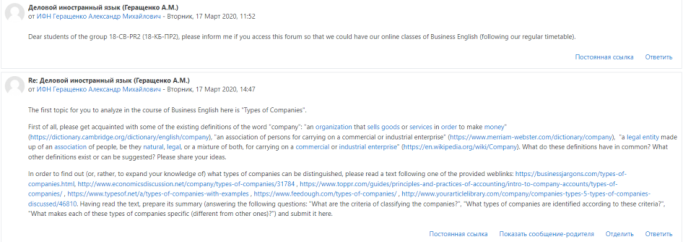
The first digital tool to be approved and promoted by Kuban State Technological University when its educational process shifted to the online environment in the end of March 2020 was the KubSTU Moodle forum available for registered users on https://moodle.kubstu.ru/mod/forum/discuss.php. (So the technical staff had to do a quick and intensive work on providing all the teachers and students with registration, in case they had not done it before.) Teachers would start their classes for particular groups of students as discussions there (with the discussion topic names featuring the names of academic disciplines and, sometimes, of the teachers and the groups of students). There they would send text messages with information concerning the class activities, such as tasks and hyperlinks. An example of such teacher’s messages, pro- vided by one of the authors on 17 March, 2020 for his Business English class in a group of second-year students majoring in software engineering can be seen in Figure 1.
Figure 1. KubSTU Moodle forum fragment with some teacher’s messages.
The students would normally (though not always) send their text messages in response (answering the teachers’ questions or at least indicating their presence and getting the task in some way). Beside text messages and hyperlinks, files (also in a text format) could also be uploaded there, containing either the teachers’ tasks or the students’ answers. The forum had to be used as the only permitted way for online classes at the first stage of the university adaptation to the new conditions of teaching and learning (providing the opportunity to practice and check writing skills during the classes) but, having been found inconvenient for this purpose, largely went out of use some weeks after its introduction, being replaced by another compulsory digital tool.
The BigBlueButton web conferencing system, which has provided sufficiently more opportunities (the list of which can be seen in Figure 2) than the forum, came to be integrated into the KubSTU Moodle platform and became the principal approved platform for conducting online classes at Kuban State Technological University (as well as in numerous other universities of Russia).
Figure 2. BigBlueButton screenshot fragment with a list of its functions.
BigBlueButton – made accessible via the electronic timetable on the university website – has provided the opportunity for teachers and students to communicate both in oral and written form, as well as to see each other and share their screens. However, not all of its functions have been implemented with equal success. For example, while teachers commonly make use of their microphones to speak to students, most of the latter would rather complain of technical problems than use their micro-phones for oral questions and answers in BigBlueButton. So the chat is a widely used place for live communication there. As for webcams, they hardly used by either of the sides in class but must be (and surely are) used to provide the students’ identification at the exams.
A special convenience of both authorized platforms for controlling the class attendance is the automatic display of the full names of those who enter the platforms and leave their messages there. Yet, the display of names is connected not with people present but with registration details (login etc.) provided on entrance – so the real presence of this or that person in class may be still dubious, at least in some cases (especially when webcams are inactive). So in this kind of “human ↔ computer ↔ human” interaction there is more risk for unexpected people to be present and ex- pected people to be absent while imitating their presence in class than in the tradition- al “human ↔ human” one.
It needs to be mentioned that a much more serious risk with the two authorized platforms than the “fake attendance” one is the technical failure making the online platform inaccessible during the time set for conducting classes due to the number of users entering the system being too large for it to function (properly). This problem,
Human Interaction & Emerging Technologies (IHIET-AI 2022) Artificial Intelligence & Future Applications https://openaccess.cms-conferences.org/#/publications/book/978-1-7923-8989-4 common during the first months of the coronavirus pandemic “offline→online” shift, made teachers and students use other digital tools for their online classes. Human-computer Interaction for Conducting Online Classes by Means of the Digital Tools Not Authorized by the University
While the university Moodle platform had been largely ignored before the transformation of the educational process resulting from the COVID-19, it had become common among teachers and students of, for example, Kuban State Technological University long before that to use other computer-based communication means, such as email and messengers, as well as social networks. With the advent of COVID-19-related changes, educators started making extensive use of the well-known digital tools. Being not provided with (usable) corporate email addresses, teachers use their private email addresses to send tasks and instructions to their students (sending their answers, as well as questions, in return). An even more frequently used way for this kind of interaction is the use of messengers, WhatsApp being the most popular one (not only) at KubSTU.
The use of WhatsApp as a tool for “teacher ↔ computer ↔ student” interaction in connection with conducting online classes should be paid special attention to. The creation of WhatsApp groups specially for classes has been a common practice at Kuban State Technological University since March 2020. Participants of such groups exchange voice messages as well as images (including screenshots and photos of paper book pages and handwritten tasks) either during or before and after classes. Being evidently less convenient than BigBlueButton for communication during online classes, WhatsApp groups mostly gave way in this respect to this “officially sanctioned” platform in the second half of spring of the year 2020. Nevertheless, they are still in use as an extra place for sending hometasks and other class-related messages in case they are to be kept accessible after the end of the BigBlueButton broadcast sessions. Besides, the few students who cannot enter the broadcast sessions during the class, can still participate in it via WhatsApp. Fig. 3 shows a relevant message exchange between a fourth-year undergraduate student and a teacher during their class of English on 1 November 2021 (the screenshot piece is from https://web.whatsapp.com/).
Figure 3. WhatsApp text message exchange between a student and a teacher in class.
Figure available in the original PDF paper.
It should be pointed out that the student sending the message was “in hospital” but still able to attend the class as all his group had to study online for some period after a COVID-19-infected student was detected there.
It also needs to be mentioned that other alternatives to authorized digital tools for online classes were suggested and used by students and teachers while the authorized ones were still not functioning properly. In fact, it was largely the students’ initiative to apply such extra tools. An example of this is a message sent to one of the authors
Human Interaction & Emerging Technologies (IHIET-AI 2022) Artificial Intelligence & Future Applications https://openaccess.cms-conferences.org/#/publications/book/978-1-7923-8989-4 during the start of communication in WhatsApp with the above-mentioned group of software engineering students on 31 March 2020: “If u want we can create a server in discord.” Beside Discord, they also widely use(d) Zoom, though never officially authorized for class use at the Russian technological university under consideration.
It must be particularly stressed that the main reason for using any digital tools not authorized by university authorities was and is the necessity to provide the best quality for online classes. When the authorized tools started functioning relatively properly (due to the hard work of the university technical staff throughout the first weeks of the COVID-19 pandemic “offline→online” shift), they firmly overtook the dominance in being used for “human ↔ computer ↔ human” interaction during the online classes at Kuban State Technological University, with desirable and real situations largely coinciding in this respect.
CONCLUSIONS
The analyzed Russian technological university case shows the ability of educators and students as humans to interact with computers and with each other by means of computers with a degree of success sufficient enough to make online classes really possible. Although the situation with using digital tools at the start of the described transformation of the educational process at the university was not really optimal (with certain educational institutions in Russia and other countries evidently showing significantly better results in this respect), the team of Kuban State Technological University managed to face the challenges and organize the relevant interaction at an acceptable level in a relatively short period of time, involving the existing opportunities. This situation has stimulated the development of digital learning in particular and raising the quality of human-computer interaction in general. The research results are applicable in connection with conducting online classes not only at universities but also at other institutions connected both with education and human- computer interaction (for example, technology parks).
ACKNOWLEDGMENTS
The research was carried out with the financial support of the Kuban Science Foundation in the framework of the scientific project No. IFR 20.1/36.
REFERENCES
Almazova, N., Krylova, E., Rubtsova, A., Odinokaya, M. (2020), “Challenges and opportunities for Russian higher education amid COVID-19: Teachers’ perspective.” Education Sciences, 10(12), 368.
Goudeau, S., Sanrey, C., Stanczak, A., Manstead, A., Darnon, C. (2021), “Why lockdown and distance learning during the COVID-19 pandemic are likely to increase the social class achievement gap.” Nature Human Behaviour, 5, 1273-1281. Grunt, E.V., Belyaeva, E.A., Lissitsa, S. (2020), “Distance education during the
pandemic: New challenges to Russian higher education.” Perspektivy Nauki i Obrazovania – Perspectives of Science and Education, 47 (5), 45-58.
Read this individual research paper free through the original publisher, or explore the full digital proceedings book.
ISBN 978-1-7923-8989-4
Explore this ISBN in the AHFE Bookstore ↗Listed in the July 2026 bookstore catalogue; search by ISBN to confirm current availability · Digital book purchase optional