Diogo Carvalho, Jorge Ferraz, João Miguel Dias (2022). Interface design to address the constraints of situational visual impairments: the context of a nautical application. In: Human Interaction & Emerging Technologies (IHIET-AI 2022): Artificial Intelligence & Future Applications. AHFE Open Access, vol. 23. https://doi.org/10.54941/ahfe100901
As technology evolves, it also reaches maritime navigation through the use of mobile devices in outside environments. Nonetheless, the use of mobile devices in this domain leads to issues concerning data visualization, since maritime navigation takes place in environmental-conditioned contexts, namely the direct incidence of sunlight, which constrains the interface data visualization on the smartphone screens. The study presented in this paper was made in the scope of the SisMAR project, which aims to support safe navigation in uncharted inland waters influenced by the tides. To achieve this a dedicated mobile application was designed to enable the simulation of the navigability conditions using routes shared by other navigators.The focus of this study was to design and evaluate the mobile application interface, aimed to be adapted to external environments assuring and adequate user experience.Preliminary evaluations highlight the favorable response of a contrasting color palette to mitigate situational visual impairments.
Navigation is an extensive area that can be applied in several contexts: from land and air (e.g. aeronautics and space) to the offshore and inland waters. Maritime navigation concerns the navigation from one waypoint to another, such a port, an island, or an anchorage, and is responsible for determining a vessel’s position to steer it safely to the defined destination. Furthermore, Jones et al. (2021) understand maritime navigation as a way to find the safest and most efficient route to avoid collisions.
According to the latest report on maritime navigation accidents, in 2020 there were nine deaths, one hundred injuries, and thirty-eight vessels lost in Portugal (Gabinete de Investigação de Acidentes Marítimos e da Autoridade para a Meteorologia Aeronáutica, 2020). Most of these accidents are driven by external factors, such as the loss of control, groundings, collisions, rumbles, and fires.
The navigation in shallow inland waters can be conditioned by the non-linearity of the tidal variation along its channels, the lack of navigation marks and absence of nautical charts with detailed and updated bathymetry. All these factors have a direct impact on the safety of maritime navigation, being one example of an inland water plan suffering from the referred problems the Ria de Aveiro, situated in Portugal, that is employed as a use case in our research.
Currently, the mobile nautical applications’ market does not offer effective solutions to promote safe navigation in this kind of inland waterways due to the lack of hydrographic data (depth and tidal variation along the network of channels) and navigation aids (buoys, marks, and beacons), being these factors of paramount importance when navigating in shallow waters where the risk of grounding is at stake.
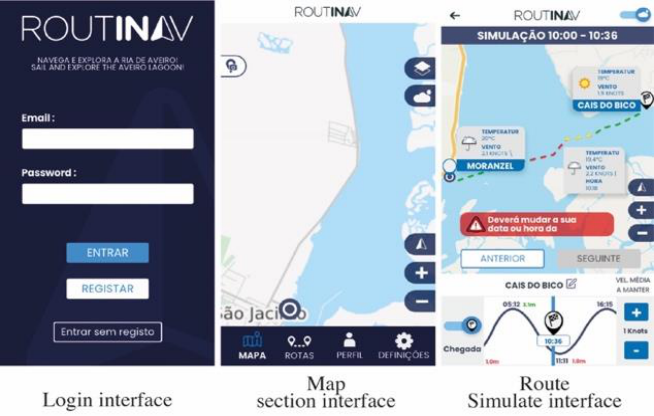
The SisMAR Project arises as a solution that aims to overcome the reported difficulties enabling a safe navigation in shallow inland waters. This is achieved by a process that augments previously shared routes with a colored scale that represents its navigability conditions. The shared routes are acquired (with a sampling rate of 1 Hz) in a synchronized way with their depth in a “x, y, z, t” format (x – latitude, y – longitude, z – depth, t – acquisition time) by volunteers belonging to nautical, fishing, and recreational associations. With a specific hydrodynamic model that predicts the local tidal height along the network of channels and a dedicated algorithm, it was made possible to estimate the variation of the tide for each coordinate (between the acquisition moment and the moment when a shared route will be navigated in the future). This variation is then summed to the acquired depth, enabling to represent if, according to the vessel draught, it will be possible to navigate the respective route. This is displayed on the Routinav mobile application (App) user interface (UI) using a colored scale for the routes (green – the forecasted depth is enough to navigate in safety conditions; yellow – there is a risk of running aground; red – the depth is not enough and the vessel will ground – see Figure 5).
From the perspective of the UI, the major problem, as will be further detailed in
Human Interaction & Emerging Technologies (IHIET-AI 2022) Artificial Intelligence & Future Applications https://openaccess.cms-conferences.org/#/publications/book/978-1-7923-8989-4 this paper, is related to the situational visual impairments (SVI) arising from the effects of the direct sunlight over the smartphone screens, that need to be addressed in an adequate way to not constrain the user experience (UX).
The article structure is divided into four sections: after this introduction; the second section presents the related work where a summary of the theoretical framework is made to support this research, the situational visual impairments are introduced, and some applications that supported the App design are presented; in section three, the user interface is presented based on heuristic principles and theories of experience design that allowed to design the App; in section four, the results of the evaluation made with the collaboration of real sailors are described, and, finally the conclusions of the study are depicted at section five.
Related work
Theorical review: The use case of Ria de Aveiro The lack of nautical updated information presents a serious problem for those who want to navigate in the Ria de Aveiro since it hampers safe navigation.
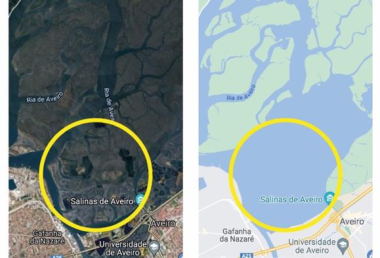
In this context, most of the vector maps contain too much detailed information about the surrounding roads, while the numerous channels of the Ria are poorly represented. The Ria’s detailed representation appears only when changing to the satellite map mode where it is possible to observe the detail of some channels (see Figure 1).
Figure 1. Difference between the representation of navigation interdicted zones in satellite mode and in vector mode (that appears fully navigable).
Nonetheless, the significant lack of contrast of satellite maps represents a challenge to distinguish between areas with water and the respective borders, islands, or islets. This lack of color contrast, especially perceptible due to screen problems such as lack of brightness, is commonly framed as a Situational Visual Impairment (SVI) (Wobbrock, 2006; Vatavu, 2017). Situational Visual Impairments.
According to Wobbrock (Wobbrock, 2006), the increase of mobile technology has become a concern in the Human-Computer Interaction (HCI) field. Until a certain moment, the HCI area was only concerned with creating, developing and evaluating the interaction mechanisms (i.e. mainly computers and machines) to improve the relation between the computer and the human being (Dix et al., 2004). Nevertheless, with the emergence of mobile technologies, it became essential to study the interactions of humans with these new devices.
In the referred context, Wobbrock (Wobbrock, 2006) presents four trends that translate the concerns for HCI in mobile devices. In our research, one of Wobbrock’s trends (Wobbrock, 2006) was considered: i.e. the Situational Impairments (SI). The SI reflects into the increased use of current smartphones to access information in outdoor environments. In this sense, the author mentions that knowing the Situationally Induced Impairments (SII) is crucial to improve the interface design and accessibility in mobile devices. So, the SVI or SII studies describe the situations in which the user's vision is compromised by effects of external environments, independent of their visual condition (Vatavu, 2017; Tigwell, Menzies and Flatla, 2018). According to Tigwell and colleagues (Tigwell, Menzies and Flatla, 2018), the type of contents to be accessed can minimize (or increase in some contexts) the SVI effects on mobile interfaces. In this sense, it is up to the designer to adapt the interface’s layout so that the contents can be accessed in any circumstance, specifically in maritime and sunlight scenarios.
In addition, it is essential to study the capacity of human visual perception (Ware, 2019) in or-der to reduce some of the effects of maritime and external environments (e.g. use a smartphone under the sunlight and navigate with one hand) that may interfere in the users' interaction with the mobile interfaces. Nautical mobile applications Besides the theoretical review, an analysis of nautical Apps was conducted. In this analysis (carried between January 2 and March 15 of 2020 with the keywords: nautical charts, marine chart gps, boat gps, marine gps, storm radar), a total of 13 Apps were identified in the App Store and Google Play. This analysis allowed to identify several user interfaces that were adequately visible in marine and outdoor environments. It also allowed to verify if the Apps were able to take in consideration the tidal variations when supporting navigation in inland waters.
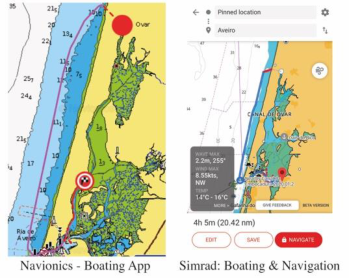
None of the Apps analyzed (Embark, Fishing Points, IMRAY Navigator, INAVX, Navily, Navionics Boating App, NV Charts, Sailgrib, Simrad, Vaarkaart Nederland, Waterkaat Live, Waterkaarten, WinGPS Marine) presented the tide variation along the Ria de Aveiro, as well as its navigability conditions. As can be seen in the Figure 2, the Apps with routing features like the ones supported by the Routinav App, developed in the SisMAR project, are not able to calculate routes to the northern
Figure 2. Example of the UI of the two Apps: Navionics (Navionics | Mobile App for Boating and Fishing, no date) and Simrad (Simrad App FAQs | Simrad Marine Electronics, no date).
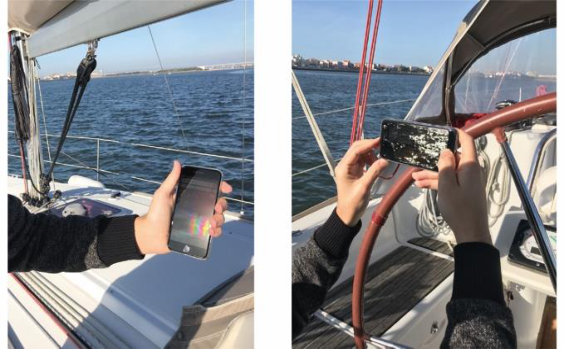
Along this analysis (see Figure 3), the Apps were tested in real context in the Ria de Aveiro. The procedure highlighted the constrains when interacting, under direct sunlight, with some Apps due to inadequate colors of the corresponded UI and low brightness level of the smartphones’ screens (the smartphones used had 500 cd/m2 or nits). This kind of SVI constrains the user experience during the navigation.
With this analysis it was also possible to verify that there are no Apps augmenting the routes with navigability conditions derived from vessel’s draught and tidal height as the SisMAR project proposes to do.
To overcome the reported SVI, some Apps resorted to adequate layouts and to the green color to present a sufficiently legible contrast, increasing the content’s readability. As described in the next section, these characteristics (e.g. interfaces’ color pallet and layout design) were used to support the design of the user interface of the Routinav App.
Figure 3. Analyzing the mobile applications in a maritime environment
THE SISMAR PROJECT: ROUTINAV APPLICATION’S USER INTERFACE A friendly and intuitive interface is of paramount importance in any context. In maritime inland navigation, where seaman/navigators require to promptly access information with reliability, this is also essential when interacting with the map, dealing with available routes and visualizing the vessel’s position. Color palette
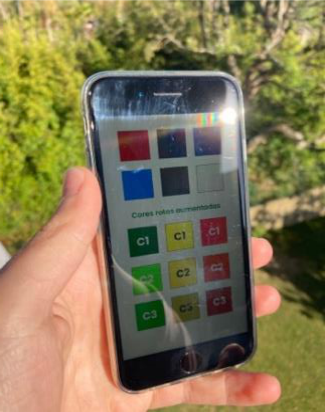
Under the development of the Routinav App it was crucial to define a set of colors to represent the augmented route. The color palette’s choice (Figure 4) was conducted prior to the interface design due to its relevance. This choice was challenging since there was the need to consider SVI that could arise during the navigation process.
Figure 4. Colors evaluation for prototype’s design The colors were validated in a real scenario, allowing to perceive that the hues of blue and red can improve the legibility of the application's contents. Regarding the augmented routes, several shades of green, yellow and red were validated to identify which were the most contrasting in the presence of sunlight: the C2 (i.e. #6b006b, #ffff00 and #d90404) was the chosen set of colors since it gives an adequate answer to the identified SVI. Agile Prototype
After the color palette was established, the research team designed an agile prototype (Figure 5) for the Routinav App using Adobe Xd. This prototype took into
Human Interaction & Emerging Technologies (IHIET-AI 2022) Artificial Intelligence & Future Applications https://openaccess.cms-conferences.org/#/publications/book/978-1-7923-8989-4 consideration the potential problems that could arise due to SVI in maritime navigation, such as the reflection of sunlight and water ripple that can influence the content visualization and the interaction with the Apps.
Figure 5. Interface design of SisMAR Routinav App The mobile interface was design centered on the project’s target audience (i.e. leisure and professional sailors) and based in the Heuristic Principles of interface design (Nielsen, 2020). In terms of heuristic evaluation, the following principles were applied: (a) “visibility of the system status” by using a navigation menu with both icons and textual content; (b) “match between the system and the real world”, by adding the checkered flag of the final lap of race cars to indicate the destination pier and by showing the navigability conditions through the use of the three colors used in the traffic light system – green, yellow and red; (c) “the user control and freedom” has been considered so that the user can, for instance, change their departure and arrival pier at any time during the interaction with the App.
USER EXPERIENCE EVALUATION APPROACH The prototype was designed based on the referred set of heuristics to avoid possible User Interface (UI) and Interaction Design problems. However, the heuristics on its own does not guarantee that a prototype will not face UX problems. Hence, the prototype was evaluated in a real scenario by five members (N = 5) of one of the nautical associations collaborating with the project.
This research followed an iterative methodology. Thus, the conceptualization/implementation of the agile prototype and its evaluation phases are interconnected, allowing the UI design to improve accordingly to the users’ needs. In this way, these phases were crucial before developing the App since they identified a set of interaction problems in the prototype. For this evaluation, a Guerrilla Test (Goodman, Kuniavsky and Moed, 2012) was the chosen method to analyze possible UX problems in the designed prototype.
Throughout the first UX evaluation of the prototype, the users were asked to perform a set of tasks, turning possible to observe some design constraints in two (out of ten) tasks: the first one (registering in Routinav App); and the ninth one (identify the tide height at the arrival pier). From the second task onwards, the users were able to interact autonomously with the App, considering the simulation process as: “user- friendly” (P2); “The selection process is intuitive” (P3); and “This information is fantastic! (…) a person is worried about the sails and the depth (of the Ria). If you look at the interface and you have all that information, it's better” (P5).
Moreover, it was identified that all users (N = 5) did not discover the way to switch between departure and arrival piers in the simulation interface. Therefore, as suggested by one of the participants, a new option was integrated into the prototype, allowing the user to directly click on the arrival pier – “Can I just directly click on the dock?” (P2) – and added a switch button on the top of the UI to shift between the departure and arrival information.
At the end of the evaluation, it was possible to verify if the SVI effects were dealed in an adequate way. With the information gathered via a questionnaire, it was possible to realize that most of the participants (N = 4) found the simulation process quite easy and that the route colors increased the interpretation of the navigational conditions. All users considered that the color palette applied to the interface allowed them to overcome the limitations in the access to visualization (e.g. reflection of sunlight). In addition, two limitations concerning the access of information on the prototype were highlighted: (1) the size of the screen (that can be overcame with a bigger device); and (2) the need of holding the mobile phone while sailing (that can be avoided if a mobile phone mount will be installed in the vessels).
Following the interface evaluation, a set of vector and satellite maps were also analyzed. In this analysis participants were asked about the map's readability in marine conditions. The vector map (leaflet outdoors style) was the chosen option (N = 5) since this type of maps allow to distinguish the geographical areas with various colors (e.g. water in blue and land in green). As far as the satellite maps are considered, most of the users (N = 4) found it less readable in outdoor conditions.
The described research aimed to identify the issues that can affect the whole user experience of an App to support navigation in inland waters, describing the design process and evaluation of a functional prototype, entitled Routinav.
Results indicated that the chosen colors for the prototype (hue of blues and reds) aid the navigators to visualize the information in outdoor environments. In the prototype evaluation, a contrasting color palette was identified presenting an adequate response to the sunlight effects overcoming some SVI.
The prototype evaluation sessions allowed the integration of the SVIs into practice and will allow to develop the technological product with the focus on the navigators' needs, and also to study specific situations regarding the Routinav App usage in maritime environments.
The use of a small and intentional sample can be considered a limitation of this study. Therefore, the interpretation of these results should be cautious. Nevertheless, this research provides results to mitigate the absence of research in SVI applied to the maritime scenario and Apps in inland waters.
ACKNOWLEDGMENTS
This work was supported by the research project SisMAR: “Maritime navigation support system”. This project is funded by Fundo Azul ref. FA_04_2017_009. Thanks are due to FCT/MCTES for the financial support to CESAM (UIDP/50017/2020+UIDB/50017/2020) and DIGIMEDIA (UIDP/05460/2020+ UIBD/05460/2020), through national funds.
REFERENCES
Dix, Alan, Finlay, Janet E., Abowd, Gregory D., Beale, Russell. (2004) Human-computer interaction. Third. Pearson. Gabinete de Investigação de Acidentes Marítimos e da Autoridade para a Meteorologia Aeronáutica (2020) Investigação de acidentes marítimos - Sumário de Atividade. Portugal. Available at: http://www.gama.mm.gov.pt/images/Relatorios_Estatisticos/Relatórios_Semestrais/Atividade _GAMA_-_IAM__-_2020.pdf (Accessed: 17 March 2021). Goodman, E., Kuniavsky, M. and Moed, A. (2012) Observing the user experience: A practitioner’s guide to user research. 2nd ed. Waltham, MA: Morgan Kaufmann. Jones, S. M. et al. (2021) Navigation | technology | Britannica. Available at: https://www.britannica.com/technology/navigation-technology (Accessed: 18 October 2021). Navionics | Mobile App for Boating and Fishing (no date). Available at: https://www.navionics.com/fin/apps/navionics-boating (Accessed: 1 November 2021). Nielsen, J. (2020) 10 Heuristics for User Interface Design. Available at: https://www.nngroup.com/articles/ten-usability-heuristics/ (Accessed: 21 December 2019).
Simrad App FAQs | Simrad Marine Electronics (no date). Available at: https://www.simrad- yachting.com/en-gb/help--support/simrad-app-faqs/ (Accessed: 1 November 2021). Tigwell, G. W., Menzies, R. and Flatla, D. R. (2018) ‘Designing for situational visual impairments: supporting early-career designers of mobile content’, in Proceedings of the 2018 Designing Interactive Systems Conference, pp. 387–399. Vatavu, R. D. (2017) ‘Visual Impairments and Mobile Touchscreen Interaction: State-of-the- Art, Causes of Visual Impairment, and Design Guidelines’, International Journal of Human– Computer Interaction, 33(6), pp. 486–509. doi: 10.1080/10447318.2017.1279827. Ware, C. (2019) Information visualization: perception for design. Morgan Kaufmann. Wobbrock, J. O. (2006) ‘The Future of Mobile Device Research in HCI’, in CHI 2006 workshop proceedings: what is the next generation of human-computer interaction. Pittsburgh, pp. 131–134. Available at: http://www.fossil.com (Accessed: 22 November 2020).
Read this individual research paper free through the original publisher, or explore the full digital proceedings book.
ISBN 978-1-7923-8989-4
Explore this ISBN in the AHFE Bookstore ↗Listed in the July 2026 bookstore catalogue; search by ISBN to confirm current availability · Digital book purchase optional