Mariem Fekih Zguir, Maryam Alhail, Muammer Koc (2022). Learning Sustainability through Digital/Social Media (DSM) and its Impact on Students in Qatar. In: Human Interaction & Emerging Technologies (IHIET-AI 2022): Artificial Intelligence & Future Applications. AHFE Open Access, vol. 23. https://doi.org/10.54941/ahfe100908
Nowadays, the utilization of Digital and Social Media (DSM) is becoming more and more ubiquitous in different fields, especially amongst the youth. A cornerstone in the technological and information revolution as well as a powerful medium in spreading knowledge in the twenty-first century, DSM is becoming omnipresent in the education arena where teachers and students alike use them for their respective education. Given the need to cater to different learning styles, to diversify instructing methods to ensure better learning outcomes for different students, and to help students become tech-savvy, DSM offers an array of opportunities to boost collaboration, communication, inquiry, and to engage students in the learning process. From blogging to using several platforms such as Twitter and Instagram, it has been proven from the literature that DSM can play a vital role in empowering students to be global citizens and to advance Sustainable Development Goals (SDGs). Amid the outbreak of the COVID-19 pandemic, schools and institutions worldwide were compelled to embrace remote classrooms and to shift to distance learning, relying more heavily on DSM as an attempt to bridge the knowledge gap and to use them as effective tools to deliver lessons. In light of this event, schools that were not previously prepared to incorporate digital media as part of their students’ learning faced numerous hurdles and issues trying to reach their students and maintain their learning standing. In a response to this emerging need, this paper suggests a website as a digital and innovative solution, which was designed by the authors and used by the English department in one preparatory school in Qatar during remote learning. The purposes of this website are threefold: i) prompting students to enhance their written communication skills through journaling on different topics via an online platform, ii) encouraging students and teachers to interact in a safe environment by reading each other’s posts and commenting on them, and iii) leveraging the use of DSM by helping students reflect on and disseminate their sustainability habits in a country that is seeking incessantly to shift to a knowledge-based economy and to meet the SDGs as part of its own national agenda. As the K-12 curriculum framework in Qatar delineates the importance to incorporate sustainability values within various subjects, this website serves to address the application void that is left to be filled in and decided by teachers in delivering these subjects. Using qualitative approaches, mainly data coding and text analysis to evaluate findings from semi-structured interviews conducted with the website users (both students and teachers), and from essays posted on the website, the results show that students were increasingly motivated and interested in topics related to sustainability and environmental issues pertinent to the local case of Qatar after posting on the website. Furthermore, findings from teachers’ perspectives reveal that the ease of sharing, commenting on and documenting students’ reflections and writings made them more prone to use the website more regularly. The study concludes with a set of recommendations to improve DSM learning in Qatar.
Human Interaction & Emerging Technologies (IHIET-AI 2022) Artificial Intelligence & Future Applications https://openaccess.cms-conferences.org/#/publications/book/978-1-7923-8989-4 sustainable development, Qatar education system
INTRODUCTION
Digital and Social Media and their role in learning Nowadays, and following the technological boom, digital and social media (DSM) platforms are increasingly becoming powerful tools that shape individuals' behavior and attitudes (Au, 2020). Given their ease of use in communication and in stimulating social interaction and connection among people, through flexible features such as posting, sharing, chatting, and commenting on others, and the role they play in reinforcing collaboration amongst individuals, these platforms are becoming ubiquitous in multiple aspects, including learning and education (Simionescu et al.2020).
The emergence of DSM in the field of education has witnessed a significant impact on students' learning and the teaching environment. It has been proved that DSM enhances discussions, participation, collaboration, and develops knowledge and critical thinking skills amongst students, which are essential 21st-century skills (Devi et al.2019). For these reasons, web-based online networks and sites are being progressively used in educational settings for collaborative learning due to their impact on students' behavior and how they share online knowledge and resources (Ansari & Khan, 2020). Additionally, given their potentials, social media sites such as Meta (formerly known as Facebook), Instagram, Twitter, as well as websites used for blogging, to name some examples, are gaining more momentum in the academic and education fields as they are being used by different instructors in the goal to enhance learning outputs of their students.
While initially several instructors might have found themselves reluctant to use these tools frequently, due to the spread of the COVID-19 pandemic—which has threatened traditional learning and forced the educational settings to be closed temporarily to prevent surge of affected cases among the community—they eventually resorted to online learning and hence used DSM tools to compensate for the physical teaching and learning that students were enjoying prior to the pandemic. An extensive body of literature looked into the impact of online learning on the education system and outlined several advantages of online learning, such as reducing the cost and financial statements related to traditional education entities (Al-Husban, 2020) and ensuring student learning continuity (Seage and Türegün, 2020).
The need for DSM to attain Education for Sustainable Development Education for Sustainable development (ESD) as a core attribute of quality education
Human Interaction & Emerging Technologies (IHIET-AI 2022) Artificial Intelligence & Future Applications https://openaccess.cms-conferences.org/#/publications/book/978-1-7923-8989-4 aims to enhance sustainable thinking and living by addressing sustainability challenges such as environmental integrity and economic feasibility to achieve a sustainable society. It equips the students with sufficient knowledge sets and skills, raises their awareness and responsibility about their attitudes towards global challenges such as climate change, environmental degradation, poverty, and unjust society. This is part of the 17 Sustainable Development Goals (SDGs) agenda promulgated by the United Nations (UN) and embraced by all member states to be met by 2030 (UN, 2015).
As these skills are becoming highly required in all walks of life whether on the personal or professional level, sustainability competencies are regarded as essential and many scholars call for the embedding of these competencies within curricula to reflect ESD and SDGs and to push sustainability forward to become a reality in action. These interpersonal traits include systems thinking, problem-solving, and decision-making (Cebrián and Junyent, 2015). To incorporate the concepts of sustainability in education systems a new paradigm approach that focuses on collaboration and social participation is required. Thus, one way to meet the requirement is by embedding social media and computer skills to develop technology literacy, numeracy skills, communication, and societal skills (Sotomayor, 2021). The ability “to use digital/ social media (DSM)” tools has been added to the competencies for sustainability as technology serves as a means in transferring sustainability messages to both the local and the global community in a very fast and effective way (Rieckmann et al. 2017).
Qatar education system (QES): the road towards ESD Currently, following the establishment of a new national curriculum framework (QNCF) for the K-12 education system, the ministry of Education and higher education (MOEHE) in Qatar is pressing on the importance to embed STEM skills as well as competencies related to sustainability and global citizenship awareness within the Qatar Education System (QES) (Fekih et al.2021; Al-Thani et al.2021; Al-Kuwari et al. 2021). The framework aims to raise awareness on and expand the sustainability topics in the curriculum to include the sustainability challenges such as the water, energy, and food nexus. Still though, the curriculum is considered to be not fully aligned with values of ESD and SDGs as per reports issued by the UN (UNESCO, 2020).
Given the importance of DSM in today’s learning and teaching and in light of the efforts and resources that the State of Qatar—as the FIFA world cup host of 2022— is summoning to meet its own national vision (QNV 2030) as well as the UN SDGs one, and referring to the important role that DSM tools can play in furthering global citizenship, sustainability and other skills among students, this empirical study, which is based on testing and using a blogging website by one department at one preparatory school in Qatar aims to answer the following questions:
1- In what ways do teachers and students in Qatar perceive the use of DSM as essential to enhance their STEM knowledge set? 2- How can a website dedicated for showcasing students’ creative writing in the English language stimulate values of global citizenship and sustainability among students? 3- What are some necessary features and pages that teachers deem to be important for the website to further propagate values on global citizenship and sustainability amongst their students?
METHODOLOGY, PARTICIPANTS AND DATA CODING In light of the importance of DSM in education explained in the literature section, this present study aims to investigate the impact of using a website by the English department at one government school in Qatar on fostering values related to global citizenship and sustainability amongst students at that school.
The website, which was designed by one of this paper’s authors was originally in- tended to encourage outstanding students to share their creative pieces of writings and for others to read, comment, and interact with each other. The main goal was to enhance English writing and to provide a safe platform for students to express them- selves using a foreign language. As the launching of the website coincided with the lockdown period during the COVID-19 pandemic where schools were forced to move to remote and distance learning (Aljazeera, 2020), this website became a useful tool for English teachers as they relied on it to encourage their students to share and post more about their activities during the quarantine. Additionally, as the school became a member of the UNESCO Associated Schools Project network (Raslan, 2021), the website was used more prominently to encourage students to post their creative writings to meet the UN SDGs goal number 4 on quality education. Once classes resumed with 50% attendance rate, the researcher delivered training sessions for teachers to use the website autonomously and to create their own accounts and share their students’ writings. Teachers who interacted with the website and students who shared content on it were contacted later on to get their perceptions on this experience. Upon receiving the approval of the preparatory school—where the website was first piloted—to contact and interview participants, researchers contacted participants individually and conducted interviews with teachers. These interviews were of semi- structured nature. As for the students, they were asked to reflect on their experience after having shared a piece of writing online. Teachers gathered these reflections and shared them with the research team. All participants (teachers and students) are females since the government school system in Qatar is based on a gender segregated model.
Prior to the meeting and upon receiving approval to conduct these interviews, English
Human Interaction & Emerging Technologies (IHIET-AI 2022) Artificial Intelligence & Future Applications https://openaccess.cms-conferences.org/#/publications/book/978-1-7923-8989-4 teachers were contacted via the instant messaging application WhatsApp to obtain their signed consent forms for participation, to explain the purposes of the study, and to share the interview questions with them. Overall, out of the eight teachers that were initially contacted, three teachers participated in the semi-structured interviews which took place after having used and interacted with the website. Their responses were collected either via voice records, emails, or phone calls. These were transcribed by the researchers and were saved on a secure server.
Semi-structured interviews comprised on eight questions as follows: 1- For what reason(s) have you used the website? 2- What topics intrigue(d) your students the most to write about? 3- To what degree do you think the website/blog encourages students to become global citizens? 4- To what degree do you think the website/blog encourages students to be more aware/ knowledgeable on sustainability? 5- To what degree do you think the website can further promote for global citizenship and sustainability awareness? Rank from 1 to 5 (1 is lowest and 5 is highest) 6- To what extent are you willing to use the website more regularly to ask your students to journal/ blog/ and share their writings? 7- Have you received enough training on how to use the website? 8- How to enhance the website and make it more aligned with the SDGs (sustainable development goals)?
For students, data gathering phase was executed using two sources: students’ posts and comments on the website, and students’ reflections after having used the website. The latter were shared by teachers with the researchers. Students were asked to reflect on how they benefited from this experience of posting their pieces of writing, in particular how did the website help them attain SDG goal 4 vis-à-vis global citizenship and ESD. These texts were typed and saved on a secure server as well. In total, five students shared their reflections with the teachers, and 19 entries posted on the website were analyzed. Data coding For this study, given the qualitative nature of data, researchers relied on thematic analysis approach and coding using the Atlas.ti software (Friese, 2019; Rädiker and Kuckartz, 2020). All interviews and students’ reflections were collated then uploaded on the software and later on analyzed using specific codes, which were created based on the recurring themes as demonstrated in Figure. 1. The main five codes used for the analysis are: purpose of use, students’ interests, benefits (sub-codes are: global citizenship, sustainability and ESD, mental health, and interpersonal and other benefits), training, and future improvements. In regards to students’ entries, these were uploaded into the system, and using the word
Human Interaction & Emerging Technologies (IHIET-AI 2022) Artificial Intelligence & Future Applications https://openaccess.cms-conferences.org/#/publications/book/978-1-7923-8989-4 cruncher feature of the Atlas.ti software, main themes were extracted.
Teacher 2 Teacher 3
Student 3
Student 5 Teacher 1
Student 2
Student 4
Student 1
training
future improvements
students' interests
Mental health
Global Citizenship Sustainability and ESD
Purpose of use interpersonal skills and other benefits We can make special part for SDGs. This part only for articles related to the above topic topics related to science, religious topics, anything to do with morals and behavior If the writing piece is very outstanding then I would take it and post in on the website I didn’t know that writing on it would help me in a lot of ways. It helped me in communicating more with… My students used it to publish their points of view and to express themselves on topics they were as…
That is why, I included my experience with mental struggles to help teach my school girls that strug…
it gave me the chance to show my potential as a future writer.
It also makes you take responsibilities of your own actions and interaction of people and members of…
It is to use the website and our students already know how to blog. So yes it is easy.
Yes I have received a very thorough training on how to use the website.
Figure 1. Main codes and sub-codes used to analyze students’ reflections and teachers’ interviews along with corresponding quotes using Atlas.ti RESULTS AND FINDINGS
Figure available in the original PDF paper.
Looking at the findings from teachers’ interviews, students’ entries on the website, and the students’ reflections after posting these entries, it is evident that, at the piloting stage of the website, both students and teachers expressed that they benefited from using this digital media, mostly during the lockdown. One teacher highlighted, “Quarantine was perfect and the website was a great way to add some extra-curricular work for the girls”. In terms of the purpose to use the website, all three teachers agreed that the website served to showcase creative students’ writings as a way to reward these students. They also agreed that they used the website to allow their students to express themselves and share their opinions. One teacher stated that, “it really sheds this spotlight on the students and that in itself is already very rewarding for them”.
On the benefits that teachers and students agreed the website helped them acquire, these were mainly classified into the following four categories: global citizenship, sustainability and ESD, mental health, and other benefits. When teachers were asked to specify how did the website help foster values related to SDG 4 (in particular glob- al citizenship and sustainability), one teacher indicated that “It is designed to help students to develop the core global citizenship competencies, including being knowledgeable of global issues and their interconnectedness, it enables them to communicate, appreciate diversity, and it promotes critical thinking and problem- solving skills”. Similarly, students found it a useful tool to disseminate values related to global citizenship by enabling them to feel more active in their local communities and the international one when tackling different topics and issues. As one student
Human Interaction & Emerging Technologies (IHIET-AI 2022) Artificial Intelligence & Future Applications https://openaccess.cms-conferences.org/#/publications/book/978-1-7923-8989-4 put it, “I didn’t know that writing on it would help me in a lot of ways. It helped me in communicating more with other people from around the world and knowing problems that are happening in their areas and how to feel about them, such as poverty and human rights”. Another student stated how reading certain posts on the website increased her level of awareness on issues related to environment. She mentioned, “[s]crolling through the website, I saw one student was talking about the problems that the environment suffers from and how to solve them. It made me aware of so many things.” Likewise, a different teacher noted, “the website can help students socialize, express themselves and stay updated on many issues including environmental and social issues”. Although some teachers expressed they do not think the website does promote for global citizenship and sustainability to a great extent, they agreed that it has a promising potential to attain this goal once more students write more substantially about these particular topics. Regarding other advantages that students have obtained from using the website these are mainly: ability to express themselves freely, gaining soft skills such as self-confidence and writing as professionals, in addition to talking about pertinent issues they face as students, such as mental health issues. One student pointed out, “I included my experience with mental struggles to help teach my school girls that struggling with anxiety or depression or stress or any other mental illness is not something to be ashamed of.”
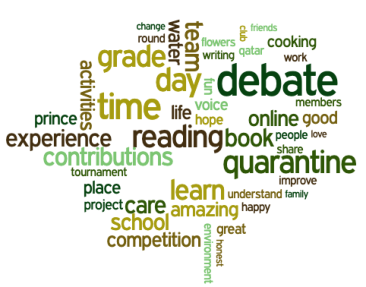
To analyze students’ entries on the website, the research team extracted all entries and using the word cruncher feature on Atlas.ti generated an excel sheet with the most recurring words. This was used to create a word cloud on a different software.
Figure 2. Word cruncher’s output using students’ entries in the website
As depicted in the word cloud in Figure 2., students were keen to write mostly about their own experiences and daily activities while covering topics on environment protection and water management. On the topic of improving the website, all teachers recognized that more specifications need to be included when asking students to share their entries. According to them, it would be more lucrative if students wrote mostly on sustainability and global citizenship and their role in advancing the SDGs in the State of Qatar instead of writing about different miscellaneous topics.
DISCUSSIONS To answer the first question on how DSM is perceived by teachers and students in Qatar, it is evident that both teachers and students participating in this study can see the potential a website dedicated to showcase students’ work can have in enhancing their STEM skills by using this technology. As the State of Qatar is focusing on STEM education (Al-Hail et al.2020; Kayan-Fadlelmula et al.2016; Sellami et al.2017), using a blogging website by posting, adding pictures, publishing, sharing and commenting as well as learning how to use blog website builders such as WordPress, Wix, Squarespace and more is a reflection on how to leverage technical skills and put them into practice within a school setting.
Second, as evidenced in the findings, teachers agreed that allowing such platform for students to share and write about issues and topics that interest them helped them advance their interpersonal and social skills and also empowered them to speak more about serious causes and issues; for instance, delving into a critical topic such as mental health is a proof that students—especially at this young age—want to share more about their experiences and contribute in their communities. This is aligned with findings from the literature that show that DSM are powerful tools not only in fostering STEM and 21st century skills among students but also in improving their social awareness on various topics including sustainability and global citizenship (Simionescu et al.2020; Ansari and Khan, 2020) Finally, having more well-defined tasks for students to write about and more pages with further information of SDGs and sustainability is an important aspect that teachers believe the website could benefit more from in the future, and could make it appealing for other schools as well to use the website.
CONCLUSIONS
This study was conducted in one preparatory government school in Qatar and aimed
Human Interaction & Emerging Technologies (IHIET-AI 2022) Artificial Intelligence & Future Applications https://openaccess.cms-conferences.org/#/publications/book/978-1-7923-8989-4 to shed lights on the importance of DSM in furthering STEM skills and to show the role they can play in disseminating values related to global citizenship and sustainability as well as education for sustainable development through interaction effectuated by teachers and students with a website. Although it is important to enhance this website based on the suggestions of the interviewees and to carry further studies to test more features based on these suggestions with more teachers and a wider number of students, the originality of this study lies in addressing the issue of integrating SDGs and ESD at the K-12 level using a sustainable and a durable digital medium such as a blogging website.
ACKNOWLEDGMENTS
The authors wish to express their sincere gratitude to Hamad Bin Khalifa University (HBKU) for their financial support and in helping the research team present this paper at the IHIET-AI 2022 Conference.
REFERENCES
Au A (2020) Reconceptualizing the generation in a digital(izing) modernity: digital media, social networking sites, and the flattening of generations. Journal for the Theory of Social Behaviour 50:163–183 Simionescu M, Horvthova Z, Kovshun N, Kushnir N (2020) Social media, sustainability, and
environmental protection in sustainable education. E3S Web of Conferences 208:09002. https://doi.org/10.1051/e3sconf/202020809002 Devi K, Eragamreddy G, Lakshmi V V, Professor A (2019) Role of Social Media in Teaching- Learning Process. 6:96–103 Ansari JAN, Khan NA (2020) Exploring the role of social media in collaborative learn-ing the
new domain of learning. Smart Learning Environments 7:9. https://doi.org/10.1186/s40561-020-00118-7 Al-Husban NA (2020) Critical Thinking Skills in Asynchronous Discussion Forums: A Case Study. International Journal of Technology in Education 3:82–91. https://doi.org/10.46328/ijte.v3i2.22 Seage SJ, Türegün M (2020) The Effects of Blended Learning on STEM Achievement of
Elementary School Students. International Journal of Research in Education and Sci- ence 6:133–140. https://doi.org/10.46328/ijres.v6i1.728 UN (2015) THE 2030 AGENDA FOR SUSTAINABLE DEVELOPMENT. https://sustainabledevelopment.un.org/content/documents/21252030%20Agenda%20fo r%20Sustainable%20Development%20web.pdf. Accessed 9 Nov 202 Cebrián G, Junyent M (2015) Competencies in Education for Sustainable Development: Exploring the Student Teachers’ Views. Sustainability 7:2768–2786. https://doi.org/10.3390/su7032768 Sotomayor CKR (2021) The Integration of Transversal Competency in Key Stage 4 English
Subjects. 2:20 Rieckmann M, Mindt L, Gardiner S (2017) Education for Sustainable Development Goals: learning objectives; 2017. UNESCO
Fekih Zguir M, Dubis S, Koç M (2021) Embedding Education for Sustainable Development (ESD) and SDGs values in curriculum: A comparative review on Qatar, Singapore and New Zealand. Journal of Cleaner Production 319:128534. https://doi.org/10.1016/j.jclepro.2021.128534 Al-Thani WA, Ari I, Koç M (2021) Education as a Critical Factor of Sustainability: Case Study
in Qatar from the Teachers’ Development Perspective. Sustainability 13:11525. https://doi.org/10.3390/su132011525 Al-Kuwari MM, Du X, Koç M (2021) Performance assessment in education for sustain-able development: A case study of the Qatar education system. Prospects. https://doi.org/10.1007/s11125-021-09570-w UNESCO (2020) Education for people and planet: creating sustainable futures for all, Global
education monitoring report, 2016 - UNESCO Digital Library. https://unesdoc.unesco.org/ark:/48223/pf0000245752. Accessed 9 Nov 2021 Aljazeera (2020) Qatar announces closure of schools, universities over coronavirus. In: Aljazeera.com. https://www.aljazeera.com/news/2020/3/9/qatar-announces-closure-of- schools-universities-over-coronavirus. Accessed 6 Nov 2021 Raslan M (2021) 81 schools join ASPnet. Alraya Magazine Friese S (2019) Qualitative Data Analysis with ATLAS.ti. SAGE Rädiker S, Kuckartz U (2020) Focuseds Analysis of Qualitative Interviews with MAXQDA,
1st ed. MAXQDA Press, DE Al-Hail MA, Al-Fagih L, Koç M (2021) Partnering for Sustainability: Parent-Teacher-School (PTS) Interactions in the Qatar Education System. Sustainability 13:6639. https://doi.org/10.3390/su13126639 Kayan-Fadlelmula F, Koc M (2016) OVERALL REVIEW OF EDUCATION SYSTEM IN
QATAR. Lambert Academic Publishing Sellami A, Kimmel L, Wittrock J, et al (2017) Factors Shaping Qatari Students’ Career Expectations in STEM, Business or Public Sector Fields. EURASIA J MATH SCI T 13:. https://doi.org/10.12973/ejmste/77043
Read this individual research paper free through the original publisher, or explore the full digital proceedings book.
ISBN 978-1-7923-8989-4
Explore this ISBN in the AHFE Bookstore ↗Listed in the July 2026 bookstore catalogue; search by ISBN to confirm current availability · Digital book purchase optional