Qiming Sun, Sharon Hsiao (2024). Supporting Informal Sustainability Learning with AI-assisted Educational Technology. In: Human Factors in Design, Engineering, and Computing. AHFE Open Access, vol. 159, pp. 53–59. https://doi.org/10.54941/ahfe1005567
This paper presents Waste Genie (WG), a novel web-based educational platform designed to enhance learning about sustainable waste management. WG employs bite-sized interactive content and leverages artificial intelligence to support sustainability education. To assess WG's efficacy, we conducted a user study involving 21 college students. The study aimed to evaluate improvements in sustainability awareness, waste sorting skills, and overall user experience. Results showed a notable increase in participants' understanding of waste management practices and their ability to correctly classify waste items. This research demonstrates the potential of combining emerging technologies like large language models with interactive learning approaches to address environmental education challenges.
In a world with escalating environmental concerns, our research group designs and implements technological solutions to foster sustainability learning. We currently focus on waste management and practices, and gradually branch out to the broader sustainability realm. The core features in WG include (1) a Waste Scanner that utilizes object detection to identify the waste items and dynamically provides the associated waste bin information; (2) Artificial Intelligence (AI) to generate interactive quizzes for waste sorting practices, meanwhile, a GPT-powered AI agent that provides adaptive feedback; (3) Virtual Carbon Credits system to help users quantify and visualize the environmental impacts of their waste sorting decisions; (4) a sizable sustainability learning material is curated, harnessed and summarized, and is periodically published on WG to enrich the learning content. All of these are delivered through an infinitive linear scroll presentation of a web application, that emulates a popular social media application Instagram, to support easy accessibility and learnability.
A study was conducted with 21 participants to evaluate the effectiveness of WG in improving waste management knowledge, sustainability awareness, and user engagement. The results demonstrated the benefits of integrating the AI agent into the educational platform. Participants achieved increased accuracy and efficiency in waste sorting tasks, attributed to the AI-generated feedback. Moreover, the study revealed positive effects on users’ overall
sustainability awareness and understanding of proper waste disposal practices.
The integration of large language models (LLMs), such as GPT, into educational technologies like WG addresses the challenges posed by the complex and evolving nature of waste management knowledge. Unlike traditional chatbots, the AI agent in WG adapts to users’ actions during waste sorting practices, providing context-specific feedback to address their queries and misconceptions effectively.
In this paper, we investigated three key questions: 1) the impact of AI-guided assistance, 2) the effectiveness of GPT-powered feedback in promoting waste management learning, and 3) the usability and user engagement with the WG platform. The findings demonstrated that AI-guided assistance enhanced the learning experience, with users reporting improved knowledge and awareness of waste management practices. Furthermore, the AI-generated feedback contributed to increased sorting accuracy and efficiency, highlighting the potential of leveraging off-the-shelf AI models in complex domains like waste classification.
Overall, the study validated the feasibility and effectiveness of integrating AI agents into educational technologies for waste management learning. Waste Genie’s high usability ratings and positive user engagement further showcased the viability of this approach. However, the research also identified limitations, such as the need for more conversational interactions and adaptive quiz generation algorithms to personalize the learning experience further. Future iterations will focus on refining the AI agent for dynamic and deeper dialogues, optimizing quiz generation algorithms for personalized sequences and paces, and introducing additional challenge types to enhance the learning process. The successful integration of AI into Waste Genie highlights the potential of leveraging emerging technologies to address pressing environmental concerns through education and awareness.
RELATED WORKS There have been drastic technological advancements in improving waste management these days. Research ranges from (a) the power of deep learning to identify wastes in medical fields (Buragohain, Mali, Saha, & Singh, 2022), to sort plastics (Padalkar, 2021), to recognize recycle materials (Wahyutama & Hwang, 2022), and to categorize them in diverse settings (Majchrowska, et al., 2022); (b) immersive or robotic technology to support waste management, such as visualizing the impact of wastes in Augmented Reality (AR) (Assor, Prouzeau, Dragicevic, & Hachet, 2023); Smart waste bins with sensors to promote waste categorization (Thieme, et al., 2012); Our team also ventured into the realm of AR and leveraged its potential to guide individuals in proper waste disposal (Sun, Hsiao, & Chien, 2023); (c) social and/or interactive gaming to educate different groups of audience with, such as ROBOTE (Jiménez Barriga & Hernández Villalba, 2023), PEAR (Wang, Tekler, Cheah, Herremans, & Blessing, 2021), FoodFights (Jespersen, et al., 2023), HotDish (Robelia, Greenhow, & Burton, 2011); (d) adaptive technology to enhance waste management awareness, for instance, Social recipes recommenders to reduce food waste (Yalvaç, Lim,
Supporting Informal Sustainability Learning With AI-Assisted Educational Technology 55
Hu, Funk, & Rauterberg, 2014); recycling suggestions upon purchasing at the vending machines (Casado-Mansilla, Foster, Lawson, Garaizar, & López-de-Ipiña, 2015).
METHODOLOGY
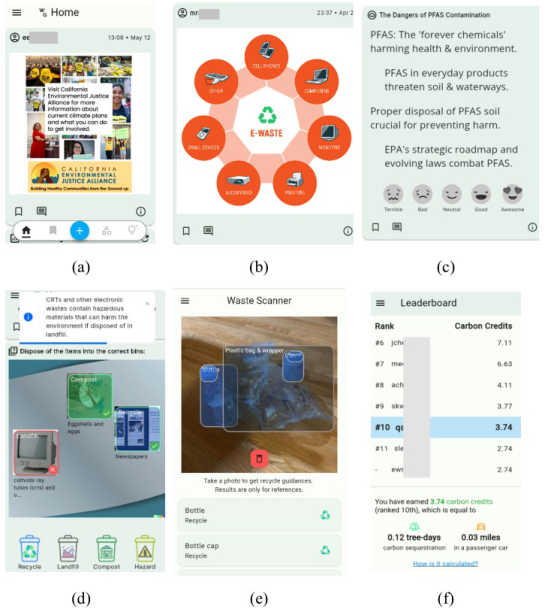
Waste Genie Application. Figure 1 demonstrates the key features in WG. The homepage presents users with an infinite linear scroll feed (Figure 1a), offering two primary types of educational content: static posts (Figure 1b and 1c) and interactive quizzes (Figure 1d). Static posts are informative articles on waste management and sustainability created by both users and AI. The AI agent creates the educational content by drawing from a variety of reputable sources, including government websites and specialized environmental blogs. This curated information is then processed through a prompt, which directs the GPT model to convert the material into concise, educational, and captivating snippets that are easily digestible for users. The interactive quizzes (Figure 1d) challenge users’ waste sorting knowledge and skills. During the process of completing a quiz, the GPT-powered AI agent will also provide adaptive feedback from the user’s action.
Figure 1: The Waste Genie application. (a) The homepage; (b) A user-created post; (c) An AI synthesized post; (d) An AI-generated quiz, the AI-guidance will be given when a user makes a mistake; (e) The waste scanner; (f) The leaderboard of virtual carbon credits.
56 Sun and Hsiao
The platform also features a waste scanner (Figure 1e), an integrated object detection tool that assists users in identifying and correctly categorizing waste items. To gamify the learning experience, WG also implements a virtual carbon credits system that quantifies the environmental impact of users’ waste sorting decisions. Upon the completion of each quiz, users are awarded virtual “carbon credits” based on EPA’s data on greenhouse gas reduction benefits from proper waste management (National Overview: Facts and Figures on Materials, Wastes and Recycling, 2022). These credits provide a tangible representation of the positive environmental impact of correct waste sorting. Users can track their contributions and rankings on the leaderboard (Figure 1f).
User Study Design. To evaluate the effectiveness and usability of Waste Genie, we conducted a user study with 21 college students enrolled in a web usability class at the authors’ institution. The study lasted for two weeks, during which participants were instructed to regularly use and explore the Waste Genie app, engage with its various features, and create at least one static post and one interactive quiz.
Data collection for the study was comprehensive, beginning with a pre- study survey to assess participants’ initial knowledge of waste sorting, composting, recycling, and related topics. Following the two-week usage period, a post-study survey evaluated changes in sustainability awareness and knowledge. Participants also completed a practical waste sorting test, classifying 15 common objects before and after using WG, to measure improvement in their sorting skills. To gather feedback on app usability and user experience, participants completed a System Usability Scale (SUS) questionnaire. Throughout the study, user activity logs were collected to capture participant interactions within the app.
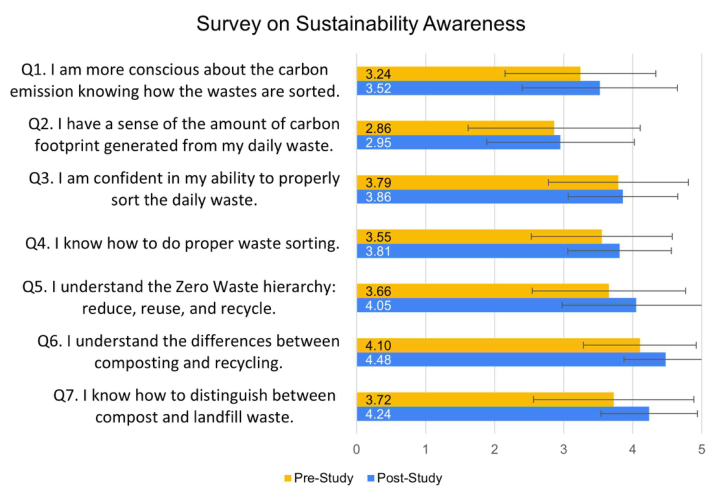
EVALUATION Impact on Sustainability Awareness. Analysis of pre-study and post- study sustainability awareness questionnaires reveals Waste Genie’s positive influence on users’ environmental knowledge (Figure 2). Particularly noteworthy were the improvements in participants’ comprehension of composting versus recycling distinctions (Q6) and their grasp of the Zero Waste hierarchy concept (Q5). Users also reported heightened confidence in their daily waste sorting abilities, a claim proved by the improved performance in waste classification tests, where average accuracy rose from 0.79 pre-study to 0.83 post-study. Despite these encouraging results, the consistently low scores on questions related to the carbon footprint of daily waste indicate an area requiring further educational emphasis in future iterations of the platform.
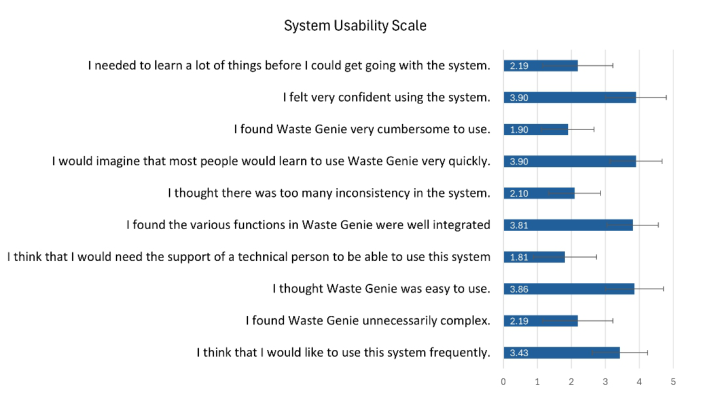
Usability and User Experience of Waste Genie. To evaluate Waste Genie’s user-friendliness, we employed the System Usability Scale (SUS), yielding an overall score of 71.8, indicating good to satisfactory usability. The results are shown in Figure 3. Participants generally found the platform intuitive, with mean scores of 3.86 (SD = 0.85) for ease of use and 3.90 (SD = 0.77) for quick learnability. Users expressed high confidence in navigating the system
Supporting Informal Sustainability Learning With AI-Assisted Educational Technology 57
Figure 2: Users’ sustainability awareness scores before and after the study.Figure 3: Results from the system usability survey.
(M = 3.90, SD = 0.89) and appreciated the seamless integration of its various functions (M = 3.81, SD = 0.75).
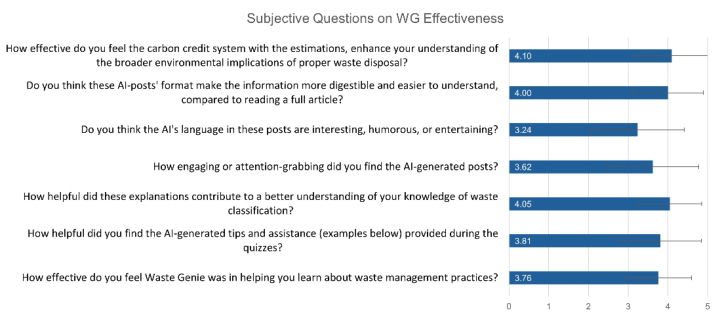
Beyond usability, we assessed users’ learning experiences and the effectiveness of specific Waste Genie features (Figure 4). Participants reported that the platform effectively facilitated their waste management education (M = 3.76, SD = 0.83). The AI-generated quiz assistance received positive feedback (M = 3.81, SD = 1.03), with users noting its contribution to
58 Sun and Hsiao
enhancing their waste classification knowledge (M = 4.04, SD = 0.80). While AI-generated posts were deemed engaging (M = 3.61, SD = 1.16), the language used wasn’t consistently perceived as entertaining (M = 3.23, SD = 1.18). However, users appreciated the concise format of these posts, finding the information more digestible than traditional long-form articles (M = 4.00, SD = 0.89). Notably, the carbon credit system and its associated metrics (tree-days and miles-driven) were highly effective in broadening users’ understanding of waste disposal’s environmental impact (M = 4.09, SD = 0.94).
Figure 4: Other subjective questions asked on the effectiveness of Waste Genie.
CONCLUSIONS
This paper demonstrates the effectiveness of Waste Genie (WG), an AI-enhanced educational platform, in improving users’ understanding and practices related to sustainable waste management. The integration of large language models, interactive quizzes, and gamification elements proved successful in engaging users and enhancing their learning experience. Users showed improvements in comprehension of waste management concepts and understanding the Zero Waste hierarchy after the study. The system usability survey also indicates that users found WG intuitive and easy to navigate.
Overall, this research validates the potential of integrating AI technologies into educational platforms to address complex environmental challenges. Future work should focus on developing more dynamic conversational interactions, personalizing learning experiences, and expanding the platform’s scope to cover broader sustainability topics. Waste Genie represents a promising step towards leveraging technology to foster environmental stewardship and promote sustainable practices in waste management.
REFERENCES
Assor, A., Prouzeau, A., Dragicevic, P., & Hachet, M. (2023). Exploring Augmented Reality Waste Data Representations for Eco Feedback. Extended Abstracts of the 2023 CHI Conference on Human Factors in Computing Systems, (pp. 1–4).
Supporting Informal Sustainability Learning With AI-Assisted Educational Technology 59
Buragohain, A., Mali, B., Saha, S., & Singh, P. K. (2022). A deep transfer learning based approach to detect COVID-19 waste. Internet Technology Letters, 5. Casado-Mansilla, D., Foster, D., Lawson, S., Garaizar, P., & López-de-Ipiña, D.
(2015). ‘Close the Loop’ An iBeacon App to Foster Recycling Through Just- in-Time Feedback. Proceedings of the 33rd Annual ACM Conference Extended Abstracts on Human Factors in Computing Systems, (pp. 1495–1500). Jespersen, K. N., Odgaard, R., Julsgaard, K., Madsbøll, J. L., Lundbak, M.
H., Niebuhr, M.,... Löchtefeld, M. (2023). FoodFighters-Improving Memory Retention of Food Items through a Mobile Serious Game. Extended Abstracts of the 2023 CHI Conference on Human Factors in Computing Systems, (pp. 1–7). Jiménez Barriga, N., & Hernández Villalba, B. (2023). ROBOTE: Interactive Educational Tool to Teach Basic Education Children to Classify and Collect Waste in their School Environment. Extended Abstracts of the 2023 CHI Conference on Human Factors in Computing Systems, (pp. 1–8). Majchrowska, S., Mikołajczyk, A., Ferlin, M., Klawikowska, Z., Plantykow, M.
A., Kwasigroch, A., & Majek, K. (2022). Deep learning-based waste detection in natural and urban environments. Waste Management, 138, 274–284. National Overview: Facts and Figures on Materials, Wastes and Recycling. (2022). National Overview: Facts and Figures on Materials, Wastes and Recycling. Environmental Protection Agency. Retrieved from https://www.epa.gov/facts-and-figures-about-materials-waste-and-recycling/ national-overview-facts-and-figures-materials Padalkar, A. S. (2021). An Object Detection and Scaling Model for Plastic Waste Sorting (Doctoral dissertation). Ph. D. dissertation, Dublin, National College of Ireland. Robelia, B., Greenhow, C., & Burton, L. (2011). Adopting environmentally
responsible behaviors: How learning within a social networking application motivated students to act for the environment. Environmental Education Research, 17, 553–575. Sun, Q., Hsiao, I.-H., & Chien, S.-Y. (2023). Immersive Educational Recycling Assistant (ERA): Learning Waste Sorting in Augmented Reality. Conference Proceedings of the 9th International Conference of the Immersive Learning Research Network. Sun, Q., Hsiao, I.-H., & Chien, S.-Y. (2023). Immersive Educational Technology
for Waste Management Learning: A Study of Waste Detection and Feedback Delivery in Augmented Reality. International Conference on Human-Computer Interaction, (pp. 509–515). Thieme, A., Comber, R., Miebach, J., Weeden, J., Kraemer, N., Lawson, S., & Olivier, P. (2012). “ We’ve bin watching you”designing for reflection and social persuasion to promote sustainable lifestyles. Proceedings of the SIGCHI Conference on Human Factors in Computing Systems, (pp. 2337–2346). Wahyutama, A. B., & Hwang, M. (2022, April). YOLO-based object detection
for separate collection of recyclables and capacity monitoring of trash bins. Electronics (Basel), 11, 1323. Wang, K., Tekler, Z. D., Cheah, L., Herremans, D., & Blessing, L. (2021). Evaluating the effectiveness of an augmented reality game promoting environmental action. Sustainability, 13, 13912. Yalvaç, F., Lim, V., Hu, J., Funk, M., & Rauterberg, M. (2014). Social recipe
recommendation to reduce food waste. In CHI’14 Extended Abstracts on Human Factors in Computing Systems (pp. 2431–2436).
LISTED IN THE AHFE DIGITAL BOOKSTORE CATALOGUE
Explore the complete digital volume
Human Factors in Design, Engineering, and Computing
Read this individual research paper free through the original publisher, or explore the full digital proceedings book.
ISBN 978-1-964867-35-9
Explore this ISBN in the AHFE Bookstore ↗Listed in the July 2026 bookstore catalogue; search by ISBN to confirm current availability · Digital book purchase optional