Maram Alzaidi, Maraim Alnfia, Khalda Ali (2022). Factors Influencing Citizens’ Adoption of Smart Government Services: The Case of Saudi Arabia. In: Human Interaction & Emerging Technologies (IHIET-AI 2022): Artificial Intelligence & Future Applications. AHFE Open Access, vol. 23. https://doi.org/10.54941/ahfe100922
This paper aims to investigate the main factors impacting the adoption of smart government services in developing countries, particularly Saudi Arabia. The research model of this study was developed grounded on the Diffusion of Innovation (DOI) theory and validated empirically using data obtained from an online questionnaire-based survey of 408 Saudi citizens. The results of this study revealed that the DOI constructs: relative advantage, trialability, observability and trialability significantly and positively influence citizens’ behavioral intentions to adopt smart government services. On the other hand, the results of the current study indicate that both complexity and privacy concerns negatively impact the behavioral intentions. This research contributes to the literature as one of the first studies in the Arab world to investigate the adoption smart government services. The paper brings the attention of researchers and practitioners to such a new area of research.
The internet and mobile technology and other Information and Communications Technologies (ICT) have revolutionized every aspect of our lives. ICTs refers to a set of artefacts, elements, techniques used for capturing, storage, processing, managing and dissemination of information. The rapid technological development and the explosive growth use of ICTs by business organizations, governments, communities and civil societies have become the centre of attention in past few decades. The extant literature shows that there is a prevalent belief about the significant role of ICTs in the socio-economic development of countries around the globe, especially those in the developing world.
Smart government is an emerging and multidisciplinary research area. The concept of smart government is still under construction and has received very much intention in the recent few years from both practitioners and academics who work in different fields. Smart government refers to the use of advanced technologies such as the Artificial Intelligence (AI), Internet of Things (IoT), Blockchain, Social Media, Big data, Virtual Reality (VR), Augment Reality (AR) and Open Government Data, by governmental organizations to delver smart, personalized and interactive public services to citizens, private organizations and other public agencies (Chatfield,2019). The smart government is seen as a foundation for transforming the ways in which public services are provided to a government’s stakeholders. The use of smart services is expected to improve accountability, transparency, public governance, decision-making and quality of life. Although smart government initiatives have the potential to offer numerous values to public entities, for various reasons, smart government is still not widely adopted (Almuraqab, 2017). Indeed, the extant literature shows that most smart government initiatives around the world are still in the planning, pilot-testing, or early stages of progress (Schedler, 2017). In addition, regardless of the growing interest in smart government, efforts are still needed to address the question of how to rise the adoption of smart government services. Consequently, it is highly important to understand why and how public adopt and use emerging innovative technologies (Al-Hujran, 2015). Prior research showed that users’ acceptance of a new technology is an imperative determinant of success of this technology (Almuraqab, 2017). The intended benefits and the anticipated values of newly implemented technological innovations by public organizations will not be recognized till these technologies are well accepted and widely used by the public (Talukder, 2018). Hence, the main aim of this research is to investigate the key factors that influence smart government adoption, and therefore support the successful operation of this innovation.
1. BACKGROUND
The majority of countries has leveraged the e-government initiatives as they wish to foster new associations between the states and their citizens. This association aims at providing public value, facilitating successful constituent association management, deliverance high quality public services, and supporting the social and economic development of the country (Lai, 2010). In the fourth industrial revolution era, many public organizations around the world, including those located in Saudi Arabia, started to use advanced technologies such as IoT, Big Data, Open Data, AI, Social Media, VR and robotics. The extensive use of aforementioned emerging technologies together with various innovative strategies represent the latest stages of e-government development and have been referred to as smart government (Mellouli, 2014). The main goal smart government is towards changing the decision-making culture, enabling organization to make data-driven decisions, facilitating public communication and collaboration and providing customer-centered innovative public services. Indeed, the extant literature showed that the use of ICTs has the potential to positively
Human Interaction & Emerging Technologies (IHIET-AI 2022) Artificial Intelligence & Future Applications https://openaccess.cms-conferences.org/#/publications/book/978-1-7923-8989-4 affect various administrative, economic and societal dimensions of the public sector such as Gross Domestic Product (GDP) growth, transparency and accountability in public administration, public governance, education, healthcare, productivity, poverty reduction and quality of life (Mbuyisa, 2017). As an initial effort toward smart government, wireless communication and mobile services have been adopted by government of Saudi Arabia for effective delivery of services. These services are currently applied to the fields of weather update, traffic update, emergency assistance, tracking of lost vehicles, notification of taxes and bills etc. (Alotaibi, 2016).
Smart government is an emerging and multidisciplinary research area. The concept of smart government is still under construction and has received very much intention in the recent few years from both practitioners and academics who work in different fields including: public administration, political science and computing. However, most of the current research on smart government is conducted in developed countries context. Very little is known about this area of research in developing countries such as Saudi Arabia. In addition, despite the worldwide increasing interest in smart government services, the question of how to promote the public acceptance and adoption of these services has not been clearly answered. For various reasons, most of the smart government initiatives around the world are still in the planning or pilot testing stages (Almuraqab, 2017). There has been limited research on understanding the public decisions to adopt smart government services (Alketbi, 2018). In his study, Alketbi (Alketbi, 2018) explored the key factors that determine the successful implementation of smart government infinitives in the United Arab Emirates, particularly Dubai government. Results of this research revealed that the main success factors for smart government implementation include: top management support, public awareness, user-friendly interfaces, trust, security, structural support, employee’s involvement, training, availability of resources and change management. Schedler et al. (Schedler, 2017) also investigated the key challenges of smart government development by public organizations in Switzerland. The key findings of this research revealed that the major barriers of smart government development in Switzerland are: insufficient technical infrastructure, legal issues, lack of financial support, inadequate knowledge and skills, low level of clarity about the costs and benefits associated with smart government, the absence of a clear strategy for smart government in addition to the low readiness for technological innovations. Kshetri et al. (Kshetri, 2014) conducted a case study analysis of the new Songdo city in South Korea's. The main objective of their research was to investigate the role of the core components of formal and informal institutions in shaping the development of smart city of Songdo and its adoption and acceptance. Finding of this study showed that regulative institutions such as those in South Korea effects the adoption and acceptance of smart city. The study provided some examples on how the regulation could hinder the adoption of smart cities. One of these examples is the existing national Medical Law in South Korea that does not allow telemedicine. This, in turn, limits the adoption and diffusion of ubiquitous health initiatives in this country. Other factors that found to negatively or positively affect end-user’s adoption of smart city in South Korea were culture and privacy concerns. Indeed, privacy and security concerns have been frequently identified in the literature as main challenges facing smart cities(Alghanim, 2017). Smart government and smart city offer high level of interconnectivity and data transfer which pose major threats to the privacy of citizen. Although combining data from multiple parties, applications, and devices could be beneficial to improve service quality, but on the other hand, it could increase the risk of privacy violations (Eckhoff, 2017). Due to the lack of research on smart government adoption, it is highly important to understand the main factors influencing citizens’ decisions to adopt and use emerging innovative technologies (Talukder, 2018). Thus, the main aim of this research is to develop and empirically validate a theoretical framework that will identify the significant predictors of citizen’s adoption of smart government services in Saudi Arabia.
THEORETICAL FRAMEWORK AND RESEARCH HYPOTHESES Grounded on the diffusion of innovation (DOI) of Rogers (Rogers, 1995), the major aim of this research is investigating the main factors affecting the adoption of smart government in Saudi Arabia and develop an effective model to address the key challenges that hindered the up-take of this innovation. The DOI theory has been widely adopted, utilized and validated to investigate the diffusion of new IS/IT innovations and the adoption of complex and networked Information System/Information technology (IS/IT) solutions by individuals and organizations (Min, 2019). An innovation refers to any new idea that is perceived to be new (Rogers, 1995). Diffusion is defined as “the process by which an innovation is communicated through certain channels over time among the members of a social society” (Rogers, 1995). DOI provides several attributes of an innovation that affect the rate of its diffusion by individuals. These are: relative advantage, complexity, compatibility, trialability and observability. Relative advantage is defined as “the degree to which an innovation is seen as being superior to its predecessor”. Complexity refers to “the degree to which an innovation is seen by the potential adopter as being relatively difficult to use and understand”. Compatibility refers to “the degree to which an innovation is seen to be compatible with existing values, beliefs, experiences and needs of adopters”. Trialability refers to “the degree to which an idea can be experimented with on a limited basis”. Finally, observability is defined as “the degree to which the results of an innovation are visible” (Rogers, 1995). Given that smart government produces privacy concerns among the people (Eckhoff, 2017), this study integrates this factor to the DOI theory to form a comprehensive model of factors that impact citizens’ adoption of smart government services in Saudi Arabia. The conceptual model of this study (Figure 1) is proposed to explore factors that effect citizens’ adoption of smart government services. Based on this model, this paper proposes the following hypotheses:
H1: Relative advantage is positively associated with citizens’ intentions to use smart government services.
H2: Compatibility is positively associated with citizens’ intentions to use smart government services.
H3: Complexity is negatively associated with citizens’ intentions to use smart government services.
H4: Trialability is positively associated with citizens’ intentions to use smart government services.
H5: Observability is positively associated with citizens’ intentions to use smart government services.
H6: Privacy concerns is negatively associated with citizens’ intentions to use smart government services.
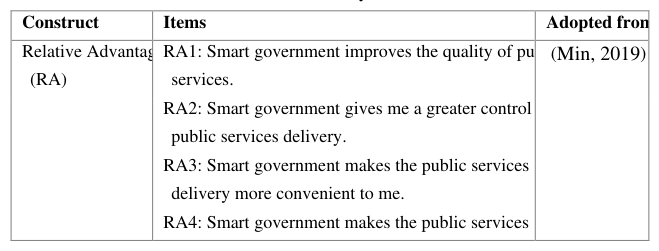
Measurements Development Our research model includes seven constructs. For relative advantage construct, the measurement items were adopted from various studies (He, 2006). The items of compatibility construct were adopted from (Wu, 2005). The measurements of trialability were adopted form (Nor, 2015). The measurement scales of observability were adopted from (He, 2006). For complexity construct, items were adopted from (Min, 2019). Privacy concerns scale items were adopted from (Mutimukwe, 2020). Finally, the measurement items of citizens’ intention to use smart government were adopted from (Al-Hujran, 2015). Five Likert scale ranging from “strongly agree” to “strongly disagree” were utilized to measure the items. Table 1 provides the final set of measurement items and their corresponding sources.
Table 1. The study constructs and measurements Construct Items Adopted from
Human Interaction & Emerging Technologies (IHIET-AI 2022) Artificial Intelligence & Future Applications https://openaccess.cms-conferences.org/#/publications/book/978-1-7923-8989-4 delivery relatively cheaper than traditional method
Human Interaction & Emerging Technologies (IHIET-AI 2022) Artificial Intelligence & Future Applications https://openaccess.cms-conferences.org/#/publications/book/978-1-7923-8989-4 services to be used by others
Data Collection The study is following quantitative approach that utilized the survey questionnaire as the main instrument for data collection. The questionnaire was then distributed randomly to participant which take a part voluntary. Simple random sampling was used to gather data from citizens living at different locations in Saudi Arabia. Structural Equation Model (SEM) via SmartPLS 3.0 is employed in this paper serving as a statistical analysis approach to determine the hypothesis. In this research, 1000 questionnaires were distributed different cities across Saudi Arabia. Of these, 517 questionnaires were returned, representing around 76% of the distributed questionnaires, and 489 responses (n = 489) were usable and valid for data analysis. Additionally, the number of returned and acceptable questionnaire (408) was more than 200, which was identified by Hair et al. (Hair, (2019) as the minimum sample size accepted for structural equation modelling.
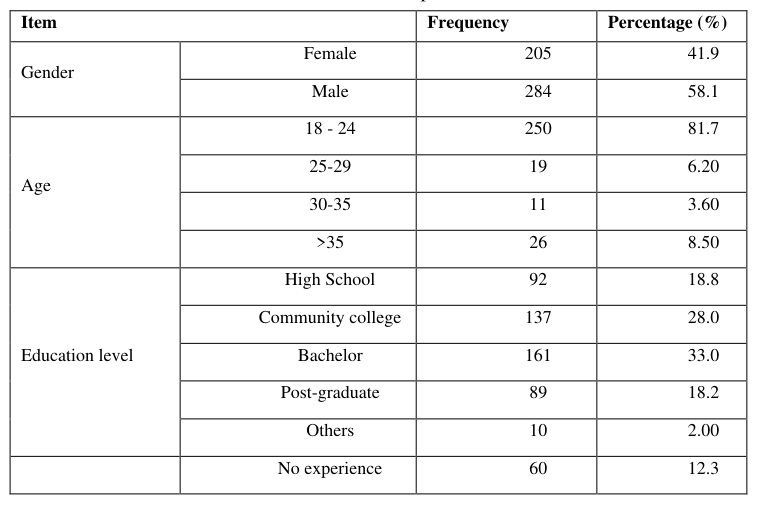
Sample Profile The sample profile demonstrated that 58.1 % of the respondent were male and 41.9% were female. The largest groups of respondents were aged between 18-24 years (81.7%) and the majority of respondents were completed a bachelors’ degree or a community college degree (33% and 28%, respectively). The majority of participants are using smart government for ≤ 2 years (64.6%), followed by 23.1% who are using smart government for more than 2 years. 12.3% of respondents have no prior experience of using smart government services. Additionally, 74% of respondents have home internet and 71% prefer to use mobile phones for using smart government services.
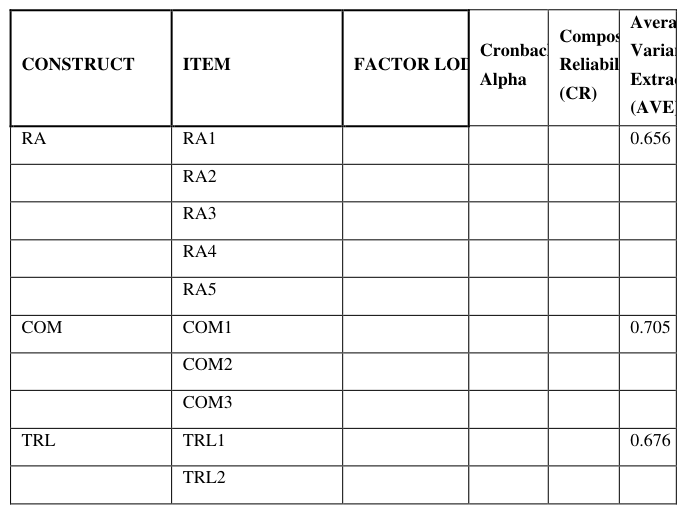
To assess the measurement model's reliability and validity, we analyzed the following elements: factor loading, internal consistency reliability, convergent validity, and discriminant validity. Factor loading concerns item reliability for each construct, where the factor loading for an item should be above 0.70 (Hair, 2019). For internal consistency reliability, we assessed it by composite reliability (CR) and Cronbach’s alpha (Cronbach's α). The required value of composite reliability values to range between 0.70 (satisfactory) and 0.90 (good), while Cronbach's α value suggested to be above 0.70. Convergent validity is assessed by the average variance extracted (AVE) of the items, which is required to be equal to or higher than 0.50(Hair, 2019).
As reported in Error! Reference source not found., the factor loadings of all items are above the recommended value, thus confirming the measurement items' adequacy. The factors loadings range from 0.730 to 0.958, and the most items loading are within 0.80 and 0.90 range. The values of composite reliability and Cronbach’s alpha are within the recommended range, which confirms the internal consistency. Composite reliability (CR) is greater than 0.70 which indicating that the scales have internal consistency. As seen in Error! Reference source not found., constructs’ CR values are higher the prescribed thresholds. The same table also shows that Cronbach's α values are above recommended value of 0.70. All Cronbach's α values are within0.80 and 0.90 range. For convergent validity, the average variance extracted (AVE) of the items required to be equal or higher 0.50. As reported in Table 3, AVE values for all items on each construct are very satisfy the recommended values. The AVE values range between 0.656 and 0.867.
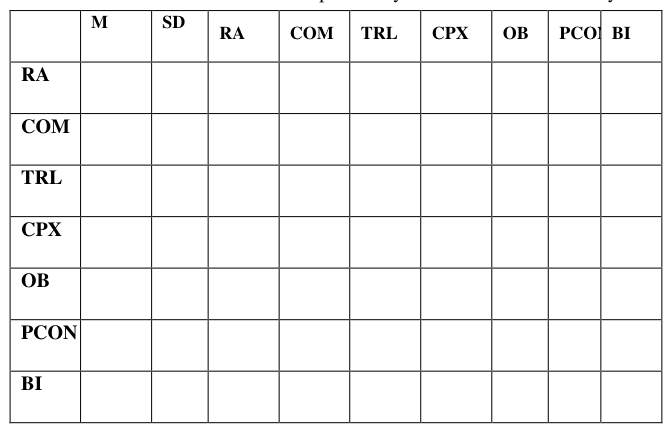
For discernment validity, the square root of AVEs should be greater than the correlation among other constructs (Chin, 1998). As depicted in Table 2, the square root of AVE (in bold) is higher than the correlation between constructs. The measurement model results presented in this section indicate satisfactory levels of reliability and validity measurements (Bagozzi, 1988), so, we can move to the next step and testing the structural model.
Table 2. Descriptive analysis and discriminant validity M SD RA COM TRL CPX OB PCONBI
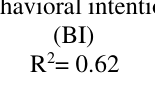
Measurement Model The structural model aimed to explain the theoretical relationship between the constructs. The results of the structural model are shown in Figure 2. The values of squared multiple correlations (R2) for the endogenous variables, standardized estimates, and the model fit indices, are presented. The obtained fit indices shown in figure 2 are within the recommended values, which reveal that the model has a good fit, since R2 values obtained are higher than 0.50(Hair, 2019).
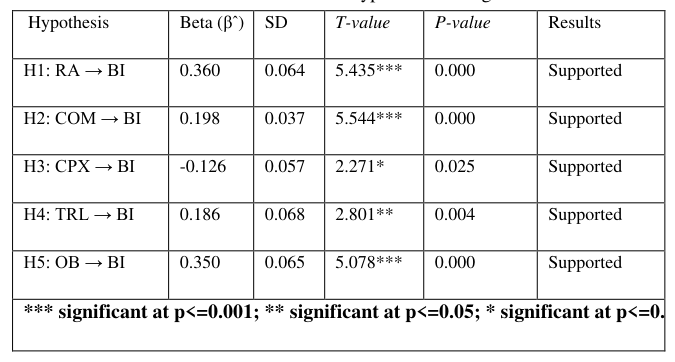
The maximum likelihood technique was used to assess the path coefficients of the relationships between constructs. Results reveal that the six hypotheses were supported (H1: RA → BI, H2: COM → BI, H3: CPX→ BI, H4: TRL → BI, H5: OB→ BI, and H6: PCON → BI). As shown in Figure 2 and Table 5, RA has a significant positive iimpact on BI (βˆ= - 0.360; p<0.000), which supported H1. Similarly, the results obtained refer to a significant positive influence of COM on BI (βˆ= 0.198; p<0.000), providing support for H2. The findings obtained refer to a significant negative influence of CPX on BI (βˆ= - 0.126; p<0.05), providing support for H3. The path analysis reveals that TRL (βˆ=0.186; p<0.01) and OB (βˆ=0.350; p<0.000) have a direct significant positive impact on BI. In view of this, the hypotheses H4 and H5 are statistically supported. Finally, the findings showed that PCON has a direct significant negative impact on BI (βˆ= - 0.302; p<0.000), providing support for H6.
Previous studies indicated that smart government is still a new area of research (Alajmi, 2020) . The diffusion of smart government is an interesting and an important issue in the literature. However, despite of the importance of this topic for many developing countries, only few studies currently exist about the adoption of smart government services in the Arab world (Alajmi, 2020). Theoretically, the current study contributes to literature and fills the knowledge gap in literature by proposing and examining a unified model of citizen’s adoption of smart government services in the context of developing countries. Finding of this paper showed important aspects and issues that are critical to be carefully understood and considered when providing smart government services. From the managerial side and based on the findings, the current paper provides practical implications for the practitioner with a number of factors that motivate citizens to use smart government services. Hence, decision makers and government officials could direct their strategic plans to increase public intentions to use smart government services. An interpterion of the findings based on the empirical outcomes is presented as follows.
Finding of this research supported the validity of the developed research model in predicting citizens’ intentions to use smart government in Saudi Arabi. As shown in Figure 2 and Table 5, all the research hypotheses were significantly supported in the context of smart government adoption. In addition, the research model of this study substantially explains the variance of citizens’ behavioral intentions to use smart government services (R2 = 62%). As hypnotized in this study, relative advantage (i.e. the expected benefits gained by using smart government services) has a significant positive impact on citizens’ intentions to use smart government services. Relative advantage was the most significant variable of our findings. The significance of this relationship is consistent with previous research (Amagoh, 2016). This result suggests that citizens will develop positive behavioral intentions to use smart government services when they believe that these services delver better benefits to them compared to offline pubic services.
The results of this research also conformed the positive relationship between compatibility and citizens’ intentions to use smart government services. This means that the higher the compatibility of smart governments systems the higher the behavioral intention to use. Increased citizens’ intentions will be attained if smart government services are consistent with the way citizens interact with others. This finding implies that public organizations need to design their smart services in a way that is congruent with other ways citizens have interacted with the government. This result is aligned with prior findings (Carter, 2005).
Moreover, the empirical findings of this research provided support evident that complexity is a significant negative predictor of citizens’ intentions to use smart government services. Smart government is associated with higher levels of complexity due to the use of breakthrough technologies such as AI, IoT, Machine learning among others. The higher levels of complexity of these technologies are associated with decreased intentions to use smart government services. Therefore, it’s really important for public agencies to provide easy to use smart services. Smart services have to be free of complexity, clear and understandable, easy to navigate, and designed carefully based on citizens’ needs. This finding agrees with the outcomes of previous e- government literature (Al-Hujran, 2015).
In this study, trialability had a significant positive affect on citizens’ intentions to use smart government services, which is in accordance with the findings of prior IT/IS adoption studies (Lee, 2011). To encourage the adoption of new technological innovations such as the smart government,
Human Interaction & Emerging Technologies (IHIET-AI 2022) Artificial Intelligence & Future Applications https://openaccess.cms-conferences.org/#/publications/book/978-1-7923-8989-4 trialability option is a critical factor. The result implies that public organizations should offer trail versions of smart services before the actual implementation. In this case citizens will be able to test these services in advance to minimize their concerns of the unknown. Providing a trail period will enable citizens to evaluate smart services and, thus reduce the uncertainty about these services. Eventually, this practice will create positive citizens’ intentions to use smart government services.
Furthermore, the obtained results supported the significant and positive influence of observability construct on citizens’ intentions to use smart government services. this result is consistent with previous research that documented significant relationship between observability and intentions to use (Folorunso). Observability is defined as “the degree to which the results of an innovation are visible to others” (Rogers, 1995). Recognizing the importance of smart government services and peer usage, as measured by observability, will develop positive behavioral intentions. In other words, citizens are more likely to adopt smart government services if the advantages and benefits of these services are apparent to them. Therefore, public organizations are required to promote smart government as a valuable system that will deliver several public values to citizens.
Finally, this paper explored the impact of privacy concerns on citizens’ intentions to use smart government services, which adds an important construct to the DOI theory. Prior literature indicated that smart government services are vulnerable to increased data privacy threats (Chatfield, 2019). Smart government offers high level of interconnectivity and data transfer which pose major threats to the privacy of citizen (Kankanhalli, 2019). Finding of this study supported previous studies and found a significant and negative affect of privacy concerns on citizens’ intentions to use smart government services. this result implies that the Saudi government is required to develop privacy policy and related regulations to protect citizens’ privacy.
Regardless of noteworthy findings, there are several limitations of this research that need to be addressed in future research. First of all, only a quantitative approach was employed to collect the data from universities in Saudi Arabia, leaving no scope for any qualitative research. The second limitation of this study is the sample size used that can be enlarged to attain more generalizable findings. The third limitation is that the data was collected only from one country. The results of this research cannot be generalized until other cross-cultural studies are conducted in deferent parts of the world.
REFERENCES
Amagoh, F. (2016). Determinants of e-government diffusion in Nigeria: An examination of theoretical models. Information Development, 32(4), 1137-1154.
Alajmi, M., Mohammadian, M., & Talukder, M. (2020). Smart Government Systems Adoption: The Case of Saudi Arabia. International Review of Business Research Papers, 16(1).
Alghanim, A. A., Rahman, S. M. M., & Hossain, M. A. (2017, December). Privacy analysis of smart city healthcare services. In 2017 IEEE International Symposium on Multimedia (ISM) (pp. 394-398). IEEE.
Alketbi, H. (2018). An evaluation of e-government effectiveness in Dubai smart government departments (Doctoral dissertation, Southampton Solent University).
Bagozzi, R. P., & Yi, Y. (1988). On the evaluation of structural equation models. Journal of the academy of marketing science, 16(1), 74-94.
Braun, T., Fung, B. C., Iqbal, F., & Shah, B. (2018). Security and privacy challenges in smart cities. Sustainable cities and society, 39, 499-507.
Carter, L., & Bélanger, F. (2005a). The utilization of e-government services: citizen trust, innovation and acceptance factors. Information systems journal, 15(1), 5-25.
Carter, L., & Belanger, F. (2005). Diffusion of innovation & citizen adoption of e-government services. In Workshop, ICEC 03, Pittsburgh, USA.
Chin, W. W. (1998). The partial least squares approach to structural equation modeling.
Modern Methods for Business Research, 295(2), 295–336.
Duan, Y., He, Q., Feng, W., Li, D., & Fu, Z. (2010). A study on e-learning take-up intention from an innovation adoption perspective: A case in China. Computers & Education, 55(1), 237-246.
Eckhoff, D., & Wagner, I. (2017). Privacy in the smart city—applications, technologies, challenges, and solutions. IEEE Communications Surveys & Tutorials, 20(1), 489-516.
Folorunso, O., Vincent, R. O., Adekoya, A. F., & Ogunde, A. O. (2010). Diffusion of innovation in social networking sites among university students. International journal of computer science and security, 4(3), 361-372.
Fornell, C., & Larcker, D. F. (1981). Evaluating structural equation models with unobservable variables and measurement error. Journal of Marketing Research, 39–50.
Frisk, J. E., & Bannister, F. (2017). Improving the use of analytics and big data by changing the decision-making culture. Management Decision. 55 (10), 2074-2088.
Fu, Z., Yue, J., Li, D., Zhang, X., Zhang, L., & Gao, Y. (2007). Evaluation of learner adoption intention of e-learning in China: A methodology based on perceived innovative attributes. New Zealand Journal of Agricultural Research, 50(5), 609-615.
Gefen, D., Straub, D., & Boudreau, M. C. (2000). Structural equation modeling and regression: Guidelines for research practice. Communications of the association for information systems, 4(1), 7.
Hair, J. F., Risher, J. J., Sarstedt, M., & Ringle, C. M. (2019). When to use and how to report the results of PLS-SEM. European business review. 31 (1), 2-24.
Hair, J. F., Sarstedt, M., Hopkins, L., & Kuppelwieser, V. G. (2014). Partial least squares structural equation modeling (PLS-SEM). European Business Review.
He, Q., Duan, Y., Fu, Z., & Li, D. (2006). An innovation adoption study of online e-payment in Chinese companies. Journal of Electronic Commerce in Organizations (JECO), 4(1), 48- 69.
Ho, C. H., & Wu, W. (2011). Role of Innovativeness of Consumer in Relationship between Perceived Attributes of New Products and Intention to Adopt. International journal of electronic business management, 9(3).
Hujran, O., Al-Debei, M. M., & Alhawsawi, R. (2021). Potential barriers to the use of social media in the public sector: lessons from Saudi Arabia. International Journal of Business Information Systems, 36(1), 119-143.
Hujran, O., Abu-Shanab, E., & Aljaafreh, A. (2020). Predictors for the adoption of edemocracy: an empirical evaluation based on a citizen-centric approach. Transforming Government: People, Process and Policy. 14(3), 523-544.
Iskandar, M., Hartoyo, H., & Hermadi, I. (2020). Analysis of Factors Affecting Behavioral Intention and Use of Behavioral of Mobile Banking Using Unified Theory of Acceptance and Use of Technology 2 Model Approach. International Review of Management and Marketing, 10(2), 41.
Kshetri, N., Alcantara, L. L., & Park, Y. (2014). Development of a smart city and its adoption and acceptance: the case of new songdo. Communications & Strategies, (96), 113.
Lai, C. S. K., & Pires, G. (2010). Testing of a model evaluating e-government portal acceptance and satisfaction. Electronic Journal of Information Systems Evaluation, 13(1), 35.
Lee, Y. H., Hsieh, Y. C., & Hsu, C. N. (2011). Adding innovation diffusion theory to the technology acceptance model: Supporting employees' intentions to use e-learning systems. Journal of Educational Technology & Society, 14(4), 124-137.
Mbuyisa, B., & Leonard, A. (2017). The role of ICT use in SMEs towards poverty reduction: A systematic literature review. Journal of International Development, 29(2), 159-197.
Mellouli, S., Luna-Reyes, L. F., & Zhang, J. (2014). Smart government, citizen participation and open data. Information Polity, 19(1, 2), 1-4.
Min, S., So, K. K. F., & Jeong, M. (2019). Consumer adoption of the Uber mobile application: Insights from diffusion of innovation theory and technology acceptance model. Journal of Travel & Tourism Marketing, 36(7), 770-783.
Mutimukwe, C., Kolkowska, E., & Grönlund, Å. (2020). Information privacy in e-service: Effect of organizational privacy assurances on individual privacy concerns, perceptions, trust and self-disclosure behavior. Government Information Quarterly, 37(1), 101413.
Nor, K. M., & Pearson, J. M. (2015). The influence of trust on internet banking acceptance. The Journal of Internet Banking and Commerce, 12(2), 1-10.
Oliveira, T., & Martins, M. F. (2011). Literature review of information technology adoption models at firm level. Electronic Journal of Information Systems Evaluation, 14(1), 110.
Palvia, P., Baqir, N., & Nemati, H. (2018). ICT for socio-economic development: A citizens’ perspective. Information & Management, 55(2), 160-176.
Rogers, M. (1995). Diffusion of innovations, New York, Free press Schedler, K., Guenduez, A. A., & Frischknecht, R. (2017). How smart can government be?
Discussing the barriers of smart government adoption. Retrieved.
Schedler, K., Guenduez, A. A., & Frischknecht, R. (2019). How smart can government be?
Exploring barriers to the adoption of smart government. Information Polity, 24(1), 3– 20.
Shareef, M. A., Kumar, V., Kumar, U., & Dwivedi, Y. K. (2011). e-Government Adoption Model (GAM): Differing service maturity levels. Government information quarterly, 28(1), 17-35.
Talukder, M. (2018). Causal paths to acceptance of technological innovations by individual employees. Business Process Management Journal. doi: http://dx.doi.org/10.1108/BPMJ-06-2016-0123
Van Zoonen, L. (2016). Privacy concerns in smart cities. Government Information Quarterly, 33(3), 472-480.
Vu, K., & Hartley, K. (2018). Promoting smart cities in developing countries: Policy insights from Vietnam. Telecommunications Policy, 42(10), 845–859.
Wang, E. S. T. (2014). Perceived control and gender difference on the relationship between trialability and intent to play new online games. Computers in Human Behavior, 30, 315-320.
Wu, J. H., & Wang, S. C. (2005). What drives mobile commerce?: An empirical evaluation of the revised technology acceptance model. Information & management, 42(5), 719-729.
Kankanhalli, A., Charalabidis, Y., & Mellouli, S. (2019). IoT and AI for smart government: A research agenda. Government Information Quarterly. 36 (2), 304-309.
Read this individual research paper free through the original publisher, or explore the full digital proceedings book.
ISBN 978-1-7923-8989-4
Explore this ISBN in the AHFE Bookstore ↗Listed in the July 2026 bookstore catalogue; search by ISBN to confirm current availability · Digital book purchase optional