Marwan Ashour, Zainab Hadi (2022). Forecasting Europe nuclear electric power using artificial neural networks. In: Human Interaction & Emerging Technologies (IHIET-AI 2022): Artificial Intelligence & Future Applications. AHFE Open Access, vol. 23. https://doi.org/10.54941/ahfe100929
The recent upsurge in research activities into artificial neural networks (ANNs) has proven that neural networks have powerful pattern classification and prediction capabilities. ANNs have been successfully used for a variety of tasks in many fields of business, industry, and science. researchers and practitioners. Interest in neural networks is evident from the growth in the number of papers published in journals of diverse scientific disciplines. A search of several major databases can easily result in hundreds or even thousands of “neural networks” articles published in one year.One of the major application areas of ANNs is forecasting. There is an increasing interest in forecasting using ANNs in recent years. Forecasting has a long history and the importance of this old subject is reflected by the diversity of its applications in different disciplines ranging from business to engineering.The ability to accurately predict the future is fundamental to many decision processes in planning, scheduling, purchasing, strategy formulation, policymaking, and supply chain operations. As such, forecasting is an area where a lot of effort has been invested in the past. Yet, it is still an important and active field of human activity at present and will continue to be in the future.Forecasting has been dominated by linear methods for many decades. Linear methods are easy to develop and implement and they are also relatively simple to understand and interpret. However, linear models have serious limitations in that they are not able to capture any nonlinear relationships in the data. The approximation of linear models to complicated nonlinear relationships is not always satisfactory. In the early 1980s, Makridakis (1982) organized a large-scale forecasting competition (often called M-competition) where a majority of commonly used linear methods were tested with more than 1,000 real-time series. The mixed results show that no single linear model is globally the best, which may be interpreted as the failure of linear modeling in accounting for a varying degree of nonlinearity that is common in real-world problems.ANNs provide a promising alternative tool for forecasters. The inherently nonlinear structure of neural networks is particularly useful for capturing the complex underlying relationship in many real-world problems. Neural networks are perhaps more versatile methods for forecasting applications in that not only can they find nonlinear structures in a problem, they can also model linear processes. For example, the capability of neural networks in modeling linear time series has been studied and confirmed by several researchers.Research efforts on neural networks as forecasting models are considerable and applications of ANNs for forecasting have been reported in a large number of studies. Although some theoretical and empirical issues remain unsolved, the field of neural network forecasting has surely made significant progress during the last decade. It will not be surprising to see even greater advancement and success in the next decade.The goal of this paper is to predict electrical energy consumption using nonlinear autoregressive (NAR) models. The practical section contains historical data on Europe's nuclear electric power by year from 1980 to 2006. It is recommended that further research be undertaken in the following areas Intelligent forecasting methods are being used as an alternative to traditional forecasting methods.
The recent upsurge in research activities into artificial neural networks (ANNs) has proven that neural networks have powerful pattern classification and prediction capabilities. ANNs have been successfully used for a variety of tasks in many fields of business, industry, and science. To achieve this, neural networks must be studied and simulated. The neural network of a person is a component of his or her nervous system, and it is made up of many interconnected neurons (neural networks). Artificial neural networks are prediction methods that are based on simple mathematical models of the brain. They make it possible to have complex nonlinear relationships between the response variable and its predictors. A neural network is a layered network of interconnected "neurons." Predictors (or in-puts) make up the bottom layer, and forecasts make up the top layer (or outputs). There could also be "hidden neurons" in the intermediate layers. Artificial neural networks are a new and promising method for time series prediction (ANNs). Artificial neural networks (ANNs) are a new and promising method for forecasting time series. ANN applications' success can be attributed to their distinct features and powerful pattern recognition capabilities. ANNs are data-driven, self-adaptive, and nonlinear methods that do not require specific assumptions on the underlying data generation process, unlike most traditional model-based forecasting techniques. These characteristics are especially appealing in practical forecasting situations where data is plentiful or easily accessible, but the theoretical model or underlying relationship is unknown. Furthermore, ANNs can capture any type of complex relationship due to their universal functional approximation ability. ANNs have an advantage in approximating nonlinear relationships in business data because the number of possible nonlinear relationships is typically large. Artificial neural networks are superior to traditional models in terms of prediction methods in several studies (Ashour and Abbas, 2018a, 2018b; Ashour, Jamal and Helmi, 2018; Abbas et al., 2020; Abdul et al., 2020; Ashour and Al-Dahhan, 2021; Ashour, 2022; Ashour and Alashari, 2022). In this paper, the time-series data for Europe Nuclear Electric Power is used in the application part. Introduction, methodology, theoretical aspect, practical aspect, results, and conclusions comprise the three major sections of the paper. Method Time series A time series is a collection of observations of a quantifiable quantity that are ordered by in-dices. While making a decision, you can use a time series analysis to analyze, describe, and explain a phenomenon over time. One of the most important objectives of time series analysis is prediction, which means that future series values are predicted based on current values (Ashour and Abbas, 2018a; Anbalagan et al., 2020; Ashour and Al-Dahhan, 2020; Ashour, 2022). Neural Network Neural Networks are a type of artificial intelligence. The connection between inputs and undesired outputs is weighted and layers adjusted to achieve network learning.
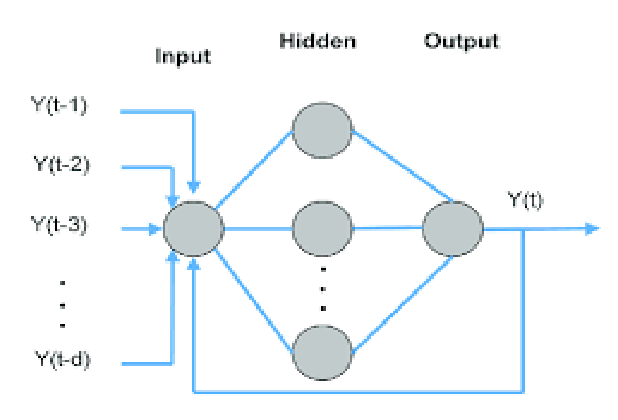
In many applications, the multifaceted perceptron network (MLP) is one of the most basic models. It describes complex relationships between independent and dependent variables using nonlinear functions (Ashour, 2022). The MLP was first applied to the classification of complex problems. These models are overly complex, requiring numerous local minima to minimize error functions, and implementation is often difficult. Figure 1 illustrates how to create an NRT to forecast a time series based on its previous values (yt-1, yt-2). A nonlinear autoregressive model, which can be automatically written in this format, is a network of neural systems for the projection of time series (Helmi, Jamal and Ashour, 2018; Munim, Shakil and Alon, 2019; Wirawan, Widiyaningtyas and Hasan, 2019; Anbalagan et al., 2020; Ashour and Al-Dahhan, 2021; Ashour and Alashari, 2022): 𝑦𝑡= 𝑟(𝑦𝑡−1, 𝑦𝑡−2, … . . 𝑦𝑡−𝑑) (1) The function r(.) It is unknown before long and the formation of the neural network aims to approximate it by optimizing network weight and optimizing neurons (Minu, Lineesh and Jessy John, 2010; Helmi, Jamal and Ashour, 2018; Derbentsev et al., 2019; Ahmed et al., 2020; Jamal et al., 2021; Ashour, 2022; Ashour, Ahmed and Al- dahhan, 2022).
Figure 1. construction of a nonlinear autoregressive neural network (Jamal et al., 2021; Ashour and Alashari, 2022). Measuring Error Accuracy To performance the accuracy of the error results, the following indicators were used root mean square error (RMSE) and mean absolute percentage error (MAPE) (Helmi, Jamal and Ashour, 2018; Wirawan, Widiyaningtyas and Hasan, 2019; Anbalagan et
Human Interaction & Emerging Technologies (IHIET-AI 2022) Artificial Intelligence & Future Applications https://openaccess.cms-conferences.org/#/publications/book/978-1-7923-8989-4 al., 2020; Ashour and Al-Dahhan, 2020; Ashour, Al-Dahhan and Al-Qabily, 2020).
𝑅𝑀𝑆𝐸= √∑𝑒𝑡
𝑛 (2) |∑𝑒𝑡 𝑦𝑡|
𝑀𝐴𝑃𝐸=
𝑛 (3)
Where: 𝑒𝑡= 𝑦𝑡−𝑦̂𝑡 Result and Decision The time-series data for Europe Nuclear Electric Power is used throughout this section to assess the accuracy of the prediction methods. Figure 2 shows Europe's Nuclear Electric Power (Electricity generated using the thermal energy released from the fission of nuclear fuel in a reactor) from 1980 to 2006, source: united states Energy Information Administration.
Figure 2. shows Europe Nuclear Electric Power by year As shown in Figure 2 a rise in production rates and the series includes a trend. The results of the model forecasting were calculated. To generate results, the MATLAB high-level programming language is used to estimate neural network forecasting results. After several tests, the number of nodes in the hidden layer with one layer that works best is 15 nodes. The observations at shift 1 are the input nodes of this time series, the prior (lag) observations are t-1, that is, Yt-1, and the output is Yt. The network performance results are shown in Figures 3, 4, and Table 1.
Table1. Error accuracy RMSE 60 MAPE 6.4 Figures 3–4 show that the values of R and the response of the output element for both the training and validation data sets are nearly identical to those for the test set for all developed neural network models. The error accuracy valuation measures have a significant impact, as shown in Table 1. CONCLUSIONS Artificial neural networks have emerged as an important tool for time series forecasting. ANNs have many desired features that are quite suitable for practical forecasting applications. ANNs have achieved remarkable successes in the field of electric power forecasting. It is, however, important to note that they may not be a panacea for every forecasting task under all circumstances. Forecasting competitions suggest that no single method, including neural networks, is universally the best for all types of problems in every situation. Thus, it may be beneficial to combine several different models in improving forecasting performance. Indeed, efforts to find better ways to use ANNs for forecasting should never cease. This discovery implies that NAR can be used to generate more accurate forecasts. The current findings support the usefulness of NAR in predicting time series, whether linear or non-linear. REFERENCES Abbas, R. A. et al. (2020) ‘Curve fitting predication with artificial neural networks: A comparative analysis’, Periodicals of Engineering and Natural Sciences, 8(1), pp. 125–132. Abdul, M. et al. (2020) Forecasting by Using the Optimal Time Series Method. Springer International Publishing. doi: 10.1007/978-3-030-44267-5. Ahmed, A. A. A. et al. (2020) ‘Using modified earned value for cost control in construction projects’, Periodicals of Engineering and Natural Sciences, 8(1), pp. 156–168. doi: 10.21533/PEN.V8I1.1103.G499. Anbalagan, N. et al. (2020) ‘Trusted Application Using Biometrics for Android Environment’, in 2020 16th IEEE International Colloquium on Signal Processing Its Applications (CSPA), pp. 7–12. doi: 10.1109/CSPA48992.2020.9068715. Ashour, M. A. H. (2022) ‘Optimized Artificial Neural network models to time series’, Baghdad Science Journal, 19(4), pp. 899–904. doi: 10.21123/bsj.2022.19.4.0899. Ashour, M. A. H. and Abbas, R. A. (2018a) ‘Improving time series’ forecast errors by using recurrent neural networks’, in Proceedings of the 2018 7th International Conference on Software and Computer Applications, pp. 229–232. Ashour, M. A. H. and Abbas, R. A. (2018b) ‘Improving time series’ forecast errors by using recurrent neural networks’, ACM International Conference Proceeding Series, (February), pp. 229–232. doi: 10.1145/3185089.3185151.
Ashour, M. A. H., Ahmed, A. A. and Al-dahhan, I. A. H. (2022) ‘Minimizing Costs of Transportation Problems Using the Genetic Algorithm’, in Proceedings of Sixth International Congress on Information and Communication Technology, pp. 165– 173. Ashour, M. A. H. and Al-Dahhan, I. A. H. (2020) ‘Turkish lira Exchange rate forecasting using time series models’, International E-Journal of Advances in Social Sciences, 6(16), pp. 294–300. Ashour, M. A. H. and Al-Dahhan, I. A. H. (2021) ‘Optimal Prediction Using Artificial Intelligence Application’, in Ahram, T., Taiar, R., and Groff, F. (eds) Human Interaction, Emerging Technologies and Future Applications IV. Cham: Springer International Publishing, pp. 76–83. Ashour, M. A. H., Al-Dahhan, I. A. H. and Al-Qabily, S. M. A. (2020) ‘Solving Game Theory Problems Using Linear Programming and Genetic Algorithms’, in Ahram, T. et al. (eds) Human Interaction and Emerging Technologies. Cham: Springer International Publishing, pp. 247–252. Ashour, M. A. H. and Alashari, O. M. N. (2022) ‘Electricity Consumption Forecasting in Iraq with Artificial Neural Network’, in Ahram, T. and Taiar, R. (eds) Human Interaction, Emerging Technologies and Future Systems V. Cham: Springer International Publishing, pp. 922–927. Ashour, M. A. H., Jamal, A. and Helmi, R. A. A. (2018) ‘Effectiveness of artificial neural networks in solving financial time series’, International Journal of Engineering and Technology(UAE), 7(4), pp. 99–105. doi: 10.14419/ijet.v7i4.11.20783. Derbentsev, V. et al. (2019) ‘Forecasting cryptocurrency prices time series using machine learning’, in CEUR Workshop Proceedings, pp. 320–334. Helmi, R. A. A., Jamal, A. and Ashour, M. A. H. (2018) ‘Identifying high impact disaster triggers on computer networks in Asia Pacific region’, International Journal of Engineering and Technology(UAE), 7(4), pp. 95–98. doi: 10.14419/ijet.v7i4.11.20782. Jamal, A. et al. (2021) ‘A Wavelet-Neural Networks Model for Time Series’, in 2021 IEEE 11th IEEE Symposium on Computer Applications Industrial Electronics (ISCAIE), pp. 325–330. doi: 10.1109/ISCAIE51753.2021.9431777. Minu, K. K., Lineesh, M. C. and Jessy John, C. (2010) ‘Wavelet neural networks for nonlinear time series analysis’, Applied Mathematical Sciences, 4(49–52), pp. 2485–2495. Munim, Z. H., Shakil, M. H. and Alon, I. (2019) ‘Next-day bitcoin price forecast’, Journal of Risk and Financial Management, 12(2), p. 103. Wirawan, I. M., Widiyaningtyas, T. and Hasan, M. M. (2019) ‘Short Term Prediction on Bitcoin Price Using ARIMA Method’, in 2019 International Seminar on Application for Technology of Information and Communication (iSemantic), pp. 260–265.
Read this individual research paper free through the original publisher, or explore the full digital proceedings book.
ISBN 978-1-7923-8989-4
Explore this ISBN in the AHFE Bookstore ↗Listed in the July 2026 bookstore catalogue; search by ISBN to confirm current availability · Digital book purchase optional