Ruotong Zhang, Ningxin Zhao, Yushan Wen, Inwai Chan, Hanyuan Li, Zhengqing Peng, Xiaojian Wu, Fan Yang, Ruikang Wang, Bojuan Ren, Lu Wang, Wei Liu (2022). Punch it baby! Exploring gestural interactions to reduce the emotion of anger for new car buyers. In: Affective and Pleasurable Design. AHFE Open Access, vol. 41, pp. 196–202. https://doi.org/10.54941/ahfe1001797
This study focuses on how new buyers experience the angry emotions while driving, which could be a dangerous situation leading to car accidents. The research team develops an interactive physical prototype suitable for the new buyers to deal with anger while driving. The direct interactions between the driver and the car's glazing include detecting decibels, absorbing punching pressure, and recognizing facial expressions. With the help of special glazing, new buyers can pay attention to driving safety and release the emotion and calm down better. Further investigations are needed to optimize the design of interactions.
Car industries are receiving increasing attention in contemporary society, and cars play essential roles in daily lives. Among many driving safeties factors, the emotional problems of drivers have a direct impact on driving safety. During driving, the driver may experience anger which would induce the dri- ver’s aggressive behaviors and result in dangerous driving. Thus, reducing the driver’s irritation is crucial to safe driving. In this case, the glazing would be a potential feature to achieve the goal since glazing takes up a high propor- tion of space in a car. In this study, by applying a typical driving scenario of the angry new buyer, the team came up with some possible interactions with glazing. Design is improved through quick usability testing, which could be applied to the future in-vehicle glazing industry.
RELATED WORKS Engineering Psychology
Experts contribute to this field by ensuring that human capabilities and limi- tations are considered. It has become clear that treating the system as separate from the users results in poor performance and potential failure in the ope- rational setting. Continued growth in technology has not delivered desired
Punch It Baby! Exploring Gestural Interactions to Reduce the Emotion of Anger 197
results. Systems engineers and others are beginning to understand the role humans play in technology systems. The core challenge is to balance succes- sful hardware and software solutions with human friendly implementations. To define the requirements of humans as a fundamental system component, it is essential to understand the inherent capacity of user populations and their typical operational environment (Booher, 2003). A description of a popu- lation’s capacity incorporates more than the basic anthropometrics or the cognitive capability of the average member of the user population (Chapanis, 1996).
Human-Centered Design (HCD) HCD refers to the design process in conformity with individuals’ behavior habits, the physiological structure of the human body, people’s psychologi- cal context, the way of human thinking, etc. Based on the original essential functions and performance of the original design, the products are optimized to be further convenient and comfortable. It shows the respect of individuals’ psychological and physiological needs, spiritual pursuit, and the humanistic of human nature in design. In a word, HCD aims to consider people’s needs and satisfaction at all stages of the design of products. Following are some theories related to human-centered design which may be used in the produ- cts. (1) Embodied cognition theory: this theory emphasizes the significant human-centered design (HCD) role that the body plays in cognitive proces- ses. It has redefined the relationship between the human body, cognition, and the environment, which inspires people to view cognition from the body and environmental perspective and brings a new perspective to cognitive science research. Therefore, embodied cognition theory becomes a research upsurge in the second generation of cognitive psychology. At present, the definition of embodied cognition has a narrow and broad sense. In the narrow sense, embodied cognition advocates that the physiological structure, activity mode, sensory and motor experience affect people’s cognitive process. This view emphasizes the core role of the body and sensation in cognitive processes. In the broad sense, embodied cognition claims that cognition comes from the human body-environment interaction, which emphasizes the role that the body plays in cognitive activities and the relationship between the body and the environment (Li and Sheng, 2006). For example, when the atmo- spheric temperature reaches too high, people tend to experience impatience or anger easily. (2) Hydraulic model: the model suggests that anger accu- mulates within individuals, which is similar to hydraulic pressure in closed environments until it is somehow released (Geen and Quanty, 1977). Its core idea is that anger accumulation, to a certain extent, has more severe con- sequences. Therefore, we should let anger be released by catharsis rather than suppressed. Moreover, Newman and Scheff supported the point from an evolutionary perspective, arguing that emotions are a natural physical response and a way to handle painful experiences (Scheff, 1979). Howe- ver, inhibiting emotions have a tremendous negative impact on individuals. For instance, when people accumulate anger emotions, they are accompa- nied by physical intense, leading to impulsive behaviors. (3) Bias interference
effect: changes in nonspecific stimulus often draw our involuntary atten- tion, and this non-casual attention helps individuals respond to external potentially dangerous information in time. However, the attention shift may be distracted in some specific context. The phenomenon is caused by irre- levant information changes that have impaired current task performance (Escera et al., 1998; Parmentier, 2008). As known to all, individual attention resources are limited. Attentional resources for processing current tasks are reduced if attention is attracted to a new stimulus. A small number of resou- rces available are used to process a task-related stimulus, and more resources are used to process irrelevant stimulus. A body of research has shown that attention has a cross-channel processing mechanism, and the emergence of attention orientation and cue transfer effects in the visual attention system under auditory bias stimulation indicates that the bias interference effect is mainly caused by the attention shift and attention transfer loss caused by bias stimulation from all senses.
Car Huamn-Machine Interaction (HMI) Human-Computer Interaction (HCI) is a challenging discipline currently concerned with designing, implementing, and evaluating interactive systems for human use and studying significant phenomena surrounding them (Chao, 2009). As cars have become increasingly computerized, HCI has made signi- ficant progress in recent years (Oehl et al., 2011). Car human-computer interaction, the ubiquitous, intuitive, and natural design to provide the drivers with straightforward and efficient operation methods is advocated. What is worth mentioning is that behind any novel design concept, strict and accurate verification is needed. Otherwise, it would violate the most basic premise of safe driving.
Neuro Design In 2018, a new research track called the Leifer NeuroDesign Research Pro- gram at Stanford University has emerged (Auernhammer et al., 2020, Ohashi et al, 2022). The program aims to investigate design, team performance, and practices through approaches from HCI, design research, experimental psychology, and neuroscientific instruments. Our research investigates design activities and relates thinking from various perspectives, including neuroscie- nce, Gestalt, etc. It aims to provide theoretical support to reduce the detriment of road rage, which younger drivers are more likely to get.
APPROACH Human Factors Engineering-Target User Group
Our target user group is new buyers. In recent years, owning a car has been necessary for the young generation. A survey focused on car consumers in China revealed the following facts: (1) compared to the older generations, the young have a higher likability and attention to cars, (2) although bus and subway are the main travel modes of young people without cars, they expect mode of self-driving the most. (3) For college students are willing first
Punch It Baby! Exploring Gestural Interactions to Reduce the Emotion of Anger 199
to purchase a car rather than purchase a house in the future. Since the young generation have been used to traveling by car as they grow up, they need a car to meet their daily needs (including commuting and road trips), new buyers are playing a growing role in car consumers. Based on Abramson, purcha- sing a new car is so-called ultra-involvement behavior. In other words, new buyers indeed make a study of cars. However, they only use a small amount of available search information, which means they follow the suggestion of family or friends or adopt the advice on the Internet (Abramson and Desai, 1993). Unlike experienced buyers and drivers, new buyers know less about the functions of cars. Moreover, their everchanging road condition is also new, so GPS is always necessary. As a result, they gradually need more time getting used to the new car.
An Emotion as the Psychological Indication According to Ekman, anger is one of the six basic emotions (Ekman and Keltner, 1997). It is confirmed that one experiences angry more often in the driving context than in the non-driving context (Parkinson, 2001). Another statistical information was from a study that explored one’s emotions while driving, which indicated that about one-fifth of all reported emotions were anger (Underwood et al., 1999). Heightened physiological arousal is a core component of anger, including heart racing, rapid breathing, blood pressure, and skin temperature rise. High-intensity arousal may override inhibitory controls on aggressive behavior, which endangers driving safety (Novaco, 2016). According to a laboratory study, people who feel angry while driving tended to exceed the speed limit more often (Mesken et al., 2007). To sum up, in the context of driving, anger happens sometimes, and it is strongly related to dangerous driving behaviors. Additionally, in Wilkens’ study, nearly half of young drivers report aggressive driving, while the proportions are one-third in middle-aged drivers and one-fifth in old drivers (Wickens et al., 2011). It seems that young drivers with less driving experience are more likely to have aggressive behaviors while driving.
Context of Car HMI The team has reviewed those new buyers are becoming the new power of car consumers. Furthermore, anger can lead to dangerous context while driving, and young drivers are more likely to have aggressive driving behaviors. One can be distracted by the anger stimulation, overlooking the driving context due to the limitation of our attention. Thus, an interaction system to reco- gnize drivers’ anger while driving and further ensure driving safety is needed, especially for new buyers. The theory of catharsis is one famous statement that venting one’s anger improves in one’s psychological state (Bohart, 1980). However, typical venting approaches such as hitting the punching bag seem to be impractical in car design. The team tries to figure out what kind of HMI can make one quickly vent his/her anger in a limited car space. On the other hand, the heat hypothesis states that hot temperature increases aggressive motivation and behaviors (Anderson, 2001). According to embodied cogni- tion, we imply that reducing the temperature in the environment produces
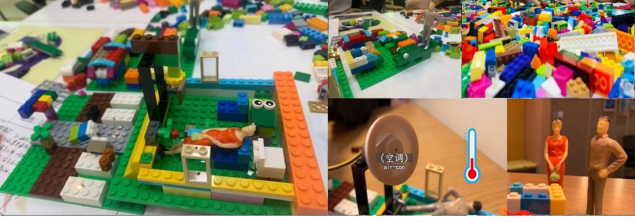
Figure 1: The context is built by Lego bricks and intelligent hardware.
an effective way to release one’s anger. Thus, a cooling down system has also been considered in our HMI.
DESIGNING GESTURAL INTERACTIONS Three interactive contexts are designed, involving sound, action, and emo- tion. When users have a dispute on the road and become angry, the glazing can warn, take specific measures to calm them, and remind them to pay atten- tion to driving safety. The team builds the whole context using Lego bricks (see Figure 1).
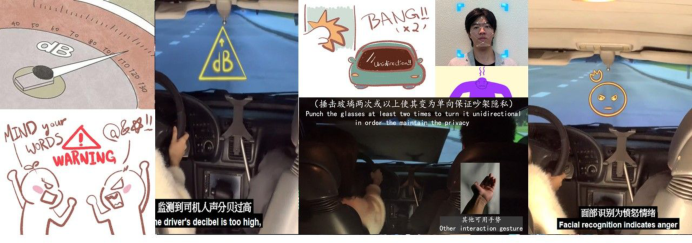
James (the passenger) and Roland (the driver) are a young couple who want to buy a car for convenience. They are both new buyers of cars. The couple traveled in their new car but lost their way in the middle of nowhere, misfortunately. One of the features of this glazing is its ability to recognize decibels. When the decibels in the car become higher than the setting value, the glazing presents the sentence ‘the decibel in the car is too high, please pull over to be safe’, which protects Roland from traffic accidents that may happen if Roland’s visual attention is distracted. The team designed this inte- raction based on the following principles: Roland feels the world through different sensory channels, so attention is allocated. If the sound is influenced too much, visual attention is distracted. When Roland gets angry or otherw- ise emotional, her voice becomes higher unconsciously. Thus, the glazing can timely remind the driver to pay attention to driving safety. Considering the different speaking habits of humans in different regions, the team added a threshold for decibel recognition, which can be set by users or automatically adapted through machine learning. What is more, the team added a sound- absorbing feature on the glazing to prevent drivers from being disturbed when the decibel level of passengers is too high.
When James becomes extremely angry, he can punch the glazing. The gla- zing can detect the skin and become flexible in letting the angry people release the emotion while protecting their hands from getting hurt. Moreover, if the glazing is punched twice, it becomes unidirectional to protect their privacy from being seen.
Darkening the glazing might be a way of protecting privacy here, but one might say being in the dark can further intensify the conflict between the two parties and may even trigger the criminal impulse of individuals, which poses a significant threat to personal safety. That is why the team made the glazing
Punch It Baby! Exploring Gestural Interactions to Reduce the Emotion of Anger 201
Figure 2: The designed gestural interactions with interactive glazing.
unidirectional instead of darkening, so that others outside cannot see in, and meanwhile, people inside can see outside. Therefore, it can guard privacy and avoid the negative impacts of a dark environment. In addition, the team adds a hand wave as an interactive way to turn on the unidirectional glazing feature, which broadens the range of using context (see Figure 2).
Another interaction is anger recognition. The glazing can use the techni- que of facial expression recognition to detect driving’s anger. And then, the glazing presents the sentence ‘your angry feeling is detected’ to the aware dri- ver that they are not in good conditions and need to calm down. Meanwhile, the temperature system starts physical cooling mode. As embodied cognition predicts, physical cooling reduces the arousal of the emotion. In this way, this feature calms down the users and keep them safe.
DISCUSSION AND FUTURE PERSPECTIVES This paper describes novel interaction designs between the angry users and the cars’ glazing. The designs include punchable body glazing that can also be changed from average to one way vision mode. The remainder or reaction to the detected anger relieves the anger-arousal aggression and reduces its risk. Further investigations are needed to optimize the design of interactions. To improve the usability and find new design possibilities, we plan to collect and analyze several behaviors and interview data from the car-driving and the anger context. Ultimately, the design intends to provide a reliable way to enhance the driving experience.
REFERENCES
Abramson, J., & Desai, S. (1993). Purchase involvement of new car buyers: A Descriptive Study. American Journal of Business, 8, 13–20. Anderson, C. A. (2001). Heat and violence. Current Directions in Psychological
Science, 10(1), 33–38. Auernhammer, J., Liu, W., Ohashi, T., Leifer, L., Byler, E., & Pan, W. (2020).
NeuroDesign: Embracing neuroscience instruments to investigate human collabo- ration in design. International Conference on Human Interaction and Emerging Technologies, 284–289. Bohart, A. C. (1980). Toward a cognitive theory of catharsis. Psychotherapy: Theory, Research and Practice, 17(2), 192.
Case, K. (2013). Tools for user-centred design. Advanced Engineering Forum, 10, 28–33. Chao, G. (2009). Human-computer interaction: The usability test methods and
design principles in the human-computer interface design. IEEE International Conference on Computer Science and Information Technology, 283–285. Dula, C. S., & Ballard, M. E. (2003). Development and evaluation of a measure of dangerous, aggressive, negative emotional, and risky driving. Journal of Applied Social Psychology, 33(2), 263–282. Ekman, P., & Keltner, D. (1997). Universal facial expressions of emotion. Nonverbal
Communication: Where Nature Meets Culture, 27, 46. Escera, C., Alho, K., Winkler, I., & Näätänen, R. (1998). Neural mechanisms of involuntary attention to acoustic novelty and change. Journal of Cognitive Neuroscience, 10(5), 590–604. Geen, R. G., & Quanty, M. B. (1977). The catharsis of aggression: An evaluation of
a hypothesis. Advances in Experimental Social Psychology, 10, 1–37. Li, H., & Sheng, X. (2006). Embodiment of cognition. Studies in Science of Science, 24(2), 184–190. Liu, W., Lee, K. P., Gray, C. M., Toombs, A. L., Chen, K. H., & Leifer, L. (2021).
Transdisciplinary teaching and learning in UX design: A program review and AR case studies. Applied Sciences, 11(22), 10648. Mesken, J., Hagenzieker, M. P., Rothengatter, T., & De Waard, D. (2007). Frequency, determinants, and consequences of different drivers’ emotions: An on-the-road study using self-reports, (observed) behaviour, and physiology. Transportation Research Part F: Traffic Psychology and Behaviour, 10(6), 458–475. Newman, G., & Scheff, T. J. (1981). Catharsis in healing, ritual, and drama. Social
Forces, 60(2), 639. Novaco, R. W. (2016). Anger. Stress: Concepts, Cognition, Emotion, and Behavior, 285–292. Ohashi, T., Auernhammer, J., Liu, W., Pan, W., & Leifer, L. (2022). NeuroDesignSci-
ence: Systematic literature review of current research on design using neuroscience techniques. Design Computing and Cognition’20, 575–592. Oehl, M., Siebert, F. W., Tews, T. K., Höger, R., & Pfister, H. R. (2011). Improving human-machine interaction: A non invasive approach to detect emotions in car drivers. International Conference on Human-Computer Interaction, 577–585. Parkinson, B. (2001). Anger on and off the road. British Journal of Psychology, 92(3),
507–526. Parmentier, F. B. (2008). Towards a cognitive model of distraction by auditory novelty: The role of involuntary attention capture and semantic processing. Cognition, 109(3), 345–362. Shi, Y., Li, X., Ouyang, D., & Jiang, H. (2017, August). Multimodal usability
of human-computer interaction based on task-human-computer-centered design. International Conference on Intelligent Computing, 459–468. Underwood, G., Chapman, P., Wright, S., & Crundall, D. (1999). Anger while driv-ing. Transportation Research Part F: Traffic Psychology and Behaviour, 2(1), 55–68. Wickens, C. M., Mann, R. E., Stoduto, G., Ialomiteanu, A., & Smart, R. G. (2011).
Age group differences in self-reported aggressive driving perpetration and victimi- zation. Transportation Research Part F: Traffic Psychology and Behaviour, 14(5), 400–412.
LISTED IN THE AHFE DIGITAL BOOKSTORE CATALOGUE
Explore the complete digital volume
Affective and Pleasurable Design
Read this individual research paper free through the original publisher, or explore the full digital proceedings book.
ISBN 978-1-958651-17-9
Explore this ISBN in the AHFE Bookstore ↗Listed in the July 2026 bookstore catalogue; search by ISBN to confirm current availability · Digital book purchase optional