Yuko Hiramatsu, Atsushi Ito, Akira Sasaki, Rochaporn Chansawang (2022). A Survey of Forest Bathing Using EEG Measurement for New Tourism after COVID-19. In: Affective and Pleasurable Design. AHFE Open Access, vol. 41, pp. 239–246. https://doi.org/10.54941/ahfe1001803
13 million hectares of forest were lost from 2000 to 2010 (ITTO International Tropical Timber Organization) Agricultural development is one of the reasons for this deforestation. The benefits of agricultural developments are significant for residents. On the other hands, If forest protection is important for the world, what brings them better benefits than agricultural developments? It is necessary not to undermine the interests of residents for the cause of other regions, but also to benefit from participating, and to actively embark on forest conservation in order to nurture forests.Considering the global issue of forest conservation, we deal with tourism in nature, especially forest bathing in this paper. Tourists not only give money for local people, but also gives people the perception that forests are not a hindrance to cultivation, but rather meaningful resources for themselves. Research in Japan has been studying the stress reduction effects of forest bathing in the last 10 years. There are physical declines in stress hormones such as blood pressure, pulse and salivary cortisol, promotion of parasympathetic nerve activity, and decreased sympathetic nerve activity even in forest bathing for about 20 minutes (Koyama, 2009). There is also research (Takeda, 2009) that analyzed the atmosphere of forests and measured phytoncide components such as terpenes emanated from trees. It told that forest bathing is effective in reducing physical and mental parts. However, these are often influenced by weather and personal factors of subjects (Alpine,2012). In addition, since the measurement method is complicated for the physiological part, it has not reached the investigation of the scale which can be general-purpose. Research originated in Japan on forest bathing is progressing overseas aiming at the elimination of Over tourism now. We had experiments in Oku-Nikko, the Natural Park in Japan on September and November 2021. We tried to measure effects of forest bathing by performing the degrees of relaxation using EEG Measurement:αwaves increased in certain areas, and multiple subjective evaluations. The participants walked in the forest wearing bandana with simple electroencephalography on the experiments. Though temperatures and deciduous conditions are different in September and in November, effects of forest bathing were observed in both experiments. It is about 26,27℃ in the forest of Oku-Nikko on September. On the other hands, we had the experiment not as high as 10℃ on November. It seems that the situations are not so suitable for experiments in the forest bathing because of the large temperature gap. However, forest bathing has become a hot topic in foreign countries and the compositions of forests varies enclosing temperature are different among those countries. Therefore, considering such different phases is useful for our research, we will lead to the versatility of forest bathing. Participants walked some courses on September. One group walked the same 30-minute course at the forest along a fall in September (n=3) and November (n=10). According to the results of Positive and Negative Affect Schedule(PANAS)scales of 13 participants (yes/no answer), total numbers of “yes” were increased from18 at the start point to 34 after walking. The answer “active” increased from3to 11after the walking in the forest (60 minutes walking). All participants were 20s. They answered that they liked to walk in the nature. However, 5 of them answered the average exercise time per week is less than an hour and 3 participants answered 1 hour or less than 3 hours, 4 participants answered 3 hours or less than 5 hours and only 1 participant answered he exercises 5 hours or less than 10 hours per week. On the other hands, negative items decreased from 14 to 6 after walking in the forest. In addition, αwave came out loudly when 3 participants stopped to see a waterfall which was flowing sideways of the forest in September. According to our experiments, there is a possibility that forest bathing makes people feel better regardless of temperature. Participants became positive after walking in the forest. We have to proceed to analyze the date for subjective evaluation and will examine the EEG data on November, too.We started to research and will continue to use EEG measurement and will have subjective evaluation to enhance evidence for forest bathing enclosing other countries. The forests in Thailand are so different from Japanese ones. Thailand have had too many tourists in several famous cities before COVID-19. There are great forests in Thailand. We will cooperate and will find the common effects of forest bathing. In addition, informing tourists themselves of the effects of forest bathing on the spot using incorporating the brain wave measurement function into the app in the future, it will be useful for new tourism after COVID-19.
13 million hectares of forest were lost from 2000 to 2010 (FAO, 2010). Agricultural development is one of the reasons for this deforestation. The benefits of agricultural developments are significant for residents. On the other hands, if forest protection is important for the world, what brings them better benefits than agricultural developments? It is necessary not to undermine the interests of residents for the cause of other regions, but also to benefit from participating, and to actively embark on forest conservation to nurture forests.
Considering the global issue of forest conservation, we deal with tourism in nature, especially forest bathing using IT in this paper. Tourists not only pay for local people, but also gives people the perception that forests are not a hindrance to cultivation, but rather meaningful resources. In addition, knowing some effects by forest bathing in the tourism information, touri- sts will respect for the importance of forests and the diversity of life that
lives in the area. Forest bathing has the potential that protects forests, rather than the conventional tourism that have exposed land to tourism develo- pment. In this research, we use our application using BLE Beacons and simple electroencephalograph to evaluate effects of forest bathing.
PREVIOUS WORKS Forest Bathing
Forest bathing was promoted by the Forestry Agency more than 30 years ago in Japan. Research in Japan has been studying the stress reduction effe- cts of forest bathing in the last 15 years. There are physical declines in stress hormones such as blood pressure, pulse and salivary cortisol, promotion of parasympathetic nerve activity, and decreased sympathetic nerve activity even in forest bathing for about 20 minutes (Koyama, 2009). There is also rese- arch (Takeda, 2009) that analyzed the atmosphere of forests and measured phytoncide components such as terpenes emanated from trees. It told that forest bathing is effective in reducing physical and mental parts. However, these are often influenced by weather and personal factors of subjects (Taka- yama, 2013). In addition, since the measurement method is complicated for the physiological parts, it has not reached the investigation of the scale which can be general-purpose. Research originated in Japan on forest bathing is progressing overseas aiming at the elimination of over tourism now.
As for international research on forest bathing, the International Hand- book of Forest Therapy (Kotte, 2019) describes efforts in various countries including Taiwan, Malaysia, Australia, Norway, Sweden, Germany etc. as well Japan. In addition, there is room for further research on whether the effects of forest bathing can be verified in the same way considering the dif- ferences in the components of the forest itself. However, there are studies that forest bathing is effective in different forest environments in Japan (Kagawa, ed. 2011).
BLE Beacon There are many research papers on BLE Beacon for indoor use (ex: Spachos, 2020). On the other hand, we have developed applications using BLE Beacon, for outdoor use in Nikko, the world heritage site in Japan. (Hiramatsu, 2016).
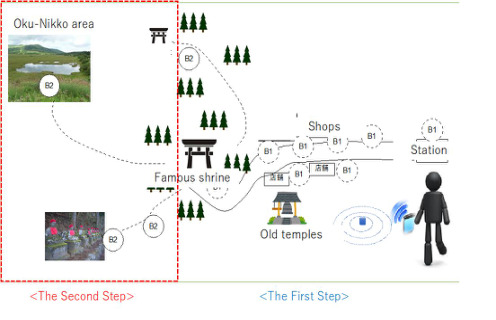
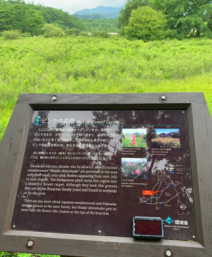
We mainly provided cultural information for foreign tourists at the main street using beacon application at the first step with cooperation of shop owners and the Tourism Association (See Figure 1). We have had a series of experiments to improve the beacon system and validated it(Hiramatsu, 2020). Then we set BLE Beacons in Oku-Nikko, where is higher and colder place than the area of the first step. It snows in winter. We had tests and experiments to use BLE Beacon in Nikko National Park, forest area named Senjogahara (Ito, 2017). Currently, there are beacons for our application that list not only bus schedules and the map but also focuses information about plants and animals in the national park in cooperation with Nikko National Park Management Office of Ministry of the Environment. Walking on the path, tourists can get information near the boards (See figure 2).
A Survey of Forest Bathing Using EEG Measurement for New Tourism after COVID-19 241
Figure 1: Beacon Map in Nikko (The 1st Step) and Oku-Nikko (The 2nd Step).Figure 2: A solar BLE Beacon on the plate.
OUR EXPERIMENTS IN OKU-NIKKO Outline of our Experiments
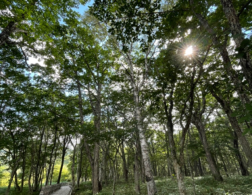
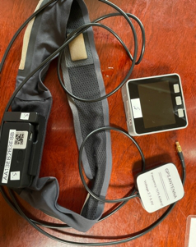
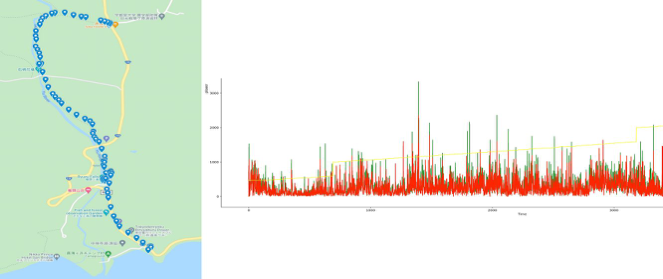
Quercus serrata and beech trees are main trees at Senjogahara in Oku-Nikko. There are also Japanese white birch and planted larch (See Figure 3). We had experiments in Oku-Nikko, the Natural Park in Japan on September and on November 2021, to evaluate effects of forest bathing by performing the degrees of relaxation using EEG Measurement. In addition, we used subje- ctive evaluations. The participants walked in the forest wearing bandanas with simple electroencephalography and each participant also wore a GPS device to investigate where the forest bathing effect is higher (See Figure 4).
Though temperatures and deciduous conditions are different in September and in November, effects of forest bathing were observed in both experiments. It is about 26–27°C in the forest of Oku-Nikko on September. On the other hands, it is less than 10°C on November (the temperature on the day of the experiment: start 1°C, finish 5°C). It seems that the situations are not so suitable for experiments in the forest bathing because of the large temperature gap. However, forest bathing has become a hot topic in foreign countries and the compositions of forests varies enclosing temperature are different among
Figure 3: Senjogahara Forest in Oku-Nikko.Figure 4: bandanas with simple electroencephalography and GPS device.Figure 5: The walking route and brain waves of a participant.
those countries. Therefore, considering such different phases is useful for our research, we will lead to the versatility of forest bathing.
Results of Experiments Participants walked several courses on September. One group walked the same 30-minute course at the forest along a fall in September (n = 3) and November (n = 10). One of the routes and brain wave data are shown as Figure 5 (Green=α wave, Red=β wave on the right part of the figure). Once every 30 seconds, EEG data was acquired. Green line is higher than red one in
A Survey of Forest Bathing Using EEG Measurement for New Tourism after COVID-19 243
Figure 6: EEG measurement data of three participants in September.Figure 7: Results of PANAS.
many points in the forest: αwave means resting and relaxing, or concentrating on one thing, and βwaves means stressful or nervous.
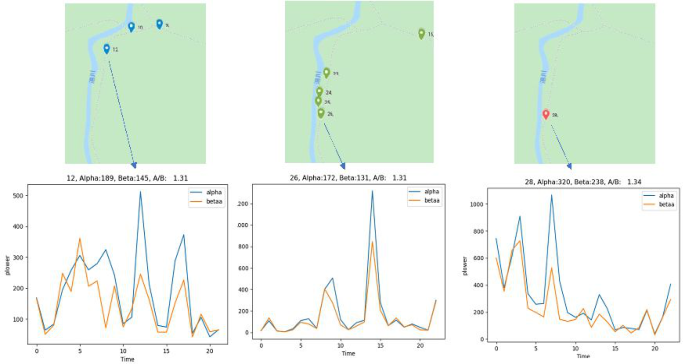
Although there were individual differences in the results of the α and β wave measurements, all three had points at which the α wave exceeded the β wave. This is particularly likely to be in places of relaxation. Figure 6 shows data of tree participants walking around the same area near Yukawa River.
The answer “active”(PA) increased from to 11 after the walking in the forest for 60 minutes’ walk. On the other hands, negative items (NA) decre- ased from 14 to 6 after walking in the forest. In addition, αwave came out loudly when 3 participants stopped to see a waterfall which was flowing sideways of the forest in September.
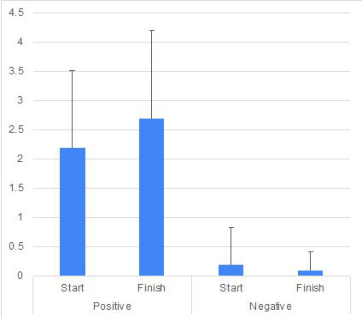
Figure 7 shows the results in November (n = 10). Since the participants were sleep-deprived the previous day in September, we conducted the expe- riment again in November on the same course. Comparing the results before
Figure 8: Screens of brain wave on the application (Image).
and after the forest bathing, the positive items increased, and the negative items decreased slightly. Correlation coefficients showed r = 0.60 for PA, and a weak negative correlation r = - 0.11. However, t-test showed that the correlation did not reach 5% significance. Since only one person checked the negative item in advance, the decrease was not fully apparent from this questionnaire.
CONCLUSION
According to the experiments, there was a possibility that forest bathing makes people feel better regardless of temperature. Participants became posi- tive after walking in the forest. However, those experiments were conducted only in the forest and numbers of participants was not so much. We intend to have more detailed survey using EEG measurement including comparisons with the city and a three-point evaluation with PANAS scale.
As the experiments were conducted in Japan with masks in the Corona Disaster, it needs to be investigated again with regard to odour. Among the previous works, PET, fMRI and near-infrared imaging studies of blood flow in the brain have revealed the relaxing effects of incense (Akakabe, 2010, Kondo, 2011). On the other hand, forest bathing made participants feel relax even wearing masks in our experiments.
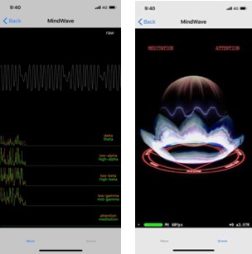
In addition, we aim to inform tourists the effects of forest bathing on the spot using incorporating the brain wave measurement function into our application. It will be useful for new tourism after COVID-19. A report by UNWTO told, “Develop segmented and sustainable products focused on nature, rural areas and culture: eco-tourism, small group or individual sports, history, bird-watching tourism, traditional routes” (GLOBAL GUIDELINES TO RESTART TOURISM, 2020). Adding this brain wave function with the nature information transmission application, that we are developng, not only help nature walks in small groups without a tour guide, but also inform tou- rists to effects of forest bathing. If tourists wear bandanas with sensors, the data (α and β waves) is relayed to their smartphone’s screens (See figure 8). This kind of quantitative measurement of the effects of walking in nature will be used to provide visual information to health-conscious tourists. It will be approved useful contents for sustainable ecotourism.
A Survey of Forest Bathing Using EEG Measurement for New Tourism after COVID-19 245
Forest bathing is also gaining attention in other countries. For example, there are great forests in Thailand and forests in Thailand are so different from Japanese ones. From cities to forests, we will cooperate and will find the common effects of forest bathing for new tourism after COVID-19.
ACKNOWLEDGMENT
This research is supported by JSPS KAKENHI Grant Number JP17H02249 and JP 18K111849. We acknowledge the cooperation of the Ministry of the Environment for the application information in Senjogahara.
REFERENCES
Akakabe, Y., (2010), “The Relaxation effect of Aroma in Forest bath(shinrinyoku) for Human”, Aroma research, 11(2), pp. 156–161 Food and Agriculture Organization (FAO) of the United Nations (25 March 2010),
“World deforestation decreases, but remains alarming in many countries”, Web- site: https://www.fao.org/news/story/pt/item/40893/icode/en/ Hiramatsu, Y., Sato, F., Ito, A. et al. (2016.3), “A Service Model using Bluetooth Low Energy Beacons-To Provide Tourism Information of Traditional Cultural Sites -” The Eighth International Conferences on Advanced Service Computing, pp. 14– 19, (Roma, Italy) Hiramatsu, Y., Harada, Y., Morishita,M., Ito,A., Saraki, M. (2020), “Surveys
about Local Traditional Objects in Nikko, The World Heritage site -Intercultural Contents and Understanding Other Cultures-”, Conference: 12th International Conference on Education and New Learning Technologies, pp. 1724–1728 Ito, A., Hiramatsu, Y., Sato, F., Ueda, K., Harada, Y., Morishita, M., (2017.9) “A Cognitive Model of Sightseeing for Mobile Support System,” Proceedings of IEEE 8th International Conference on Cognitive Infocommunications: CogInfoCom, pp. 57–62 Kagawa, T., ed. (2011), “Comparison of therapeutic effects in different natural envi-
ronments and research on the therapeutic effects of familiar forests” (in Japanese), Forest Research and Management Organization, p5 Kawahito, J., Otsuka, Y., Kaida, K., Nakata, A. (2011), “Reliability and validity of the Japanese version of 20-item Positive and Negative Affect Schedule”, Hiroshima Psychological Research No.11, pp. 225–240 Kondo, T., Takeda, A., Kobayashi I., Yatagai, M. (2011), “Positive healthy Physiolo-
gical Effects of Shinrin-yoku in Human”, The Journal of the Japanese Society of Balneology, Climatology and Physical Medicine, 74(3), pp. 169–177 Kotte, d., Li, Q., Shin, WS. and Michalsen, A. ed. (2019), International Handbook of Forest Therapy, Cambridge Scholars Publishing Koyama, Y., Takayama, N., Park, B., Kagawa, T., Miyazaki, Y. (2009), “The Rela-
tionship between Changes in Salivary Cortisol and the Subjective Impression of Shinrin-yoku (Taking in the Atmosphere of the Forest, or Forest Bathing)”, Japanese Journal of Physiological Anthropology. 14(1), pp. 21–24 Petros Spachos (2020), “BLE Beacons for Indoor Positioning at an Interactive IoT- Based Smart Museum”, IEEE Systems Journal Vol. 14, Issue: 3, pp. 3483–3493 Takeda, A., Kondo, T., Takeda, N., Okada, R., Kobayashi, I. (2009), “Good mind-
healing and health keeping effects in the forest walking”, HEART’s Original, vol. 41–4, pp. 405–412
Takayama, N., Kagawa, T. (2013), “Study on a Function of the Forest Environment as the Restorative Environment Using the Attention Restoration theory”, Journal of the Japanese Institute of Landscape Architecture, 76(5), pp. 539–542 UNWTO (2020.6) GLOBAL GUIDELINES TO RESTART TOURISM, 5 Harmonize and coordinate protocols & procedures, Website: https: //webunwto.s3.eu-west-1.amazonaws.com/s3fs-public/2020-05/UNWTO-Gl obal-Guidelines-to-Restart-Tourism.pdf Watson, D., Clark, LA. & Tellegen, A., (1988), Development and validation of brief
measure of positive and negative affect: The PANAS scales. Journal of Personality and Social Psychology, 43, pp. 111–122 Zuo, Z., Liu, L., Zhang, L., (2018), “Indoor Positioning Based on Bluetooth Low- Energy Beacons Adopting Graph Optimization”, Sensors 18(11):3736
LISTED IN THE AHFE DIGITAL BOOKSTORE CATALOGUE
Explore the complete digital volume
Affective and Pleasurable Design
Read this individual research paper free through the original publisher, or explore the full digital proceedings book.
ISBN 978-1-958651-17-9
Explore this ISBN in the AHFE Bookstore ↗Listed in the July 2026 bookstore catalogue; search by ISBN to confirm current availability · Digital book purchase optional