Yonghong Wang, Ying Cao (2022). Design of Firefighter's special call unit based on Emotional Design theory. In: Affective and Pleasurable Design. AHFE Open Access, vol. 41, pp. 51–57. https://doi.org/10.54941/ahfe1001780
Based on the use environment and requirements of the firefighter's special call unit, the paper aims to improve the design of firefighter's special call unit from the perspective of emotional design. The method that includes questionnaire and interview is adopted to explore firefighters' needs and appearance preference for such product, with literature researches combined to obtain the technical parameters and functions that meet the needs of users. Emotional design theory is used to improve the design of firefighters' special call unit. The firefighter's call for help is improved through the emotional design method, the shape is more in line with the firefighter's preference, the functional structure is optimized and a smart terminal solution is proposed to connect the pad and the firefighter's call unit to the backfield receiving device to improve the use of it. Emotional design theory is used to innovate and upgrade the appearance of the product, and to complete the design of the firefighter's rescue device and the backfield command APP. This design is of great significance to better protect the life safety of firefighters and promote the cause of fire safety.
Personal protective equipment for firefighters refers to the protective equi- pment or special equipment that firefighters must wear, wear and use during firefighting, emergency rescue and other operations. It is an indispensable and important part of firefighting equipment (Zhao, 2013). At present, the design of the firefighter’s special call unit is mainly aimed at the iteration of functi- onal technology, ignoring the subjective experience of firefighters on the use of the firefighter’s special call unit, and the design is not humanized enough, so firefighters often have operational errors and leakage during rescue. and so on, resulting in an increased probability of an accident. This paper hopes to improve the design of the fireman’s special call unit from the perspective of emotional design, so as to make it more in line with the needs of users and improve the usability of the product.
OVERVIEW OF EMOTIONAL DESIGN Modern designism overemphasizes the function orientation of products and neglects the emotional needs of people. Emotional design comes into being in this situation (Norman, 2015). At present, emotional design has been
extensively studied in industrial design, cognitive psychology, ergonomics and other fields, but only one design theory can form a systematic and complete theoretical system: (1) Desmet product design emotional model. (2) Kan- sei Engineering. (3) The three-level theory proposed by Donald Norman (2015).
Donald Norman divided human brain activity into three levels, namely the instinctual layer, the behavioral layer and the reflective layer (2015). When users use the product, it is a process from the basic to the deep from the insti- nct level to the behavior level and then to the reflection level (Wu, 2017). (1) Instinct layer refers to the sensory stimulation brought by external factors, including product shape, color, material, etc.; (2) Behavior layer refers to triggering emotions from product use, paying attention to the physical con- tact and feeling between users and products , that is, behavioral level design, including function, intelligibility, usability and physical feeling; (3) Reflection layer is to generate emotional support in the user’s heart through the role of instinct layer and behavioral layer, which is reflected in the product’s back- ground, culture, value, experience, etc. In product design, attention should be paid to the integration of emotional factors as well as functions and appe- arance, so as to make the emotional exchange and communication between products and users more natural (Sun, Zhang, 2015)and solve the contradi- ction between product availability and aesthetics (Norman, 2005). In product design, the three levels are mutually influenced and difficult to separate,so is the product of the special call unit studied in this paper.
EXISTING PROBLEMS Through market research, we can collect several types of special call units with typical appearance and functions on the market, namely Yongsheng fire special call unit, Huatong fire special call unit, Yaoze technology spe- cial call unit, Mei Si’an fire special call unit and Tianan Hunter firefighter special call unit. device. The appearance of the five firemen’s rescuers has undergone a certain change, from a transparent shell to a black matte tex- tured shell; in terms of function, Tianan Hunter and Yaoze Technology have carried out some iterations, adding function buttons to enhance identifi- cation, but there are still some loopholes in the design. For example, the circular structure under the display screen of the Tianan Hunter firefigh- ter’s ambulance is confusing, which is easy to be mistaken as an operable button.
Existing firemen’s rescue apparatuses are mostly designed in appearance, most of the design behaviors stay at the instinct level, and a few involve the behavior level, which lacks the perfection of the behavior level and the reflection on the reflection level.
ANALYSIS OF CHARACTERISTICS AND NEEDS OF FIREFIGHTERS Based on the three-level theory, the user needs are divided into three cate- gories. The instinct layer corresponds to the appearance requirement, the behavior layer corresponds to the function requirement, and the reflection layer corresponds to the use mode requirement.
Design of Firefighter’s Special Call Unit based on Emotional Design Theory 53
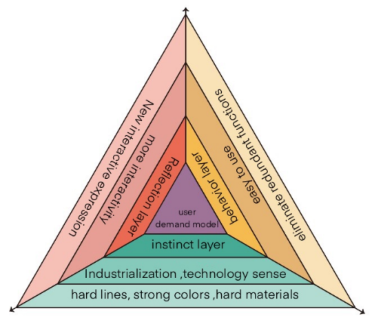
Figure 1: User demand model.
Different from other consumer goods, firefighter’s special call unit has a certain professional attribute, so the use of the crowd is relatively fixed, accor- ding to China’s national conditions and relevant needs, the application object is China’s fire officers and soldiers. In China, the physical age of the indivi- dual firefighting soldier is restricted from 18 to 35 years old, which belongs to the young and middle-aged population. And according to the national requirements, enlisted firefighters have good physical quality, after training, the body is stronger than the general youth. The respondents of the que- stionnaire in this paper are 17 active firefighters of Yulin Fire Brigade in Guangxi.
The questionnaire mainly includes five aspects: the user’s use of the special call unit type, wearing habits, usage preferences, functional requirements, and appearance preferences. Statistics are performed on the results of the questionnaire to understand the needs of firefighters. Through research and analysis, it can be seen that: (1) All types of special call units are ordinary firefighter’s special call units; (2) Belt and respirator straps are the main places for firefighters to wear their special call units; (3) More inclined to use duckbill clips; (4) The real-time temperature and the location of the callers should be displayed on the screen; (5) Among the buttons, manual alarm, switching screen information and voice intercom are the most important functions in sequence; (6) Appearance prefers industrial technology style.
A user demand model can be constructed through a questionnaire survey (see Figure 1). On the instinct level, users are more inclined to industriali- zation and technology; tough lines, strong colors, and hard materials are more in line with the needs. Behavioral users advocate removing redundant functions, highlighting the main functions, and the product should be usable and easy to use. The reflective layer emphasizes more interactivity, not just accepting instructions.
54 Yonghong and Ying
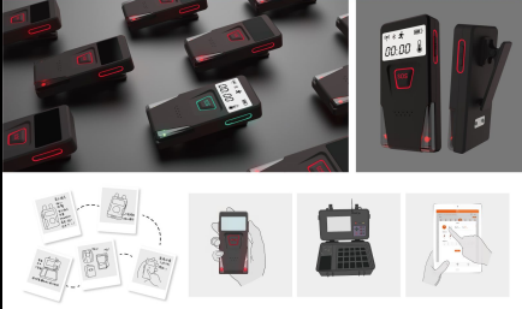
Figure 2: The scheme design of the rescuer.
EMOTIONAL DESIGN PRACTICE OF FIREFIGHTER’S SPECIAL CALL UNIT According to the user demand model, the design of the scheme starts from the shape, function and usage. Through the improvement of appearance, the upgrade of functional structure and the change of interaction mode, the use efficiency of the firefighter’s special call unit is improved, and the firefigh- ter has a different emotional experience. The product scheme is shown in Figure 2.
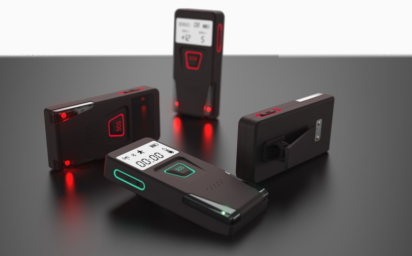
(1) Modeling Design of Firemen’s Special Call Unit - Instinctive Layer In recent years, the combination and aesthetic form of modeling design has attracted more and more attention (Durbin, Chen, Smith, et al, 2005). In the design of firefighter’s special call unit, based on the style of industrial science and technology, combined with the current popular trend, the whole is rela- tively flat square, can give a strong feeling, the button is rounded trapezoid, giving a sense of direction and touch; The buttons on the side are coordina- ted with the overall shape, and are handled in a square and rounded manner, giving people a stable and modern feeling.
The difference in color will affect people’s psychology. The temperature and saturation of the color can have hints on people’s psychology, and can also prevent production accidents. Black gives people a mysterious, tough and firm feeling, and the body shape of the caller can be made of black, giving people a sense of trust. The red light wave travels the farthest in the air and is easy to be found by people, so red light can be added to the rescuer for prompting. Bright colors can be set around the button to guide firefighters to the next step, and the product can be used efficiently in a dark environment. The effect is shown in Figure 3.
Limited by the working environment, firefighter’s special call unit need to meet the characteristics of high temperature resistance, explosion-proof, flame retardant, waterproof and so on. Therefore, polycarbonate is used as the appearance material of the units.
Design of Firefighter’s Special Call Unit based on Emotional Design Theory 55
Figure 3: The shape design of the rescuer.Table 1. Arrangement of functions of firemen’s rescuers.
Table available in the original PDF paper.
PART FUNCTION display
Show backcourt command
length of work
battery power
temperature
Altitude
The height, distance, number of the caller iPad
Read the temperature, altitude and other data of on-site personnel
Send retreat order
command rescue
View past alarm data
Set timed alarm and temperature alarm thresholds
Set personnel number and corresponding name (other information) back field receiver
Send data to tablet via Bluetooth
(2) Functional Design of Firemen’s Special Call Unit - Behavior Layer According to the questionnaire survey, the priority of firefighters’ functional requirements is collected, and the functions of the emergency caller are orga- nized and planned based on the results of the questionnaire survey and the ergonomic dimension definition, and the buttons and functions are matched, as shown in Table 1. The usage of keys is shown in Table 2.
(3) Interaction Design of Firemen’s Call for Help - Reflection Layer According to the user demand model, it is obtained that firefighters prefer to send fast and intelligent instructions in the way of use. Originally, the backfield receiving device used a black box computer for command, the com- mand sending process was complicated, and the interaction efficiency was low. On this basis, an intelligent terminal solution is proposed , which con- nects the handheld pad, the fire emergency caller and the command backyard to improve the efficiency of firefighters’ search and rescue. After entering the
56 Yonghong and Ying
Table 2. The way keys are used.
Table available in the original PDF paper.
KEY FUNCTION boot Long press the left button shutdown Long press the left button Toggle screen display information right click Manual alarm Press and hold the middle button Cancel the alarm Press and hold the middle button Confirm button Short press the left button Search and rescue completed Press the left button twice confirm evacuation left button switch mode right click pass the word Press and hold the right button for three seconds to start sending a message, release it to end
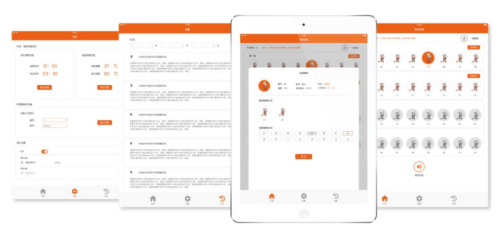
Figure 4: APP design.
homepage, 32 (4 groups) of firefighters can be detected in real time. When the firefighters turn on the caller, the corresponding icon on the APP will change to color, and the icon of the caller that is not turned on corresponds to black and white; according to the general firefighters grouping According to the rules, 8 people are divided into groups, and inspection, call, and retreat instructions can be sent to groups or individuals . When a firefighter presses the manual alarm button , the APP displays the detailed information of the firefighter, including altitude, temperature detection information, status, etc., click on the picture of the firefighter who calls for help to enter the designa- ted search and rescue interface, and the system intelligently recommends the distance according to the intelligent algorithm. For reference, the rear field commander can drag the avatars of the personnel to be dispatched to the search and rescue interface according to the actual situation and provide per- sonnel information, and press the “confirm button” to conduct search and rescue. The main interface of the Pad is shown in Figure 4.
CONCLUSION
This paper uses three-level theory of emotional design to investigate the needs of firefighters in terms of instinct layer, behavior layer and reflection layer,
Design of Firefighter’s Special Call Unit based on Emotional Design Theory 57
we can get the main points that can be improved in shape, function and use method, so as to improve the appearance of the product. Carry out innova- tion and function optimization and upgrade, complete the design scheme of fireman’s special call unit and rear field command APP, improve user experi- ence, improve work efficiency and reduce casualties during rescue, and hope that this article can provide new ideas for the design of firefighter’s special call unit.
SUPPORT FUND PROJECTS 2021 Teaching research project of Huazhong University of Science and Technology “Teaching Reform and Practice of Basic Curriculum Group of Design Subject oriented to Aesthetic Education”, project number: 2021069.
REFERENCES
Donald, A. N. (2015). Design Psychology 3[M]. Beijing. CITIC Press. Donald, A. N.(2005).Emotional Design [M]. Beijing: Publishing House of Electronics Industry, 2005. DR Durbin, Chen I, Smith R, etal. (2005) Effects of seating position and appropri-
ate restraint use on the risk of injury to children in motor vehicle crashes. EJ. Pediatrics. 2005. Sun Wenjie, Zhang Yuhong. (2015). The Emotional Design in Metro Platform Screen Door [J]. Packaging Engineering, 2015, 36(4): 68–71. Wu Yaojia, He Xiaomei. (2017). Application of Emotional Design in the Intelligent
Hardware [J]. Packaging Engineering, 2017, 38(18): 162–165. Zhao Fusen. (2013) Firefighter Personal Protective Equipment Industry and Technical Status and Future Development Direction [J]. China’s Personal Protective Equipment, 2013(03); 12–16. Zhao Fusen. (2013) Firefighter Personal Protective Equipment Industry and Tech-
nical Status and Future Development Direction [J]. China’s Personal Protective Equipment, 2013(03); 12–16.
LISTED IN THE AHFE DIGITAL BOOKSTORE CATALOGUE
Explore the complete digital volume
Affective and Pleasurable Design
Read this individual research paper free through the original publisher, or explore the full digital proceedings book.
ISBN 978-1-958651-17-9
Explore this ISBN in the AHFE Bookstore ↗Listed in the July 2026 bookstore catalogue; search by ISBN to confirm current availability · Digital book purchase optional