Marita Canina, Daniela Amandolese, Carmen Bruno (2022). Design for Sustainable Behaviour to design an Adaptive Climbing Wall. In: Design for Inclusion. AHFE Open Access, vol. 45, pp. 190–198. https://doi.org/10.54941/ahfe1001885
In recent years, Europe has been moving towards a concept of inclusivity as highlighted by the sixteenth goal of the 2030 Sustainable Development Goals Agenda that promotes peaceful and inclusive societies. (UN Dept. of Global Communications, 2015). The increasing awareness of social diversity has attracted the attention of designers who started to adopt an inclusive design approach and design products or services to be usable by as many people as reasonably possible, without the need for specialised adaptions. The inclusive design approach has been largely applied in adaptive sports to improve levels of functioning and independence in daily living activities and increase physical capability, physiological capacity, social status, and sense of belonging. Adaptive sports can become a way to promote involvement as an active part of the rehabilitation exercise to stimulate neuromotor recovery, particularly in children with disabilities (Canina et al., 2020). Recent research has demonstrated that climbing could be an excellent rehabilitation tool that involves the child with disabilities in a natural way. This sport exploits the propensity to play, to sport, to compete, to stimulate the execution of specific exercises, can transform this effort into a game and multiply the effectiveness of the rehabilitation process (Reljin, V., 2019). An intensive rehabilitation from an early age guarantees the recovery of part of their neuromotor abilities. In order to achieve better results in rehabilitation, adaptive sports must adopt a holistic approach to the user considering both the physical and the psycho-perceptual aspects, i.e. the ability to do it but also the feeling of fulfilment in doing it. However, current climbing walls do not include these aspects of the adaptive sport. An adaptive climbing wall design requires identifying a methodology that could lead to a coherent and effective solution, using explicit attention for inclusiveness. The paper describes the Design for Sustainable Behaviour (DfSB) approach adopted to design an adaptive climbing wall as a tool for the rehabilitation of children with Cerebral Palsy (CP) by identifying the sustainable, inclusive requirements that consider children’s diversity. The DfSb approach, as user- and use-centred design that create preconditions for a sustainable everyday life, considers the sustainability aspects from two essential points of view. The user's sustainable behaviour, in which inclusiveness is a fundamental part of these attitudes, and the product's sustainability that uses new recycled materials create a more natural environment (similar to climbing in natural environments). Indeed, the project considers first the sustainable behavioural aspects, spreading climbing as a tool to improve the health conditions of CP children, introducing them to climbing by making it accessible and inclusive, intending to help children with different abilities to build trust and awareness of their potentialities, and a sense of accomplishment while training problem-solving and decision-making skills. As a second point of DfSB, the climbing wall and holds are designed with sustainable materials (waste material content) that provide the feeling of natural stone considering the entire product lifecycle. This paper shows how the DfSB approach can support the definition of design requirements of a training tool introducing children with CP to climbing as a natural approach to rehabilitation, making it accessible and inclusive. The project brings children with disabilities closer to the adapted sport through an indoor and democratic recreational activity. Bibliography 1. AA.VV. (2020). What is inclusive design? Inclusive Design Toolkit. University of Cambridge. Retrieved from http://www.inclusivedesigntoolkit.com/whatis/whatis.html 2. Canina M., Parise C., Bruno C. (2020). An Inclusive Design Approach for Designing an Adaptive Climbing Wall for Children with CP. 3. DesignCouncil. (2020). What is the framework for innovation? Retrieved from https://www.designcouncil.org.uk/news-opinion/what-framework-innovation-design-councils-evolved-double-diamond 4. Dixon-Fyle, S., Dolan, K., Hunt, V., Prince, S.: Diversity wins! How inclusion matters, pp. 1–12. McKinsey Co. (2020) 5. Persson, H., Åhman, H., Yngling, A. A., & Gulliksen, J. (2015). Universal design, inclusive design, accessible design, design for all: different concepts—one goal? On the concept of accessibility—historical, methodological and philosophical aspects. Universal Access in the Information Society, 14(4), 505–526. 6. Reljin, V. (2019). Effects of Adaptive Sports on Quality of Life in Individuals with Disability. Williams Honors College, Honors Research Projects., 822. 7. United Nations Department of Global Communications. (2015). Transforming our world: the 2030 Agenda for Sustainable Development.
Sustainable design takes into account environmental, economic and social impacts enacted throughout the product lifecycle (Bhamra et al., 2011; Elkington, 1997). Whereas economic and environmental concerns are gene- rally well defined and understood, the social sphere of sustainable design is less so (Colantonio, 2007). In its broadest terms it can encompass personal responsibility, quality of life, health, well-being and happiness, democratic participation and cooperative behaviour among others (Polese and Stren, 2000, Baines and Morgan, 2004, Sinner et al., 2004, Colantonio, 2007). As highlighted by the 17 Sustainable Development Goals (SDGs), the heart of 2030 European Agenda for Sustainable Development provides a shared blueprint for wellbeing and prosperity for people and the planet, now and into the future. They show a holistic approach to sustainability, that sustai- nable design should increasingly consider in their actions. Indeed, designers shape the development of products and services, and their user experience, which directly impact upon people and the environment while promoting wellbeing and motivating a change in most of the users’ behaviour. Sustaina- ble design requires therefore the integration of an inclusive designer approach to better understand what users do with, and how they interact with produ- cts, as well as the hidden factors behind the daily decision-making process to create human-centred solutions that promote sustainable significant beh- aviour. This integration is particularly crucial when designing for disabilities,
Design for Sustainable Behaviour to Design an Adaptive Climbing Wall 191
for example in the field of adaptive sports that can improve wellbeing and quality of life of people with disabilities. Indeed, adaptive sports can become a way to promote the adoption of a more sustainable behaviour towards an improvement of personal and environmental wellbeing. In children with disabilities, adaptive sports can play an active role in the rehabilitation to stimulate neuromotor recovery, improving levels of functioning and indepen- dence in daily living activities, increasing physical capability, physiological capacity, levels of employment, social status and sense of belonging. Reh- abilitation tools that involve the child in a natural way, that exploit the propensity to play, to sport, to compete, to stimulate the execution of specific exercises, can be designed to effectively transfer the awareness and the atten- tion towards sustainable lifestyle habits that multiply the effectiveness of the rehabilitation process (Reljin, 2019). Habitual and routine behaviour contri- butes to the awareness–intention–behaviour gap between environmental and social values and everyday interaction with products (Bhamra et al., 2011). The paper describes the Design for Sustainable Behaviour (DfSB) approach adopted to design an adaptive climbing wall as a tool for the rehabilita- tion of children with Cerebral Palsy (CP) by identifying the sustainable and inclusive requirements that consider children’s diversity. This approach has been applied within the ACCEPT (Adaptive Climbing for Cerebral Palsy trai- ning) project, funded by the Polisocial Award 2019 contest of Politecnico di Milano, in which the authors are involved as Polimi design team. Indeed, the aim of the ACCEPT is to adapt the indoor climbing activity allowing chil- dren - specifically between 6 and 13 year-old - with Cerebral Palsy (CP) to rehabilitate, improve the motor movement experience, gain confidence and develop social communication skills (https://accept.polimi.it/). ACCEPT ado- pts the relevant dimensions of the Design for Sustainable Behaviour (DfSB) approach, presented in section 2, integrating a more holistic view of sustaina- bility that consider the mental, physical, emotional, social and environmental impacts of the climbing experience on the CP children, as a rehabilitation tool. The DfSB approach model that guided the design of the adaptive clim- bing experience, explained in section 3, has been applied through an inclusive design approach to involve in the design process the CP children and all the relevant actors that deals with their rehabilitation and the climbing sport: the children family, physiotherapists, climbing instructors, and the project resea- rchers. This allowed to identify the design requirement by broadly and deeply considering their needs, desires, knowledge, experience and expertise.
A HOLISTIC VIEW OF SUSTAINABILITY The quality of human life is strongly intertwined with the quality of the envi- ronment (Zawojska, 2011; Dietz et al., 2009; Corral-Verdugo, 2012). This realization resulted in numerous international and national initiatives such as the United Nations’ “sustainable development goals,” the Organization for Economic Cooperation and Development’s “better life index,” and the New Economic Foundation’s “happy planet index” (Durand, 2015; Dolan and Metcalfe, 2012; O’Brien, 2012). The well-being of the planet is indeed a crucial part of the physical, mental and emotional well-being of individuals
(Nordic Health Report 2030). We should therefore refer to sustainability from a holistic perspective by considering it as a combination of human and environmental wellbeing and their interaction and interconnectedness.
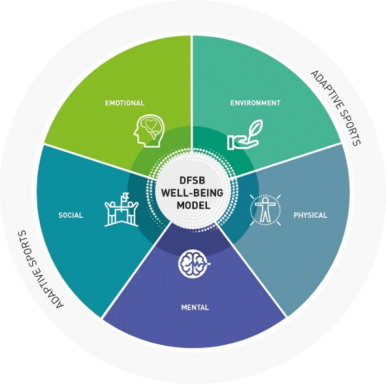
Well-being is a dynamic, ever-changing, fluctuating process (Ardell, 1986). Lifestyle habits very much influence health, well-being, and quality of life. Therefore, as highlighted by the Sustainable Development Goal 3, ensuring healthy habits and promoting well-being of the people and the planet is essen- tial to sustainable development. The DfSB approach is indeed a fundamental approach that can have a profound influence in altering users’ behaviour into more sustainable behaviour and habits for well-being (Boks, 2011). The design of a climbing wall for rehabilitation requires special attention for improving well-being and inclusiveness. A crucial step is the identification of the requirements needed to consider children’s diversity that allow to spread this sport as a tool to improve their health conditions. To define these requi- rements, it has been necessary to identify a sustainable concept of well-being that could lead to a coherent and effective solution. The concept of well-being is indeed not universally defined (Mackey, 2009), and is a holistic integra- tion of physical, mental, and spiritual well-being, fuelling the body, engaging the mind, and nurturing the spirit (UMD Report, 2017). It encompasses several interdependent dimensions that have been defined by many models across the literature. As the design team, it has been fundamental to consider our design’s impacts on sustainable behaviour by identifying the dimensi- ons of well-being that interrelate and interact with children’s needs, adaptive sport, societal needs, and environmental needs. Indeed, by using an inclu- sive design methodology (Canina et al., 2021) we interviewed and observed physiotherapists, CP children’ families, climbing instructor, that provided us the insights enabling the identification of the requirements to design the new climbing experience that will promote sustainable well-being habits in CP children. Starting from the analysis of the existing model of children’s well-being (CASCW Report, 2015; Nordic Health Report 2030, 2019) we intersected the interview results to selected the most relevant dimensions of well-being and define a new ad hoc model of well-being. The DfSB Well-being model addresses the idea of a holistic approach to inclusive and sustainable well-being for a rehabilitation purpose. As shown in fig. 1, the model inclu- des 5 main dimensions - physical, mental, emotional, social, environmental - here briefly described.
Physical_ The physical well-being dimension refers to children’s ability to care for their bodies through prevention and management of physical illness and engagement in healthy behaviours (CASCW Report, 2015). Indeed, phy- sical well-being is not merely the absence of illness, but about maintaining an active lifestyle and discovering what healthy habits make children feel better and suit their lifestyle and level of mobility and fitness. The CP chil- dren should be able to gain a holistic understanding of their physical health, recognizing the physical activity and rehabilitation movement they should perform to improve their well-being taking care for their body.
Mental_ Well-being as mental health refers to the children’s intelle- ctual potential and engagement in activities that promote growth, curiosity, and identity development (CASCW Report, 2015). This domain includes
Design for Sustainable Behaviour to Design an Adaptive Climbing Wall 193
Figure 1: Visualization of the DfSB Well-being model management of time and responsibilities and engagement in interests and hobbies. Mental well-being encourages participating in mentally stimulating and creative activities. It is the ability to think critically, reason objectively, make responsible decisions, and explore new ideas and different points of view. It also emphasizes lifelong learning and inspires curiosity.
Emotional_ This dimension is relative to children’s self-esteem and their ability to cope with adversity and manage emotions in a constructive way and improve their self-confidence. Emotional well-being encompasses optimism, self-esteem, self-acceptance, and the ability to experience and cope with fee- lings independently and interpersonally. It also includes finding unique ways of coping with stressors and empathizing with others.
Social_ In our framework, well-being is an inclusive social dimension which means children are able to maintain healthy relationships with peers, enjoy being with others, develop friendships and intimate relations also through practising sport. This domain includes children’s sense of trust and sense of belonging (Nordic Health Report 2030, 2019): they must be able to rely on a network of people that can support their well-being by deve- loping a sense of connection. Social Well-being focuses on connecting with the people around children and encourages not only developing meaningful relationships but creating safe and inclusive spaces.
Environment_ This framework dimension refers to the children’s rela- tionship and connection with nature (CASCW Report, 2015) and their commitment to a healthy planet. It includes the children’s sense of impact (Nordic Health Report 2030, 2019), i.e. the ability to positively impact their health through their actions. Environmental well-being inspires children to live a lifestyle that is respectful of their surroundings. It involves under- standing the dynamic relationship between the environment and persons, recognizing their responsibility for the quality of natural elements and that social, natural and built environments affect people’s health and well-being.
DFSB WELL-BEING MODEL & ACCEPT PROJECT The project main goal was to explore and promote the role of sport climbing as a therapeutic tool, an inclusive training solution, and a means of tracking rehabilitation progress to children with Cerebral Palsy disease. Indeed, CP is a permanent movement disorder that affects a person’s ability to move and maintain balance and posture, while climbing is a physically demanding activity that requires concentration, motor planning and sequential thinking. Several studies, reports that climbing training has the potential to serve as a new rehabilitation method for training the whole motor system (Marianne Anke et al., 2011). There are already few programs around the world, which aim to use indoor climbing sport as a tool for rehabilitation of people with disability of their body. Despite that in the market there are not many ada- ptive climbing products, not to mention cerebral palsy. Therefore, the project faced the challenge to design a new climbing experience for CP children to promote a sustainable attitude towards their well-being. ACCEPT has been designed considering the several dimensions of wellbeing included in the DfSB Well-being model to promote and spread climbing as a tool to improve the wellbeing of children with a different ability from a holistic perspective. For the sake of clarity, the new climbing experience is described according to the 5 sustainable dimensions of the model to highlight and emphasize all the requirements, emerged during the interviews, and answered by the pro- ject. However, these dimensions are strictly interconnected among them and influence each other.
To meet the physical dimension of the DfSB model the ACCEPT pro- ject designed an engaging platform to support rehabilitation and clinical assessment that includes a hi-tech adaptive climbing structure and specially designed holds that facilitate typical rehabilitation exercises with scalable dif- ficulty according to participants. The climbing wall is equipped with sensors that evaluate the children’s motor performance as they use the wall, to sup- port a continuous clinical assessment thus reducing the need for costly and time consuming in-hospital sessions. A dedicated software interface will pro- vide specialists with valuable data to guide therapy and modulate exercises based on observed progress. Indeed, the sensors implemented in the wall enable different activities to be tested during motor rehabilitation sessions, providing the medical staff with a valid tool for qualitative and quantita- tive analysis of progress in a context that is stimulating and functional for the child. ACCEPT helps children practise balance, become aware of the body’s different parts, and increase muscle strength. An initial co-design ses- sion, involving therapists, climber instructors, researchers and CP children’s families, also revealed the need for ad-hoc holds that favour therapeutic exercises as part of the climbing movements, and create perceptual path- ways to engage the child. Holds with different textures, properly installed on the wall, can stimulate the tactile sensitivity of the plegic limbs. Subse- quent expert interviews allowed the design team to identify four upper limbs movements that need particular focus during the rehabilitation/climbing acti- vity: hand prone-supination, hand opening, thumb opposition, and elbow extension. Holds (patent pending) were designed to respond to these needs,
Design for Sustainable Behaviour to Design an Adaptive Climbing Wall 195
obtaining a platform that is a unique and powerful message of inclusiveness and hope. The holds integrate in their shape various sizes, a larger section and the thinner that is more challenging to grip, and different textures to improve fingers sensitivity. By adopting an inclusive design approach, ACCEPT directly involve the CP children allowing them to improve their well-being through physical activity achieve a holistic understanding of their physical health.
ACCEPT introduces CP children to climbing making it accessible and inclusive, intending to help children with different degrees of disability build trust and awareness of their potentialities and a sense of accomplishment while training problem-solving and decision-making skills. ACCEPT has been designed to become a climbing experience for CP children to engage them from the cognitive point of view. These aspects completely satisfy the men- tal dimension of the well-being model. The climbing experience, indeed, take in consideration three main moments that can benefit the rehabilita- tion activity improving children well-being: a pre-activity, a during-activity and a post-activity. In the pre-activity children are involved in an activity to identify the preparatory routes for climbing. They are indeed invited to obse- rve their peers and to learn from their moves. This process of observation activates the mirror neurons, fundamental for understanding the actions of other people, and for learning new skills by imitation. The climbing activity can be designed as a specific route defining the specific placement of holds that children could follow to be engaged cognitively and from the emotio- nal point of view. The route can indeed lead children to reach a goal placed in a specific spot of the wall (e.g. ring a bell, pick up a toy,…) making the climbing experience satisfactory. Rewarding children represent an incentive for children to perform the rehabilitation activity continuously in the post experience.
ACCEPT, appropriately configured through a human-centred approach, enable CP children to perform typical rehabilitation movements in the con- text of a game. This involves the emotional dimension and makes them feel like protagonists in the climbing game. Indeed, the rehabilitation practice requires a lot of effort from the children and providing them with an ada- ptive climbing tool represents a way to engage them more effectively in the therapy. Speaking of rehabilitation therapy, it is always good to make the work rewarding. The game that promotes a privileged psycho-affective and relational setting would favour motor skills and exploit the creative chan- nel. The playful learning context stimulates creativity and intentionality, but it is a therapeutic approach of a new meaning, in which the solution of the problem built in a playful environment aims at the exercise of predetermined and repetitive patterns. Regardless of disabilities, almost all children enjoy playtime, and play therapy helps them learn to express themselves better. Although playing tends to be natural and comes easily for most children, those with cerebral palsy may find it a bit more challenging than others. The inclusive approach adopted to design the climbing tool allows children with different abilities to climb and be together. This opportunity helps the CP children improve their physical disease and increase their self-confidence and self-esteem, improving their emotional dimension.
ACCEPT was designed with the twofold intent of being the proof of concept of a technological rehabilitation platform and a message of inclusion, of a democratic and accessible form of sport and rehabilitation, inspiring a healthier, more inclusive and sustainable lifestyle. Therefore, sustainability, inclusion, and aesthetics were pillars on which the whole project was foun- ded and the metrics by which its achievement can be measured. ACCEPT is unique and effective in overcoming the main barriers to sporting acti- vity for CP children: the modular wall is easily adaptable to placement outdoor as well as indoor in widely different contexts, without the need to redesign and certify the structure. It represents a tool for inclusion and aggregation covering the social dimension of DfSB model. It offers the oppor- tunity to perform an activity that does not require expensive equipment for practice, taking advantage of the support of para climbing instructors trai- ned to initiate into the sport of Paralympic disciplines. In this, ACCEPT stands as a successful example of collaboration between researchers and experts from extremely different backgrounds, from design to engineering to medicine and sports sciences. It brightly illustrates how such collabora- tion can be fruitful and necessary to address the complexity of these societal issues.
Currently, many commercial climbing holds are made of polyurethane since it is lighter, more flexible, and less prone to chipping and breakage than other materials. However, ACCEPT decided to adopt different mate- rials to meet the environmental dimension of the DfSB model to drive user behaviour in the adoption of more sustainable and healthy practices tow- ards our planet (Bhamra and Lofthouse, 2007). The design team performed an analysis of the most suitable materials to adopt for climbing wall and holds to select the most suitable materials in terms of performances and sustainable life cycle. ACCEPT, indeed, is designed with sustainable mate- rials, considering the entire product life cycle. The adapted climbing holds are made of Stone 3D Printing, a highly sustainable 3D printing techno- logy1 that uses residual waste powder from the stone industry to create strong, durable, and affordable structures. This eco-friendly inkjet techno- logy offers durability and superior performance while using less material. The supporting structure is made of FSC®-certified okoumè plywood2, a symbol of responsible forest management. This material is more durable and weather-resistant; it is a domestic wood, and no chemical processes are used for varnishing. ACCEPT was designed to encourage sustainable behaviour, popularizing climbing as a form of minimal-impact outdoor activity, a heal- thy lifestyle for people with and without disability and an incentive to an eco-friendly outdoor activity. This philosophy is embodied in the choice of hosting ACCEPT at PlayMore!, an urban sporting centre that is entirely out- door. Regular physical activity enhances well-being and contributes to the delay of chronic disease, and in this context, ACCEPT brings children with and without disabilities closer to the practice of sport through an outdoor and democratic recreational activity. More broadly, by designing ACCEPT as an outdoor and publicly accessible structure, we reconnect urban users with the outdoors and instill the appreciation of the outdoor space, both urban and natural.
Design for Sustainable Behaviour to Design an Adaptive Climbing Wall 197
CONCLUSION
The increasing awareness of social diversity has prompted designers to cre- ate solutions to foster independence in everyday tasks. Among the effects of CP are a variety of motor disabilities that impair a person’s ability to move, maintain balance, perform daily tasks. Climbing, on the other hand, is a physically demanding, highly symmetric activity that requires concentration, motor planning, and sequential thinking, and is regarded by practitioners as a promising tool to counteract the effects of CP and other neurologic disorders. The ACCEPT project’s ambition was to explore and promote the role of adapted climbing as a therapeutic tool, an inclusive training solution, and a means to track and support rehabilitation. ACCEPT, starting from the standard climbing wall, optimized ergonomics, materials, appearance and meaning to obtain a structure that is profoundly adapted to its scope. In this transformation the design team defined a DfSB well-being framework, consi- dering environmental, economic and social impacts throughout the product lifecycle and considering user behaviour to drive the development of a pro- duct that encourages sustainability. ACCEPT provides not only an accessible and inclusive path to sport and rehabilitation but by inspiring children with a healthy passion for outdoor physical activities, a passion that is easily tran- sferable to a more sustainable and healthier lifestyle as adults. The resulting structure is open to public and used weekly by over 260 children, including 29 with disabilities, and 22 with other forms of socio-economic fragility. Its impact on children well-being is currently under evaluation to consequently implement the opportunities to reproduce it nationwide.
REFERENCES
8 Dimensions of Wellness, (UMD) University of Maryland’s Your Guide to Living Well. [Last accessed June 27, 2017]. Available from: https://umwellness.wordpre ss.com/8-dimensions-of-wellness/ Ardell D.B. (1986) Definition of Wellness. Ardell Wellness Report, 18:1–5 Canina, M. R., Parise, C., & Bruno, C. (2021). An Inclusive Design Approach for Designing an Adaptive Climbing Wall for Children with CP. In Congress of the International Ergonomics Association, 180–188, Springer, Cham. Center for Advanced Studies in Child Welfare, CASCW Report (2015), at the Univer-
sity of Minnesota, Well-being Indicator Tool for Youth (WIT-Y) Available from https://mch.umn.edu/resource-well-being-indicator-tool-for-youth-wit-y/ Christensen, M.S., Jensen, T., Voigt, C.B., Nielsen, J.B., Lorentzen, J. (2017), To be active throughindoor-climbing: An exploratory feasibility study in a group of children with cerebral palsyand typically developing children. BMC Neurol.17, 1–20. Corral-Verdugo V. (2012) The positive psychology of sustainability. Environ. Dev.
Sustain., 14:1–16. Dietz T., Rosa E.A., York R. (2009) Environmentally efficient well-being: Rethinking sustainability as the relationship between human well-being and environmental impacts. Hum. Ecol. Rev.16:114–123. Dixon-Fyle, S., Dolan, K., Hunt, V., Prince, S. (2020), Diversity wins! How inclusion
matters, pp. 1–12. McKinsey Co.
Dolan P., Metcalfe R. (2012), Measuring subjective wellbeing: Recommendations on measures for use by national governments. J. Soc. Policy, 41:409–427. Dong, H., McGinley, C., Nickpour, F., Cifter, A.S. (2015). Designing for designers:
insights into theknowledge users of inclusive design. Appl. Ergon.46, 284–291. Durand M. (2015), The OECD better life initiative: How’s life? And the measurement of well-being. Rev. Income Wealth, 61:4–17. doi: 10.1111/roiw.12156. Hunt, V., Prince, S., Dixon-Fyle, S., Yee, L. (2018). Delivering through Diversity, p.
42. MckinseyCo. Marianne Anke, S., Sylvie, K., Jérôme, P., Shahid, B., Thomas, F., Dieter Georg, R., & Karin, D. (2011). Effect of long-term climbing training on cerebellar ataxia: a case series. Rehabilitation research and practice vol. 2011, 8 pp. O’Brien C. (2012), Sustainable happiness and well-being: Future directions for
positive psychology. Psychology, 3:1196. doi: 10.4236/psych.2012.312A177. Reljin, V. (2019). Effects of Adaptive Sports on Quality of Life in Individuals with Disability. Williams Honors College, Honors Research Projects., 822. United Nations Department of Global Communications. (2015). Transforming our
world: the 2030 Agenda for Sustainable Development. Waller, S., Bradley, M., Hosking, I., Clarkson, P.J. (2015), Making the case for inclusive design.Appl. Ergon.46, 297–303
LISTED IN THE AHFE DIGITAL BOOKSTORE CATALOGUE
Explore the complete digital volume
Design for Inclusion
Read this individual research paper free through the original publisher, or explore the full digital proceedings book.
ISBN 978-1-958651-21-6
Explore this ISBN in the AHFE Bookstore ↗Listed in the July 2026 bookstore catalogue; search by ISBN to confirm current availability · Digital book purchase optional