Eva Monestier, Tatiana Efremenko, Maria Ida Fiore, Marita Canina (2024). Beyond Boundaries: Art-Tech Collaboration Driving Future-Oriented Innovation. In: Creativity, Innovation and Entrepreneurship. AHFE Open Access, vol. 125, pp. 134–143. https://doi.org/10.54941/ahfe1004729
The current innovation landscape, shaped by digital transformation and increasing complexity, force businesses and creators not only to enhance their technological and innovation capacity, but also address sustainable and societal challenges. To do so, it becomes paramount to rethink creative approaches for innovation to move beyond traditional human-centred frameworks that often lack a future-oriented and inclusive visions (Canina et. al, 2021) in favour of a more holistic conception of innovation for planetary well-being. Art and Technology collaboration emerges as a promising avenue, enabling artists and companies to design sustainable solutions and contribute to societal and environmental impact. While such collaboration offers significant opportunities, challenges hinder its potential. A key obstacle is the absence of a strategic, vision-led process, often implemented ad hoc. Futures Thinking is proposed as an approach to provide artists and companies a common ground for collaboration. This article explores the potential of Art-Tech collaboration for innovation, grounded in the Horizon Europe MUSAE project. The project aims to overcome collaboration challenges by defining a novel collaborative model, exploring the role of futures thinking in facilitating cross-disciplinary dialogue between art and technology. This approach enhances the Art-Tech collaboration process, driving innovation in a future-oriented and responsible manner. The conclusion underscores the potential of this cross-disciplinary approach to foster sustainable innovation through equal collaboration, emotional exploration, strategic tools, and anticipation of technological advancements' impact on people and the planet.
Considering the highly uncertain, complex, and ambiguous contemporary times, a networked, collaborative, and integrative approach among differ- ent stakeholders is essential to achieve European sustainability goals (Klein et al., 2021). Moreover, to thrive in the current digital era and reach inno- vation, research shows that companies and organizations need to leverage people’s creative attitudes to find original future-proof solutions (Vocke et al., 2020). Indeed, creativity - coupled with critical thinking and emotional intel- ligence - has been recognized to be one of the key abilities for the future
world of work (Leopold et al., 2018). Therefore, to stay competitive in such a transforming world, companies need to pursue new strategies that aim for, on the one hand, a more structured collaboration among different stakeholders and, on the other hand, the valorization of creativity within innovation processes to deliver farsighted sustainable solutions. To enhance creative potential, a worthwhile opportunity for high-tech companies lays in the incorporation of artistic input within traditional corporate processes1. Artists are often considered to be innovators able to generate original and cre- ative ideas (Schnugg & Song, 2020). Indeed, through creative thinking, they can stimulate reflection and discussion in organizational settings (Meisiek and Barry, 2018). Thus, art-driven contributions might foster unconventional and playful explorations of new technologies’ potential, as well as provide critical perspectives on the value of technology for society and its impacts1. Several experiments have demonstrated that Art-Tech collaboration repre- sents a win-win opportunity for organizations and corporations to achieve innovation (Schnugg & Song, 2020).
The paper will explore the potential of bringing art-driven approaches into innovation processes. Highlighting its pros and cons, the paper will demon- strate that Art-Tech collaboration should be sustained and fostered by a new, structured creative process oriented towards the future to address contempo- rary challenges and deliver sustainable solutions. In this regard, the value of Futures Thinking in Art-Tech collaboration will be investigated introducing the Horizon Europe project MUSAE.
OPPORTUNITIES OF ART-TECH COLLABORATION In the rapidly evolving technology landscape, challenges grow alongside its pervasive influence on daily life, making the integration of artistic expertise into technical domains a necessity (EUNIC, 2019). Despite technologies being developed in siloed engineering fields, their effects extend beyond, reaching social, environmental, political, and other domains. New and diverse perspec- tives are needed for the operationalization of these technologies (O’Dea et al., 2020). Art, focusing on the social and cultural implications of technological development (Mitchell et al., 2003), represents a shift in mindset that holds promise for innovation. Incorporating artistic thinking into tech companies can act as a catalyst, prompting a transformative re-evaluation of our rela- tionships with established paradigms, norms, and routines (Whitaker, 2016). This section explores the benefits and opportunities of Art-Tech collaboration as a relevant strategy for future innovation.
Opportunity 1: Enhancing tech innovation with critical thinking. A review of the key future competencies shows the growing importance of critical thinking, relevant both for future individual abilities, and for businesses to grow and contribute to the economic development in the coming years (Visvizi et al., 2021). Artists possess the ability to broaden the mentality and perspectives of vision, encouraging decision-making processes through critical thinking (Purg et al., 2023). As proved by the method developed 1S+T+ARTS (2019) https://starts.eu/wp-content/uploads/brochure-starts-residencies.pdf
by Fondazione Casoli of collaboration between managerial community and artistic community, both co-present in the factory places, art enhances tech- nological innovation by providing critical reflections, and provocations to produce unconventional ideas, enabling the generation of creative solutions to complex and interconnected problems (Deborah et al., 2022).
Opportunity 2: Diffusing creative environment in organizational settings. In many corporate settings, vertical structures are commonly employed for overall operational efficiency. However, transitioning to more horizontal approaches has potential to foster knowledge sharing between stakeholders (Friesl et al., 2011). Inclusion of artists in the organizational environment enhances knowledge exchange, induces creative spillovers, transforms orga- nizational hierarchy, and catalyses innovation in processes and products (European Commission, 2012). Tested in many artists-in-residence initiatives at high-tech companies (O’Dea et al., 2020), artists actively engaged with employees, fostering a creative mindset, while also acquiring technical and entrepreneurial skills.
Opportunity 3: Bringing emotional value to strategic process. Hamel (2000) argues for an economy driven by emotions, values, and dreams, termed “an economy of hearts.” The creative industry pioneers incorporating the richness of the human condition into entrepreneurial thinking (Forminca & Edmonson, 2020). In Art-Tech collaboration, creativity injects a human- centered perspective into business, using emotions for sensitive innovation, like designing new hardware in a more empathetic way (EUNIC, 2019). Artistic approaches bring empathy to technology’s consequences, influenc- ing future forecasting (UN Global Pulse, 2024). Minski (2020) recommends blending open-ended (art, design) and closed-ended (enterprise, company) approaches to turn artistic ideas into user-friendly solutions with emotional connections. Arts-based initiatives enhance emotional intelligence, promot- ing exploration of skills complementary to the strategic field (Simeone et al., 2018).
CHALLENGES OF ART-TECH COLLABORATION While Art-Tech collaboration holds great potential for innovation, creativity does not spread by integrating artists in the company; it arises from a thought- fully balanced collaboration that creates a space for meaningful interaction and exchange (Raviola & Schnugg, 2016). Yet, setting up such space presents a range of challenges that need to be addressed to make collaborations effec- tive and fruitful. The following section will introduce the challenges present in this field.
Challenge 1: Communication and language barrier between art and business. Despite their coexistence and interaction, there is an enigmatic relation marked by a sense of alienation and separation. The different back- grounds of art and business impact their communication, with companies perceiving artists as reluctant to abandon their artistic identities in the cor- porate environment. Artists, on the other hand, are concerned about the use of unsuitable technical and strategic language. This highlights the need for a shared language tailored to collaborative needs (Strauß, 2017; EUNIC, 2019).
Challenge 2: Divergence of priorities and objectives in the working process. Artistic interventions in organizations involve diverse stakeholders (artists, managers, employees), each with unique worldviews and motivations. Rec- ognizing misalignments in intentions is crucial for successful Art-Tech col- laborations (O’Dea et al., 2020). The research highlights the varied interests of artists’, from provoking change to earning income, as well as of man- agers to pursue creativity, change, or financial gains. Lack of engagement from all stakeholders compromises potential benefits (TILLT Europe, 2009). Establishing a creative process with common objectives is vital for successful artistic interventions (McNiff, 1998).
Challenge 3: Lack of vision-led and structured collaboration process at the intersection of art and science within organizations. While collaboration programs have potential at individual and organizational levels, measuring outcomes is challenging, and long-term effects are hard to determine. The absence of standardized models for artist-technologist collaborations leads to independent program development and limited cross-pollination of success- ful approaches. Arts-related work in tech companies often lacks a strategic or vision-led approach, resulting in limited impact (EUNIC, 2019). This high- lights the need for unified frameworks, systems, and training to spread the value of art-tech programs and provide replicable models (Shnugg & Song, 2020; EUNIC, 2019). The challenges outlined provide insights into potential risks in Art-Tech engagements, emphasizing the necessity for a more effective collabora- tion between the tech industry and the art world. This entails establishing common ground, aligning language and vision, and creating standardized collaboration models, drawing from existing experiences and best prac- tices (EUNIC, 2019). Given the peripheral status of Art-Tech collaboration in management practice, a structured synergic framework is crucial for institutionalization within organizations and fostering innovation pathways (Schnugg & Song, 2020). The subsequent section illustrates the value of Futures Thinking in setting shared goals for sustainable and responsible innovation, bridging the gap between art and technology realms.
FUTURES THINKING TO EMPOWER ART-TECH COLLABORATION Futures Thinking is a cognitive approach and method for building a well- informed decision-making process by anticipating significant future changes (Bühring & Liedtka, 2018). Societal challenges compel innovation processes to not only pursue technological advancements but also formulate strate- gies with consistent visions of the future (De Smedt et al., 2013). Traditional models of technological innovation often fall short in addressing holistic and intertwined challenges (De Smedt et al., 2013; OECD, 2011). Employed across diverse range of disciplines, Futures Thinking navigates complex- ity by exploring beyond the horizon, identifying trends, envisioning futures opportunities, and acting on them (Buhring and Liedtka, 2018).
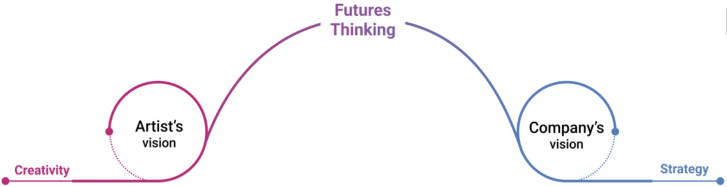
Building upon the potential of Art-Tech collaboration, we argue that Futures Thinking can serve as a bridge between the creative vision of the artist and the strategic vision of the company for innovation. Both visions are
representations of the future, yet they pursue different objectives and employ different tools. While artist’s vision of the future is primarily driven by creativ- ity and critical reflection, company’s vision of the future is primarily steered by strategic goals. Thus, Futures Thinking can serve as a common ground for envisioning futures both creatively and strategically (Fig. 1).
Figure 1: Futures thinking to bridge the gap between creativity-driven and strategy- driven visions of innovation.
In particular, Futures Thinking can facilitate Art-Tech collaboration by providing artists and companies with i) a framework to create a shared vision and facilitate inter-disciplinary collaboration; ii) a structured and data-driven approach to achieve innovation; iii) the abilities to anticipate and lever- age opportunities of emerging technologies; iv) the opportunity to empower decision-making process with creativity-driven approaches grounded on empathy; v) tools and methods to envision alternative futures and start moving towards the most preferable one. The above-mentioned features of Futures Thinking that can benefit Art-Tech collaboration are described in detail in the following sections.
Futures Thinking to create a common ground for shared language and col- laboration visioning. Futures Thinking can be implemented in various modes - either independently by certain experts, or collectively by involving different stakeholders to create the future vision together. The latter type is becoming more widespread in the futures-oriented practices (Nikolova, 2013), as it equips participants with tools and methods to follow a structured process of future making and align on common vision of the future (Inayatullah, 2008). Indeed, one of the characteristics of Futures Thinking is its ability in creat- ing a common language and shared understanding between various types of stakeholders (De Smedt et al., 2013). Thus, Futures Thinking can provide an overall framework for creating a shared ground and align diverse objectives of stakeholders to support innovation process by employing creativity and strategy-driven vision-building process.
Futures Thinking for technology foresight. Technology foresight is piv- otal in current strategic management, emerging as a crucial discipline to identify drivers and signals, shaping desirable futures and averting chal- lenges (Apreda et al., 2016; Miles, 2010). Technology foresight anticipates and assesses impacts of new technologies, requiring a systemic approach for unbiased future overviews (Martin, 1995; Mulder, 2013). It serves as a cru- cial resource for companies gaining competitive advantage and individuals
becoming resilient professionals (Mulder, 2013). In Art-Tech collaboration, technology foresight acts as a convergence point for artistic anticipation and company expertise in technology domain.
Futures Thinking to guide innovation with “preferable futures”. Analytical futures thinking, coupled with an artistic approach, enables the exploration of alternative scenarios and the selection of the most favourable one for the planet and society. In futures studies, these scenarios are called “prefer- able futures” (Raudsepp-Hearne et al., 2020), closely tied to the emotional sphere (Voros, 2001). The selection of these futures is subjective, based on individual or collective moral values (Canina et al., 2022). Using preferable futures for innovation helps overcome the challenge of our thinking limited to only current aspirations, which limits our ability to make radical visions for deep systemic transformations (Pereira et al., 2018). Thus, Futures Think- ing has potential to steer art-tech innovation in mapping preferable future orientations and strategically acting upon them.
Futures Thinking to anticipate change through a systematic approach. Futures thinking involves a variety of methods to systematically scan the future and tackle complexity by analysing trends, exploring the implications of events, and creating futures scenarios. This allows to make informed deci- sions already in the present to achieve the future vision and develop strategies to adopt to forthcoming changes. Indeed, future readiness became one of the imperatives for companies to survive and operate in the current environment (Smith & Ashby, 2020). The ability to anticipate changes is closely related to considering the consequences and implications of innovation, which is the core principle of responsible and sustainable innovation (Nordmann, 2014). Nordmann (2014) further argues that anticipatory thinking requires imagi- nation, creativity, and critical reflection to foresee the impact of technological innovation. Thus, while Futures Thinking employs a set of tools and meth- ods to scan the environment for possible implications, it also needs to be leveraged by creative and imaginative input into the structured process of future-making.
Futures Thinking to evoke empathy and creativity in decision-making. Emerging directions in futures studies, such as Experiential futures (Candy et al., 2019), Speculative futures (Dunne and Raby, 2013) enable immersive engagements with future narratives, aiming to bring up emotions to ques- tion the future(s) (Vallet et al., 2020). Lederwash (2012) similarly argues that futures scenarios stimulate creative thinking and evoke empathy, which makes the decision-making process in sustainable transitions more holistic by outlining long-term implications of social, economic, political, and environ- mental aspects. By encouraging emotional exploration of alternative future scenarios, Futures Thinking facilitates the creation of more responsible and inclusive actions for just transitions.
Thus, innovating for the future goes beyond merely technological advance- ments, requiring consideration of implications. To anticipate the opportu- nities and threats of innovation, a future-driven approach is essential. As it was identified, anticipating, and building a future vision requires both strategic and creative attitudes. Today, Futures Literacy and Futures Think- ing are widely considered to be the key skills in the 21st century (UNESCO,
2023), while future-mindedness has become one of the crucial requirements for the modern economy (Smith & Ashby, 2020). As a result, developing and integrating new interdisciplinary collaboration models driven by Futures Thinking into the processes of innovation becomes imperative.
A Framework for Art-Tech Collaboration Fuelled by Futures Thinking The article highlights Art-Tech collaboration’s opportunities and challenges, as well as identifies Futures Thinking as a bridging approach. To address these challenges in Art-Tech collaboration, a new methodological and struc- tured approach is needed. The MUSAE Horizon Europe project, initiated in 2022, by a multi-disciplinary consortium of art, design, tech institutions and companies, aims to create a collaborative model for Art-Tech innovation. The collaborative model lies on three essential components, which are the futures-driven method, people, technology, and environment. People, implies artists and technology companies collaborating and creating a shared space to ensure an inter-disciplinary approach for responsible and disruptive inno- vation. As highlighted in the previous sections, a great opportunity is creating a shared language in favour of knowledge exchange and objectives, as well as vision alignment between both parties. Technology is key to provide an experimental ground to explore and test technological developments. Pre- vious sections highlighted that a holistic approach towards innovation can lead to consider technology under its implications on societal, environmen- tal, political, and economic areas. And finally, Environment is essential to create a platform for interaction between a variety of stakeholders, experts, and citizens. The challenges outlined earlier in the article underscore the crit- ical importance of active engagement from all stakeholders for the successful development of art-tech collaborations, ensuring that the innovation process is reflexive, democratic, and sustainable. The core Method of this framework is positioned at the centre and is thought to methodologically guide the col- laboration between the three elements of the framework. Futures Thinking as an approach with diverse tools and activities enables artists and companies to experiment and innovate in a creative and strategic ways. The collaborative model proposed by MUSAE project will be operationalised in the format of Art-Tech residencies during the project with artists and companies working together on envisioning future scenarios in the domain of Food as Medicine. Together they will address the future challenges to develop innovative proto- types that improve people and planet wellbeing. In this case, the collaborative model has potential to boost innovation processes by leveraging the comple- mentarity of creative and strategic visions and creating a common ground and language for artists and companies.
CONCLUSION
The paper emphasizes the value of artistic input in corporate processes, high- lighting benefits and challenges. While creative thinking, critical reflection, and emotional intelligence enhance innovation, communication barriers, divergence of priorities, and the lack of a structured process hinder collab- oration. The authors propose Futures Thinking as a bridge between artists’
creative vision and companies’ strategic vision, facilitating a shared language and guiding technology foresight. The integrated art-driven approach holds promise for a more sustainable future. The framework proposed by the authors offers a structured approach to navigate the complexities of Art-Tech collaboration, fostering creativity, empathy, and foresight for innovative and impactful outcomes. The framework will be tested and implemented within the MUSAE Horizon Europe project, where artists are working together with companies to envision future preferable scenarios and create future-driven prototypes.
ACKNOWLEDGMENT
This paper presents reflections from the research tasks carried out by the authors within the MUSAE. A Human-Centred Factory for a Future Tech- nological Sustainable Development driven by Arts Project. This project has received funding from the Horizon Europe Framework Programme under grant agreement No. 101070412. The views expressed in this paper do not necessarily reflect the views of the EC.
REFERENCES
Apreda, R., Bonaccorsi, A., dell’Orletta, F., Fantoni, G. (2016). Functional technology foresight. A novel methodology to identify emerging technologies. Eur J Futures Res, 4(13), doi: 10.1007/s40309-016-0093-1. Canina, M., Bruno, C., Monestier, E. (2022). Futures Thinking. In: The Palgrave
Encyclopedia of the Possible. Palgrave Macmillan, Cham. https://doi.org/10.1007/ 978-3-319-98390-5_272-1 Barry, D., & Meisiek, S. (2010). Seeing More and Seeing Differently: Sensemaking, Mindfulness and the Workarts. Organization Studies, 31, 1505–1530. https://do i.org/10.1177/0170840610380802 Bühring, J., & Liedtka, J. (2018). Embracing systematic futures thinking at the
intersection of Strategic Planning, Foresight and Design. Journal Of Innova- tion Management, JIM 6(3), 134–152. https://doi.org/10.24840/2183-0606_006- 003_0006 Care’, D., Smarrelli, M., & Paolino, C. (2022). Innovating Business with Art: The Fondazione Casoli Method. Egea Bocconi University Press. EUNIC. (2019). Art + Tech Report: Stakeholder Investigation. Available at: https://europeanspacesofculture.eu/media/site/db6c5860aa-1618836362/art- tech-report-2019_eunic-silicon-valley.pdf. ESDN. (2020). The European Green Deal. Available at: https://www.esdn.eu/filead
min/ESDN_Reports/ESDN_Report_2_2020.pdf. European Commission. (2012). Promoting cultural and creative sectors for growth and jobs in the EU. COM. 537. https://www.eesc.europa.eu/en/our-work/opinion s-information-reports/opinions/communication-promoting-cultural-and-creative -sectors-growth-and-jobs-eu-com2012537 Friesl, M., Sackmann, S. A., & Kremser, S. (2011). Knowledge sharing in new
organizational entities: The impact of hierarchy, organizational context, micro- politics and suspicion. Cross Cultural Management: An International Journal, 18(1), 71–86. https://doi.org/10.1108/13527601111104304
Hamel, G., & Trudel, J. (2001). Leading the Revolution. Journal of Product Innovation Management, 18, 212–213. https://doi.org/10.1016/S0737-6782(01)00097-2 Inayatullah, S. (2008). “Six pillars: futures thinking for transforming.” Foresight, 10(1). https://doi.org/10.1108/14636680810859550 Klein, M., Gerlitz, L., & Spychalska-Wojtkiewicz, M. (2021). Cultural and creative
industries as a boost for innovation and sustainable development of companies in cross-innovation process. Procedia Computer Science, 192, 4218–4226. https: //doi.org/10.1016/j.procs.2021.09.198 Leopold, T. A., Ratcheva, V., Zahidi, S. (2018) The Future of Jobs Report 2018. Available at: https://www.weforum.org/reports/the-future-of-jobs-report-2018/. Martin, B. (1995). Foresight in Science and Technology. Technology Analysis and
Strategic Management, 7(2), 139–168. doi: 10.1080/09537329508524202. McNiff, S. (1998). Trust the Process: An Artist’s Guide to Letting Go. Boston: Shambhala. Meisiek, S., Barry, D., 2018. Finding the sweet spot between art and business in
analogically mediated inquiry. Journal of Business Research 85, 476–483. https: //doi.org/10.1016/j.jbusres.2017.10.026 Miles, I. (2010). The development of technology foresight: A review. Technological Forecasting and Social Change. 77(9), 1448–1456. https://doi.org/10.1016/j.tech fore.2010.07.016 Minski, K. (2020). Collaboration in experimental art: case studies in co-creation,
transdisciplinarity, and art-science practice at Ars Electronica Futurelab. https: //doi.org/10.13140/RG.2.2.34658.66242 Mitchell, W. J., Inouye, A. S., & Blumenthal, M. S. (2003). Beyond Productivity: Information Technology, Innovation, and Creativity. Washington, DC: National Academies Press. https://www.nap.edu/read/10671/chapter/6 Mulder, K. (2013). Impact of New Technologies: How to Assess the Intended and
Unintended Effects of New Technologies?. In J. Kauffman & K. Lee, Hand- book of Sustainable Engineering (1st ed., pp. 817–836). Springer, Dordrecht. doi: 10.1007/978-1-4020-8939-8_35. National Research Council. (2003). Beyond Productivity: Information Technology, Innovation, and Creativity. Washington, DC: The National Academies Press. http s://doi.org/10.17226/10671 Nikolova, B. (2013). The rise and promise of participatory foresight. Eur J Futures
Res, 2, 33. [Online] Available at: https://doi.org/10.1007/s40309-013-0033-2 Nordmann, A. (2014). Responsible innovation, the art and craft of anticipation.
Journal of Responsible Innovation, 1, 87–98. https://doi.org/10.1080/23299460. 2014.882064 O’Dea, T., Alacovska, A., & Fieseler, C. (2020). The Role of Art in Enterprise.
Artsformation Report Series. http://dx.doi.org/10.2139/ssrn.3716274 OECD. (2011). Fostering Innovation to Address Social Challenges: Workshop Proceedings. Available at: https://www.jst.go.jp/ristex/en/events/files/OECD.pdf. Pereira, L. M., Hichert, T., Hamann, M., Preiser, R., & Biggs, R. (2018). Using
futures methods to create transformative spaces: Visions of a good Anthro- pocene in southern Africa. Ecology and Society, 23(1). https://www.jstor.org/st able/26799045 Prosser, Z., & Basra, S. (2019). Futures thinking: A mind-set, not a method.
Embedding futures thinking within design practices. Touchpoint. The Journal of Service Design. Medium. https://medium.com/touchpoint/futures-thinking-a-min d-set-not-a-method-64c9b5f9da37
Purg, P., Cacciatore, S., & ˇCuˇcek Gerbec, J. (2023). Establishing ecosystems for disruptive innovation by cross-fertilizing entrepreneurship and the arts. Creative Industries Journal, 16(2), 115-145. doi: 10.1080/17510694.2021.1969804. Raudsepp-Hearne, C., Peterson, G. D., Bennett, E. M., et al. (2020). Seeds of good
anthropocenes: developing sustainability scenarios for Northern Europe. Sustain- ability Science, 15, 605–617. https://doi.org/10.1007/s11625-019-00714-8. Raviola, E., & Schnugg, C. A. (2015). Fostering creativity through artistic interventions: Two stories of failed attempts to commodify creativity. In U. Johannson & J. Woodilla (Eds.), Artistic Interventions in Organizations: Research, Theory, and Practice (pp. 90–106). New York: Routledge. Schnugg, C., & Song, B. (2020). An Organizational Perspective on ArtScience
Collaboration: Opportunities and Challenges of Platforms to Collaborate with Artists. Journal of Open Innovation: Technology, Market, and Complexity, 6(1), 6. https://doi.org/10.3390/joitmc6010006 Simeone, L., Secundo, G., & Schiuma, G. (2018). Arts and design as translational mechanisms for academic entrepreneurship: The metaLAB at Harvard case study. Journal of Business Research, 85, 434–443. https://doi.org/10.1016/j.jbus res.2017.10.021 Smith, S. and Ashby, M. (2020) How to Future. 1st edn. Kogan Page. Strauß, A. (2017). Dialogues Between Art and Business: Collaborations, Coopta-
tions, and Autonomy in a Knowledge Society. Cambridge Scholars Publishing. TILLT Europe, 2009, Transforming organizations with the arts. Available at: https: //wzb.eu/system/files/docs/dst/wipo/researchreport.pdf UNESCO. Futures Literacy. https://www.unesco.org/en/futures-literacy/about UN Global Pulse, 2024, The Most Creative Look to the Future: Imagination and
Creative Practice in Service of Organizational Transformation. Available at: https://www.unglobalpulse.org/document/the-most-creative-look-to-the-future- imagination-and-creative-practice-in-service-of-organizational-transformation/. Vallet, F., Puchinger, J., MILLONIG, A., Lamé, G., Nicolaï, I., 2020. Tangible futures: Combining scenario thinking and personas. Futures 117. https://doi.org/10.1016/ j.futures.2020.102513 Visvizi, A., Troisi, O., Grimaldi, M., & Loia, F. (2022). Think human, act digi-
tal: activating data-driven orientation in innovative start-ups. European Journal of Innovation Management, 25(6), 452–478. https://doi.org/10.1108/EJIM-04- 2021-0206 Vocke, C., Constantinescu, C., & Popescu, D. (2020). Status quo and quo vadis: creativity techniques and innovation methods for generating extended innovation processes. Procedia CIRP, Enhancing design through the 4th Industrial Revolution Thinking 91, 39–42. https://doi.org/10.1016/j.procir.2020.02.148 Voros, J. (2001). A Primer on Futures Studies, Foresight and the Use of Scenarios. Prospect: The Foresight Bulletin, 6(1). Retrieved from https://www.semanticscholar.org/paper/A-Primer-on-Futures-Studies%2C-F oresight-and-the-Use-Voros/c0ccb4a4dc3d35314ca203a575b29743793c6269. Whitaker, A. (2016). Art thinking: How to carve out creative space in a world of
schedules, budgets and bosses. NY: HarperCollins
LISTED IN THE AHFE DIGITAL BOOKSTORE CATALOGUE
Explore the complete digital volume
Creativity, Innovation and Entrepreneurship
Read this individual research paper free through the original publisher, or explore the full digital proceedings book.
ISBN 978-1-964867-01-4
Explore this ISBN in the AHFE Bookstore ↗Listed in the July 2026 bookstore catalogue; search by ISBN to confirm current availability · Digital book purchase optional