Benjamin Zierock, Matthias Blatz, Kris Karcher (2024). Team-Centric Innovation: The Role of Objectives and Key Results (OKRs) in Managing Complex and Challenging Projects. In: Creativity, Innovation and Entrepreneurship. AHFE Open Access, vol. 125, pp. 22–33. https://doi.org/10.54941/ahfe1004717
Within the intricate landscape of IT projects, managing complexities, optimizing task allocation, and incessantly refining work methodologies stand as fundamental imperatives. Spanning from sophisticated infrastructure management to pioneering AI tool testing, IT projects demand methodologies adept at navigating intricacies while ensuring optimal outcomes.In this context, the Stacey Matrix [1] emerges as a critical tool for analyzing project complexity and uncertainty within the IT domain. This model provides invaluable insights into diverse challenges, guiding efficient task and resource allocation while emphasizing the need for adaptability and responsiveness in IT endeavors.John Doerr's seminal work, "Measure What Matters" [2] underscores the significance of Objectives and Key Results (OKRs) as a transformative approach. In the realm of IT, where innovation and performance are paramount, OKRs serve as compass points, guiding projects toward strategic objectives and fostering accountability at every level. Whether optimizing IT service delivery or fortifying cybersecurity frameworks, OKRs infuse clarity and agility into IT ventures.Furthermore, the integration of Lean Startup principles, as advocated by Eric Ries in "The Lean Startup: How Today's Entrepreneurs Use Continuous Innovation to Create Radically Successful Businesses" [3] amplifies the innovation quotient within IT projects. By emphasizing validated learning, iterative experimentation, and a customer-centric approach, Lean Startup principles bolster IT ventures by nurturing a culture of adaptive problem-solving and rapid prototyping.This study seeks to explore the interplay between the Stacey Matrix [4], Lean Startup methodologies and OKR frameworks within the realm of IT projects. By examining practical applications in areas such as IT infrastructure management, AI tool testing, and cybersecurity enhancement, it endeavors to illustrate how the synergistic integration of these approaches addresses complexities in IT projects and fosters iterative improvements within the dynamic landscape of information technology.(1)Hopp, C., Vargo, S.L.: The Stacey matrix and service ecosystems: insights and opportunities. J. Serv. Manag. 30(4), 444–459 (2019)(2)Doerr, J. (2018). Measure What Matters: How Google, Bono, and the Gates Foundation Rock the World with OKRs. USA: Penguin Publishing Group.(3)Ries, E. (2011). The Lean Startup: How Today's Entrepreneurs Use Continuous Innovation to Create Radically Successful Businesses. Vereinigtes Königreich: Crown.(4)Zierock, B., Jungblut, A., Senn, N. (2023). Chaotic Customer Centricity. In: Stephanidis, C., Antona, M., Ntoa, S., Salvendy, G. (eds) HCI International 2023 Posters. HCII 2023. Communications in Computer and Information Science, vol 1832. Springer, Cham. https://doi.org/10.1007/978-3-031-35989-7_24
Team-Centric Innovation: The Role of Objectives and Key Results (OKRs) 23
UNDERSTANDING AGILE PROJECT MANAGAMENT Agile project management is a flexible, iterative approach used in manag- ing projects. It prioritizes adaptability, collaboration, and responsiveness to change. In essence, agile methodologies focus on breaking down complex projects into smaller, manageable components called iterations or sprints. These iterations involve continuous planning, execution, and evaluation, allowing teams to adapt and adjust based on feedback received throughout the project lifecycle. Agile practices often involve close collaboration between cross-functional teams, emphasizing communication, transparency, and cus- tomer involvement. The goal is to deliver value incrementally, ensuring that the project evolves in alignment with stakeholder needs and priorities.
In 2017, a global study (Salo, 2017) by management consultants McKin- sey found that three quarters of the organizations surveyed stated that agility was one of the top three priorities on the corporate agenda. The 3 most com- mon reasons for introducing OKRs are transparency, better prioritization and overall more effective strategy implementation (Impact Report, 2022).
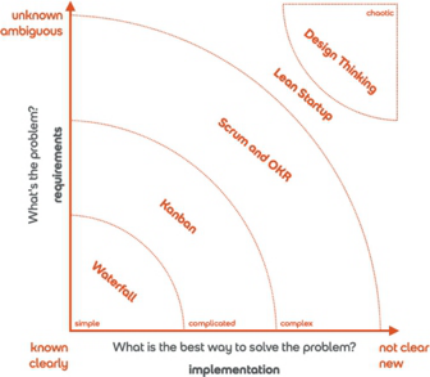
The Stacey matrix visualizes the relationship between the accuracy with which the project objective is specified and the knowledge of the project solution approach with which it can be achieved. In complex situations and projects, the matrix also recommends relying on OKRs and Lean Startup.
SERVICE ECOSYSTEMS - THE STACEY MATRIX The Stacey Matrix, a framework for decision-making in complex and uncer- tain situations, is adapted to the context of service ecosystems. It delves into how this matrix can provide insights into the dynamics of service ecosys- tems, offering opportunities for a better understanding of interactions and interdependencies within these complex systems (Wang et al., 2022).
Figure 1: The Stacey matrix to represent different levels of complexity (Zierock et al. 2023).
Measure What Matters – Objectives and Key Results Objectives and Key Results (OKR) is a goal-setting framework highlighted in “Measure What Matters” as a practical methodology utilized by success- ful organizations like Google, Bono’s philanthropic initiatives, and the Gates Foundation. This framework emphasizes the establishment of clear, ambi- tious Objectives, complemented by measurable Key Results. The primary purpose of OKRs is to drive focus, alignment, and success within organiza- tions and philanthropic endeavors alike. By defining ambitious yet achievable Objectives and quantifiable Key Results, OKRs enable organizations to align efforts, drive performance, and foster a culture of accountability. This goal- setting approach aims to create clarity, prioritize objectives, and provide a structured method for tracking progress, ultimately leading to improved performance and success across diverse sectors and organizational settings (Linares Fernandes and Gomes, 2023).
Figure 2: Sentence structure of the OKR formulation.
Figure available in the original PDF paper.
Types of OKR Companies and teams facing challenges in establishing OKRs create guidance through three distinct types:
Exploratory: These are beneficial for delving into unknown ideas, possi- bilities, or technologies. They prove effective for very early-stage projects or innovation teams seeking to chart unexplored territories.
Hypothesis: Geared towards formulating hypotheses and acquiring data to validate a strategy or identify the necessity for a pivot, these OKRs are well-suited for teams in the intermediate stages of development.
Milestone: Designed to assess whether ongoing efforts align with the intended direction and are likely to succeed, Milestone OKRs provide insights before committing to substantial projects.
Continuous Innovation – The Lean Startup The Lean Startup is a methodology developed by Eric Ries, specifically tailored for startups, aimed at navigating uncertainties inherent in new product or business launches. It emphasizes continuous innovation, vali- dated learning, and rapid iteration as core strategies for building successful ventures. This approach encourages iterative experimentation, customer feedback, and adaptive decision-making to validate assumptions, mitigate risks, and foster a culture of continuous improvement and innovation within startups (Ries, 2011).
Team-Centric Innovation: The Role of Objectives and Key Results (OKRs) 25
SOLVING COMPLEX PROJECT MANAGEMENT Agile Set Up in 5 Steps for Team-Centric Innovation
In the realm of Solving Complex Project Management, the adoption of Objectives and Key Results (OKRs) introduces a structured approach to team-centric innovation. Firstly, OKRs establish Clarity in Objectives by providing clear, measurable goals for projects. This clarity aids teams in understanding the purpose of their work and effectively prioritizing tasks within complex environments. Secondly, OKRs facilitate Align- ment and Focus among teams by breaking down overarching goals into measurable outcomes. This approach fosters alignment and ensures that teams remain focused on critical tasks, minimizing distractions. Thirdly, OKRs promote Continuous Adaptation in complex and evolving projects. By encouraging adaptability and rapid iteration, OKRs enable teams to respond effectively to changing dynamics. Additionally, OKRs contribute to Enhanced Accountability by providing a framework for measuring progress and enhancing transparency. This framework empowers teams to take ownership of their work, fostering accountability and informed decision- making. Lastly, OKRs play a pivotal role in the Promotion of Inno- vation by emphasizing outcomes and encouraging experimentation. This fosters a culture of innovation and problem-solving within teams, pro- moting creative solutions to challenges encountered in complex project scenarios.
A Crucial Role in Lean Management OKRs, integral to Lean Management, uphold its foundational principles, including continuous improvement and waste reduction. They offer a struc- tured framework for objective setting and outcome measurement, allowing organizations to concentrate on high-impact areas while minimizing unpro- ductive activities (Kudernatsch, 2020). Furthermore, they prioritize value cre- ation for customers, aligning with Lean’s customer-centric ethos by defining objectives connected to customer needs and focusing on delivering valuable outcomes (Ries, 2011).
In line with Lean philosophy, OKRs support continuous learning and adaptation, encouraging iterative improvement cycles, experimentation, and adapting strategies based on validated learning (Rasmussen and Tanev, 2016). This iterative approach resonates with Lean’s emphasis on ongoing improvement and flexibility. Additionally, OKRs foster enhanced visibility and accountability within organizations by establishing clear objectives and measurable results, cultivating a culture of ownership and accountability among teams (Doerr, 2018).
Moreover, OKRs contribute significantly to employee engagement and empowerment in Lean Management. Involving employees in setting and achieving OKRs enhances their engagement, commitment, and sense of ownership in driving Lean initiatives within the organization (Liker, 2004). Overall, OKRs serve as a vital tool in implementing and sustaining Lean principles, promoting efficiency, value creation, learning, accountability, and employee engagement within organizations.
CHALLENGES AND OPPORTUNITIES Communication Skills
Strategic communication is the backbone of agile management, enabling teams to adapt, collaborate effectively, and deliver value in a dynamic and fast-paced environment.
Precise and specific communication is an important part of reviews and ret- rospectives. These two formats take place at the end of an iteration of an OKR cycle. This ensures that the team still remembers the most important events and can immediately use the knowledge gained for the next iteration (Waern et al., n.d.).
Definitions in Team Communication and Knowledge Acquisition Precise word definitions serve as fundamental tools, establishing standardized interpretations and ensuring clear communication and shared understanding. In academic and professional settings, they enable specificity, coherence, and conceptual understanding. These definitions facilitate knowledge acquisition, allowing individuals to comprehend complex topics and delve deeper into specialized fields. In legal domains, they delineate boundaries and interpre- tations of laws, ensuring compliance and clarity in legal documents. Precise definitions play a crucial role in effective communication, knowledge acquisi- tion, compliance, and accuracy across various fields and contexts (Woodman, 1989).
SMART Communication Criteria The subsequent sections delve into the discerned patterns, key insights, and notable observations gleaned from employing OKR-oriented wording within the context of Lean Project Management. These findings aim to elucidate the strategic implications, practical applications, and transformative potential of integrating language precision through OKRs into Lean methodologies for project success.
SMART criteria (SMART, 2015) serve as a guide for setting effective goals, ensuring clarity, feasibility, motivation, and a structured approach within a defined timeline.
The SMART criteria comprise five key aspects: Specific: Goals must be clear, concise, and devoid of ambiguity. A goal should ideally be expressed in a single, positive sentence, such as “Increase website visitors by 40% in the next six months.”
Measurable: Objectives should be quantifiable or supported by qualitative metrics to objectively assess achievement.
Achievable: Referred to as “achievable” in English, in German-speaking contexts, it emphasizes goals being attractive, motivating, and feasible for team members. They should inspire and drive the team, even amid challenges.
Relevant: While aiming high is encouraged, goals must remain achiev- able within employees’ capabilities to avoid demotivation. Smaller, realistic objectives leading to significant success are valuable.
Time-based: Every goal should have a timeframe, aiding project man- agement and progress monitoring. Deadlines create urgency, ensuring focus amidst routine tasks.
Team-Centric Innovation: The Role of Objectives and Key Results (OKRs) 27
BEST PRACTICES AND RECOMMENDATIONS In the dynamic landscape of modern business, organizations often seek methodologies that drive focus, innovation, and alignment to propel their growth and success. The Lean Startup methodology, characterized by its emphasis on rapid experimentation, validated learning, and iterative devel- opment, has gained prominence as a framework for fostering entrepreneurial endeavors and product innovation. Within this context, OKRs emerge as a structured approach for goal-setting and performance tracking, aligning seamlessly with the iterative nature of Lean Startup practices.
This study aims to explore the efficacy and adaptability of OKR formu- lations within the Lean Startup framework. It seeks to assess the impact of precise and actionable OKR wordings on the alignment of objectives with Lean Startup principles, the facilitation of rapid experimentation and learn- ing, and the promotion of an innovation-driven culture within startups and entrepreneurial ventures. By testing various iterations of formulations in a Lean Startup context, this scenario aims to unveil the most effective lan- guage and structure for setting objectives and key results that complement the iterative and adaptive nature of Lean methodologies.
The scenario involves the formulation and implementation of OKRs across different stages of a startup’s lifecycle – from ideation and product develop- ment to market validation and scalability. Through rigorous testing, obser- vation, and analysis, this scenario endeavors to identify how the articulation and wordings influences the clarity of objectives, fosters alignment among team members, and drives the pursuit of impactful outcomes in line with Lean Startup principles.
Insights Having established a framework for testing the efficacy of OKRs within the context of Lean Startup methodologies, the subsequent phase delved into practical application. This phase involved the formulation and implemen- tation of targeted tasks across various stages of the project lifecycle. The objectives were meticulously crafted to align with the Lean principles of rapid experimentation, customer-centricity, and continuous improvement. Each objective was paired with measurable key results to gauge progress, ensuring the attainment of actionable insights and facilitating informed decision-making.
Evaluating the Efficacy This study centers on evaluating the efficacy of employing clear and struc- tured goal-setting techniques within Lean Project Management, specifically in the context of AI-supported IT security measures. The analysis encom- passes 150 tasks, seeking insights into how effectively these goals, framed using a structured approach, impact project outcomes.
The integration of focused goal-setting techniques holds significant sway in this scenario. These techniques, known for fostering clarity, feasibility, and motivation, align with Lean Project Management principles. The objective is to understand how these strategies, rather than specific OKRs, influence
the attainment of predefined security objectives, particularly in leveraging artificial intelligence for fortified security protocols.
To comprehensively assess the implications of employing structured goal- setting approaches in this niche, an inclusive survey will be conducted. This survey aims to gather data from a wide array of industries and organiza- tional scales, pooling perspectives from stakeholders entrenched in IT security practices. The intent is to glean insights into how these goal-setting methods, within the ambit of Lean Project Management, shape outcomes and strategies in AI-enhanced IT security.
Results Obtained From Using OKR Wording The integration of OKRs within the framework of Lean Project Management marks a pivotal convergence of goal-setting methodologies geared towards fostering agility, alignment, and continuous improvement. By harnessing the power of precise and actionable language inherent in concrete formulation, this embarks on a comprehensive exploration of the outcomes yielded within the realm of project management.
The application of OKR-oriented wording within Lean methodologies has culminated in a realm of discernible results and insights, delineating the impact of language precision, goal alignment, and iterative progress track- ing on project dynamics. The utilization of explicit and measurable language in setting objectives and defining key results offers a strategic lens into the realm of project management, enabling a seamless alignment between the Lean principles of value maximization and the pursuit of targeted outcomes.
We meticulously dissect and analyze the tangible outcomes derived from the adoption of OKR wording in Lean Project Management endeavors (Cruz and Alves, 2020). Through a structured analysis of objectives, key results, and their alignment with lean principles, we unravel the efficacy of language precision in driving focus, fostering team alignment, and propelling project success within Lean frameworks.
Exploring Formulation Patterns in Objectives and Key Results Utilization The review investigates the widespread usage and formulation characteristics within organizational contexts. The research aims to ascertain the prevalence of OKR implementation and the recurring linguistic patterns characterizing their formulation. A hypothesis is posited to discern the extent of utilization, the predominant characters employed in their formulation, and the frequently recurring words.
Prerequisite and Assumption of the Review OKRs are widely used across diverse organizational settings. How does the formulation of OKRs rely on the consistent use of specific characters and lin- guistic patterns? How does the frequent recurrence of specific words impact the formulation of effective OKRs?
Methodology: A comprehensive survey encompassing a diverse range of industries and organizational sizes will be conducted to collect data on
Team-Centric Innovation: The Role of Objectives and Key Results (OKRs) 29
OKR utilization. The formulation patterns will be analyzed quantitatively and qualitatively to identify prevalent characters and frequently recurring words. Statistical tools and linguistic analysis software will aid in data interpretation.
SAMPLE SELECTION AND PARTICIPANT CHARACTERISTICS The success and validity of any research or study often hinge upon the individ- uals involved as test participants. In the context of this review, the selection of test persons embodies a critical component, shaping the reliability and rele- vance of the research outcomes. The following outlines the meticulous criteria employed for selecting participants, elucidating the specific characteristics sought in the chosen sample.
The delineated criteria for participant selection were meticulously crafted to ensure a diverse yet targeted representation. The identified characteristics were carefully tailored to encapsulate a spectrum of attributes relevant to the research domain while excluding particular expertise or domains outside the review’s scope. Each criterion serves as a deliberate filter to curate a cohort of participants adept at comprehending complex information within specified realms while eliminating potential confounding variables, ensuring focused insights pertinent to the review’s objectives (Moujib, 2007).
The subsequent section delineates the sought-after attributes, highlighting the specific expertise, educational backgrounds, language proficiency, and professional interests sought in the selected participants. By elucidating these characteristics, this review’s endeavors to underscore the rationale behind the sample selection process and the deliberate inclusion or exclusion of cer- tain attributes, thereby bolstering the credibility and relevance of the ensuing research findings.
The following 3 aspects were fundamentally addressed. Build, Improve and Innovate encapsulates a dynamic progression within a process or strategy. It signifies a continuum of actions:
1. Build: This represents the foundational stage, involving the creation or establishment of something tangible or conceptual from scratch. It involves constructing, setting up, or initiating a base or framework. 2. Improve: Following the initial creation, this phase involves enhancement or refinement. It focuses on making incremental or significant changes to existing structures or processes to optimize their efficiency, functionality, or quality. 3. Innovate: This stage represents a leap forward, emphasizing the intro- duction of novel ideas, methods, or solutions. Innovation involves original thinking, creativity, and the implementation of groundbreak- ing concepts to bring about substantial change or revolutionize current practices.
Together, these concepts outline a progressive cycle: building a foun- dation, refining it for optimization, and finally, innovating to introduce groundbreaking changes or ideas for continued growth and advancement.
In the review we conducted, we found that definitions of objectives and corresponding measures are increasingly being used in various business areas. In particular, OKRs are transcending industry boundaries and are being adopted by various sectors such as technology, finance and healthcare.
Their appeal lies in their ability to provide a clear framework for set- ting and tracking goals. OKRs enable organizations to articulate ambitious yet achievable objectives and define measurable outcomes that demonstrate progress toward those objectives. This structured approach fosters align- ment, focus, and accountability throughout an organization, regardless of its industry or scale.
While their implementation might vary based on organizational culture and specific needs, the fundamental principles, setting ambitious objectives and delineating measurable results are widely recognized as effective for driving performance, aligning teams, and fostering a culture of continuous improvement across diverse organizational settings.
Accordingly, we refer to the following characteristics in the wording:
In culmination, this research underscores the indispensable fusion of the adaptive Stacey Matrix and the precision-driven OKRs in managing extensive and intricate projects. Crucially, this review highlights the pivotal role that precise wordings play in the effective application of these methodologies.
Strategic Synergy The Stacey Matrix’s adaptability in embracing ambiguity and diverse per- spectives aligns harmoniously with OKRs’ clear and precise language in goal-setting and action alignment (Stacey, 1992; Doerr, 2018). However, the
Team-Centric Innovation: The Role of Objectives and Key Results (OKRs) 31
success of this integration is intrinsically tied to the meticulous selection of words and formulations within this framework.
The strategic utilization of the Stacey Matrix and OKRs demands an acute awareness of language nuances, where a precise choice of words delin- eates the pathway toward effective goal attainment amidst complexity. The right wordings enable concise communication, ensuring clarity, focus, and alignment toward overarching objectives.
As a vision for future endeavors, it becomes increasingly evident that lever- aging the synergy between the Stacey Matrix and OKRs demands not only their harmonious integration but an acute attention to language precision. The judicious selection of words within the framework stands as an imper- ative, shaping the trajectory of success within the realm of complex and extensive projects.
OKRs serve as a crucial link between strategy and execution within organizations. While leaders often hold a strong understanding of strategy, overlooking the involvement of the team in OKR planning can pose chal- lenges. This omission might lead to setting unrealistic goals due to a lack of insight into daily operations and potential details of team responsibilities.
Furthermore, neglecting team involvement in defining objectives misses an opportunity to enhance employee engagement. Although top-down OKR setting has its place, collaborating with the team is considered a best prac- tice. To overcome this challenge, engaging, communicating, and empowering teams in the OKR planning process is crucial. This collaborative approach helps craft OKRs that acknowledge daily hurdles and opportunities, fostering accountability and motivation among team members.
CONCLUSION
In the dynamic landscape of IT projects, the confluence of the Stacey Matrix, OKRs, and Lean Startup methodologies emerges as a transformative paradigm. The Stacey Matrix provides a robust lens to navigate complex- ities and uncertainties inherent in IT endeavors, guiding adaptive resource allocation. Complementing this, OKRs serve as indispensable navigational tools, directing projects toward strategic goals with clarity and fostering accountability across all levels. The integration of Lean Startup principles further amplifies innovation within IT, nurturing an environment of continu- ous learning and customer-centric problem-solving. Through their synergistic interplay, these methodologies fortify IT projects, enabling agile responses to challenges and iterative improvements, ultimately steering the course toward success in the ever-evolving realm of information technology.
The next phase involves delving deeper into OKRs through Natural Lan- guage Processing (NLP) testing within an AI tool scenario. This step aims to enhance our understanding of how the language and vocabulary used in OKRs interact with AI-driven processes. Through NLP analysis, we’ll dissect a broad spectrum of OKR formulations, focusing on their linguistic patterns, coherence, and alignment with AI-oriented tasks and goals. By leveraging NLP techniques, we aim to uncover recurring terminologies, prevalent word- ings, and linguistic structures within OKRs, shedding light on their impact on
AI tool performance, adaptability, and comprehension of tasks. This explo- ration seeks to leverage NLP’s capabilities to discern the nuances of language within OKRs, illuminating how precise language usage in these frameworks correlates with the functionality of AI tools. Ultimately, these efforts aim to advance our understanding and optimization of OKR implementation in AI-driven environments.
REFERENCES
Cruz, André, and Anabela Carvalho Alves. “Traditional, agile and lean project management-A systematic literature review.” The Journal of Modern Project Management 8.2 (2020). Doerr, J. (2018). Measure What Matters: How Google, Bono, and the Gates
Foundation Rock the World with OKRs. USA: Penguin Publishing Group. Impact report. (2022). Moonbase. Retrieved November 30, 2023, from https://mooncamp.com/de/2022-okr-impact-report/. Kudernatsch, Daniela. “Toolbox objectives and key results.” Transparente und agile Strategieumsetzung mit OKR. Stuttgart: Schäffer-Poeschel Verlag (2020). Liker, J. K. (2004). The Toyota Way: 14 Management Principles from the World’s
Greatest Manufacturer. McGraw-Hill Education. Linares Fernandes, B. C. & Gomes, J. V. (2023). OKR Methodology: Challenges and Trends. In J. Martínez-Falcó, B. Marco-Lajara, E. Sánchez-García, & L. Millan- Tudela (Eds.), New Perspectives and Possibilities in Strategic Management in the 21st Century: Between Tradition and Modernity (pp. 195–208). IGI Global. Moujib, A. (2007). Learning library - project management institute. Lean Project Management. Paper presented at PMI® Global Congress 2007—EMEA, Budapest, Hungary. Newtown Square, PA: Project Management Institute. https: //www.pmi.org/learning/library (TED, 2023.10.26, 14:44). Niever, Manuel/Trinh, Han Jennifer et. al. (2021). Integration of agile approaches
in SME’s product development : demand analysis and concept development. In: Athens journal of business & economics 7 (4), S. 349–364. Rasmussen, Erik Stavnsager, and Stoyan Tanev. “Lean start-up: Making the start-up more successful.” Start-up creation. Woodhead Publishing, 2016. 39–56. Ries, E. (2011). The Lean Startup: How Today’s Entrepreneurs Use Continuous
Innovation to Create Radically Successful Businesses. Crown. Ries, E. (2011). The Lean Startup: How Today’s Entrepreneurs Use Continuous Innovation to Create Radically Successful Businesses. Vereinigtes Königreich: Crown. Salo, O. (2017). How to create an agile organization. www.mckinsey.com. Retrieved
October 20, 2024, from https://www.mckinsey.com/capabilities/people-and- organizational performance/our-insights/how-to-create-an-agile-organization SMART Criteria: Become More Successful by Setting Better Goals. (2015). Belgien: 50Minutes.com. (TED, 2023.11.18, 16:30). Wang, C., Dai, M., Fang, Y. et al. Ideas and methods of lean and agile startup in the VUCA Era. Int Entrep Manag J 18, 1527–1544 (2022). https://doi.org/10.1007/ s11365-022-00797-3 Woodman, R. W. (1989). Organizational Change and Development: New Arenas for
Inquiry and Action. Journal of Management, 15(2), 205–228. https://doi.org/10. 1177/014920638901500205 Yvonne Waern, Sture Hägglund, Jonas Löwgren, Ivan Rankin, Tomas Sokolnicki, Anne Steinemann, Communication knowledge for knowledge communication, International Journal of Man-Machine Studies, Volume 37, Issue 2.
Team-Centric Innovation: The Role of Objectives and Key Results (OKRs) 33
Zierock, B., Jungblut, A., Senn, N. (2023). Chaotic Customer Centricity. In: Stephanidis, C., Antona, M., Ntoa, S., Salvendy, G. (eds) HCI International 2023 Posters. HCII 2023. Communications in Computer and Information Science, vol. 1832. Springer, Cham. https://doi.org/10.1007/978-3-031-35989-7_24 has context menu
LISTED IN THE AHFE DIGITAL BOOKSTORE CATALOGUE
Explore the complete digital volume
Creativity, Innovation and Entrepreneurship
Read this individual research paper free through the original publisher, or explore the full digital proceedings book.
ISBN 978-1-964867-01-4
Explore this ISBN in the AHFE Bookstore ↗Listed in the July 2026 bookstore catalogue; search by ISBN to confirm current availability · Digital book purchase optional