David Moscoso - Montenegro, Luis Serpa-Andrade (2022). Design Process in the Development of Educational Tools for Children with Special Educational Needs. In: Design for Inclusion. AHFE Open Access, vol. 45, pp. 204–209. https://doi.org/10.54941/ahfe1001887
The educational tools have become important resources in the learning path of children with special educational needs. When designing such tools its important to follow some guidelines starting with defining what activity it will be used for, how it will be used, identifying the user or group of users, what they are using right now to accomplish that activity, how the actual tool adapts to their needs and finally the specific design requirements. This paper presents a methodological process for the development of devices focused in children with SEN and the addition of assistive technologies taking as an example the development of a sensorized pen in the GIIATA research group at the Universidad Politécnica Salesiana.
Ergonomics is the science of fitting a task to humans and products to users (Pheasant, 2003). The physical size and shape of target users are an important consideration for many products or environments, an approach frequently referred to as, designing for physical accommodation. Anthropometry plays an essential role as it provides the body size data in the physical configura- tion of products, applying this data requires the use of different methods and appropriate analysis tools, often included in courses on Human Factors/Ergo- nomics (HF/E) (Garneau and Parkinson, 2016). According to anthropometric principles all products and spaces should be designed to accommodate the largest percentage possible of the user population. At the moment anthropo- metric research to design for special groups, such as children, the elderly and people with disabilities is scarce (Dianat et al. 2018).
Into designing of products, decisions are often assessed in terms of cost, fit, safety and other performance metrics. An understanding of body dimen- sions, capabilities and other characteristics of the population of potential users can assist engineers and designers in creating artefacts that meet these goals. Quantifying the variability in key factors (e.g., age, anthropometrics
Design Process in the Development of Educational Tools for Children 205
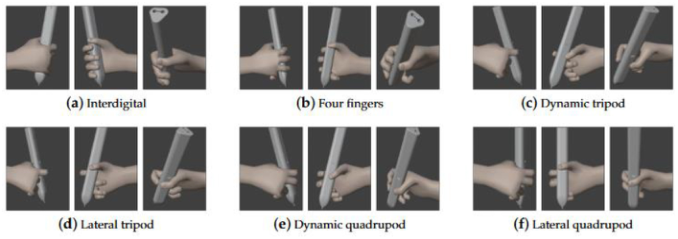
Figure 1: 3D simulation of pencil grasps of a sensorized pen designed from scratch. (Serpa-Andrade et al. 2020).
and capabilities) in the target user group is essential to assess accommoda- tion, the degree to which a design meets the needs of its users (Garneau and Parkinson, 2011).
When talking about writing is important to differentiate two concepts: handwriting which refers to the mechanical ability to write and writing that refers to the ability to produce structured text (Hen-Herbst, 2019). Children must acquire certain dexterity in writing in order to advance their education as it is an essential part of language, prior it requires that some linguistic, motor and cognitive skills have been achieved. In this paper we present the design process carried out to build a sensorized pen for children aged 6 to 10 focused on special educational needs (SEN) associated or not with some form of disability, a device designed and built from scratch taking into account a variety of factors related to the handwriting technique at early ages specially grasp, a key feature to improve writing speed and readability, also related to ergonomic posture.
DESIGN OF A SENSORISED PEN In a previous work (Serpa-Andrade et al. 2020) we presented a sensorized low-cost pencil capable of providing enough data to make a quantitative analysis of handwriting in children with and without disabilities, this study made emphasis on how this new tool performs compared to similar solutions in terms of features and cost, evaluating it with students of an institution of inclusive basic education in Cuenca (Ecuador), the participants were children with and without SEN including cases of motor disability, cognitive impair- ment, visual impairment and/or learning disabilities. Figure 1 shows a 3D simulation of the most common pencil grasps during handwriting applied to our pen proposal (triangular prism variant).
The primary requirement apart from its sensing characteristics (grip, pres- sure, tilt) was the shape, that will differ from the common cylindrical pencils to favor the dynamic tripod grip based on the fact that it has been traditi- onally promoted as the most suitable in many educational systems around the world, for inducing the lowest pressure, tension and fatigue (Carter and Synolds, 1974). If a geometry subtly promotes a shift towards the dynamic tripod grip that is the triangular shape, with its advantages proved by (Azzam,
206 Moscoso-Montenegro and Serpa-Andrade
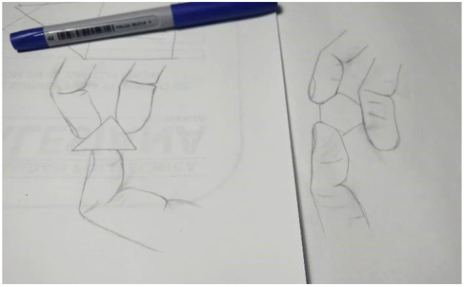
Figure 2: Sketches of triangular-prism and hex-prism pen shape with desired tripod grasp.
2018), however this is not the unique solution because if the diameter of the circumscribed circle of the of the triangular section of the pen is large enough, the polygon order can be extended to an hexagon, this shape also promote the dynamic tripod grip that is desired and the side panels still have enough area to support the finger contact points.
The design started with sketches (Figure 1) of the sectional shape (triangu- lar and hexagonal) and the intended grasp by the user (tripod), considering the contact points we want to sense which are the flat surfaces of each side that will be covered by thin pressure sensors. Dimensions are based on the child hand size to wrap the entire object comfortably and the ratio betw- een fingers tip area and side panels width. In order to follow mentioned anthropometrics, required hand measurements were obtained directly from participants within the target population users.
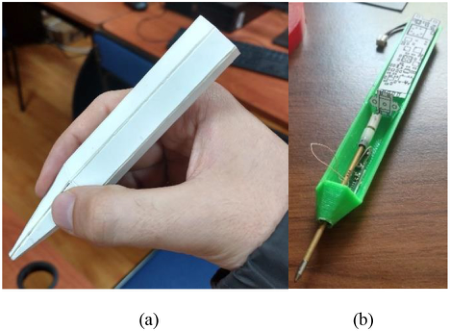
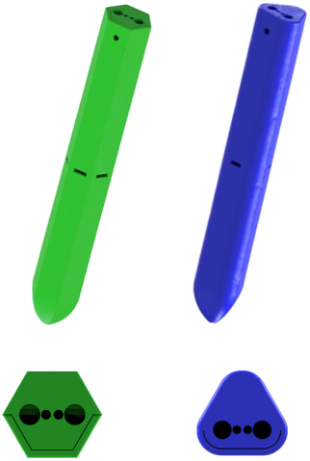
With a primary idea of shape and size of the pen, the next step was to start prototyping with rapid and easy to handle materials like cardboard (Figure 3a) to get the object at least in a basic but useful way. With a tan- gible device begins a series of tests about ergonomics and the user experience when holding, manipulating and interacting with the tool. At this stage the opinion of therapists and children themselves is crucial not just for technical parameters but even for subjective aspects like color, smoothness and what the tool visually transmits to the user. After some hours of modeling, observa- tion and interviewing, there’s enough information to move to another type of prototyping, the one focused on structural and functional development. Mantaining most of the previous body characteristics we include parts nee- ded to add the functions desired from the beginning (e.g., ink tip, sensors, PCB, battery). The pen body that support the parts is PLA plastic built using 3D printing technology (Figure 3b). This stage like every other in the design process is iterative, editing CAD models and 3D printing them many times until achieving a solution that fits all components integrated in a way that keeps usability, form and good looking appearance. Figure 4 shows the two variants developed to further experimentation about advantages and preferences.
Design Process in the Development of Educational Tools for Children 207
Figure 3: (a) cardboard model (b) plastic 3D printed model and placement of some internal parts for sizing verification.Figure 4: Hexagonal and Triangular prism shaped variants of the sensorised pen.
There’s no such thing as a final product but a good enough, the one that is the result of an acceptable trade-off made by the designer between the pros and cons that version has. The whole process described at the moment has an infinite number of variables but it’s the designer’s job to select a well-balanced design in terms of requirements and available resources that usually includes: time of development/construction, final cost and functionality. Table 1 pre- sents a list of self –made questions that have been answered during designing to have a clear perspective of what we are making and the reason of every decision.
208 Moscoso-Montenegro and Serpa-Andrade
Table 1. Inquiry for the designer of an educational tool for children.
Table available in the original PDF paper.
Design questions Answer for the sensorized pen example
Generic pen for children
Who will be using it? Children aged 6 to 10, with or without special educational needs associated or not with some form of disability. What it will be used for? Handwriting. How it will be used? Taking the pen with right or left hand with the grasp better suited for the child (ideally the dynamic tripod). What is used right now to accomplish that activity?
How the actual tool adapts to his/her needs?
In best case follows an ergonomic approach for a wide range of users, but not a narrow fit neither the additional sensing features. How the new tool adapts to his/her needs?
Ergonomic design that promotes the dynamic tripod grasp and handwriting technique sensing capabilities (although transparent to the user) What are the most important requirements?
Ergonomic form that naturally incentivize user to apply the dynamic tripod grasp.
Data will be collected through different sensors located inside and on the surface of the pen, this process should be completely transparent to the user.
Cannot include any distracting factor such as lights, sound, or vibration.
The device must be completely wireless
Bigger tool due to size restrictions because of the internal electronics.
What are the trade-offs between the current solution and the proposal?
Slightly heavier than a crayon which is the heaviest tool children that participated in the experiment have used regularly.
The idea of a universal design (i.e., a design that accommodates everyone equally well) falls apart from reality and this becomes clearer when talking about designing products for children with SEN, some of them with a physical or cognitive disability. A design for an educational tool that accommodates to every user condition is an impossible task because of practical limitations such as cost, development time, and conflicting user requirements, it can be said that every case has particularities. The correct and more realistic appro- ach should be selecting a design topology and dimensionally optimizing the product, with the objective of achieving some level of accommodation for its target users (Roe, 1993).
CONCLUSION
The design process of an educational tool involves a detailed research and direct observation of the child interacting with the current solution that is
Design Process in the Development of Educational Tools for Children 209
intended to be replaced or the closest object in form or function, then it’s important to answer a variety of self-made questions about the specific cha- racteristics and purpose of the object, some of them may arise conflicting or incoherent decisions about the design. Even after achieving a consistent, integrated and balanced approach, this journey is about trial and error with every iteration solving an issue encountered when testing the previous one, turning the idea into a tangible device means constantly rethinking a solution.
REFERENCES
Azzam, A. (2018). Efficacy of Hand Arches Training In the Improvement of Dynamic Tripod Grasp and Handwriting Skills in Hemiplegic. Carter, J. L. and Synolds, D. (1974) ‘Effects of Relaxation Training upon Han-
dwriting Quality’, Journal of Learning Disabilities, 7(4), pp. 236–238. doi: 10.1177/002221947400700409. Dianat, I., Molenbroek, J. & Castellucci H.I. (2018) A review of the methodology and applications of anthropometry in ergonomics and product design, Ergonomics, 61:12, 1696–1720, DOI: 10.1080/00140139.2018.1502817 Garneau, C. J., & Parkinson, M. B. (2011) A comparison of methodologies for desi-
gning for human variability, Journal of Engineering Design, 22:7, 505–521, DOI: 10.1080/09544820903535404 Garneau, C. J., & Parkinson, M. B. (2016). A survey of anthropometry and physical accommodation in ergonomics curricula. Ergonomics, 59(1), 143–154. https://doi.org/10.1080/00140139.2015.1052853 Hen-Herbst, L.; Rosenblum, S. Which characteristics predict writing capabilities
among adolescents with dysgraphia? Pattern Recognit. Lett. 2019, 121, 6–12. Serpa-Andrade, L.J. et al. (2020) ‘Sensorised Low-Cost Pencils for Developing Countries: A Quantitative Analysis of Handwriting Learning Progress in Children with/without Disabilities from a Sustainable Perspective’, Sustainability, 12(24), p. 10682. doi:10.3390/su122410682 Pheasant, S. (2003). Bodyspace: Anthropometry, Ergonomics And The Design Of
Work: Anthropometry, Ergonomics And The Design Of Work (2nd ed.). CRC Press. https://doi.org/10.1201/9781482272420
LISTED IN THE AHFE DIGITAL BOOKSTORE CATALOGUE
Explore the complete digital volume
Design for Inclusion
Read this individual research paper free through the original publisher, or explore the full digital proceedings book.
ISBN 978-1-958651-21-6
Explore this ISBN in the AHFE Bookstore ↗Listed in the July 2026 bookstore catalogue; search by ISBN to confirm current availability · Digital book purchase optional