Jonnathan Santiago Berrezueta-Guzman, Stephan Krusche, Luis Serpa-Andrade (2022). Design, Development and Assessment of a Multipurpose Robotic Assistant in the Field of Cognitive Therapy. In: Human Factors in Robots, Drones and Unmanned Systems. AHFE Open Access, vol. 57, pp. 31–37. https://doi.org/10.54941/ahfe1002307
Advances in robotics have contributed to the support of different treatments for neurodevelopmental disorders (NDD) in children around the world. Several studies have developed and used robotic assistants to support these treatments, making robotic assistants a key tool for this purpose. Their results have been promising and have provided insight into what can be leveraged from them for future research. Therefore, this article presents a robotic assistant whose design and functionality can be adapted to support cognitive therapy processes. To test the adaptability of its design, an experiment is performed where some electronic elements are changed and it is verified that the design has changed automatically. A second experiment will test the feasibility of using the same robotic assistant in various types of cognitive therapies by modifying its functionality. The results show that the design of this robotic assistant can be adapted and it is also possible to determine if the new design violates any physical constraints. In addition, the results of the exercise performed previous to a cognitive therapy show positive results and this robotic assistant has been recommended by most therapists to be part of cognitive therapies.
In recent years robotics has been a fundamental tool for the support of beh- avioral therapies in people with some kind of disability (Balasuriya et al., 2019). Countless robots have been designed to support cognitive therapies for children (Barcaro et al., 2018) resulting in robotic cognitive therapies that are characterized by applying scheduled goal-oriented sessions in a limited time. Here, robots guide children to meet these goals by providing them with precise instructions (Yuan et al., 2021). Among the most widely used robots, many papers show that Nao has been a robot in high demand for this type of therapy with children (Berrezueta-Guzman, Robles-Bykbaev, et al., 2021). Nao is a robot whose functionalities can be adapted to act as a companion in these therapeutic processes, and the results obtained have been signifi- cant in advancing this line of research over the years (Assad-Uz-Zaman et al., 2019; Robaczewski et al., 2021). However, some researchers have designed
and developed robotic assistants to perform personalized cognitive therapies (Meghdari & Alemi, 2018; Tapus et al., 2009). It is evident that the deve- lopment and use of robotic assistants are growing every year and so is the range of applications in the mental health care (Sun & Wang, 2021).
In this work, we have developed a multipurpose robotic assistant that not only allows us to adapt its functionalities, but also allows us to adapt its design based on the minimum hardware available. Here, we present how this ergonomic robotic assistant has a programmable design that automatically adapts its internal and external structure automatically. It is proposed two experiments to test this feature and also its feasibility for cognitive therapies with children.
RELATED WORK
Leaving aside the robotic assistants developed by brands such as Nao, we can find some models developed by researchers to carry out speci- fic cognitive therapies for patients with Autism, Cerebral Palsy, Dementia, and Attention Deficit Hyperactivity Disorder (ADHD) (Berrezueta-Guzman, Robles-Bykbaev, et al., 2021; Cibrian et al., 2020; Cibrian et al., 2022). Each robotic assistant varies according to the type of therapy however, stu- dies by (Rakhymbayeva et al., 2020; Tleubayev et al., 2019) show that the same robotic assistant can be used for both Autism and ADHD. It can also be verified in the study conducted by (Berrezueta-Guzman et al., 2020) that a robotic assistant designed to teach preschool children to avoid accidents at home or school can modify its design and functionality to ela- borate behavioral therapies for children with ADHD, the results presented in (Berrezueta-Guzman, Pau, et al., 2021) were promising as in the first study. These investigations are the premises that a robot that has been designed for a specific therapy can adapt its functionalities and design to cover some other types of cognitive-behavioral therapies. However, reusing a robotic assistant could imply huge efforts for adapting its design and functionalities.
METHODOLOGY
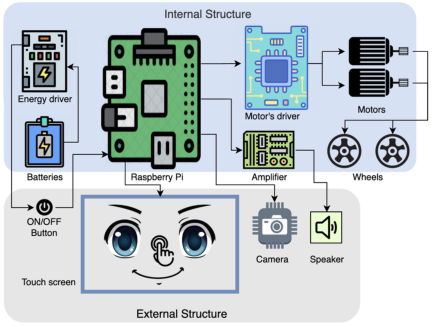
The robotic assistant developed in this work has a design that has been auto- mated by using programming rules. These rules use the dimensions of the hardware that composes the robotic assistant (see Figure 2) to adapt the dimensions of the internal and external structure of the robotic assistant. Parameters, configurations, interactions, assemblies, and constraints have been programmed so that each of them automatically adjusts to the new dimensions of the new electronic components of the robotic assistant. For this, we use Autodesk Inventor, which makes it possible to reuse the original design of the robotic assistant and adapt it automatically. Inventor uses iLogic technology, which standardizes and automates design processes by program- ming rules that are stored as objects directly in part and assembly documents (.ipt and .iam files). These rules determine and control the parameters and values of the design attributes, and by controlling these values you can define the behavior of the attributes, features, and components of a 3D model. It
Design, Development and Assessment of a Multipurpose Robotic Assistant 33
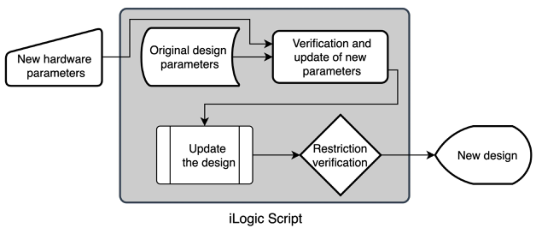
Figure 1: The processes inside the iLogic Script when some components are replaced.Figure 2: Components of the robotic assistant and the structures that hold them.
is possible to use these types of parameters to write rules containing input values other than numeric values, such as Boolean statements.
As shown in Figure 1, the parameters of the new hardware components are entered into our design, here the script compares these parameters with those of the original design to determine in which structure the change will be made. These parameters are updated and the design is automatically updated applying all the design rules. As an additional process, the program checks if both, the new center of gravity and the new balance point are ideal to keep the robot standing.
The robotic assistant design consists of an internal structure (part 1) capa- ble of housing the Raspberry Pi, power controller, batteries, motor controller, motors, wheels, and amplifier. The external structure (part 2 and part 3) is capable of housing the touch screen, camera, power button, and speaker (see Figure 3). These devices can be replaced; however, the design cannot automatically accommodate additional components or removed some of the ones established in the original design. All redesigns will maintain the same number of components (an important rule).
The components of this robotic assistant and its design allow (1) its displa- cement on flat surfaces thanks to the motors and wheels on the lower part, (2) audiovisual projection through animations and sound on its screen located
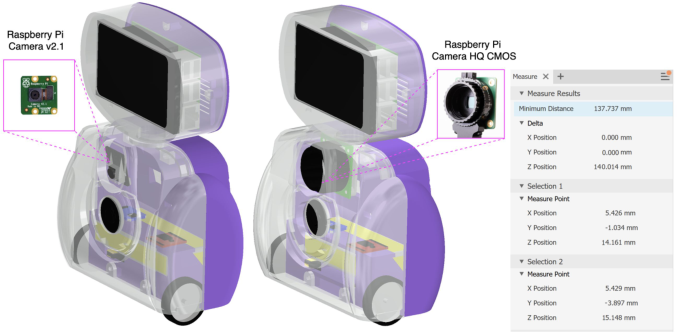
Figure 3: The design’s adaptability and the balance point’s calculation offset when the camera component has been replaced for another version.
on the head and its speaker on the chest, respectively, (3) computer vision, through its camera, and (4) interaction with the touch screen on the head.
The design process of this robotic assistant takes as a reference the ele- ctronic components and based on their dimensions, the original internal and external structure that will contain them is designed. The design of the robo- tic assistant and the distribution of the elements inside it, make the center of mass and the equilibrium point coincide on the Z-axis [x = 0, y = 0]. As there are only two wheels, the robot becomes a Segway-like (unstable) system, but the axis of these wheels and their motors coincide with the X-axis [y = 0], so the motor controller adjusts the displacement more significantly along the Y-axis and a third spherical wheel is adapted at the back to avoid an imba- lance along this axis. The design of the robotic assistant and the distribution of the elements inside it, make the center of mass and the equilibrium point coincide on the Z-axis [x = 0, y = 0]. As there are only two wheels, the robot becomes a Segway-like (unstable) system, but the axis of these wheels and their motors coincide with the X-axis [y = 0], so the motor controller adjusts the displacement more significantly along the Y-axis and a third spherical wheel is adapted at the back to avoid an imbalance along this axis. Another constraint is the weight distribution of the robotic assistant when its com- ponents are replaced. In this case, it is determined that the displacement of the center of mass does not present a significant difference in the X and Y axes concerning the original design, from this value depends that the robotic assistant maintains its balance as well.
Figure 3 shows how a component, specifically the camera, is replaced by a different version: from Raspberry Pi Camera V2.1 to Raspberry Pi Camera HQ CMOS). The dimensions of the new camera are 4 times larger than the previous version, and its weight is double according to the official documen- tation (Raspberry-Pi, 2022). However, the camera represents 4% of the total weight of the robotic assistant making the balance point move only 2.863 mm on the Y-axis and 0.003 mm on the X-axis (this displacement is insi- gnificant because the camera is symmetrical on that axis). This variation of
Design, Development and Assessment of a Multipurpose Robotic Assistant 35
the balance point does not represent an imbalance for the robotic assistant. Otherwise, we should get a warning message in the calculation.
EXPERIMENTS To test the feasibility of the automatic design of the robotic assistant, it is proposed to replace three components of the original design: the camera, the motors, and, consequently, the wheels. These new components will cause the design of the internal and external structure to change. To do this, following the process in Figure 1, these new versions of components are digitized and their dimensions (3D) are introduced into the design of the robotic assistant assembly. It is verified that the structures have been redesigned in seconds. Also, to check that the program recognizes whether the new design may represent an imbalance in the robot structure, we replace the dimensions of the touch screen from 3.5 inches to 7 inches, and its weight (doubled). The result shows that the balance point leaves the robot structure on the Y-axis, as well as its center of mass. This represents that the robot has no balance and will fall as soon as we place it on a flat surface.
To test the feasibility of the robotic assistant as a support in a therapy process with children, an introduction to a cognitive therapy session consi- sting of a concentration and memorization game is performed. Here, a group of 10 children will try to remember pictures without labels, labels without pictures, and pictures with labels. This exercise is ideal to find out how the child can retain information in the short term. Normally, this exercise is done with sheets of paper, but with the robotic assistant, it was only necessary to program the game in Python. This means that the multimedia content (ima- ges and labels) allows several iterations without repeating the images, and the feedback the child receives from the robotic assistant motivates him to continue and improve with each iteration.
RESULTS
The first test demonstrates that automatic redesign brings significant advan- tages to researchers who want to take advantage of an already designed robot, but with other versions of the hardware. The result of the first experiment showed that the robotic assistant can be redesigned very quickly by replacing its components, for example, the new camera changed the external structure. And by changing the motors and wheels, the internal structure is automati- cally modified. These modifications did not alter the balance of the robotic assistant.
In a second test, the reconfiguration of the robot’s functionalities for the cognitive therapy process is examined, demonstrating that the procedure for configuring a game is simple and can take advantage of unlimited resources (multimedia). All multimedia content can be imported into the robotic assi- stant and can be deployed according to the needs of the cognitive therapy. The game designed in Python provides greater freedom for the use of visual resources, as it leverages its touch screen as a way of interaction, replacing printed images. The children find this exercise more engaging using the robot,
so 3 of the 4 therapists consider the robot ideal to support a cognitive the- rapy session. They also believe that they could obtain better results with the robotic assistant in such therapies as the child’s attention is maintained over time.
CONCLUSION
This work shows a robotic assistant that allows adjusting its design accor- ding to the available hardware. Despite the restrictions that prevent adding new elements or removing existing ones, the presented methodology allows replicating this robot with substitute elements such as other versions of these components. However, this development can save the development team 90% of the time invested in the design of a robotic assistant, without taking into account the time to 3D print it. The experiment demonstrates that automa- tion in design also makes it possible to determine whether an element does not meet the physical conditions of the robotic assistant, such as balancing it.
The exercise performed for cognitive therapy demonstrates that the robo- tic assistant allows to easily adapt its functionality. After this exercise, the robotic assistant was accepted by the children in the therapy session and was an element that made the therapy process innovative. The therapists have used its functionalities and in this first approach have proposed important improvements to the robotic assistant that the developers can quickly adapt thanks to its ergonomic features. Although it is a novel element, one therapist considered that the robotic assistant could be replaced by a tablet, however, the other three therapists stated that a tablet is a distracting element in a the- rapy session. To support the use of the robotic assistant instead of a tablet, the children were asked individually and 90% of them expressed that they would like the robot to be part of the therapy instead of a tablet because they like the way it looks and works.
REFERENCES
Assad-Uz-Zaman, M., Rasedul Islam, M., Miah, S., & Rahman, M. H. (2019).
NAO robot for cooperative rehabilitation training. Journal of Rehabilitation and Assistive Technologies Engineering, 6, 2055668319862151. Balasuriya, S. S., Sitbon, L., Brereton, M., & Koplick, S. (2019). How can social robots spark collaboration and engagement among people with intellectual disability? Proceedings of the 31st Australian Conference on Human-Computer- Interaction, Barcaro, R., Mazzoleni, M., & Virgili, P. (2018). Ethics of care and robot caregivers.
Prolegomena: ˇCasopis za filozofiju, 17(1), 71–80. Berrezueta-Guzman, J., Pau, I., Martín-Ruiz, M.-L., & Máximo-Bocanegra, N.
(2021). Assessment of a robotic assistant for supporting homework activities of children with ADHD. IEEE Access, 9, 93450-93465. Berrezueta-Guzman, J., Robles-Bykbaev, V., Pau, I., Pesántez-Avilés, F., & Martín- Ruiz, M.-L. J. I. A. (2021). Robotic Technologies in ADHD Care: Literature Review.
Design, Development and Assessment of a Multipurpose Robotic Assistant 37
Berrezueta-Guzman, J., Serpa-Andrade, L., Robles-Bykbaev, V., & Montalvo, M.
(2020). Robotic assistant for the teaching in trauma accidents prevention in chil- dren of initial age. 2020 IEEE International Conference on Consumer Electronics (ICCE), Cibrian, F. L., Hayes, G. R., & Lakes, K. D. (2020). Research Advances in ADHD and Technology. Synthesis Lectures on Assistive, Rehabilitative. and Health-Preserving Technologies, 9(3), i-156. Cibrian, F. L., Lakes, K. D., Schuck, S. E., & Hayes, G. R. (2022). The poten-
tial for emerging technologies to support self-regulation in children with ADHD: A literature review. International Journal of Child-Computer Interaction, 31, 100421. Meghdari, A., & Alemi, M. (2018). Recent advances in social & cognitive robotics and imminent ethical challenges. Recent Advances in Social & Cognitive Robo- tics and Imminent Ethical Challenges (August 22, 2018). Proceedings of the 10th International RAIS Conference on Social Sciences and Humanities, Rakhymbayeva, N., Seitkazina, N., Turabayev, D., Pak, A., & Sandygulova, A.
(2020). A long-term study of robot-assisted therapy for children with severe autism and ADHD. Companion of the 2020 ACM/IEEE International Conference on Human-Robot Interaction, Raspberry-Pi. (2022). Introducing the Raspberry Pi Cameras. Retrieved April, 2022 from https://www.raspberrypi.com/documentation/accessories/camera.html Robaczewski, A., Bouchard, J., Bouchard, K., & Gaboury, S. (2021). Socially
assistive robots: The specific case of the NAO. International Journal of Social Robotics, 13(4), 795–831. Sun, Y., & Wang, R. (2021). The research framework and evolution of service robots.
Journal of Computer Information Systems, 1–11. Tapus, A., Tapus, C., & Mataric, M. J. (2009). The use of socially assistive robots in the design of intelligent cognitive therapies for people with dementia. 2009 IEEE international conference on rehabilitation robotics, Tleubayev, B., Zhexenova, Z., Zhakenova, A., & Sandygulova, A. (2019). Robot-
assisted therapy for children with ADHD and ASD: a pilot study. Proceedings of the 2019 2nd International Conference on Service Robotics Technologies, Yuan, F., Klavon, E., Liu, Z., Lopez, R. P., & Zhao, X. (2021). A systematic review of robotic rehabilitation for cognitive training. Frontiers in Robotics and AI, 8, 105.
LISTED IN THE AHFE DIGITAL BOOKSTORE CATALOGUE
Explore the complete digital volume
Human Factors in Robots, Drones and Unmanned Systems
Read this individual research paper free through the original publisher, or explore the full digital proceedings book.
ISBN 978-1-958651-33-9
Explore this ISBN in the AHFE Bookstore ↗Listed in the July 2026 bookstore catalogue; search by ISBN to confirm current availability · Digital book purchase optional