George Chow (2022). Experimental Processes with Precious Plastics. In: Interdisciplinary Practice in Industrial Design. AHFE Open Access, vol. 48, pp. 59–63. https://doi.org/10.54941/ahfe1002016
According to the UN Environment Program (UNEP), 400 million tons of plastic is produced every year, but only 9% of it is recycled. More than 40% of plastic is used just once before being thrown out and at least 14 million tons of plastic enters oceans every year. To help address these enormous plastic pollution problems, an open source organization called Precious Plastic was established in 2012 with the goal of diverting plastic from waste streams, and recycling it into valuable products. They developed a series of open source, plastic processing machines which could be replicated by people with a desire to recycle plastic. Students from the University of Houston Industrial Design Program established a student chapter of Precious Plastic and obtained a plastic shredder and heat press. This paper describes some of the unique processes that a couple of students developed when challenged to design products utilizing the Precious Plastic processing machines.
According to the UN Environment Program, 400 million tons of plastic is produced every year, but only 9% of it is recycled (UNEP, 2021). More than 40% of plastic is used just once before being thrown out (National Geogra- phic Society, 2019). Approximately 14 million tons of plastic enters oceans every year (IUCN, 2021). To help address these enormous plastic pollution problems, an open source organization called Precious Plastic was established in 2012 with the goal of diverting plastic from waste streams, and recycling it into valuable products. They developed a series of open source, plastic pro- cessing machines which could be replicated by people with a desire to recycle plastic (Hakkens, 2016). Students from the University of Houston Industrial Design Program established a student chapter of Precious Plastic in 2019 and obtained a plastic shredder and heat press to experiment with (Baker, 2019). This paper describes several different processes that two industrial design students developed when challenged to design products utilizing the Precious Plastic processing machines in a second year industrial design studio course.
DECORATIVE LAMINATION PROCESS One student developed a cup/mug holder concept which can be placed over sofa arms. At the start of the process, shredded plastic pieces were placed
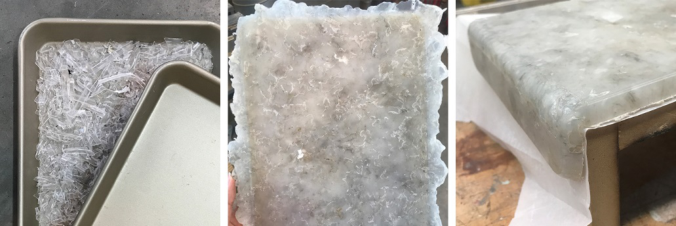
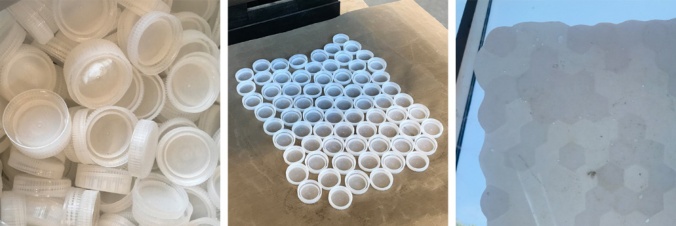
Figure 1: Melting and forming process. (Taghreed Ayman Shalaby, 2021).Figure 2: Melting water bottle caps into thin translucent honeycomb patterned sheets. (Taghreed Ayman Shalaby, 2021).
between two metal baking trays and melted under a vacuum-form machine heater. After removing the trays from the heat, weights were placed on them to further flatten the plastic and left on until fully cooled. The rough edges were trimmed off and the resulting melted plastic block and two sides were bent using a heating strip and left to cool over a Medium Density Fiberboard (MDF) mold (see Figure 1).
In another experiment, water bottle caps were arranged closely next to each other and squashed and melted into a thin translucent honeycomb pat- terned sheet using a Precious Plastic heat press. The honeycomb pattern was a result of the close proximity and layout of the caps. Due to some of the sli- ght mass and size differences in the bottle caps, some of the honeycomb hex shapes were darker and some, lighter, adding to the diversity in the patterns and overall aesthetic beauty of the sheets (see Figure 2).
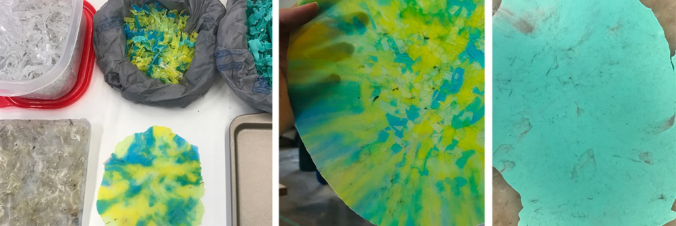
The student also experimented with mixing different colored plastic pie- ces to create multi-colored, translucent sheets. Another approach was mixing similar aquamarine-colored plastic pieces together to form a subtler, homo- genous colored sheet (see Figure 3).
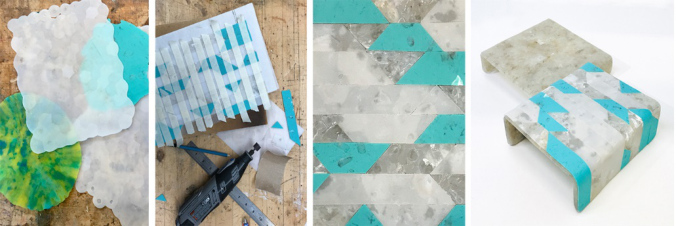
Once the student had several sheets made from different explorations, she cut some of them into trapezoidal strips and wove them together into another patterned sheet and laminated them onto the top surface of the bent cup/mug holder using a plastic-compatible adhesive (see Figure 4).
Experimental Processes with Precious Plastics 61
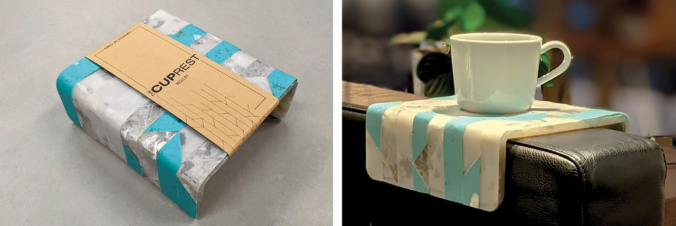
Figure 3: Combining multi-colored and similar colored pieces to form different sheet options. (Taghreed Ayman Shalaby, 2021).Figure 4: Laminating decorative woven trapezoidal strips onto the cup holder. (Tagh- reed Ayman Shalaby, 2021).Figure 5: Finished Cuprest concept with packaging (left) and on sofa arm (right). (Taghreed Ayman Shalaby, 2021).
A simple cardboard sleeve with “CUPREST” (name of the product) prin- ted on it served as minimal recyclable packaging. Cuprest is able to hold cups/mugs successfully on sofa arms as shown in Figure 5.
LAYERING PLASTIC FOR CNC MILLING Another student developed a portable cutting board/case concept which holds a knife and sharpening stone for users who would like the ability to prepare food outdoors such as at a campsite or fishing trip. In order to pro- totype the design, the student developed a process of creating thick plastic
62 Chow
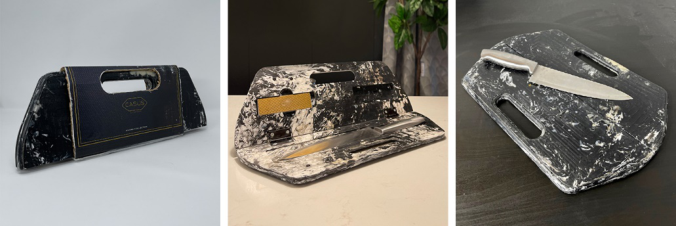
Figure 6: Layering plastic to form thick blocks for CNC milling. (Cong Khanh Vu, 2021).Figure 7: CNC milling and finishing the portable cutting board. (Cong Khanh Vu, 2021).Figure 8: Final portable cutting board/case prototype. (Cong Khanh Vu, 2021).
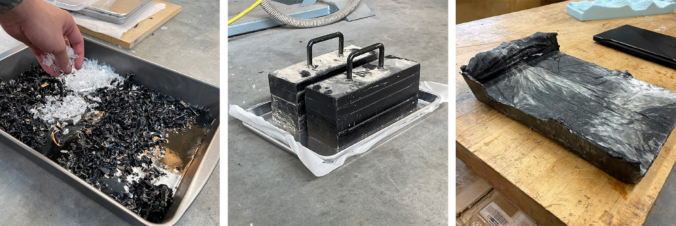
blocks by melting shredded plastic one layer at a time in a baking pan. Each layer of plastic took approximately 10-15 minutes to melt under the vacuum- forming heating elements at 350 °F. Once the first layer was melted, another layer of plastic was added on top. The process was repeated until the desired thickness was reached, which in this case was about 0.75”. A baking pan was placed on top of the thick mass of melted plastic and 200 lbs. of weights were placed on top to squeeze the layers together, help push bubbles out, and cool the mass. Once fully cooled, the block was removed from the baking pan (see Figure 6).
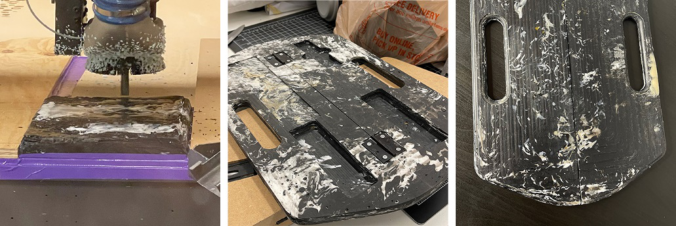
The flash around the edges of the block were cut off with a table saw and the uneven face surfaces were leveled with a CNC mill. The cutting board design and receptacles for a knife, a sharpener, and recessed hinge areas were
Experimental Processes with Precious Plastics 63
also cut with the CNC mill. The radii on the cutting board side edges and handle cut-outs were added with a router power tool (see Figure 7).
Hinges were fastened to the two cutting board halves to allow it to be fol- ded up. Neodymium magnets were glued in the receptacles and in recessed holes to hold the knife and sharpening stone in place and to provide enough magnetic force to keep the case safely closed during transport. A simple cardboard sleeve serves as minimal recyclable packaging (see Figure 8).
CONCLUSION
The problem of excess plastic in our oceans and landfills will continue to exist as long as consumers continue to buy and utilize products with plastic material- especially single-use plastics like straws, cups, grocery bags, and water bottles. The world-wide Precious Plastic movement is helping to miti- gate this problem by recycling plastic into products that people can use again. Industrial Design programs have a great opportunity to explore design possi- bilities with their students utilizing Precious Plastic processing machines. This case study covered two such explorations where students developed processes and experiments to laminate decorative thin plastic strips onto thicker plastic blocks and layering shredded plastic to create thicker blocks for CNC milling. With the addition of future Precious Plastic machines such as an extruder, injection molding machine, and large sheet press, even more explorations and experiments can take place. With more people helping with collecting, experimenting, and recycling plastic into valuable products, we can continue to reduce our plastic pollution while improving the quality of life for people.
REFERENCES
Baker, A.-E., (2019). About. Precious Plastic UH. Available at: https://www.precious plasticuh.com/about [Accessed February 28, 2022]. Environment, U.N., (2021). Drowning in plastics – marine litter and plastic waste
vital graphics. UNEP. Available at: https://www.unep.org/resources/report/drow ning-plastics-marine-litter-and-plastic-waste-vital-graphics [Accessed February 28, 2022]. Hakkens, D., (2016). Precious plastic history. Precious Plastic History. Available at: https://preciousplastic.com/about/history.html [Accessed February 28, 2022]. IUCN, (2021). Marine plastic pollution. IUCN. Available at: https://www.iucn.org/r
esources/issues-briefs/marine-plastic-pollution [Accessed February 28, 2022]. National Geographic Society, (2019). A whopping 91 percent of plastic isn’t recycled.
National Geographic Society. Available at: https://www.nationalgeographic.org/a rticle/whopping-91-percent-plastic-isnt-recycled/ [Accessed February 28, 2022].
LISTED IN THE AHFE DIGITAL BOOKSTORE CATALOGUE
Explore the complete digital volume
Interdisciplinary Practice in Industrial Design
Read this individual research paper free through the original publisher, or explore the full digital proceedings book.
ISBN 978-1-958651-24-7
Explore this ISBN in the AHFE Bookstore ↗Listed in the July 2026 bookstore catalogue; search by ISBN to confirm current availability · Digital book purchase optional