Sarawuth Pintong (2022). Revitalizing The National Folk Play: The Tiger Hunting Folk Play. In: Human Factors in Communication of Design. AHFE Open Access, vol. 49, pp. 132–138. https://doi.org/10.54941/ahfe1002046
“Kratua Thaeng Suea” is a story of hunting the tigers that trespass into town. It is a Thai traditional folk play which has been passed down from generation to generation for more than 200 years. However, this folk play is rapidly fading away from the Thai society due to the change of aesthetic preference which caused its unpopularity. Nowadays, there are only two troupes left in Bangkok which recently one of them decided to discontinue their show because of COVID-19 situation. How to preserve this intangible cultural heritage and combine it with modern aesthetics for transmission is an urgent issue. This study combines literature research and field trip methods in order to identify some of the problems faced in the dissemination of it. The research results show that, in order to renew this folk play that complement the new aesthetic preference, all related elements of this play such as its story, costumes, music, and performance need to be modernized. The new play will combine “Street Culture” such as street art, street fashion, street music, and street performance into the play with a new storyline which is twisted from the story of a tiger hunter to be rescuing the tigers instead. All of this could draw some attention from the society and thus achieve the goal of sustainable inheritance and preservation of this folk play. The new concept of “Kratua Thaeng Suea” is the combination between the old and the new which does not only reflect the beauty of cultural dynamic or build up the sense of ecological awareness in the form of “Soft Power”, but also provides a “Cultural Revitalizing model” which could be an alternative model to inherit the culture.
“Kratua Thaeng Suea” or Tiger Hunting Folk Play is one of long-standing cultural heritages. There is no clear evidence to when it existed. However, it was academically assumed that ‘Kratua Thaeng Suea’ was played as one of preludes which received its influence from ‘Kraoua Thaeng Kwai’ or Buf- falo Hunting Folk Play of Dawei. It was a play performed in a royal tonsure ceremony and was later joint together as one of royal plays. (Honghengseng, K., 2017) There were changes of characters and elements to be more sui- table for social value and context. It is said that when the play turned to be Kratua Thaeng Suea folk play, it became to perform for fun and plea- sure and to add some festivity to parades or religious ceremonies because of its music and singing style which was combined and adapted from Menora,
Revitalizing the National Folk Play: Tiger Hunting Folk Play 133
musical instruments that complement the acrobatic acting, and the exciting story.
Nowadays, Kratua Thaeng Suea can be seen and still performs in Thon Buri of Bangkok. However, the society has turned to globalization trends and there are other shared factors that cause the vanishment of the play which reflects ways of life, beliefs, and the identity of the locality. This is the reason that drives this study to find ‘Revitalization’ and ways to con- serve and sustain the play via applicating and redesigning Kratua Thaeng Suea, improving and adjusting the play to be more suitable to the changing society to create value and awareness of the cultural heritage. This means to push the folk play to be a support of soft power. Besides, to response to the current time and the present society that increasingly values natural resou- rces and wild animals, the concept of Kratua Thaeng Suea revitalization will support that goal. This is to emphasize that the destruction of natural resou- rce by human makes huge impact on not only animal lives but also human lives.
In addition to the goal of the study and revitalization of Kratua Tha- eng Suea to raise awareness of culture and environment, it also includes adding cultural value which is a foundation that supports sustainability of the community according to the Sustainable Development Goals (SDGs).
LITERATURE REVIEW
“Kratua Thaeng Suea”, or sometimes called “Bong Tan Thaeng Suea”, is one of traditional folk play passed down from generation to generation for more than 200 years. It has its reference from the legend play of Phra Suthon Menora. The synopsis is that once upon a time, an unfortunate incident has taken place. Bong Tan has heard that the city ruler is looking for a talent who can conquer tigers that have been violently hurting and killing people. Those who can overcome the tigers will be granted enormous fortune. Consequently, Bong Tan decides to volunteer and go to the woods with his wife to find the tigers. At last, they succeed and are able to bring the tigers’ heads to the city ruler (Nakhonwilai, S., 2014).
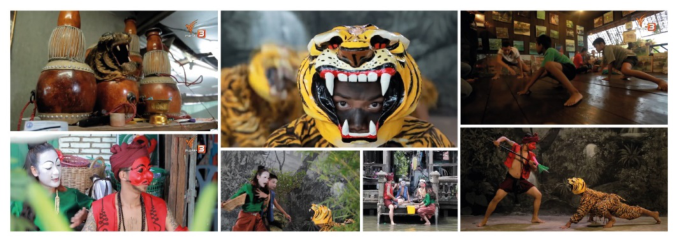
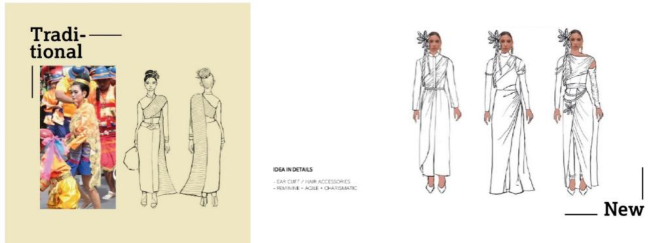
The elements of Kratua Thaeng Suea consist of ‘Bong Tan’, a hunter who wears long-sleeved shirts, shin length pants with a traditional waist band, and a head dress on his head. His weapon is a spear and by his side is his wife, the hunter’s wife who dresses with long-sleeved shirt and a sarong that covers her ankles. On top of her shirt is a shawl and she wears some accessories and carries a basket. Their children, ‘Jao Juk’ and ‘Jao Klae’, wear long-sleeved shirts and a Thai traditional loincloth. One holds an axe, the other holds a chopping knife. The tigers are Bengal tigers as to the original story, it was a tiger man or a demon that looks like a huge Bengal tiger wearing a tiger- printed costume and a tiger mask. Taloong rhythm will be used while Bong Tan enters the city. The singing that is performed while the characters are dancing has southern dialect and is similar to the singing of Menora. The musical instruments are such as traditional Thai drums, Thai small cymbals, cymbals, rhythm clappers, and a bass gong to create exciting feelings while the tigers and the hunter are fighting.
134 Pintong
Figure 1: Kratua Thaeng Suea performance in a Thai TV show, Klang Mueng. (Thai PBS, 2019).
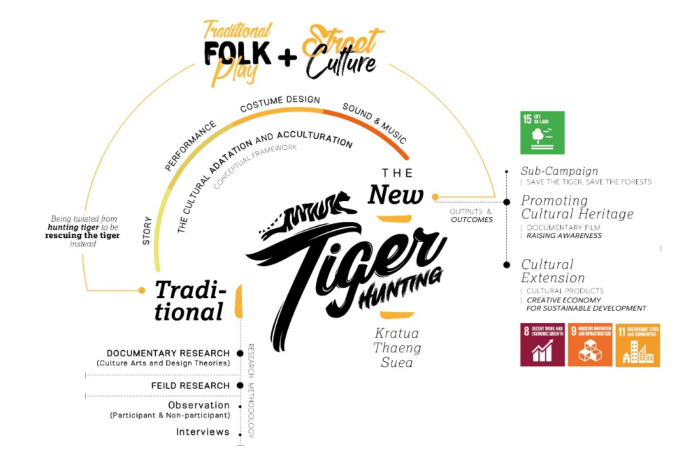
As mentioned to the concept of Kratua Thaeng Suea, the revitalization ver- sion is the combination between the old and the new which the original model can be improved to be suitable for the society. The methods are 1) concept and story creation 2) performance and dancing creation 3) music creation 4) costume design.
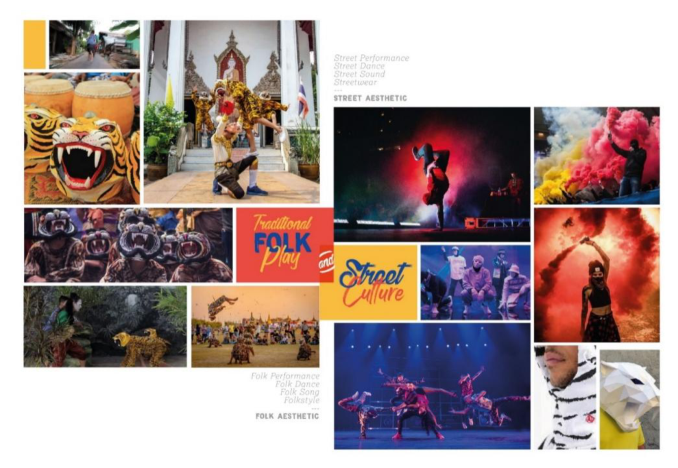
From the concept creation and the identity of Kratua Thaeng Suea along with current cultural trends, it is decided to choose ‘Street Culture’ as a way to portray Kratua Thaeng Suea folk play. This is to meet the target groups such as children and people in the community as they are the inheritors of the play. Also, people outside the community will help remain and conserve Kratua Thaeng Suea in the society. Kratua Thaeng Suea is hoped to support and add value to cultural performance, to create human interaction, community and country identity, and incomes.
Theoretically, the Street Culture harmonizes with Thai traditional perfor- mance in terms of belief portrayal, simplicity, and informality. There are some elements that work well with the revitalization of Kratua Thaeng Suea such as the similarity of the prelude. The parade of Kratua Thaeng Suea is compara- ble to Street Culture; the acrobatic dancing style while fighting with the tigers. This also includes the identity of Street Culture that connects the environmen- tal diversity in the community which is the core to reflect one community’s uniqueness.
DESIGN METHODOLOGY Revitalization process to restore and conserve Kratua Thaeng Suea takes place under the concept of cultural adaptation. This is to create ideas and solutions that will build up from the primary knowledge to design different and creative work that is suitable for the current society.
The first procedure was to collect information via documentary research and field research. It was done by using non-participant and participant obse- rvations. Interviews were used for research before analyzing and synthesizing to design different elements of ‘Modernized Kratua Thaeng Suea’ as follo- wing 1) concept and story creation 2) performance and dancing creation 3) costume design 4) music creation which was adapted to ‘Street Culture’ by
Revitalizing the National Folk Play: Tiger Hunting Folk Play 135
Figure 2: Conceptual framework.
twisting the story. Also, to raise awareness about natural conservation, tigers are seen as forest fertility indicator. This is to urge people to be more aware of the life balance between nature and human than only taking advantages from the nature.
DESIGN PROCESS The design process of modernized Kratua Thaeng Suea is categorized into four parts as following.
Concept and Story Creation As mentioned above, the new story of Kratua Thaeng Suea will be about the current world situation where natural resource has been destroyed by humans. This leads to the shortage of animal natural shelters. The conse- quences are world’s natural disasters, draught, unusual rainfall, flood, and starvation. Famous geologists assume that that is because the last three tigers, Bengal tiger, white tiger, and black tiger that are forest fertility indicator, have been lost from the deforestation by humans. The way to resolve the problem is to find the three tigers and bring them back to the forest and human should learn to balance between nature and humans.
Hunter Bongtan and his wife are missioned to find the three tigers that have escaped to the city and are facing crisis from human either intentionally or unintentionally. When Bongtan and his wife discover the trace of the tiger and eventually find the tigers, they have had bad experience from human and will not listen about anything. Bongtan, his wife and the tigers are fighting endlessly that they wore out. Bongtan who has no bad intention chooses the
136 Pintong
Figure 3: Concept board.
gentlest way to calm the tigers. Eventually, the tigers realize the real purpose behind, they accept and follow Bongtan and his wife back to the forest with the aim to create balance and return the richness to the world together.
Performance and Dancing Creation The performance will be portrayed in a style of documentary short film. There are five characters which are Hunter Bongtan and his wife, and the three tigers: Bengal tiger, white tiger, and black tiger. The climax will remain the uniqueness of the original Kratua Thaeng Suea which is to create excitement by using acrobatic movement that blends well with street dance.
Music Creation The music is thoughtfully designed to support the performance. It will be rich of street sound such as Hip Hop and Electro, and Thai music to produce unique music for the modernized Kratua Thaeng Suea.
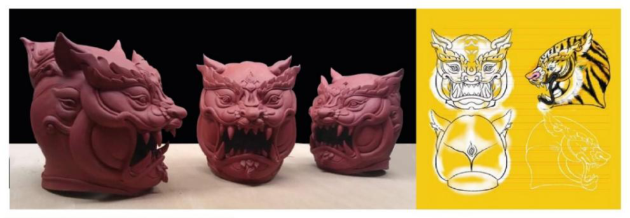
Costume Design The design for modernized Kratua Thaeng Suea will also have a touch of street style matched well with the Thai. The unique design of street style is besides function that supports acrobatic movement, it can also be built up to become streetwear fashion. Another element that is special about Kra- tua Thaeng Suea is a mask. It is a significant element of Hunter Bongtan’s costume. According to the performer’s belief, the mask will be worshipped before the performance.
Revitalizing the National Folk Play: Tiger Hunting Folk Play 137
Figure 4: Costume and mask design of tiger character (sketch idea and prototype).Figure 5: Costume design of Hunter Bongtan and his wife (sketch ideas).
CONCLUSION
There are a number of folk plays that are gradually vanishing due to globa- lization trends. Ways to conserve and restore the art is to realize its value. People in the community should see the significance. Research and study
138 Pintong
should be available to develop and the art should be adjusted to be suita- ble for the current society. Revitalizing a folk play in order to add value and reach people in the current time is a possible way for a play like Kratua Thaeng Suea to remain in the society as long as possible.
ACKNOWLEDGMENT
This paper is partially supported by the Ministry of Culture (Thailand) and also partially supported by Faculty of Decorative Arts, Silpakorn University, Thailand which are gratefully acknowledge.
REFERENCES
Honghengseng, K. (2017). Kraoua Tang Kwai and Kratua Tang Seua: History and Development of Ancient Amusement Play. Journal of Thai Studies, Bangkok. Nakhonwilai, S. (2014, November 21). Decoding of Kratua Thaeng Suea. Kom Chad
Luek Online. Thai PBS. (2019). Klang Muang: Kratua Thaeng Suea. Retrieved December 2, 2021 from program.thaipbs.or.th/KlangMuang/episodes/58481
LISTED IN THE AHFE DIGITAL BOOKSTORE CATALOGUE
Explore the complete digital volume
Human Factors in Communication of Design
Read this individual research paper free through the original publisher, or explore the full digital proceedings book.
ISBN 978-1-958651-25-4
Explore this ISBN in the AHFE Bookstore ↗Listed in the July 2026 bookstore catalogue; search by ISBN to confirm current availability · Digital book purchase optional