Marc Antoine Moinnereau, Tiago Henrique Falk, Alcyr Alves De Oliveira (2022). Measuring Human Influential Factors During VR Gaming at Home: Towards Optimized Per-User Gaming Experiences. In: Human Factors in Virtual Environments and Game Design. AHFE Open Access, vol. 50, pp. 15–24. https://doi.org/10.54941/ahfe1002056
It is known that human influential factors (HIFs, e.g., sense of presence/immersion; attention, stress, and engagement levels; fun factors) play a crucial role in the gamer’s perceived immersive media experience [1]. To this end, recent research has explored the use of affective brain-/body-computer interfaces to monitor such factors [2, 3]. Typically, studies have been conducted in laboratory settings and have relied on research-grade neurophysiological sensors. Transferring the obtained knowledge to everyday settings, however, is not straightforward, especially since it requires cumbersome and long preparation times (e.g., placing electroencephalography caps, gel, test impedances) which could be overwhelming for gamers. To overcome this limitation, we have recently developed an instrumented “plug-and-play” virtual reality head-mounted display (termed iHMD) [4] which directly embeds a number of dry ExG sensors (electroencephalography, EEG; electrocardiography, ECG; electromyography, EMG; and electrooculography, EoG) into the HMD. A portable bioamplifier is used to collect, stream, and/or store the biosignals in real-time. Moreover, a software suite has been developed to automatically measure signal quality [5], enhance the biosignals [6, 7, 8], infer breathing rate from the ECG [9], and extract relevant HIFs from the post-processed signals [3, 10, 11]. More recently, we have also developed companion software to allow for use and monitoring of the device at the gamer’s home with minimal experimental supervision, hence exploring its potential use truly “in the wild”. The iHMD, VR controllers, and a laptop, along with a copy of the Half-Life: Alyx videogame, were dropped off at the homes of 10 gamers who consented to participate in the study. All public health COVID-19 protocols were followed, including sanitizing the iHMD in a UV-C light chamber and with sanitizing wipes 48h prior to dropping the equipment off. Instructions on how to set up the equipment and the game, as well as a google form with a multi-part questionnaire [12] to be answered after the game were provided via videoconference. The researcher remained available remotely in case any participant questions arose, but otherwise, interventions were minimal. Participants were asked to play the game for around one hour and none of the participants reported cybersickness. This paper details the obtained results from this study and shows the potential of measuring HIFs from ExG signals collected “in the wild,” as well as their use in remote gaming experience monitoring. In particular, we will show the potential of measuring gamer engagement and sense of presence from the collected signals and their influence on overall experience. The next steps will be to use these signals and inferred HIFs to adjust the game in real-time, thus maximizing the experience for each individual gamer.References[1] Perkis, A., et al, 2020. QUALINET white paper on definitions of immersive media experience (IMEx). arXiv preprint arXiv:2007.07032.[2] Gupta, R., et al, 2016. Using affective BCIs to characterize human influential factors for speech QoE perception modelling. Human-centric Computing and Information Sciences, 6(1):1-19.[3] Clerico, A., et al, 2016, Biometrics and classifier fusion to predict the fun-factor in video gaming. In IEEE Conf Comp Intell and Games (pp. 1-8).[4] Cassani, R., et al 2020. Neural interface instrumented virtual reality headsets: Toward next-generation immersive applications. IEEE SMC Mag, 6(3):20-28.[5] Tobon, D. et al, 2014. MS-QI: A modulation spectrum-based ECG quality index for telehealth applications. IEEE TBE, 63(8):1613-1622.[6] Tobón, D. and Falk, T.H., 2016. Adaptive spectro-temporal filtering for electrocardiogram signal enhancement. IEEE JBHI, 22(2):421-428.[7] dos Santos, E., et al, 2020. Improved motor imagery BCI performance via adaptive modulation filtering and two-stage classification. Biomed Signal Proc Control, Vol. 57.[8] Rosanne, O., et al, 2021. Adaptive filtering for improved EEG-based mental workload assessment of ambulant users. Front. Neurosci, Vol.15.[9] Cassani, R., et al, 2018. Respiration rate estimation from noisy electrocardiograms based on modulation spectral analysis. CMBES Proc., Vol. 41.[10] Tiwari, A. and Falk, T.H., 2021. New Measures of Heart Rate Variability based on Subband Tachogram Complexity and Spectral Characteristics for Improved Stress and Anxiety Monitoring in Highly Ecological Settings. Front Signal Proc, Vol.7.[11] Moinnereau, M.A., 2020, Saccadic Eye Movement Classification Using ExG Sensors Embedded into a Virtual Reality Headset. In IEEE Conf SMC, pp. 3494-3498.[12] Tcha-Tokey, K., et al, 2016. Proposition and Validation of a Questionnaire to Measure the User Experience in Immersive Virtual Environments. Intl J Virtual Reality, 16:33-48.
Restrictions from the COVID-19 pandemic have disrupted research activi- ties in the university setting, forcing students and researchers to work from home. This has particularly disrupted research involving human data colle- ction. As such, new protocols had to be quickly deployed to allow for remote experiments. While this can be easily done with experiments requiring only subjective rating data collection (e.g., provide an engagement rating after pla- ying a new game), it can be particularly challenging if the research involves the use of hardware, such as virtual reality head-mounted displays (HMD) or neurophysiological signal monitors (e.g., smartwatches or brain-wave moni- toring headbands). This is true because such experimental protocols require close inspection by a trained experimenter to assure the devices are worn properly, that the signals are of usable quality, that sensor impedances are within operable ranges, and within the scope of a pandemic, that the devices are properly sanitized and quarantined between users. Passing these tasks on to the user would be overwhelming and beyond the scope of their consent to participate. As such, a different methodology is needed. This is where this paper come in.
In this paper, we describe our proposed setup to collect multimodal neuro- physiological data while users play a virtual reality game at home in order to build models of the overall gameplay experience. To achieve these goals, several innovations had to come together. First, an instrumented “plug-and- play” HMD (henceforth termed iHMD) (Cassani et al., 2020) was needed which directly embeds a number of dry ExG sensors (electroencephalogra- phy, EEG; electrocardiography, ECG; facial electromyography, EMG; and electrooculography, EOG) into the HMD. A portable bioamplifier is used to collect, stream, and/or store the biosignals in real-time. Moreover, a softw- are suite was developed to automatically measure signal quality (Tobon V et al., 2016), to enhance the biosignals (dos Santos et al., 2020; Rosanne et al., 2021; Tobon and Falk, 2018), and to extract relevant human influen- tial factors (HIFs) from the post-processed signals (e.g., Moinnereau et al., 2020; Tiwari and Falk, 2021). The iHMD was dropped off at the partici- pant homes and via a dedicated videoconference link, the experimenter had access to real-time ratings of signal quality and could instruct participants if any changes were needed. Signals and HIFs were recorded and uploaded to an accompanying laptop for future analysis. Devices were then picked up, sanitized, quarantined, and dropped off to the next participant.
Development of the iHMD was motivated by the fact that HIFs (e.g., sense of presence/immersion; attention, stress, engagement; fun factors) are known to play a crucial role in the gamer’s perceived immersive media expe- rience (Perkis et al., 2020). Recent research has explored the use of affective brain-/body-computer interfaces to monitor such factors (Gupta et al., 2016). Traditionally, subjective methods have been utilized, which rely on post- experience questionnaires, such as the sense of presence (Witmer and Singer, 1998). Subjective tests, however, can be highly biased, lack temporal resolu- tion, and are performed after the immersive application is finished, thus rely on gamer memory to recall events. Monitoring HIFs in real-time requires
Measuring Human Influential Factors During VR Gaming at Home 17
objective methods and physiological signals have proven to be particularly effective. For instance, stress, engagement, emotions, sense of presence, immersion, and overall experience have been monitored from EEG, ECG, and EOG signals (Dehais et al., 2018). As virtual reality and the metaverse are projected to boom in the coming years, being able to objectively quan- tify user experience in immersive settings will be crucial and automated HIFs measurement will be needed to enable real-time user experience optimization on a per-user basis.
The remainder of this paper is organized as follows. In the Materials and Methods section we describe the iHMD development, the at-home drop-off protocol, and signal acquisition method. Next, in the Experimental Results and Discussion section we present the results obtained from the biosignal and HIFs analysis and their use in measuring overall player experience and compare to existing literature. Lastly, Conclusions are presented.
MATERIALS AND METHODS
In this section, we detail the experimental procedure followed, including data collection, signal pre-processing, analysis and HIF metric measurement.
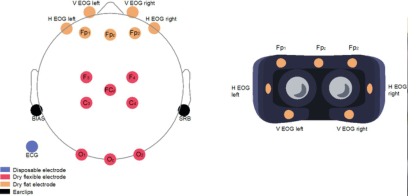
iHMD integration We have recently developed a fully portable and wireless solution that inte- grates several physiological sensors on any off-the-shelf VR headset. In this study, we integrated sensors on an HTC VIVE Pro Eye VR headset. It is a PC-powered VR headset, released in 2019 and has the following features: 98° field-of-view, 1440x1600 per eye resolution, 90 Hz refresh rate, and 6 degrees-of-freedom tracking. It offers increased visual resolution and spatial sound to enhance the immersion and improve the gameplay experience. An OpenBCI bioamplifier, including the Cyton and Daisy boards (Open BCI, USA), was used to record sixteen fully-differential input channels to record EEG, EOG, and ECG signals. We proposed to acquire 11 EEG signals from dry electrodes located in three areas: frontal (Fp1, Fpz and Fp2), central (F3, F4, FCz, C3 and C4), and occipital (O1, Oz and O2), as shown in Figure 1. The EOG signals were derived from the EEG electrodes on the frontal area, as well as two vertical and two horizontal electrodes (H EOG right, H EOG left, V EOG right, and V EOG left), all embedded directly into the foam of the VR headset. Moreover, one disposable electrode was placed on the user’s col- larbone for ECG recording. Signals were acquired at a sampling rate of 125 Hz. Lastly, two earclip electrodes were used as references on each lobe. Data was streamed wirelessly using the standalone OpenBCI Graphical User Inter- face (GUI) to a laptop that was also dropped off at the user’s home alongside the iHMD.
Remote Data Collection Eight participants consented to take part in this experiment (5 male and 3 female, 28.9 +/−2.9 years of age) which received Ethics approval by the INRS Ethics Committee. A box was placed in front of the participant’s home at a mutually-agreed time including two laptops and the iHMD. One laptop
Figure 1: Proposed 16-ExG electrode configuration embedded into the HTC VIVE pro eye.
was used to display the VR content and the other was used to record the stre- amed biosignal data. Gameplay and real-time signal quality monitoring was achieved through the “Teamviewer” platform and a dedicated videoconfere- nce session. Instructions on how to set up the gaming environment, how to wear the iHMD, as well as how to play the game: Half-life Alyx were given live via the videoconference call. Participants went through two conditions, which we term (1) baseline and (2) exploration/fight. The baseline corre- sponds to the first two chapters of the game (about 30 minutes of gameplay). Here, the player discovers the game world and learns to navigate and interact with objects. The second exploration/fight condition corresponds to subse- quent phases that alternate between exploration and fight where the player is confronted with puzzle solving and fighting challenge phases (about 1 hour of gameplay). At the end of these two sessions, participants were asked to fill a unified user experience questionnaire via a Google form. The unified questionnaire combined 87 different items, compiled from 10 different sca- les measuring the gamer’s sense of presence, engagement, immersion, flow, usability, skill, emotion, cybersickness, judgement, and technology adoption. Eighty-four such items used 10-point Likert scale and three were open que- stions. Once the two sessions were completed, participants were asked to put everything back inside the box. Once the box was collected by the experi- menter, the cleaning and disinfecting phase would start. All VR equipment, the iHMD electrodes, and the two laptops were thoroughly disinfected with alcoholic wipes. The iHMD was disinfected using a Cleanbox UV-C chamber built specially for VR headsets. Upon sanitation, the iHMD stayed in quaran- tine in the chamber for 24 hours and outside the chamber for another 24h. After 48h of quarantine, all the material was ready to be boxed up again and delivered to the next participant.
Pre-Processing and HIF Features Extraction As mentioned previously, all the biosignals were streamed and stored to one of the laptops for posterior analysis. Here, signal processing was performed using MATLAB in combination with the EEGLab toolbox. For EEG, signals were first band-pass filtered between 0.5 and 45 Hz and then zero-mean normalized. Motion-related artifacts were automatically removed using the Artifact Subspace Reconstruction (ASR) algorithm available in EEGLab.
Measuring Human Influential Factors During VR Gaming at Home 19
Signals were segmented into quarter-second windows with 50% hops. As we are interested in measuring HIFs, several EEG metrics described and widely used in the literature were tested, namely: the engagement index (EI), arousal and valence, and frontal alpha asymmetry (FAA). The engagement index EI was calculated as the ratio of the beta-band (12-30Hz) EEG power to the sum of the alpha-band (8-12Hz) and theta-band (4-8Hz) EEG powers from Fp1 (Coelli et al., 2015; Nuamah et al., 2017). As we are also interested in the emotion states of the gamer, arousal levels were measured using the (beta power (electrode F3) + Beta power (F4) ) / (alpha power (F3) + alpha power (F4 )) ratio while valence was measured via the (alpha power (F4) / beta power (F4) ) - (alpha power (F3) / beta power (F3)) ratio, as proposed by (Mcma- han et al., 2015). Valence corresponds to the level of pleasantness, whereas arousal measures how calming or exciting the stimulus is. Moreover, engage- ment and arousal indexes have been shown to also measure immersion levels (Mcmahan et al., 2015). Finally, we explored FAA as an additional index of pleasantness; its calculation is given by the log-power of alpha EEG band in electrode F4 subtracted by the log-power of the alpha band from electrode F3. A positive FAA index reflects greater left-sided frontal activity and may serve as an index of approach motivation or related emotion (e.g., anger and joy); whereas negative values indicate greater right-sided activity and may serve as an index of withdrawal motivation or related emotion (e.g., disgust, fear, and sadness) (Fischer et al., 2018).
For ECG signal processing, in turn, an open-source MATLAB toolbox was used to extract heart rate (HR) measures (OK, 2022). Experiencing emotio- nal or physical stress may cause an increase in HR and, consequently, impact the user experience. Finally, from EOG signals we extracted eye blink and saccade measures using the EOG Event Recognizer Tool toolbox (Toivanen et al., 2015); these could be indicative of user frustration. Eye blinks have also been shown to be useful in predicting cybersickness (Dennison et al., 2016). EOG signals were first band-pass filtered between 0.1 and 60 Hz and then zero-mean normalized. An ASR algorithm was also applied to remove some motion-related artifacts while keeping the eye blinks and movements intact. The blinks and saccade measurement algorithm relies on a probabili- stic method that requires a short period of unsupervised training before the actual measurements. To this end, we considered the first 60 seconds of each session for each participant. The parameters of the Gaussian likelihoods were learned using an expectation maximization algorithm (Toivanen et al., 2015).
RESULTS AND DISCUSSION
Subjective Ratings To compare the baseline and exploration/fight conditions, a t-test was con- ducted on each question of the 10 scales of the subjective questionnaire. Three significance levels were assessed: 90%, 95%, and 99.99%. In total, twenty-one out of the eighty-four questions showed statistically significant differences between the two conditions. Table 1 reports the obtained rating statistics from 11 of these 21 questions that are related to the gaming experi- ence and that also showed significant correlation with HIFs (see next section
Table 1. Statistics and t-test results for each questionnaire scale (B: baseline; E/F: exploration/fight). * corresponds to p < 0.1, ** to p < 0.05, and *** to p < 0.0001. Units: HR – beats per min; saccade – saccades per minute.
Table available in the original PDF paper.
Questions Mean +/- std Correlation per Epoch B E/F HR Saccades 6.3±1.7 8.6±0.5 −0.32*** −0.13** “I do not suffer from vertigo during my interaction with the virtual environment” – Cybersickness**
5.2±2.8 7.8±2.1 −0.01 −0.17***
“Time seemed to flow differently than usual” – Flow**
7.4±0.5 9.1±1.1 −0.21*** −0.13**
“When I mention the experience in the virtual environment, I feel emotions I would like to share” – Flow**
7.1±1.4 8.5±1.6 0.31*** −0.25***
“I become so involved in the virtual environment that it is if I was inside the game rather than manipulating a controller and watching a screen” – Immersion**
5.1±3.4 8.4±1.9 0.19*** −0.20***
“I got scared by something happening in the virtual environment” – Immersion**
9.1±0.8 9.9±0.3 0.09** 0.07*
“The virtual environment was responsive to actions that I initiated” – Presence**
8.1±1.5 9.3±0.8 0.07* 0.25***
“I could examine objects from multiple viewpoints” – Presence**
6.9±1.6 8.6±0.9 0.23*** 0.08**
“I felt confident selecting objects in the virtual environment” – Skill**
6.8±1.3 8.5±1.5 0.30*** 0.04
“I felt confident moving the cross hair around the virtual environment” – Skill**
7.0±2.4 8.7±1.3 0.23*** −0.25
“I enjoyed the challenge of learning the virtual reality interaction devices”- Emotion*
4.1±2.4 5.7±1.3 0.17*** −0.05
“I got tense in the virtual environment”- Emotion*
for more details). As can be seen, the scales cybersickness, flow, immersion, presence, skill, emotion, and technology adoption showed significant diffe- rences between the two conditions. For each question, except cybersickness, the average scores are higher in the exploration/fight condition relative to the baseline. Since the former includes fight and puzzle solving challenges, this condition is likely to induce higher stress and concentration levels for the gamer, thus increasing such states. Increases in their perception of skill, for example, could also be due to the fact that the exploration/fight condition came second, thus the gamers had obtained some experience in navigating and interacting with the objects. Moreover, as the fight conditions were more challenging, participants also reported becoming more involved, excited, and
Measuring Human Influential Factors During VR Gaming at Home 21
engaged during this phase, hence explaining the increases in emotion, flow, immersion, and presence subscales. However, in most cases, participants complained of visual fatigue after 15-20 mins of playing. Only one parti- cipant reported cybersickness with a little nausea when using VR for a while. After 50 minutes of play, some participants experienced physical and mental fatigue.
HIF Metrics from Physiological Data
Table 2 shows statistics obtained from the HIF metrics extracted for each participant in each condition, as well as an average snapshop across all par- ticipants. For ECG, we can observe an increase in the HR (in bpm) in the exploration/fight condition for all participants, as well as on average. This is expected, as in the first condition, the gamers explore the game and are not confronted with any stressful situations, while in the second condition, they face period of stress while fighting to defeat the enemies. From the EEG signals, half of the participants showed a slightly higher EI score during the exploration/fight condition, suggesting improved engagement. According to the results for valence and arousal, all participants showed low values for the arousal index and moderate values for the valence index, thus, sugge- sting an overall positive emotion eliciting joy, and happiness. We observed similar effects as in (Mcmahan et al., 2015) where the valence index decre- ased during death events. In fact, participants face death situations several times during the exploration/fight condition, hence explaining the decrease in valence index for several of the participants, as well as on average. Lastly, from the FAA metric, we can observe that most of the participants exhibi- ted a negative value and an increase in the negative direction with the E/F conditions, thus corroborating the increased levels of fear.
Next, we look at the EOG-based metrics and note that the number of blinks/min (for 6 of the 8 participants) as well as the number of saccade- s/min (for all participants) increased for the E/F condition. Indeed, during the fight sequences, participants must react very quickly and look in seve- ral directions, which explains the increase in the number of saccades/min. Moreover, visual fatigue in known to increase the number of blinks/min. Seve- ral participants reported visual fatigue. As the E/F condition lasted twice as long as the baseline, this could explain the increase in blink rate for many of the participants. Overall, across all subjects HR and saccades showed to be significantly different across the two explored conditions, thus suggesting potentially useful metrics to objectively characterize gamer experience. To this end, we computed the Pearson correlation between these two HIFS and the 11 subjective ratings in Table 1. As can be seen, several of these measures showed highly significant correlations with flow, immersion, cybersickness, skill, presence, and emotion. Future work will explore the use of these para- meters to estimate gamer experience in a per-user basis, thus allowing for user-specific game updates to maximize the experience for each gamer. The obtained results are promising as they were achieved in highly uncontrolled “in-the-wild” scenarios.
Table 2. Statistics of HIF metrics per subject and averaged across all subjects. Notation: B-baseline; E/F-exploration/fight, * corresponds to P-value < 0.1 and ** to P-value < 0.05 Units: HR – beats per min; blinks – blinks per minute; saccade – saccades per minute.
In this paper, we describe a new protocol to collect physiological data remo- tely for virtual reality (VR) studies at home with minimal experimenter intervention. By instrumenting a commercial off-the-shelf VR headset with a number of ExG sensors (i.e., ECG, EEG, EMG, EOG), combined with a strict disinfecting protocol, we were able to collect data from eight participants remotely from their homes. From the collected data, several human influ- ential factor metrics were collected and shown discriminate several gamer experience factors, including engagement, immersion, and emotional states from the collected signals. As future work, we will explore extraction of facial gesture HIF metrics, additional EOG metrics (e.g., gaze velocity/accelera- tion), as well as additional heart rate variability measures. Ultimately, the goal will be to use the measured HIF metrics to adjust the game in real-time to maximize the user experience for each individual gamer.
Measuring Human Influential Factors During VR Gaming at Home 23
ACKNOWLEDGMENT
The authors would like to acknowledge funding from NSERC Canada.
Gagnon, J.-C., Jackson, P., 2016. Biometrics and classifier fusion to predict the fun-factor in video gaming. IEEE Conference on Computational Intelligence and Games (CIG) 1–8. Coelli, S., Sclocco, R., Barbieri, R., Reni, G., Zucca, C., Bianchi, A., 2015. EEG-based index for engagement level monitoring during sustained attention. 37th Annual International Conference of the IEEE Engineering in Medicine and Biology Society (EMBC) 2015, 1512–1515. Dehais, F., Dupres, A., Di Flumeri, G., Verdiere, K., Borghini, G., Babiloni, F., Roy, R.,
2018. Monitoring Pilot’s Cognitive Fatigue with Engagement Features in Simula- ted and Actual Flight Conditions Using an Hybrid fNIRS-EEG Passive BCI. IEEE International Conference on Systems, Man, and Cybernetics (SMC) 544–549. Dennison, M.S., Wisti, A.Z., D’Zmura, M., 2016. Use of physiological signals to predict cybersickness. Displays 44, 42–52. dos Santos, E.M., Cassani, R., Falk, T.H., Fraga, F.J., 2020. Improved motor imagery
brain-computer interface performance via adaptive modulation filtering and two- stage classification. Biomedical Signal Processing and Control 57, 101812. Egan, D., Brennan, S., Barrett, J., Qiao, Y., Timmerer, C., Murray, N., 2016. An evaluation of Heart Rate and ElectroDermal Activity as an objective QoE eva- luation method for immersive virtual reality environments. Eighth International Conference on Quality of Multimedia Experience (QoMEX), 1–6. Fischer, N.L., Peres, R., Fiorani, M., 2018. Frontal Alpha Asymmetry and Theta
Oscillations Associated With Information Sharing Intention. Frontiers in Behavi- oral Neuroscience 12, 166. Gupta, R., Laghari, K., Banville, H., Falk, T.H., 2016. Using affective braincomputer interfaces to characterize human influential factors for speech quality- of-experience perception modelling. Human-centric Computing and Information Sciences 6, 5. Mcmahan, T., Parberry, I., Parsons, T., 2015. Evaluating Player Task Engagement and
Arousal using Electroencephalography. Procedia Manufacturing 3, 2303–2310. Moinnereau, M.-A., Oliveira, A., Falk, T.H., 2020. Saccadic Eye Movement Classification Using ExG Sensors Embedded into a Virtual Reality Headset, in: 2020 IEEE International Conference on Systems, Man, and Cybernetics (SMC). Presen- ted at the 2020 IEEE International Conference on Systems, Man, and Cybernetics (SMC), 3494–3498. Nuamah, J., Seong, Y., Yi, S., 2017. Electroencephalography (EEG) classification of
cognitive tasks based on task engagement index. IEEE Conference on Cognitive and Computational Aspects of Situation Management (CogSIMA), 1–6. OK, D., 2022. ECG Class for Heart Rate Variability (https://www.mathworks.com/ matlabcentral/fileexchange/84692-ecg-class-for-heart-rate-variability-analysis), MATLAB Central File Exchange. Perkis, A., Timmerer, C., Barakovic, S., Barakovic Husic, J., Bech, S., Bosse, S., Botev,
J., Brunnström, K., da Silva Cruz, L., De Moor, K., Saibanti, A., Durnez, W., Egger-Lampl, S., Engelke, U., Falk, T., Hameed, A., Hines, A., Kojic, T., Kukolj, D., Zadtootaghaj, S., 2020. QUALINET White Paper on Definitions of Immersive Media Experience (IMEx). arXiv preprint arXiv:2007.07032.
Rosanne, O., Albuquerque, I., Cassani, R., Gagnon, J.-F., Tremblay, S., Falk, T.H.,
2021. Adaptive Filtering for Improved EEG-Based Mental Workload Assessment of Ambulant Users. Frontiers in Neuroscience 15, 611962. Tiwari, A., Falk, T.H., 2021. New Measures of Heart Rate Variability Based on Subband Tachogram Complexity and Spectral Characteristics for Improved Stress and Anxiety Monitoring in Highly Ecological Settings. Frontiers in Signal Processing 1, 737881. Tobon, D.P., Falk, T.H., 2018. Adaptive Spectro-Temporal Filtering for Electrocar-
diogram Signal Enhancement. IEEE J Biomed Health Inform 22, 421–428. Tobon V, D.P., Falk, T.H., Maier, M., 2016. MS-QI: A Modulation Spectrum-Based ECG Quality Index for Telehealth Applications. IEEE Trans Biomed Eng 63, 1613–1622. Toivanen, M., Pettersson, K., Lukander, K., 2015. A probabilistic real-time algori-
thm for detecting blinks, saccades, and fixations from EOG data. Journal of Eye Movement Research 8(2). Witmer, B.G., Singer, M.J., 1998. Measuring Presence in Virtual Environments: A Presence Questionnaire. Presence: Teleoperators and Virtual Environments 7, 225–240.
LISTED IN THE AHFE DIGITAL BOOKSTORE CATALOGUE
Explore the complete digital volume
Human Factors in Virtual Environments and Game Design
Read this individual research paper free through the original publisher, or explore the full digital proceedings book.
ISBN 978-1-958651-26-1
Explore this ISBN in the AHFE Bookstore ↗Listed in the July 2026 bookstore catalogue; search by ISBN to confirm current availability · Digital book purchase optional