Dingzhou Fei (2022). Revisiting the correlation between video game activity and working memory: evidence from machine learning. In: Human Factors in Virtual Environments and Game Design. AHFE Open Access, vol. 50, pp. 234–238. https://doi.org/10.54941/ahfe1002083
With the popularity of video games, more and more researchers are trying to understand the relationship between video game activity and cognitive abilities, and one of the important cognitive systems is working memory. Working memory is a limited capacity short-term memory system for processing currently active information and is an important predictor of goal-driven behavioral domains. Its scope of action includes, but is not limited to, fluid intelligence, verbal ability, and mathematical analysis.Due to the importance of working memory for the analysis of human behavior, numerous studies have attempted to describe the architecture and models of working memory. In general, models of working memory can be loosely categorized into content and process models, depending on their focus. The content model focuses on the static material of working memory, which includes mainly verbal and spatial visual material. The process model focuses on the dynamic processes of working memory and includes both Updating and Maintenance of memory.However, this area of research has also been the subject of debate among researchers.Translated with www.DeepL.com/Translator (free version). These disputes involve two main assumptions. According to the so-called core training hypothesis, a potential machine for improving cognitive ability through video games is provided by the so-called core training hypothesis. According to this hypothesis, repeated stress on the cognitive system will induce plastic changes in its neural matrix, leading to improved cognitive response performance. According to this hypothesis, repeated strains of the cognitive system can induce plastic changes in its neural matrix, which is an important reason for the improvement of performance. The other proposed basic mechanism is the meta-learning mechanism, that is, learning how to learn. According to this, video games (especially action games) can improve related motor control skills, such as rule learning, cognitive resource allocation, and probabilistic reasoning skills, which are used in many different situations.A recent study showed that the analysis of certain extreme groups showed that video game players performed better than non-game players in all three WM measurements, and that when extended to the entire sample, video game time and visual space WM and n-back performance. In general, the relationship between cognition and playing video games is very weak.This study used the Waris et al, 2019 dataset to re-investigate the correlation between video game activity and three different dimensions of working memory using seven different supervising learning models. It was concluded that video game activity was most highly correlated with the visuospatial component, slightly less correlated with the mnemonic updating component, and least correlated with the verbal component. This partly confirms Waris et al, 2019's view that the analytic method may be the key to the study.
Ludology as the Study on Gamification It is widely accepted that play gaming is an instinctive behaviour of living beings, and that the higher their intellectual capacity, the more frequent and complex the manifestations of play. For games, there has never been a revo- lution as radical and controversial as the “video game”. Whereas before the birth of videogames, games were still objective and material, videogames have expanded human play to a different level - the virtual and spiritual world. Whether it was the first arcade game, Computer Space, born in 1971 in MIT, or the Nintendo Red and White and handheld consoles that took the world by storm in the 80s and 90s. The expressive power of video games was not fully demonstrated due to the limitations of technological power and the inertia of game design thinking. With the development of technology and the matu- rity of the game industry, the design and implementation of video games will be further enriched. The scientific and humanistic studies related to games will also be further developed. It is very likely that Ludology as the study on the gamification will become a separate discipline in its own right, and that games will become more than just virtual (Aarseth,2001) Games will not only be virtual, but will be inextricably linked to ourselves and to our society. The
Revisiting the Correlation between Video Game Activity and Working Memory 235
population and market for video games continued to expand, and people’s needs and understanding of games were no longer limited to simple enter- tainment, but more and more psychological and sociological studies began to be closely integrated with video games.
However, this area of ludology has also been the subject of debate among researchers.
These disputes involve two main assumptions. According to the so-called core training hypothesis, repeated stress on the cognitive system will induce plastic changes in its neural matrix, leading to improved cognitive response performance. which is an important reason for the improvement of performa- nce. The other proposed basic mechanism is the meta-learning mechanism, that is, the video games (especially action games) can improve related motor control skills, such as rule learning, cognitive resource allocation, and probabilistic reasoning skills, which are used in many different situations.
A recent study showed that the analysis of certain extreme groups sho- wed that video game players performed better than non-game players in all three working memory(WM) measurements (Unsworth et al., 2015), and that when extended to the entire sample, video game time and visual space WM and n-back performance. In general, the relationship between cognition and playing video games is very weak.
This study used the Waris et al., 2019 dataset to re-investigate the correla- tion between video game activity and three different dimensions of working memory using seven different supervising learning models. It was concluded that video game activity was most highly correlated with the visuospatial component, slightly less correlated with the mnemonic updating component, and least correlated with the verbal component. This partly confirms Waris et al, 2019’s view that the analytic method may be the key to the study.
Working Memory: Verbal, Visuospatial, and Dynamic With the popularity of video games, more and more researchers are trying to understand the relationship between video game activity and cognitive abilities, and one of the key cognitive systems is working memory. The wor- king memory is a limited capacity short-term memory system for processing currently active information and is an important predictor of goal-driven beh- avioural domains. It is an important predictor of goal-driven behavioural domains. Its scope of action includes, but is not limited to, fluid intelligence (Kane, M. J., 2005, Waris, O., et al., 2019), verbal ability (Baddeley, A., C, 1998; Conway, A. R. A, et al. 2013) and mathematical analysis (Raghubar, K. P., 2010).
Due to the importance of working memory in the analysis of human beha- viour, many studies have attempted to describe working memory and models of working memory. In general, models of working memory can be loosely classified according to their focus as content models and process models. The content model analyses the static material of working memory and includes mainly verbal and visuospatial material. The process model, on the other hand, focuses on the dynamic processes of dynamic processes of working memory, mainly consisting of updating and maintenance of memory.
236 Fei
Because there is no consensus in the academic community on how to study working memory, especially with large amounts of data, Therefore, the cur- rent data collection method was based on the research method proposed by Otto Waris (Waris., et al., 2017), in which three dimensions were used to evaluate the ability of working memory, namely. 1) the ability to maintain verbal material 2) the ability to maintain visuospatial material 3) the ability to update memory.
The study was conducted using an online test format with five groups of questions, including Forward Simple Span, Backward Simple Span, Complex Span, Running Memory Span and N-back tasks. Each set of questions inclu- ded the Numeric Verbal Task and the Visuospatial Task. In total, there were 10 tests (Waris, et al., 2017). Finally, the participants’ ability to maintain linguistic material in working memory was evaluated on the Numeric Ver- bal Task, the Complex Task and the Dynamic Memory Task; their ability to maintain visuospatial material in working memory was evaluated on the Visual Spatial Task, the Complex Task and the Dynamic Memory Task; and their ability to update their working memory was evaluated on the N-back Task.
METHODOLOGY: ALGORITHMS FROM MACHINE LEARNING Description of Data Sources
The current experimental dataset was derived from data from a survey study of video game players conducted by Otto Waris (Waris, 2019). The experiment yielded 503 valid experimental data through questionnaires, tra- cked data collection and an online working memory capacity test with 711 participants.
The experiment was divided into three parts: 1) a questionnaire was used to collect the participants’ age, education, upbringing and level of game pla- ying; 2) an online test was used to test and evaluate the three dimensions of working memory, and the results were standardized by Cox-Box transforma- tions and Z scores; 3) follow-up data were collected on the number of hours played per week and the amount of time spent playing each type of game.
The data collected from the three components were aggregated to obtain a comprehensive dataset of player information and working memory evaluations.
Data Processing Process In order to comprehensively evaluate the association between working memory and video game activities and to avoid specificity bias of particu- lar machine learning algorithms, seven algorithms, namely Lasso regression, ElasticNet regression, logistic regression, K-nearest neighbour method, finite state machine, decision tree and random forest, were used in this data analysis. The models’ scores were compared to qualitatively determine the association between the three dimensions of working memory capacity and video game activity.
Given that the data are processed multiple times, the data processing part of this project is based on the Pipeline approach provided in Sklearn (a free
Revisiting the Correlation between Video Game Activity and Working Memory 237
machine learning platform) which encapsulates and manages all the steps in a streamlined manner.
In the first step, the pipeline for data pre-processing is first constructed. The numerical data pre-processing pipeline and the categorical data pre- processing pipeline are constructed separately. The numerical data is filled with mean strategy values and normalized, while the categorical data is fil- led with constant strategy data (since it will be coded with one- hot coding afterwards, it can be filled with constant 0 directly) and coded with one- hot coding. Finally, the two data preprocessing pipelines are aggregated using a column converter (CoumnTransformer).
In the second step, the combined data pre-processing pipeline and the ori- ginal models of the individual machine learning algorithms are encapsulated into a full machine learning processing pipeline.
In the third step, the dataset is read from an external file and the set of independent variables is retrieved from the dataset.
In the third step, the dataset is read from an external file and the set of independent variables is retrieved from the dataset.
The dataset was then randomly partitioned into a training set and a test set in a ratio of 8:2. Finally, the model is trained and an array of scores is obtained (only the Verbal part of the training process is given, the Spatial and The Spatial and N-back sections are similar and will not be repeated).
Step 5 is that printing the score results in both table and bar chart form.
RESULTS
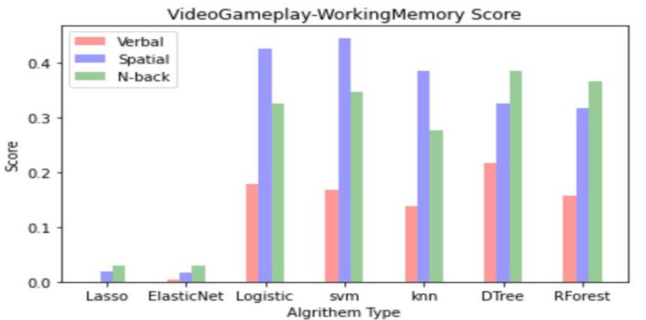
The bar chart depicts the comparison of the scores of the 7 models for each of the 3 dimensions. From the Figure 1 below, we can obtain some meaningful findings about the relationship between algorithms and the cognitive abilities.
Figure 1: The scores in test dataset of the seven algorithm from machine learning according to three dimensions of working memory.
It is clear that the two linear regression algorithm models (Lasso regression and ElasticNet regression) have a significant difference in scores compared
238 Fei
to the remaining five classification algorithm models, so we have ignored the results of the two linear regression models. By comparing the scores of the five classification models, it can be seen that video game activity is slightly more correlated with the visuospatial dimension of working memory (Spatial) than with the memory update dimension (N-back) in general, and significantly more so than with the verbal dimension (Verbal).
This suggests that video games have a significant impact on the human visual-spatial awareness, as well as on dynamic judgement and memory upda- ting, but are less relevant to the human verbal ability. At the same time, the experimental data also reveal a commonality in the design of video games, namely that they rely heavily on graphic information, with sound effects often playing a supporting role, and are often accompanied by rapid and frequent dynamic response input during the game.
CONCLUSION
Three different dimensions of working memory is not equally powerful in relating to gamers’ cognitive ability. We show this claim using seven different supervising learning models. This certainly confirms Waris et al, 2019’s view that the analytic method may be the key to the study of the gamification.
REFERENCES
Baddeley, A., Gathercole, S., and Papagno, C. (1998). The phonological loop as a language learning device. Psychol. Rev. Volume 105, pp. 158–173. doi: 10.1037/0033-295X.105.1.158 Conway, A. R. A., MacNamara, B. N., and Engel de Abreu, P. M. J. (2013). “Wor-
king memory and intelligence: an overview,” in Working Memory: The Connected Intelligence, T. P. Alloway and R. G. Alloway (Eds). New York: Psychology Press, pp. 13–35. Espen Aarseth, (2001). Computer Game Studies, Year One, the international journal of computer game research, volume 1, No.1 Kane, M. J., Hambrick, D. Z., and Conway, A. R. A. (2005). Working memory
capacity and fluid intelligence are strongly related constructs: comment on Acker- man, Beier, and Boyle (2005). Psychol. Bull. Volume 131, pp. 66–71. doi: 10.1037/0033-2909.131.1.66 Raghubar, K. P., Barnes, M. A., and Hecht, S. A. (2010). Working memory and mathematics: a review of developmental, individual difference, and cognitive approa- ches. Learn. Individ. Dif. Volume 20, pp. 110–122. doi: 10.1016/j.lindif.2009. 10.005 Science, Volume 26, pp. 759–774. Unsworth, N., Redick, T. S., McMillan, B. D., Hambrick, D. Z., Kane, M. J., & Engle,
R. W. (2015). Is playing video games related to cognitive abilities? Psychological Waris, O., Jaeggi, S., Seitz, A., Lehtonen, M., Soveri, A., Lukasik, K., et al.
(2019). Video gaming and working memory: A large-scale cross-sectional correlative study, Computers in Human Behavior, Volume 97, pp. 94–103. https://doi.org/10.1016/j.chb.2019.03.005 Waris, O., Soveri, A., Ahti, M., Hoffing, R. C., Ventus, D., Jaeggi, S. M., et al.
(2017). A latent factor analysis of working memory measures using large-scale data. Frontiers in Psychology, 8, 1062. https://doi.org/10.3389/fpsyg.2017.01062. Waris, Otto (2019), “Data for: Video gaming and working memory: a largescale cross-sectional correlative study”, Mendeley Data, V1, http://dx.doi.org/10. 17632/jcj9j7b4bd.1
LISTED IN THE AHFE DIGITAL BOOKSTORE CATALOGUE
Explore the complete digital volume
Human Factors in Virtual Environments and Game Design
Read this individual research paper free through the original publisher, or explore the full digital proceedings book.
ISBN 978-1-958651-26-1
Explore this ISBN in the AHFE Bookstore ↗Listed in the July 2026 bookstore catalogue; search by ISBN to confirm current availability · Digital book purchase optional