Weiwei Ding, Muhua Xu, Qianxiang Zhou, Zhongqi Liu (2026). Brain Network–Informed Optimization of Individualized tACS Targets for Working Memory Modulation. In: Neuroergonomics and Cognitive Engineering. AHFE Open Access, vol. 207, pp. 77–86. https://doi.org/10.54941/ahfe1007397
Working memory underpins complex task execution and human–machine interaction, yet conventional transcranial alternating current stimulation (tACS) commonly targets the left dorsolateral prefrontal cortex (DLPFC) without accounting for inter-individual neural specificity or task-related activation, which may contribute to variable and poorly reproducible effects. In this study, we proposed a brain network–informed strategy to optimize individualized tACS targets for working-memory enhancement. High-density electroencephalography was recorded during a graded working-memory task, and task-related functional brain networks were constructed using the phase lag index. A modified K-order structural entropy algorithm was applied to quantify network topology and identify individual hub nodes showing load-dependent enhancement and significant associations with behavioral performance as candidate stimulation targets. In a within-subject, three-condition crossover design, participants received sham stimulation, conventional DLPFC-targeted stimulation, and network-guided stimulation centered on the individualized hub node. Compared with sham and conventional stimulation, the network-guided condition showed a more consistent improvement trend in working-memory performance under high load. These findings support a task-state brain network–based framework for translating quantitative network features into individualized stimulation site selection, providing a feasible and transferable pathway for precision neuromodulation in cognitive engineering and neuroergonomics.
In cognitive neuroscience and neuroergonomics, working memory (WM) is widely regarded as a core cognitive function supporting complex task execution, logical reasoning, and human–machine interaction performance (Cowan, 2022). From a neuroergonomic perspective, increases in workload are often accompanied by prolonged reaction times, elevated error rates, and cumulative subjective fatigue, all of which heighten operational risk. Accordingly, achieving a more resilient and efficient WM state under high- load conditions has become a critical objective in cognitive engineering and human factors research.
As a higher-order cognitive process, WM is not attributable to the activation of a single brain region; rather, it relies on rhythmic coordination Received February 5, 2026; Revised April 10, 2026; Accepted April 25, 2026; Available online July 20, 2026
and network-level communication across distributed neural systems. Recent neurodynamical accounts further conceptualize WM as a cross- regional “systems engineering” process coordinated through frequency- specific regulation (Alekseichuk et al., 2016). At the electrophysiological level, functional connectivity and network topology may provide a richer characterization of WM states than univariate power measures alone. As WM load increases, theta-band coherence between prefrontal executive-control regions and posterior storage-related regions is robustly enhanced (Sauseng et al., 2009), while theta–gamma phase–amplitude coupling (PAC) exhibits systematic modulation (Lisman et al., 2013). With advances in graph theory and network neuroscience, EEG-derived network features have become a prominent line of inquiry in WM research. During WM task performance, global network efficiency increases, presumably facilitating rapid cross- regional information transfer (Bullmore et al., 2009) and the locus of core hubs shifts from the default-mode network toward the frontoparietal control network (Cai et al., 2021). As the field has matured, neurostimulation strategies guided by neural-signal features have emerged as a major avenue for WM enhancement.
Transcranial alternating current stimulation (tACS), which delivers weak oscillatory currents at specific frequencies to modulate endogenous neural oscillations and synchrony, is viewed as a primary tool for probing causal links between brain rhythms and cognitive function. However, there is currently no standardized stimulation protocol in neurophysiological modulation research. Due to its central role in higher cognition, the left dorsolateral prefrontal cortex (DLPFC) is frequently adopted as a fixed stimulation target (Reinhart et al., 2019). Such “one-size-fits-all” approaches neglect pronounced inter-individual neurophysiological heterogeneity and task-dependent activation patterns, contributing to substantial variability in outcomes across participants and cohorts. Meta-analytic evidence in healthy populations suggests that the overall benefit of tACS for WM performance is not robustly significant, underscoring the need for more precise approaches to achieve reliable enhancement (Chuderski et al., 2024). While some studies report small positive effects of tACS on n-back performance—with theta-band stimulation showing comparatively favorable results (Zhang et al., 2025)— others find that prefrontal theta-tACS yields no measurable improvement (Dauren et al., 2025). A recent review indicates that while theta-tACS may improve WM, the effect is strongly moderated by task characteristics and stimulation parameters (Hou et al., 2025). Collectively, these findings imply that the neurocognitive and biophysical effects of tACS are highly dependent on task context, stimulation site, brain state, and individual differences.
To further characterize the electrophysiological signatures of WM in neuroergonomic settings, the present study builds on functional brain network theory. We constructed task-related functional networks by computing the phase lag index (PLI) to quantify the load-dependent reorganization of functional network architecture. Subsequently, we extracted key network features capable of explaining inter-individual differences and fluctuations in behavioral performance, translating these abstract topological properties into a practically feasible design for individualized stimulation targets. By explicitly accounting for neurophysiological specificity and cognitive task
Brain Network–Informed Optimization of Individualized tACS Targets 79 context, this approach aims to improve both the efficacy and interpretability of electrophysiological WM modulation.
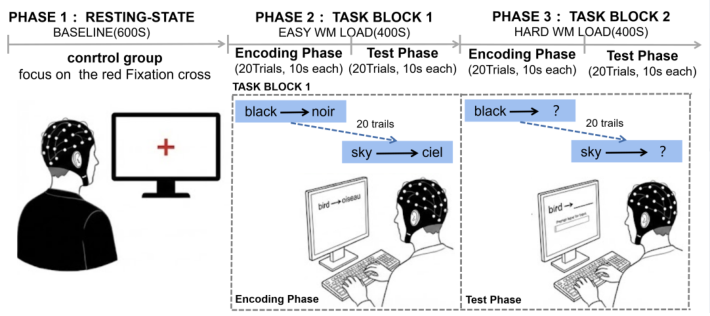
Working-Memory Paradigm and EEG Acquisition Electroencephalographic (EEG) activity associated with working memory (WM) is predominantly task-evoked and thus depends critically on the experimental paradigm used to elicit it. Prior evidence indicates pronounced neuroanatomical heterogeneity across WM domains: for instance, verbal WM preferentially engages temporal regions (Durbin et al., 2012), whereas character-based WM is more closely linked to frontal cortical activation (Rämä et al., 2005). Accordingly, designing a paradigm that is appropriately matched to the specific WM construct under investigation is central to ensuring interpretability. The present study focuses on the neurophysiological signatures of letter encoding. To this end, we developed a paradigm based on “unfamiliar vocabulary reconstruction,” utilizing French—presumed to be unfamiliar to the participants—as the stimulus language to rigorously control for prior knowledge. To create a memory environment consistent with cognitive processing constraints, English–French word pairs were presented, leveraging shared morphemes or roots between the two languages to facilitate semantic inference. English stimuli were selected from high- frequency basic vocabulary to maximize comprehension consistency across participants. The overall experimental workflow is illustrated in Figure 1.
Before the WM task, 600 s of resting-state EEG data were recorded as a baseline control condition. Participants were seated comfortably in front of a computer monitor and instructed to fixate on a dark-red cross to maintain stable attention. The WM task employed a block design consisting of two blocks differentiated by word complexity, corresponding to low-load and high-load WM conditions. Each block comprised 20 trials. In each trial, an English–French word pair to be memorized was presented for 10 s (encoding phase). Following the completion of the encoding phase for each block, participants performed a 200 s memory performance test to quantify WM ability and ensure sustained engagement. Behavioral performance was indexed primarily by accuracy during the test phase.
Figure 1: Schematic of the working memory experimental paradigm.
EEG data were recorded continuously and synchronously throughout task performance. Thirty healthy, right-handed university students were recruited (10 females, 20 males; mean age = 22 years, SD = 2.6). EEG data were acquired using a Neuroscan 64-channel system. Electrode placement followed the international 10–20 system to ensure adequate spatial coverage and cross-study comparability. The left and right mastoids (M1 and M2) served as reference electrodes to provide a stable reference and mitigate systematic shifts attributable to reference choice, thereby partially attenuating environmental and physiological noise components, particularly low-frequency drift and common-mode noise.
EEG preprocessing and analysis were conducted offline. First, raw data were band-pass filtered between 0.5 and 60 Hz to remove very low-frequency drift and high-frequency noise, and a 50 Hz notch filter was applied to suppress power-line interference. Next, data were re-referenced to a common average reference (CAR) to reduce bias introduced by a single reference site and to improve global spatial consistency. Subsequently, bad channels were interpolated, and bad segments arising from poor contact, transient saturation, or prominent artifacts were identified and rejected manually to prevent downstream network estimates from being driven by extreme noise. Finally, independent component analysis (ICA) was performed to identify and remove components associated with ocular and myogenic activity, providing a reliable basis for subsequent phase-based network analyses.
Using the preprocessed EEG data, we constructed weighted functional connectivity networks. Each EEG channel was treated as a network node (N = 64), and edge weights reflected phase-based coupling strength, yielding an $N \times N$ adjacency matrix. Because WM processing exhibits pronounced temporal dynamics, a static connectivity estimate over a single interval is insufficient to capture the rapid reconfiguration of functional coupling during task execution. We therefore adopted a sliding-window strategy to estimate dynamic task-related functional connectivity, constructing an undirected weighted functional brain network within each window. Given that EEG connectivity analyses are susceptible to spurious zero-lag coupling induced by volume conduction and common sources, we used the Phase Lag Index (PLI) to quantify inter-channel functional coupling. The PLI summarizes the asymmetry of the phase-difference distribution, thereby attenuating near- zero-lag synchronization artifacts and improving sensitivity to genuine time- lagged inter-regional coupling (Polat et al., 2023).
Consistent with oscillation–network accounts of WM, theta-band (4–8 Hz) oscillations are widely implicated in executive control and the increased coordination demands associated with higher WM load (Chang et al., 2023). Furthermore, theta oscillations exhibit robust load sensitivity and behavioral relevance at the frontoparietal network level (Hu et al., 2022). Accordingly, the present study prioritizes dynamic network analyses in the theta band.
Brain Network–Informed Optimization of Individualized tACS Targets 81 Node Importance Analysis of Functional Brain Networks Based on Structural Entropy
Identifying key brain regions involved in working memory (WM) tasks is fundamental for elucidating WM processing mechanisms, discovering interpretable neural signatures, and ultimately enabling individualized neuromodulation strategies. A range of classical node-importance methods has been applied to brain networks, including weighted degree centrality (WDC) (Opsahl et al., 2010), mutual information (MI)–based approaches (Wang et al., 2015), and weighted PageRank (WPR) (Page et al., 1999). However, each of these methods has notable limitations in the context of functional brain networks. WDC primarily considers the weights of edges directly connecting a node to its neighbors and therefore under-represents multi-step, global influence. MI-based approaches often fail to incorporate the topological role of neighboring nodes and higher-order interactions in the network. WPR, while effective for capturing recursive importance, may underestimate the role of bridge nodes that mediate inter-module communication in complex networks. More broadly, traditional centrality metrics can quantify node status from specific topological perspectives, yet they often struggle to simultaneously capture both local and global properties that are critical for characterizing distributed WM-related communication.
To better quantify node importance in functional brain networks, our previous work introduced a novel method termed the Weighted K-order Propagation Number (WKPN) (Weiwei et al., 2022). Inspired by epidemic- spreading models, WKPN treats each node as a potential infection source and evaluates its propagation capability within a predefined propagation distance K, using structural entropy to characterize network heterogeneity and stabilize the ranking. In this framework, small K emphasizes local network structure, whereas larger K reflects more global organization. Compared with conventional metrics, WKPN exhibits improved convergence behavior and mitigates the tendency of some methods to overlook bridge nodes.
Nevertheless, despite introducing the concept of propagation path length, the original WKPN framework was still constrained by information truncation induced by threshold-based binarization of the underlying connectivity matrix. Such “all-or-none” binarization has substantial drawbacks. First, threshold selection is often subjective, and different thresholds can lead to abrupt changes in network topology and derived metrics. Second, under high cognitive load, critical regulatory processes may be implemented through numerous weak but coordinated connections; binarization can easily discard these weak links and their subtle dynamical information, thereby reducing the precision of individualized tACS target localization.
To address these limitations, this chapter proposes an improved Full- weighted K-order Structural-Entropy Propagation algorithm, termed FWKPN, based on fully connected weighted networks. FWKPN eliminates binarization of the PLI matrix and directly models PLI values as infection probabilities governing neural information transmission between nodes. With this modification, we aim to quantify each node’s multi-step information diffusion capability across the whole-brain network, thereby
more accurately identifying individualized hub nodes that strengthen with increasing WM load. To capture the temporal dynamics of WM processing, we further construct dynamic functional networks using a sliding-window approach with 50% overlap, explicitly accounting for load-dependent and time-varying network reconfiguration. The FWKPN procedure is described below: Step 1: We construct a fully connected weighted graph G = (V, E, W), where V denotes the set of N nodes (corresponding to the 64 EEG channels), E denotes the set of edges, and W is the weighted adjacency matrix. Here, each weight ij W represents the one-step diffusion probability (One-step Diffusion Probability), the probability that neural information is transmitted directly from node i to node j. The weighted degree of node i is defined as id :
Equations and mathematical formulas are available in the original paper PDF.
To convert edge weights into a strict probability distribution, we construct a one-step state transition probability matrix ijP :
ij ij
By construction, P satisfies row normalization, which can be interpreted as the probability distribution of neural impulses departing from node i and reaching its neighboring nodes through one-step synaptic transmission.
Step 2: We seek to approximate the outcome of an SIR-like spreading process. However, enumerating all simple paths is computationally prohibitive. We adopt an approximation in which transmissions to node j via different paths are treated as a set of approximately independent Poisson events. Under this assumption, the cumulative intensity equals the sum of probabilities over all paths ( ) K ij Λ , and the infection probability can be approximated by: ( ) ( ) ( ) 1 K K ij ij exp ρ ≈ − −Λ
For a random walk formulation, the sum of probabilities of all paths with length ℓ from i to j is exactly the ( ) K ij ρ . Therefore, the cumulative multi-step diffusion intensity within K steps can be expressed as K-order diffusion propagation number ( ) K i N : ( ) ( )
n K K i ij j N ρ
Step 3: Although K-order diffusion propagation number could captures information diffusion ability, the choice of propagation length K still bias the ranking. To mitigate this sensitivity, we compute structural entropy k H to quantify network heterogeneity at different propagation scales.
N H
K n K i n K i j j
Brain Network–Informed Optimization of Individualized tACS Targets 83 Step 4: Considering the propagation time K plays a critical role, FWKPN traverses K from 0 to the network radius and constructs an integrated evaluation model that combines structural entropy and K-order diffusion propagation. After applying dimensionless normalization to both metrics, we compute an overall node-importance score:
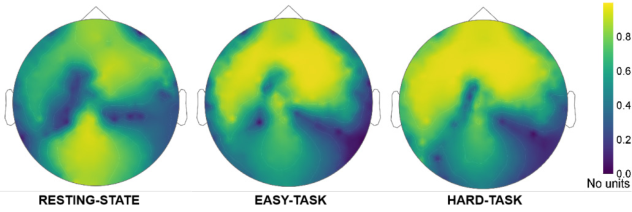
We applied FWKPN to compute node importance for the functional brain networks of 30 participants performing WM tasks at different load levels. For each experimental block, node-importance rankings were obtained by averaging across sliding windows within the block. The resulting scalp topographies of node importance across the three task states are shown in Figure 2. A clear pattern emerged: as WM load increased, high-importance nodes progressively concentrated toward the prefrontal region. This anterior shift of network hubs suggests a tight association between prefrontal network control and increasing WM task demands, consistent with the role of prefrontal executive control in maintaining and coordinating WM processing under higher cognitive load.
Figure 2: Topography of node importance in functional brain networks.
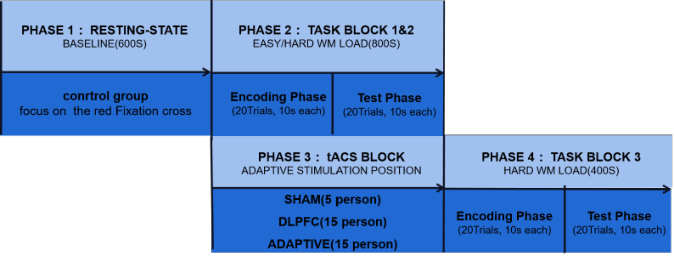
Adaptive Transcranial Electrical Stimulation for Working-Memory Modulation Based on the improved FWKPN algorithm introduced above, the present study further investigates an adaptive stimulation paradigm for transcranial electrical modulation of WM. The overall procedure is illustrated in Figure 3.
Figure 3: Workflow of transcranial electrical stimulation intervention.
Step 1: Based on FWKPN, we computed the distribution of important nodes in the functional brain network in real time based on a sliding-window approach. The node exhibiting the largest load-related change in importance was selected as the individualized stimulation target for transcranial electrical stimulation.
Step 2: A 5 Hz alternating-current stimulation was delivered for 30 min at the computed target location. In parallel, the experiment included a sham stimulation condition and a conventional DLPFC stimulation condition— commonly adopted in WM research—as control groups.
Step 3: After stimulation, participants completed an additional block of the WM task, and their WM performance was re-evaluated.
Following stimulation, we compared pre- versus post-stimulation accuracy in the word-memorization test across the three conditions. Notably, the sham group showed a slight decrease in post-stimulation accuracy, which may reflect a decline in performance due to cognitive fatigue. In contrast, both the DLPFC and adaptive conditions demonstrated improved accuracy after stimulation. Importantly, the adaptive condition exhibited the largest increase in accuracy, suggesting that an adaptive, network-guided stimulation protocol may be more effective for WM enhancement than a conventional fixed- target approach. These findings provide preliminary evidence supporting the efficacy of adaptive transcranial electrical modulation for cognitive regulation and offer a methodological foundation for subsequent human factors and cognitive engineering research on state-aware neuromodulation.
Table 1: The effects of electrophysiological modulation.
Table available in the original PDF paper.
POSITION SHAM DPPFC ADAPTIVE Accuracy before stimulation 65.4% 73.5% 69.7
Accuracy after stimulation 64.8% 79.4% 84.9
CONCLUSION
This study targets working-memory (WM) modulation in neuroergonomics and cognitive engineering contexts and proposes and validates an individualized transcranial alternating current stimulation (tACS) target- optimization framework guided by task-state brain network features. In contrast to the conventional paradigm that adopts the left dorsolateral prefrontal cortex (DLPFC) as a fixed stimulation site, we recorded high- density EEG while participants performed a graded-load WM task. Task- related functional brain networks were constructed using the Phase Lag Index (PLI), and network topology was quantitatively characterized via an improved K-order structural-entropy framework. On this basis, we further identified individualized hub nodes that increased significantly with workload and were significantly associated with behavioral performance as candidate stimulation targets, thereby establishing a closed-loop mapping from “network features → quantitative indices → stimulation targets.” This approach translates abstract topological properties into engineering-feasible
Brain Network–Informed Optimization of Individualized tACS Targets 85 stimulation-site designs while minimizing target-selection bias introduced by threshold-based binarization or overly strong prior assumptions. By selecting individualized targets from task-evoked networks without increasing protocol complexity, the proposed framework improves the stability and reproducibility of WM modulation effects and provides methodological support for maintaining cognitive states and safeguarding performance in complex operational environments. More broadly, it offers an interpretable and replicable pathway for human–machine system optimization, workload management, and cognitive enhancement applications in neuroergonomics.
REFERENCES
Alekseichuk, I., Turi, Z., Amador de Lara, G., Antal, A., & Paulus, W. (2016). Spatial working memory in humans depends on theta and high gamma synchronization in the prefrontal cortex. Current Biology, 26(12), 1513–1521. https://doi. org/10.1016/j.cub.2016.04.035 Bullmore, E., & Sporns, O. (2009). Complex brain networks: Graph theoretical
analysis of structural and functional systems. Nature Reviews Neuroscience, 10(3), 186–198. https://doi.org/10.1038/nrn2575 Cai, W., Ryali, S., Pasumarthy, R., Talasila, V., & Menon, V. (2021). Dynamic causal brain circuits during working memory and their functional controllability. Nature Communications, 12, Article 3314. https://doi.org/10.1038/s41467-021-23509-x Chang, W.-S., Liang, W.-K., Li, D.-H., Lim, V. K., & Juan, C.-H. (2023). The
association between working memory precision and the nonlinear dynamics of frontal and parieto-occipital EEG activity. Scientific Reports, 13, Article 14252. https://doi.org/10.1038/s41598-023-41387-3 Chuderski, A., & Chinta, S. R. (2024). Transcranial alternating current stimulation barely enhances working memory in healthy adults: A meta-analysis. Brain Research, 1839, Article 149022. https://doi.org/10.1016/j.brainres.2024.149022 Cowan, N. (2022). Working memory development: A 50-year assessment of research
and underlying theories. Cognition, 224, Article 105075. https://doi.org/10.1016/j. cognition.2022.105075 Ding, W., Zhang, Y., & Huang, L. (2022). Using a novel functional brain network approach to locate important nodes for working memory tasks. International Journal of Environmental Research and Public Health, 19(4), Article 2364. https://doi.org/10.3390/ijerph19042364 Durbin, J., & Koopman, S. J. (2012). Time series analysis by state space methods
(2nd ed.). Oxford University Press. Hou, T. Y., Mao, X. F., & Zhang, R. K. (2025). Effect of theta-transcranial alternating current stimulation on working memory performance among healthy adults: A systematic review and meta-analysis. World Journal of Psychiatry, 15(9), Article 107754. Hu, Z., Samuel, I. B. H., Meyyappan, S., Bo, K., Rana, C., & Ding, M. (2022).
Aftereffects of frontoparietal theta tACS on verbal working memory: Behavioral and neurophysiological analysis. IBRO Neuroscience Reports, 13, 469–477. https://doi.org/10.1016/j.ibneur.2022.10.012 Kasanov, D., Dorogina, O., Mushtaq, F., & Pavlov, Y. G. (2025). Theta transcranial alternating current stimulation is not effective in improving working memory performance. Journal of Cognitive Neuroscience, 37(3), 641–656.
Lisman, J. E., & Jensen, O. (2013). The θ–γ neural code. Neuron, 77(6), 1002–1016.
https://doi.org/10.1016/j.neuron.2013.03.007 Opsahl, T., Agneessens, F., & Skvoretz, J. (2010). Node centrality in weighted networks: Generalizing degree and shortest paths. Social Networks, 32(3), 245– 251. https://doi.org/10.1016/j.socnet.2010.03.006 Page, L., Brin, S., Motwani, R., & Winograd, T. (1999). The PageRank citation
ranking: Bringing order to the web (Technical Report 1999-66). Stanford InfoLab. Polat, H. (2023). Brain functional connectivity based on phase lag index of electroencephalography for automated diagnosis of schizophrenia using residual neural networks. Journal of Applied Clinical Medical Physics, 24(6), Article e14039. https://doi.org/10.1002/acm2.14039 Rämä, P., & Courtney, S. (2005). Functional topography of working memory for
face or voice identity. NeuroImage, 24(1), 224–234.https://doi.org/10.1016/j. neuroimage.2004.08.026 Reinhart, R. M. G., & Nguyen, J. A. (2019). Working memory revived in older adults by synchronizing rhythmic brain circuits. Nature Neuroscience, 22(5), 820–827. https://doi.org/10.1038/s41593-019-0371-x Sauseng, P., Griesmayr, B., Freunberger, R., & Klimesch, W. (2010). Control
mechanisms in working memory: A possible function of EEG theta oscillations. Neuroscience and Biobehavioral Reviews, 34(7), 1015–1022. https://doi. org/10.1016/j.neubiorev.2009.12.006 Wang, B., Ma, R. N., Wang, G., & Chen, B. (2015). Improved evaluation method for node importance based on mutual information in weighted networks. Computer Applications, 35, 1820. Zhang, S., Cui, X., Yu, S., & Li, X. (2025). Is transcranial alternating current
stimulation effective for improving working memory? A three-level meta-analysis. Psychonomic Bulletin & Review, 32(2), 636–651.
LISTED IN THE AHFE DIGITAL BOOKSTORE CATALOGUE
Explore the complete digital volume
Neuroergonomics and Cognitive Engineering
Read this individual research paper free through the original publisher, or explore the full digital proceedings book.
ISBN 978-1-964867-83-0
Explore this ISBN in the AHFE Bookstore ↗Listed in the July 2026 bookstore catalogue; search by ISBN to confirm current availability · Digital book purchase optional