Sandrina Rodrigues, Cláudia Quaresma, Krupa Hansraj, Patricia Santos, Nidia Grazina, Ana Antunes, Bruno Mendes, Carla Quintão, Ricardo Vigário (2022). RehbBrain: A serious gaming platform for perceptual and cognitive rehabilitation. In: Human Factors and Systems Interaction. AHFE Open Access, vol. 52, pp. 48–56. https://doi.org/10.54941/ahfe1002138
1 Physics Department, Nova School of Science and Technology, Nova University, Lisbon, 2892-516 Caparica, Portugal ↗
2 Physics Department, Nova School of Science and Technology, Nova University Lisbon, 2892-516 Caparica, Portugal; Laboratory of Instrumentation, Biomedical Engineering and Radiation Physics (LIBPhys-UNL), Physics Department, Nova School of Science and Technology, Nova University Lisbon, 2892-516 Caparica, Portugal ↗
3 Área de Medicina Física e Reabilitação, Hospital Curry Cabral, Centro Hospitalar, Lisboa Central, Portugal ↗
Stroke sequelae significantly affect the individual's functionality, namely at the level of their perceptive and cognitive skills. Consequently, these patients require rehabilitation therapies that are adapted to their dysfunctions. Conventional approaches (traditional board and paper games) have the disadvantage of not being suited to the dysfunctions of some patients, making the rehabilitation process unstimulating and demotivating. RehbBrain is a serious gaming platform, adapted for all patients whose rehabilitation process focuses on stimulating, visually, perceptual and cognitive skills. It simulates the individual’s daily activities, in various environments, and with progressive levels of difficulty. The platform aims to help therapists monitor their patients by promoting a systematized and standardized assessment. The games on the platform are intended to complement conventional rehabilitation methods, and render therapy sessions more dynamic, leading to a faster and more patient-oriented stimulation process.RehbBrain’s usability was tested by 5 specialists and 33 subjects with no associated pathologies. They completed separate System Usability Scale (SUS) questionnaire to assess the platform, but reached and combined average score of 88.4, classifying RehbBrain as "Excellent".
Stroke is one of the main causes of permanent disabilities in the Western world (Poungvarin, 1998) and the leading cause of death in Portugal (SPAVC, November 2021). Moreover, in comparison with other Western European countries, Portugal has the highest mortality rate from stroke (Correia et al., 2004). This is a disease that affects the brain in a severe and sudden manner, caused by blood blockage (ischaemic stroke) or rupture of a cerebral artery (hemorrhagic stroke), and may lead to critical complications for the patient
RehbBrain: A Serious Gaming Platform for Perceptual and Cognitive Rehabilitation 49
(Gomes and Wachsman, 2013). In Portugal, 30% of all strokes lead to the direct death of the individual, whereas 40% of the remaining are left with highly incapacitating sequelae (SPAVC, November 2021), severely impairing the individual’s ability to cope with daily routines. Rapid response and trea- tment, during the first hours, are critical to reduce the number and severity of permanent sequelae and increasing the chances of optimal recovery (Belagaje, 2017). Stroke sequelae are not only motor, in nature, they also include behavioral or sensory system impairments, which are largely cognitive and perceptual. The former includes slowing mental processes, difficulty in concentrating, memory loss, aphasia, and difficulty in planning, monitoring, and performing tasks (SPAVC, November 2021; NeuroSer, November 2021). Perceptual skills may also be affected, with a decrease in the ability to process sensory stimuli, making the patient unable to distinguish certain characteristics of objects, such as their depth, size, spatial orientation, or assess how far away they are from an obstacle (NeuroSer, November 2021). It is estimated that approxima- tely 50% of all stroke patients will require some form of rehabilitation to help them reach their pre-stroke functional level (Pinter and Brainin, 2012). Seve- ral studies confirm the importance of rehabilitation programs to help patients adapt as much as possible to life after stroke. These programs enable the reco- very of lost functional skills and the development of new competencies, which will allow patients to lead an independent life.
It is important that rehabilitation is monitored by multidisciplinary teams, specialized in providing care to stroke patients, with health specialists, such as nurses, physiotherapists, occupational therapists, speech therapists, social workers, and other care providers (SPAVC, November 2021; NeuroSer, November 2021). Yet, in most countries, only a small percentage of all stroke rehabilitation units include the complete set of required valences mentioned above. As an illustrative example, from the 28 units, distributed throughout Portugal, only 6 comprise complete rehabilitation teams, as mentioned above (Público, November 2021).
Regarding the rehabilitation methodologies adopted in stroke units, the vast majority is inadequate to fit the specific dysfunction needs of a speci- fic patient. Conventional cognitive and perceptual rehabilitation therapies are mainly based on traditional board games, paper games and mathemati- cal problems (Faria et al., 2016). The cognitive dysfunction of one patient depends on the characteristics of the originating lesion. Hence, generic methods are not applicable and may render the rehabilitation process unmoti- vating and time consuming (Elaklouk, Zin and Shapii, 2015). With advances in Information and Communication Technologies (ICT), new methodologies are proposed that allow for a greater amount of adaptation and personaliza- tion to each patient. They include serious gaming and Virtual Reality (VR) in the set of possible therapy approaches (Faria et al., 2016; Gamito et al., 2017). The current manuscript describes a set of improvements and extensions proposed to RehbBrain, a serious gaming platform for personalized stroke rehabilitation. The complete work was developed in co-creation with the- rapists of the Occupational Therapy service of the Hospital Curry Cabral
(HCC). The platform is mainly directed to stroke patients but can be adapted to the rehabilitation of any patient with cognitive and perceptual impair- ments. RehbBrain arose from the need to help therapists keep records of their patients’ progress, providing the possibility for future analyses and drawing conclusions about the patient’s evolution in a standardized way. It has then evolved to include a growing set of personalized rehabilitation games.
PRESENTING THE REHBBRAIN PLATFORM The platform was built in Django1, which is written in Python. To construct the platform pages, a set of templates were created in HTML, where Java- Script can be used to include a level of dynamics to certain functionalities. RehbBrain was then made available online via Heroku2, a platform that allows developers to deploy, run and manage web applications entirely in the cloud.
RehbBrain presents different interfaces and functionalities, whether the user is an administrator or a therapist. The latter sees a home page with access links to all stakeholders’ websites, with the ability to add new patients, view their therapy history, and the list of available games. Admins can access two extra pages, displaying the list of all patients, of all therapists using the platform, as well as the history of all patients’ game interactions.
The platform has currently four therapeutic games, with 10 or 12 levels of complexity each. Two games correspond to oral and bath “hygiene”, one deals with “kitchen items”, and another with “visuospatial organization”. The ones dealing with hygiene and cooking activities demand patients to select images according to a set of instructions, or to identify the correct order of events in a complex task. The visuospatial organization theme consi- sts of organizing objects on a grid, according to their characteristics of shape, color, or orientation in space, in relation to other objects. Two examples of the proposed games are illustrated in the following sections.
The platform records the time, in seconds, required to fulfill the propo- sed task; the score attained, which depends on the type and level of the game played; the number of moves; the images submitted, together with the order proposed; and all the images selected, in addition to the ones that were submitted. Additionally, the platform records also the path taken by the mouse during the gaming session. This feature may be used, for exam- ple, to analyze path irregularities, such as the ones related to indecision or to attention deficit.
Example of the Oral Hygiene Theme In this category there are two types of games, i.e., image selection and image sequencing. The 10 levels have different objectives, and their complexity is progressively increased as the level advances. The degree of difficulty was pre- viously discussed and defined with the help of occupational therapists from
RehbBrain: A Serious Gaming Platform for Perceptual and Cognitive Rehabilitation 51
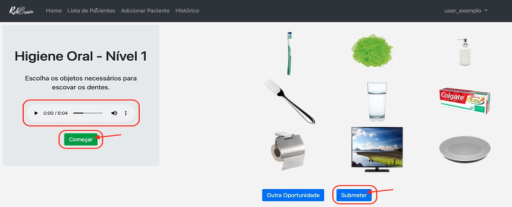
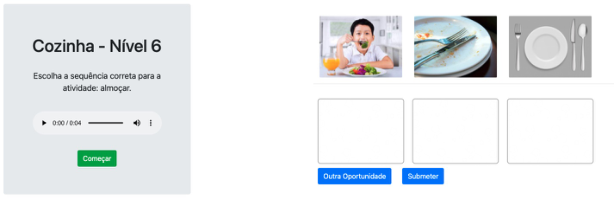
Figure 1: Example of a game from the oral hygiene theme, level 1. As written on the left portion of the screen, patients are asked to choose all objects required for brushing their teeth.Figure 2: Example of a game from the kitchen theme, level 6. Patients are asked to cho- ose the correct sequence of events for a meal, taking into consideration the proposed images.
the HCC, and it is up to the therapist to choose which game levels their patients should play in each rehabilitation session.
The first level of Oral Hygiene, illustrated in Fig. 1, is about selecting obje- cts needed for the activity of brushing one’s teeth. All levels have instructions on how to play expressed in writing and through a voice file, presen- ted on the left-most part of the screen. The game is initiated by pressing the button “Começar”, which means “Start”. At the end of the task, the patient may choose between to submit (“Submeter”) or to restart (“Outra Oportunidade”).
Example of the Kitchen Theme The kitchen levels, following the ones proposed for the Oral Hygiene and the Bath levels, are about selecting the correct objects, in this case related to food. In addition to the previous examples, we also added sequencing and categorization games to this theme. One example of level 6 is illustrated in Fig. 3, where patients are asked to sort the three pictures on top as a mea- ningful temporal sequence. Taking into consideration that motor skills may also have been impaired by the stroke, patients are not required to drag each picture to the correct place, but simply click the desired picture, which will be placed in the first available place in the sequence bellow.
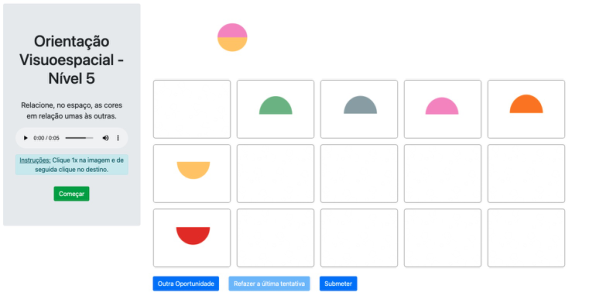
Figure 3: Example of a game from the Visuospatial Organization theme, level 5. Pati- ents are asked to relate, spatially, the colours of the object above with the templates. The instructions on the left pane also include how to position the object on the grid – click on the object, to select it, and another time on the grid to place it.
Example of the Visual Organization Theme With 12 levels of increasing complexity, games in this theme require the orga- nization of objects on a grid, according to their shape, color, or orientation, within the space and in relation to other objects. There are three grid dimensi- ons, varying with the level of the game. Levels 1–3 use 1×4 grids, in addition to one fixed column, on the left, and one line, on top. Levels 4–6 show 2×4 grids and levels 7–12 have 3×4 grids. The goal is to identify the cell in the grid that best matches the presented image. As with the previous example, patients click once on the proposed picture, and a second time in the cell where they want to move it to.
Figure 3 illustrates this theme, for an intermediate level of complexity. The patient needs to identify which top and bottom semi-circles form the propo- sed object. Since the grid dimension is rather large, a “Redo the last attempt” (“Refazer a última tentativa”) option was added, to avoid the need to redo the complete game, in case of an unintended move. “Another chance” is still present, to restart that complete game.
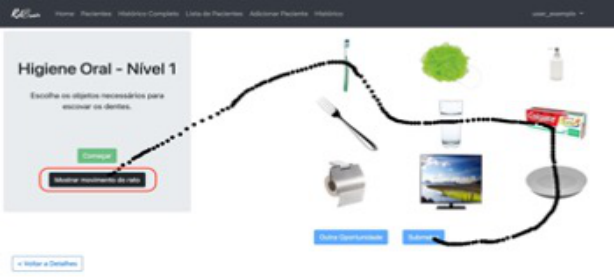
Example of Mouse Path Recording This is a feature of the platform that clearly differentiates RehbBrain from other perceptual or cognitive rehabilitation platforms. It gives healthcare pro- fessionals the possibility to review the mouse path, while playing any given game, confirming the patient’s choices, searching and hesitations. The pati- ent’s mouse path appears as a black dotted line, overlayed to the screen of the played game, as illustrated in Fig. 4. This visualization is activated by pressing the button “Show mouse movement” (“Mostrar movimento do rato”). Alth- ough presented to the therapist after the patient played the game, the dotted line will appear at the same speed patients made their actual movements.
USABILITY TESTING Two groups of users were recruited to test the usability of the proposed plat- form. The first comprised 5 occupational therapists, from Hospital Curry
RehbBrain: A Serious Gaming Platform for Perceptual and Cognitive Rehabilitation 53
Figure 4: Example of the mouse tracking functionality, overlayed to the hygiene game shown in Fig. 1.Table 1. Results of the SUS questionnaire of the occupational therapist users.
Table available in the original PDF paper.
Cabral, with high expertise in stroke rehabilitation programs. The other group comprised 44 individuals without associated pathologies or cognitive disorders.
They were asked to register on the platform and test all its functionali- ties, including the therapeutic games. They were then asked to complete a SUS questionnaire (SUS, September 2021). That questionnaire assessed the users’ level of satisfaction when using the platform, as well as if there were errors and inconsistencies that needed improvement. Also important was to understand if the therapeutic games were clearly presented and easy to understand.
A SUS questionnaire consists of a 10-item questionnaire. Each item pre- sents response options ranging from 1 to 5, where 1 corresponds to “Strongly Disagree” and 5 to “Strongly Agree” (SUS, September 2021). The final score ranges from 0 to 100. If that final score is lower than 51, it values the platform as “Terrible”; if it fits in the interval [51, 68[, it corresponds to “Poor”; whe- reas [68, 80.3[ is “Good”; and if it exceeds 80.3, the evaluation is classified as “Excellent”.
Table 1 displays the summarizing results of the SUS questionnaire for the specialist group of occupational therapists. Of the 5, 3 rated the platform as “Good”, 1 as “Excellent” and 1 as “Poor”. A justification for this low rating could be the score assigned to statement 10, by participant 45, which we consider to be due to a response error. The average rating obtained by the therapists was therefore “Good”, with rather high degree of confidence.
After obtaining the usability feedback from the therapists, who were the first ones to evaluate the platform, their suggestions for improvement were implemented, prior to non-specialist testing. From the original 44 subjects considered only 33 returned their SUS questionnaire. A table with all 33 eva- luations would be too lengthy for the manuscript’s page limitations. Hence, only an overall analysis will be made herein. From the 33 participants in this group, 4 rated the platform as “Good” and the rest as “Excellent”, with an average score of 90.2, and a confidence interval of 2.32.
Considering the responses given by both the occupational therapists and the group of non-health professionals, the average score obtained on SUS was 88.4, which classifies the platform as “Excellent”. To obtain more detailed feedback on the current functionalities of the plat- form, in addition to the SUS usability questionnaire, participants were asked 17 additional questions, which focused both on their experience of using the platform and the proposed games. Those were important to understand what needed to be improved. Although not built with the purpose of truly evalu- ating the platform, a similar 5 scale employed in the SUS questionnaire was used.
The results of the supplementary questions confirmed that the participants had a good experience when using RehbBrain. They found the platform functional, intuitive, and easy to use. The therapeutic games also received positive feedback, the way of playing proved to be simple and the tasks were clear and easily understandable.
CONCLUSION
The goal the current work was to improve RehbBrain, a software platform for perceptual and cognitive rehabilitation programs, which includes therapeutic games, designed to be used with stroke patients or suffering from other dise- ases that affect those mental skills. In addition to helping care takers record patients’ progress and evaluate their evolution throughout therapy sessions, RehabBrain’s serious gaming allow for dynamic, standardized and systema- tic therapeutic interventions, with a very clear focus on the personalization of said therapy, which complements more conventional strategies, such as traditional board and pencil and paper games.
In addition to helping to manage patients’ therapy interventions, the plat- form currently has 42 therapeutic games, rooted on daily living tasks. As outcomes of playing them, the platform registers several parameters. The path covered by mouse, during the game, is one of the most useful and differentiating such parameters. It may be of great interest for clinical and research purposes alike, allowing for a deeper evaluation of the intervention programmes.
The functionality of RehbBrain was tested with a group of individuals without associated pathologies. The SUS questionnaire results obtained an overall average score of 88.4. Additional questions in usability tests confir- med that participants felt comfortable using the platform, that it is functional and easy to understand for patients and rehabilitation specialists. The sim- plicity and clarity of the proposed games received positive comments. In this
RehbBrain: A Serious Gaming Platform for Perceptual and Cognitive Rehabilitation 55
respect, occupational therapists from HCC manifested their intention to take the proposed technology into use within future regular therapy sessions.
Considering those observations, we conclude that RehbBrain complies with the objectives initially proposed, although there is margin for impro- vement. In particular, the functionality that allows for the analysis of mouse movements, while playing the proposed game, may be complemented in the future with tools that allow automatic and objective analyses of the path, through indicators based on the time the cursor remains in a certain point, speed, backtracking points, etc. As for the therapeutic games, the main sugge- stions are to explore different cognitive areas, such as memory, and to include games of greater cognitive demand.
Even taking into consideration the aforementioned evolutions of propo- sed platform, it is already fit for practical use, in order to help occupational therapists improve their rehabilitation routines, when dealing with stroke patients. Early use of RehbBrain was received with very positive feedback from therapists and patients alike.
ACKNOWLEDGMENT
The authors would like to acknowledge the financing from Fundação para a Ciência e Tecnologia [UIDB/FIS/04559/2020], as well as the close collabora- tion with the Physical Medicine and Rehabilitation Department of Hospital Curry Cabral.
REFERENCES
Belagaje, S. R. (2017) “Stroke Rehabilitation”, CONTINUUM Lifelong Learning in Neurology, Volume 23 No 1, pp. 238–253. Correia, M., Silva, M. R., Matos, I. et al. (2004) “Prospective community-based
study of stroke in Northern Portugal: Incidence and case fatality in rural and urban populations”, Stroke, Volume 35 No 9, pp. 2048–2053. Elaklouk, A. M., Mat Zin, N. A., Shapii, A. (2015) “Investigating therapists’ intention to use serious games for acquired brain injury cognitive rehabilitation”, Journal of King Saud University - Computer and Information Sciences, Volume 27 No 2, pp. 160–169. Faria, A. L., Andrade, A., Soares, L., Badia, S. B. I. (2016) “Benefits of virtual reality
based cognitive rehabilitation through simulated activities of daily living: a ran- domized controlled trial with stroke patients”, Journal of NeuroEngineering and Rehabilitation, Volume 13 No 1, pp. 1–12. Gamito, P., Oliveira, J., Coelho, C. et al. (2017) “Cognitive training on stroke patients via virtual reality-based serious games”, Disability and Rehabilitation, Volume 39 No 4, pp. 385–388. Gomes, J., Wachsman, A. M. (2013) “Types of Strokes”, In Handbook of Clinical
Nutrition and Stroke, M. L. Corrigan, A. A. Escuro and D. F. Kirby, Eds. Totowa, NJ: Humana Press, pp. 15–31. NeuroSer (November 5, 2021) “Alterações cognitivas pós-AVC”. Website: https://neuroser.pt/2016/03/08 /alteracoes-cognitivas-pos-avc/ Pinter, M. M., Brainin, M. (2012) “Rehabilitation after stroke in older people”, Maturitas, Volume 71 No 2, pp. 104–108.
Poungvarin, N. (1998) “Stroke in the developing world”, Lancet, Volume 352 No SUPPL.3, pp. 19–22. Público (November 5, 2021) “Apenas seis das 28 unidades de AVC do país têm equipas de reabilitação completas”. Website: https://www.publico.pt/2018/10/26/sociedade/noticia/ apenas - seis - 28 - unidades - avc - pais - equipas - reabilitacao - completas - 1849062 SPAVC (November 19, 2021) “Sociedade Portuguesa do Acidente Vascular Cerebral,
O essencial dobre AVC”. Website: https://static.lvengine.net/spavc2013/Imgs/pag es/PUBLICO/GUIA%20AVC%20POPULACAO_final.pdf SUS (September 8, 2021) “Measuring Usability with the System Usability Scale (SUS)”. Website: https://measuringu. com/sus/
LISTED IN THE AHFE DIGITAL BOOKSTORE CATALOGUE
Explore the complete digital volume
Human Factors and Systems Interaction
Read this individual research paper free through the original publisher, or explore the full digital proceedings book.
ISBN 978-1-958651-28-5
Explore this ISBN in the AHFE Bookstore ↗Listed in the July 2026 bookstore catalogue; search by ISBN to confirm current availability · Digital book purchase optional