Barbara La Scaleia, Francesco Lacquaniti, Myrka Zago (2023). A novel stimulation protocol for vestibular rehabilitation. In: Emerging Technologies in Healthcare and Medicine. AHFE Open Access, vol. 116, pp. 204–210. https://doi.org/10.54941/ahfe1004373
Vestibular hypofunction due to aging or disease can be severely debilitating for daily life, causing dizziness, space disorientation, imbalance, limited mobility, and increased risk of falls. Current methods and techniques for vestibular rehabilitation often fail short of achieving stable, effective results due to the lack of physiologically-based, ergonomic approaches. Here we propose a novel approach based on the application of small-amplitude random displacements of the head and body, which can lead to enhanced vestibular function. The phenomenon we studied is akin to stochastic resonance, whereby the application of a given, optimal level of noise during periodic or non-periodic stimuli can determine an increased sensitivity in nonlinear systems, such as the vestibular perceptual system. The idea is that an appropriate level of noise can raise subthreshold stimuli above threshold, thereby making them detectable by the brain. We tested the protocol in a series of experiments involving 30 healthy young participants who were asked to discriminate the direction of whole-body motion imparted by a MOOG platform. Blindfolded subjects were presented with the discrimination of forward-backward single-cycle sinusoidal motion in a two-alternative forced-choice paradigm. The procedure followed an adaptive staircase. Vestibular threshold (i.e., minimum amplitude of applied motion that was discriminated by the subjects) was then computed from the slope of the psychometric function fitting the individual performance. We compared the vestibular threshold between the baseline condition (no external noise) and the conditions when band-limited white-noise was applied by the platform in the forward-backward direction. We found that in 26/30 participants the discrimination threshold was better with at least one noise level than that at baseline. The overall response curve roughly obeyed the bell-shaped function typical of stochastic resonance. We conclude that small-amplitude noise can ameliorate vestibular perception even in healthy young subjects. The advantage of this approach is that it is non-invasive and ecological, since it involves the application of small oscillations to the patient. Moreover, the task is easily understood since it consists of a classical discrimination paradigm.
A Novel Stimulation Protocol for Vestibular Rehabilitation 205
INTRODUCTION
Vestibular hypofunction is a common disturbance associated with ageing and/or disease. Vestibular function is affected after the age of about 40 years, two decades earlier than other sensory functions, such as vision (Bermudez Rey et al., 2016). Functional impairment at middle adulthood presumably depends on the specific vulnerability of the vestibular apparatus to the action of free radicals, due to the high resting discharge rates of vestibular neu- rons and the consequent metabolic overload (Bermudez Rey et al., 2016). In disease, vestibular impairment can be unilateral or bilateral, and result from surgery, neoplasia, autoimmune and idiopathic affections, or medi- cation side effects (Strupp et al., 2020). Vestibular disorders include, for example, conditions such as benign positional paroxysmal vertigo, Menière’s disease, bilateral vestibulopathy due to ototoxic drugs or metabolic disorders, vestibular paroxysmia, functional dizziness (persistent postural-perceptual dizziness). Patients typically complain of vertigo or dizziness and dyse- quilibrium, motion sensitivity, oscillopsia, locomotion incoordination and imbalance. Symptoms may be exacerbated by head movements.
Therapeutic approaches vary as a function of the cause (Strupp et al., 2020). Treatments may include drugs (e.g., betahistine, oxcarbazepine, sero- tonin reuptake inhibitors, etc), psychotherapy (e.g., cognitive behavioral therapy), or physical rehabilitation. Vestibular rehabilitation can ameliorate the symptomatic and functional problems of a number of vestibular disor- ders, but current rehabilitation approaches are not universally effective nor do they lead to improvements sustained for months after the end of reha- bilitation (Herdman 2013). Current approaches are diversified (Herdman 2013). One approach involves habituation exercises that are aimed at dimin- ishing symptoms by repeatedly provoking them. Another approach involves adaptation exercises that try to decrease visual blurring during head move- ments, and thereby improve postural stability. In this case, the hypothesized mechanism is that of determining long-term changes in the neural vestibular responses to retinal slip. The substitution approach involves exercises that encourage patients at using alternative strategies to substitute the compro- mised vestibular function. Most vestibular rehabilitation protocols include balance and gait exercises. Thus, several studies have examined whether training balance on force platforms has an added benefit to the more tra- ditional vestibular exercises (e.g., Nardone et al., 2010; Winkler and Esses 2011). Approaches that are more sophisticated involve virtual reality envi- ronments and/or gaming paradigms to train patients to walk in complex, cluttered visual scenarios (Bergeron et al., 2015). Another intervention for patients with total vestibular loss relies on the development of implantable vestibular prostheses, currently at the experimental stage with animal models (Karmali et al., 2021; Wiboonsaksakul et al., 2022).
Vestibular therapy remains challenging, due to the large interindivid- ual variability of response, especially in the medium to long-term. One reason why the results of current therapeutic approaches are so variable across patients with vestibular hypofunction is that we do not understand yet the mechanisms underlying the improvement that occurs with various treatments. Moreover, most treatments do not address directly the issue of
impaired vestibular perception of self-motion, which is most often at the basis of ominous losses of balance and falls. In fact, the problem starts even before the stage of establishing the appropriate treatment to a patient. Most clini- cal tests of vestibular dysfunction are based on vestibular oculomotor and/or spinal responses, but do not assess vestibular perception of self-motion. In this respect, early diagnosis of impaired vestibular discrimination of self- motion should lead to personalized interventions aimed at establishing the appropriate vestibular treatment.
Recently, direct vestibular stimulation using galvanic vestibular stimu- lation (GVS) has been used in the attempt to ameliorate either motion perception or postural instability. GVS involves the electrical stimulation of the peripheral vestibular system with anode and cathode on the two mas- toid processes (Fitzpatrick and Day 2004). In healthy people, noisy GVS can improve vestibular perception (Galvan-Garza et al., 2018; Keywan et al., 2018), as well as balance (Mulavara et al., 2011; Fujimoto et al., 2016). Noisy GVS has also been applied to vestibular patients, but current results are insufficient to draw definitive conclusions. Thus, noisy GVS alone improved balance in bilateral vestibulopathies (Fujimoto et al., 2016; Wuher et al., 2016). However, when it was used in conjunction with classical vestibu- lar rehabilitation (training of gaze stabilization during standing and walking) in the same category of patients, it did not improve significantly the results compared with the results obtained with vestibular rehabilitation alone (Eder et al., 2022).
One reason why GVS may not provide the ideal stimulation protocol for patients is that it elicits unphysiological responses. GVS directly activates the hair cells and vestibular afferents via electrical transmission, bypassing both the body biomechanics and the mechano-electrical transduction of the vestibular organs (Dlugaiczyk et al., 2019). Moreover, it has been shown in animal models (monkey) that GVS simultaneously activates the primary affer- ents from all vestibular end organs on one side with concomitant inhibition of those on the contralateral side, so that the resulting stimulation pattern has no physiological motion equivalent (Kwan et al., 2019).
We recently proposed a stimulation protocol that involves noisy external perturbations roughly mimicking natural conditions (La Scaleia et al., 2023). In essence, the protocol consists in applying small mechanical whole-body oscillations on top of the motion stimulus used to determine the vestibular discrimination of self-motion direction. Our idea was that some optimal level of random perturbations, entraining specific populations of central vestibu- lar neurons, can enhance vestibular motion discrimination. If the protocol succeeds in enhancing the vestibular perception of self-motion, it could be applied in the rehabilitation of patients with vestibular hypofunction.
METHODS AND RESULTS Detailed methods and results are reported in La Scaleia et al., (2023). In brief, 30 participants were asked to report the perceived direction of antero- posterior 1 Hz sinusoidal motion delivered over 1 s by a MOOG platform. In the perturbed trials, we superimposed bandpass (1.8–30 Hz) white noise, scaled in amplitude as a function of the individual threshold determined for
A Novel Stimulation Protocol for Vestibular Rehabilitation 207
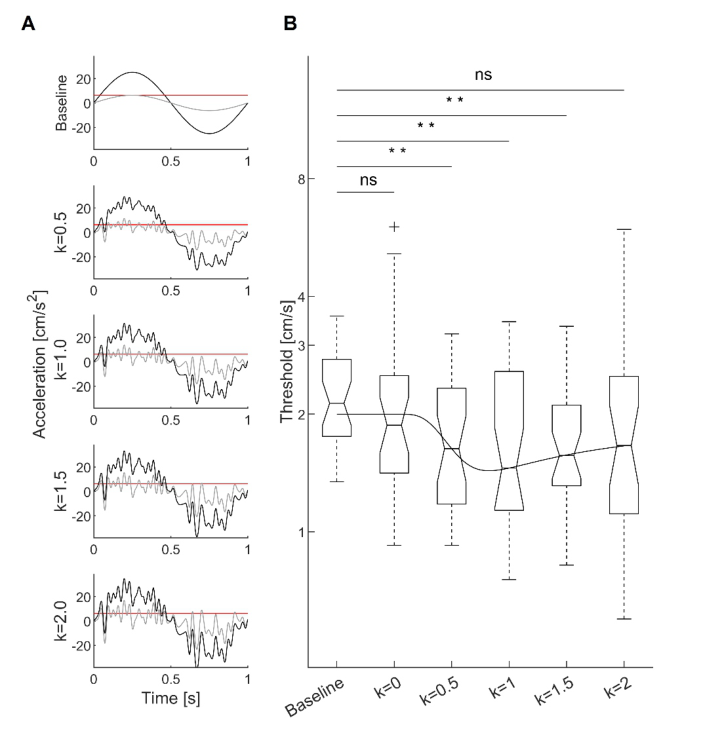
each participant during the baseline condition (unperturbed trials). Noise consisted in random fluctuations of acceleration along the antero-posterior axis, i.e., the same axis of the sinusoidal stimuli. The scaling factor of the noise amplitude was equal to 0, 0.5, 1, 1.5, or 2 in different blocks of tri- als, presented in randomized order (Fig. 1A). The amplitude of the sinusoidal stimuli changed from trial to trial according to an adaptive staircase in the trials with and without noise, but the added noise was the same in all tri- als of a given block. After each stimulus, participants indicated the perceived direction of motion (forward or backward, in a two-alternative forced-choice direction recognition task). We fit a Gaussian cumulative distribution psy- chometric function to the responses with a maximum likelihood estimate via a generalized linear model and a probit link function (Merfeld 2011). The individual threshold is estimated by the standard deviation of the distribu- tion function, and corresponds to the stimulus level that would be expected to yield 84% correct performance in the absence of any bias (Merfeld 2011).
We found that the log-transformed thresholds in 26/30 participants were lower with at least one noise intensity than the corresponding values in both unperturbed conditions (the baseline and the control with scaling factor equal to 0). These results show that low amplitude noise added to vestibular stim- ulation does improve the perception of motion direction in the vast majority of tested participants. Moreover, in 20 of these 26 participants, the thresh- old at the highest level of applied noise (scaling factor equal to 2) was worse than the threshold at a lower level of noise. The trend over all participants (Fig. 1B) is reminiscent of the phenomenon of stochastic resonance, whereby the addition of a given amount of noise to a subthreshold signal can raise otherwise silent sensory neurons above their spiking threshold (McDonnell and Abbott 2009). The characterizing feature of stochastic resonance is a bell-shaped function, such that best discrimination performance is observed with an intermediate level of noise while both low and high levels of noise cause no improvement of the performance.
We also found a significant positive correlation between the threshold val- ues in the unperturbed conditions and the maximum noise-induced improve- ment (P<0.05). In other words, participants with higher thresholds in the unperturbed conditions benefitted more from added noise than participants with lower unperturbed thresholds.
CONCLUSION AND PERSPECTIVES We believe that our novel stimulation protocol with low-amplitude noisy vibrations of the whole-body holds promise as a physiological, ergonomic tool for rehabilitation in vestibular patients. We expect that vestibular patients may benefit from the small-amplitude mechanical stimuli by improv- ing their perceptual threshold of discrimination of self-motion. Indeed, it is well known that such thresholds are often abnormally elevated in vestibu- lar patients (Diaz-Artiles and Karmali 2021; Lacquaniti et al., 2023). For instance, thresholds in patients with total bilateral labyrinthectomy (vestibu- lar ablation) were up to 57 times greater than normal (Valko et al., 2012). Idiopathic bilateral vestibulopathy mainly affects lateral canal and utricular thresholds, while it may spare vertical canal and saccular function (Priesol
et al., 2014). In patients with unilateral vestibular nerve section, detection thresholds for yaw rotation were higher than for healthy persons, as expected by assuming that the lesion halved the variance of both the signal and noise (Cousins et al., 2013). A relevant finding of our study in healthy participants was that persons with higher thresholds in the unperturbed conditions bene- fitted more (i.e., showed greater threshold improvements) from added noise than participants with lower unperturbed thresholds. Thus, we may expect that vestibular patients with abnormally high thresholds demonstrate an even greater improvement with noisy mechanical stimulation.
Figure 1: (A) Motion stimuli consisting of a single cycle of 1 Hz sinusoidal accelerations along the antero-posterior direction. Black and gray correspond to stimuli with peak velocities of 8 cm/s and 2 cm/s, respectively. The red line denotes the peak value of acceleration corresponding to a vestibular threshold of 2 cm/s. Top to bottom: unper- turbed, noise level 0.5, 1, 1.5 and 2, respectively (B) Box-and-whisker plots of motion discrimination thresholds at population level (N = 30 participants, ** P< 0.01). Data from La Scaleia et al., 2023.
A Novel Stimulation Protocol for Vestibular Rehabilitation 209
An additional factor that may contribute to the success of our protocol resides in the potential re-establishment of normal head movements. It is known that persons with loss or degradation of peripheral vestibular inputs due to chronic unilateral vestibular hypofunction as resulting from Meniere’s disease, vestibular neuritis or vestibular schwannoma show altered statis- tics of head movements during natural self-motion typical of daily activity (Zobeiri et al., 2021; 2022). Stimulation protocols such as the one we pro- posed here may be tailored to mimic the normal statistics of head movements during natural self-motion. They might be used to train vestibular patients toward recuperating normal or quasi-normal head movement statistics via appropriate rehabilitation protocols.
ACKNOWLEDGMENT
The authors would like to acknowledge the Italian Ministry of Health (Ricerca corrente, IRCCS Fondazione Santa Lucia, Ricerca Finalizzata RF- 2018-12365985), Italian Space Agency (grant I/006/06/0), INAIL (BRIC 2019 BRISK and BRIC 2022 LABORIUS), and Italian University Min- istry (PRIN grant 20208RB4N9_002, PRIN grant 2020EM9A8X_003). Work supported by #NEXTGENERATIONEU (NGEU) and funded by the Ministry of University and Research (MUR), NRRP project MNESYS (PE0000006) – A Multiscale integrated approach to the study of the nervous system in health and disease (DN. 1553 11.10.2022)
REFERENCES
Bergeron M, Lortie CL, Guitton MJ. (2015) Use of virtual reality tools for vestibular disorders rehabilitation: a comprehensive analysis. Adv Med. Oct. 2015. Bermúdez Rey MC, Clark TK, Wang W, Leeder T, Bian Y, Merfeld DM. (2016)
Vestibular perceptual thresholds increase above the age of 40. Front Neurol. 7:162. Cousins S, Kaski D, Cutfield N, Seemungal B, Golding JF, Gresty M, Glasauer S, Bronstein AM, Sathian K. (2013) Vestibular perception following acute unilateral vestibular lesions. PLoS One 8: e61862. Diaz-Artiles, A, Karmali, F. (2021) Vestibular precision at the level of perception, eye
movements, posture, and neurons. Neuroscience 468: 282–320. Dlugaiczyk J, Gensberger KD, Straka H. (2019) Galvanic vestibular stimulation: from basic concepts to clinical applications. J Neurophysiol 121: 2237–2255. Eder J, Kellerer S, Amberger T, Keywan A, Dlugaiczyk J, Wuehr M, et al. (2022)
Combining vestibular rehabilitation with noisy galvanic vestibular stimulation for treatment of bilateral vestibulopathy. J Neurol. 269:5731–7. Fitzpatrick RC, Day BL. (2004) Probing the human vestibular system with galvanic stimulation. J Appl Physiol 96: 2301–2316. Fujimoto C, Yamamoto Y, Kamogashira T, Kinoshita M, Egami N, Uemura Y, et al.
(2016) Noisy galvanic vestibular stimulation induces a sustained improvement in body balance in elderly adults. Sci Rep. 6:1–8. Galvan-Garza RC, Clark TK, Mulavara AP, Oman CM. (2018) Exhibition of stochastic resonance in vestibular tilt motion perception. Brain Stimul. 11: 716–722. Herdman SJ. (2013) Vestibular rehabilitation. Curr Opin Neurol. 26(1): 96–101.
Karmali F, Haburcakova C, Gong W, Della Santina CC, Merfeld DM, Lewis RF. (2021) An Implanted Vestibular Prosthesis Improves Spatial Orientation in Animals with Severe Vestibular Damage. J Neurosci. 41(17): 3879–3888. Keywan A, Wuehr M, Pradhan C, Jahn K. (2018) Noisy galvanic stimulation
improves roll-tilt vestibular perception in healthy subjects. Front Neurol. 9, 83. Kwan A, Forbes PA, Mitchell DE, Blouin JS, Cullen KE. (2019) Neural substrates, dynamics and thresholds of galvanic vestibular stimulation in the behaving primate Nat Commun 10: 1–15. La Scaleia, B., Lacquaniti, F., Zago, M. (2023). Enhancement of vestibular motion
discrimination by small stochastic whole-body perturbations in young healthy humans. Neuroscience. 510, 32–48. Lacquaniti, F., La Scaleia, B., Zago, M. (2023). Noise and vestibular perception of passive self-motion. Front Neurol. 14:1159242. McDonnell MD, Abbott D (2009) What is stochastic resonance? Definitions, mis-
conceptions, debates, and its relevance to biology. PLoS Comput Biol 5(5): e1000348. Merfeld DM. (2011) Signal detection theory and vestibular thresholds: I Basic theory and practical considerations. Exp Brain Res 210: 389–405. Mulavara AP, Fiedler MJ, Kofman IS, Wood SJ, Serrador JM, Peters B, Cohen HS,
Reschke MF, Bloomberg JJ. (2011) Improving balance function using vestibu- lar stochastic resonance: optimizing stimulus characteristics. Exp Brain Res 210: 303–312. Nardone A, Godi M, Aruso A, et al. (2010) Balance rehabilitation by moving platform and exercises in patients with neuropathy or vestibular deficit. Arch Phys Med Rehabil 91:1869–1977. Priesol AJ, Valko Y, Merfeld DM, Lewis RF. (2014) Motion perception in patients
with idiopathic bilateral vestibular hypofunction. Otolaryngol Head Neck Surg 150:1040–2. Strupp M, Dlugaiczyk J, Ertl-Wagner BB, Rujescu D, Westhofen M, Dieterich M.
(2020) Vestibular disorders: diagnosis, new classification and treatment. Dtsch Arztebl Int. 117(17):300. Valko Y, Lewis RF, Priesol AJ, Merfeld DM. (2012) Vestibular labyrinth contributions to human whole-body motion discrimination. J Neurosci 32:13537–13542. Wiboonsaksakul KP, Roberts DC, Della Santina CC, Cullen KE. (2022) A pros-
thesis utilizing natural vestibular encoding strategies improves sensorimotor performance in monkeys. PLoS Biol. Sep. 14;20(9): e3001798. Winkler PA, Esses B. (2011) Platform tilt perturbation as an intervention for people with chronic vestibular dysfunction. J Neurol Phys Ther 35:105–115. Wuehr M, Nusser E, Decker J, Krafczyk S, Straube A, Brandt T, et al. (2016)
Noisy vestibular stimulation improves dynamic walking stability in bilateral vestibulopathy. Neurology. 86:2196–202. Zobeiri OA, Ostrander B, Roat J, Agrawal Y, Cullen KE. (2021) Loss of peripheral vestibular input alters the statistics of head movement experienced during natural self-motion. J Physiol. 599:2239–54. Zobeiri OA, Wang L, Millar JL, Schubert MC, Cullen KE. (2022) Head move-
ment kinematics are altered during balance stability exercises in individuals with vestibular schwannoma. J Neuroeng Rehabil. 19(1):120.
LISTED IN THE AHFE DIGITAL BOOKSTORE CATALOGUE
Explore the complete digital volume
Emerging Technologies in Healthcare and Medicine
Read this individual research paper free through the original publisher, or explore the full digital proceedings book.
ISBN 978-1-958651-92-6
Explore this ISBN in the AHFE Bookstore ↗Listed in the July 2026 bookstore catalogue; search by ISBN to confirm current availability · Digital book purchase optional