Minna Takala, Taina Tukiainen (2022). Regional Innovation Ecosystems Fostering Sustainable Development. In: Human Factors, Business Management and Society. AHFE Open Access, vol. 56, pp. 17–24. https://doi.org/10.54941/ahfe1002247
Since 2014, European Union has recommended European regions to conduct development activities based on Smart Specialisation. Smart Specialisation is a place-based approach characterised by the identification of strategic areas based both on the analysis of the regional strengths and potential of the economy. It aims to enhance prosperity of European regions by creating enabling conditions, accelerating research, development and innovation activities as well as supporting Entrepreneurial Discovery Process (EDP) with wide stakeholder involvement. This outward-looking approach embraces open innovation ecosystems supported by collaborative activities combined with effective monitoring mechanisms. This paper examines experiences of the creation and implementation of smart specialisation strategies across Baltic Sea Region and at Häme Region in Finland. The paper introduces results of a SmartUp BSR –project. The study builds on ten cases in nine countries of the Baltic Sea Region. Large number of regional stakeholders involved in regional smart specialization strategy processes participated in project events to share their experiences and best practices. The aim was also to encourage participants to include Sustainable Development Goals 2030 into regional development activities. Activities also included innovation camps and pilots, which endorsed and accelerated activities related to strategy content and chosen spearheads. This also enhanced stakeholder participation and international collaboration widening the scope of the innovation ecosystem. The paper takes a deeper look as a case example of Häme Region, Finland. At Häme region open regional portfolio management tools were created, piloted and taken in use to support implementation of regional smart specialization strategy. Prior to development a benchmarking study was conducted with 18 Finnish regions. The aim was to support collaboration among regional stakeholders, provide flexible monitoring and reporting practices over the time and collection of new development ideas for the future. Experiences of new portfolio management tool practices were openly shared with other Finnish regions and interested stakeholders.The goal of this paper is to share experiences from ecosystem based leadership and management practices for regional development to support active stakeholder participation stakeholder and sustainable development.
Since 2014, European Union has recommended European regions to con- duct development activities based on Smart Specialization Strategies (S3). These strategies aim to enhance prosperity of European regions by creating enabling conditions, accelerating research, development and innovation acti- vities as well as supporting active stakeholder involvement for enhancing new entrepreneurial activities. Smart specialization approach embraces open innovation ecosystems supported by collaborative activities. (Asheim et al. 2019, EU 2021) New concepts Smart Specialization Strategy for Sustainability or Sustaina- ble Smart Specialization Strategy (S4) were introduced by European Commis- sion for the new program period 2021–2027. Smart Specialization Strategies are ex-ante conditionality for EU regional funding programs. Smart Speci- alization is defined currently as “a place-based approach characterized by the identification of strategic areas for intervention based both on the analy- sis of the strengths and potential of the economy and on an Entrepreneurial Discovery Process (EDP) with wide stakeholder involvement. It is outward- looking and embraces a broad view of innovation including but certainly not
limited to technology-driven approaches, supported by effective monitoring mechanisms.” (EU 2021) A recent study about “Prioritisation in Smart Specialisation in the EU” (EU 2021) systematically screened and assessed all available European S3 strategies to analyse if priorities set within the strategies correspond to regi- onal innovation capabilities. Over 180 S3 strategies were evaluated. In most S3 strategies, a linkage between EU-funded projects in the field of research, development, and innovation and associated S3 priority areas exists. The study recommended that a better, more holistic delineation and specification of S3 priority areas is necessary to increase the effectiveness of smart spe- cialisation. The study suggested also that adequate economic, scientific, and technological resources are required for implementation of successful S3 stra- tegies. Concrete projects are elementary important for inducing the desired economic, environmental, and societal changes. Good governance structures and efficient monitoring practices are essential for successful implementa- tion. Study also recommended more effective and participatory governance structures for the implementation of S3 strategies.
The European Commission’s Joint Research Centre (JRC) has been sup- porting smart specialization strategy activities across the Europe. Recently themes related to sustainability, climate change and circular economy have been increasingly emphasized. The guidelines, accompanied with a self- assessment tool for regions, have been proposed to support of regions’ effort in designing and implementing Smart Specialization strategies for sustainable transformation. JRC have worked together with the United Nations to share the EU experiences to achieve also Sustainable Development Goals 2030 agenda with localized place-based approach in Europe (Stancova, 2021).
SMART SPECIALIZATION – ENABLING REGIONAL ECOSYSTEMS AND SUSTAINABLE TRANSFORMATION The SmartUp BSR study builds on ten cases in nine countries of the Baltic Sea Region. Large number of regional stakeholders involved in regional smart specialization strategy processes participated in project events to share their experiences and best practices. The aim was also to encourage participants to include Sustainable Development Goals 2030 into regional development acti- vities. Activities included innovation camps and pilots, which endorsed and accelerated activities related to strategy content and chosen spearheads. This enhanced stakeholder participation and international collaboration widening the scope of the innovation ecosystem (Tukiainen and Hongisto 2020).
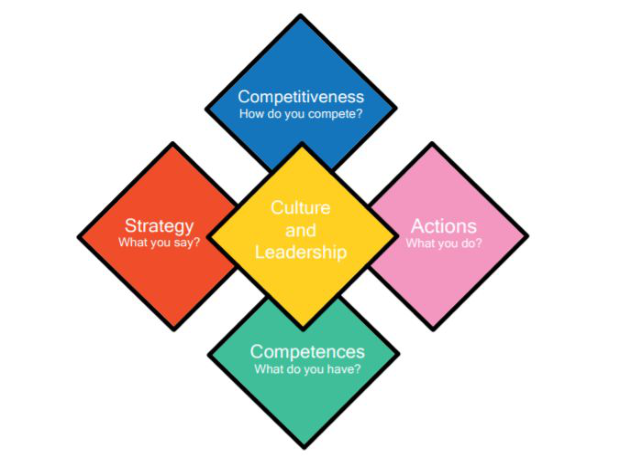
SmartUp study used a strategy framework from management science to examine the Smart Specialization strategy processes in each region. Based on the strategy diamond (Burgelman, 2008), the study introduced a model ada- pting the strategy diamond to serve as illustration for the process of regional strategy creation and revision: the Regional Strategy Diamond for Economic Transformation. The model as illustrated in Figure 1 was used to guide the analysis of the ten regional strategies.
The strategy diamond consists of five dimensions: strategy, competences, competitiveness, actions, and culture & leadership. These five dimensions are
Regional Innovation Ecosystems Fostering Sustainable Development 19
Figure 1: Regional strategy diamond for economic transformation (Tukiainen and Hongisto, 2020).
interlinked. Each dimension drives the implementation process in significant way. The center of the diamond culture & leadership links other dimensi- ons to each other. In this model strategy creation is one of the dimensions and is only partly responsible for the success needed to reach desired tran- sformation. Actions (what region does) implement the strategy and induce real impact. The other two dimensions are equally important: competences including regional resources – economic, scientific, and technological. Com- petitiveness addresses how the region competes, but also how it collaborates. In ecosystems enhancing innovation and sustainability capability for collabo- ration is becoming increasingly important for meaningful change across the regions (Tukiainen and Hongisto 2020, Lappalainen et al 2015, Stancova 2021). The emphasis on the process description of a specific implementing organi- zation included the reality of how collaboration is steered in practice. In many cases collaborative strategic action is not necessarily led through strategy, but largely by balancing common and divergent elements between organi- zations. By collecting local evidence with the explicit procedural features as described in the model, the process of strategic creation and revision attem- pted to respond to the commonalities and divergencies among regions. The aim of the analysis was to provide a lens to make the Smart Specialization strategy process sufficiently easy to recognize, point to, and align with. The implementation plans are only relevant regarding to what an organization is realistically mandated to do within the innovation ecosystem.
Innovation Camps as Tools for Sustainable Change The project organized six Innovation Camps in various locations across the Baltic Sea Region. The SmartUp Innovation Camps focused on chosen
20 Takala and Tukiainen
“innovation challenges” based on regions’ smart specialization themes. The camps included several participatory workshops using creative facilitation methods and visualizations strengthening active stakeholder involvement. Camps of 1-3 days fostered bottom-up and needs driven innovation processes in regions providing an opportunity for ideation, experimenting and co- creation. Events also enhanced cross regional collaboration and gave insights for more efficient smart specialization strategy implementation.
Pilots related to innovation challenges addressed four themes relevant to all regions: healthy ageing, climate change, circular economy, and smart cities. The participants also were advised by experts from the Committee of Euro- pean Regions and Joint Research Centre. Based on experiences during the project the SmartUp team created a Pilot Planning Methodology to encou- rage participation and to support the future S3 strategy implementation and practical work.
The findings of the study with respect to economic transformation and SDG implementation show a lot of future potential, which will help regions in the transition to a more sustainable regional innovation ecosystem. Based on place-based regional view, Smart Specialization Strategies could be a step towards a sustainable economic transformation across the regions.
OPEN PORTFOLIO MANAGEMENT PRACTICES FOSTERING COLLABORATIVE CHANGE At Häme Region portfolio management tools were created, piloted, and taken in use to support implementation of regional smart specialization stra- tegy SmartTavastia 2018–2021. The aim was to support collaboration among regional stakeholders, provide flexible monitoring and reporting practices over longer periods of time. The intent was also to enhance open innova- tion approach and provide better overview of on-going development activities across the region as well as enable collection of new development ideas for the future.
Development and funding programs are monitored via various IT-tools. However, these IT-tools typically focus on one development program or one funding instrument only. This has made monitoring regional development activities and assessing their long-term impact at a specific region difficult. Data about development projects was scattered in many different databases.
There are multiple funding sources for research, development, and inno- vation projects across Finland. The Finnish RD roadmap aims to increase RDI expenditure to 4% of GDP by 2030. The potential RDI funding sou- rces include EU funding and national funding. For regional development projects the main funding sources are - EU structural funds European Regio- nal Development Fund (ERDF) and European Social Fund (ESF), European Agricultural Fund for Rural Development (EAFRD); the national Sustainable Growth Programme for Finland boosting reforms and investments; Inter- reg programmes for cross regional development, Horizon Europe for RD programmes, and new Missions programmes by EU. There are also multi- ple sources of development funding by Finnish ministries, Business Finland, Finnish Academy, and many foundations e.g. the Finnish Research Impact
Regional Innovation Ecosystems Fostering Sustainable Development 21
Foundation. Häme Portfolio aims to collect data of all relevant development projects linked to regional smart specialization themes.
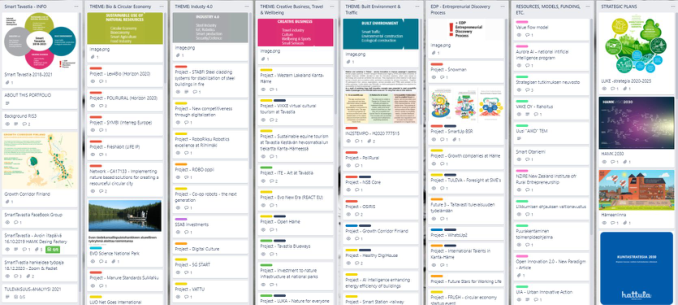
The first of reginal development project portfolio was created in 2018 with an open platform tool Trello to enhance visibility, to identify gaps in funding allocation and to encourage across project collaboration. The aim was to enh- ance visibility and collaboration among stakeholders and to support open and systemic development approaches of local authorities, academia, busi- nesses, and civil society. The first portfolio tool (Figure 2) provided on-line visibility to covered regional smart specialization themes and related deve- lopment projects, EDP activities, funding sources and stakeholder strategies, but it had inadequate analysis and reporting capabilities.
Prior to development of the second version a benchmarking study was conducted with 18 Finnish regional councils. Based on responses variety of portfolio management tools had been used in the other regional councils before. They were used for mainly for internal reporting and monitoring purposes, and they covered only the projects funded by regional councils.
Häme Portfolio Management Tool Enables Strategic Steering and Supports Collaboration in Regional Ecosystem The second portfolio management tool was designed to enable more efficient steering and monitoring practices. Participatory workshop was arranged at HAMK Design Factory and feedback from previous version and suggestions for the next version were collected from the regional stakeholders. The core team was assigned to deliver the next generation Häme Portfolio and it consi- sted of employees from Regional Council of Häme, development experts and developers from ThinkingPortfolio, the company selected to deliver the solu- tion. A cloud-based portfolio application was tailored based on requirements, testing and feedback using agile development approach in three workshops with demo sessions. Pilot testing was conducted with regional stakeholders to collect their feedback and recommendations. Häme Portfolio was launched in March 2020. Data transfer of development project data from previous EU program period 2014–2020 was conducted during spring and summer 2020.
22 Takala and Tukiainen
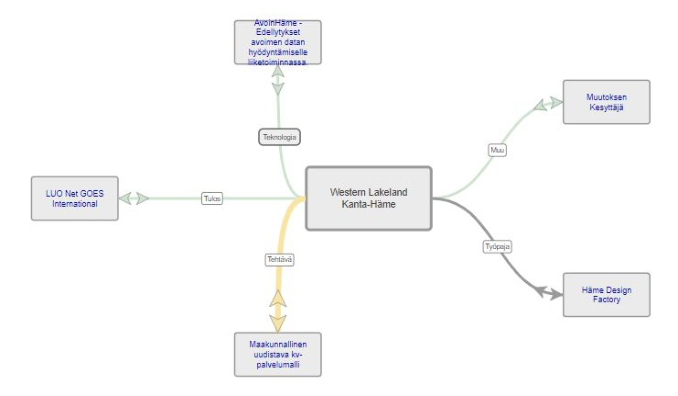
Figure 3: Häme Portfolio tool - visualization of development project connections.
Design principles aimed for usability and simplicity. The focus was on the main functionalities. The intent was to provide support for better regio- nal development project management practices, encourage collaboration and knowledge sharing and enable better alignment of projects with strategic development themes. Also steering, monitoring, and evaluation functiona- lities were added for individual projects, as well as to strategic development programs.
The Häme Portfolio management tool has good search capabilities of ongoing and past projects, and versatile analysis and reporting tools. Projects can be interlinked to form larger entities to contribute sustainable solutions related wider societal, economic, and environmental challenges. Interaction and collaboration between projects can be described and visualized (see Figure 3). Häme Portfolio also has a section for project ideas and suggestions. This feature can be used prior to official funding calls to support stakeholder collaboration and formation of larger projects.
Häme Portfolio supports strategic development themes of the Finnish Research, Development, and Innovation (RDI) Roadmap (Ministry of Educa- tion and Culture 2021). It complements new partnership model encouraging collaboration among projects and regional stakeholders and it supports innovation ecosystem development. It is the first cloud-based portfolio mana- gement tool for regional development in Finland. Häme Portfolio enhances also new ways of working and collaboration thus strengthening innovative public sector. Based on open innovation principles experiences of new port- folio management tool has been openly shared with other Finnish regions in the national network meetings of smart specialization professionals from regional councils.
The future activities include finetuning the practices related to long term impact evaluation both at project as well as program level. Häme Port- folio will be used for evaluation of the new regional Smart Specialization
Regional Innovation Ecosystems Fostering Sustainable Development 23
Strategy - Smart Häme 2022-2025 and for monitoring long term impact to sustainability, and SDGs.
RESULTS AND CONCLUSION The analysis of regional strategies based on the balance of the five dimen- sions of the Regional Strategy Diamond: strategy, actions, competitiveness, competence, and culture & leadership. The Diamond can be used as an active continuous tool for regions to secure positive results from the implementation of the Smart Specialization strategy and avoid imbalances between dimensi- ons. Regions may have well formulated strategies but may be missing the competences to put them into action or vice versa. Regions cannot be succes- sful without competitive and competent strategies and actions. All the Baltic Sea regions were analyzed in the study to help the regions to find out their bottlenecks and achieve the balance between Regional Strategy Diamond dimensions.
The results related to Häme Portfolio capability to steer strategic develo- pment and encourage collaboration at regional innovation ecosystem looks promising. Several other Finnish regions are also renewing their portfolio management practices. The work continues with a longitudinal study so that long term impact can be evaluated.
Addressing Sustainable Development Goals 2030 challenges all stakehol- ders operate differently. Globalization, digitalization, and climate change demand new approaches from RDI activities linked with regional deve- lopment. It is essential to bring businesses, industries, public sector, and academia closer to each other for sustainable development. Open inno- vation practices and regional innovation ecosystems enhance stakeholder participation and accelerate sustainable development. Cross regional colla- boration enables sharing and applying better practices. Digitalization and new interconnected open tools provide possibilities for new ways of working, collaboration with development projects across regions, countries, and con- tinents. Action acceleration combined with sense of responsibility and sense of urgency is needed to induce and support successful concrete projects and concrete results – aiming for true impact.
ACKNOWLEDGMENT
We would like to thank many colleagues with whom we have collabora- ted, your contribution and encouragement has been very valuable. We would like to acknowledge the support of the Uusimaa Regional Council, Regional Council of Häme, the European Committee of Regions, the Aalto Uni- versity, Häme University of Applied Science (HAMK) and the EU Interreg Programme.
REFERENCES
Asheim, B. T., Isaksen A. Trippl, M. (2019) Advanced Introduction to Regional Innovation Systems. Cheltenham: Elgar.
24 Takala and Tukiainen
Burgelman, R. (2008). “Cutting the Strategy Diamond in High-technology Ventures.”
California Management Review, 50:3, pp. 140–167. European Commission (2021) Study on prioritisation in Smart Specialisation Strategies in the EU. Luxembourg: Publications Office of the European Union. Lappalainen, P., Markkula, M., Kune H. (ed) (2015) Orchestrating Regional Inno-
vation Ecosystems: Espoo Innovation Garden. Otavan Kirjapaino Oy. Finland. Ministry of Education and Culture (2021) The National Roadmap for Research, Development and Innovation. Website: https://okm.fi/en/rdi-roadmap Stancova, K. C. (2021) Addressing sustainability challenges and Sustainable Deve-
lopment Goals via Smart Specialisation. Towards a theoretical and conceptual framework. Luxembourg: Publications Office of the European Union. Tukiainen, T., Hongisto, P. (2020) Sustainable Baltic Sea Region – Towards Economic Transformation by Smart Specialisation Strategies. Aalto University. Helsinki: Unigrafia.
LISTED IN THE AHFE DIGITAL BOOKSTORE CATALOGUE
Explore the complete digital volume
Human Factors, Business Management and Society
Read this individual research paper free through the original publisher, or explore the full digital proceedings book.
ISBN 978-1-958651-32-2
Explore this ISBN in the AHFE Bookstore ↗Listed in the July 2026 bookstore catalogue; search by ISBN to confirm current availability · Digital book purchase optional