Silvia Zaharia, Elena Adolphs (2022). Antecedents of Intention to Use Voice Commerce Applications and its Impact on Recommendation Intention. In: Human Factors, Business Management and Society. AHFE Open Access, vol. 56, pp. 282–290. https://doi.org/10.54941/ahfe1002279
The present study is based on a representative online survey of online shoppers conducted in Germany. To explain consumers´ intention to use voice-commerce applications and its impact on recommendation intention an integrated explanatory model was developed. The model is based on the Unified Theory of Acceptance and Use of Technology 2 (UTAUT 2), which was expanded to include the constructs of “perceived risk” and “recommendation intention”. The postulated associations were studied using regression analysis. “Performance expectancy” and “social influence” are the factors that have the strongest (highly significant) influence on the intention of the surveyed German online shoppers to use voice-commerce applications. For “hedonic motivation” a weaker (significant) influence can be confirmed. “Effort expectancy” has no significant effect. “Privacy risk” has a weak but highly significant negative influence on the intention to use a voice commerce application. Perceived “functional risk” has no significant effect. The “intention to use” a voice commerce application has a strong and highly significant influence on the “recommendation intention”.Keywords: voice commerce; voice assistant; hedonic motivation; performance expectancy; effort expectancy; social influence; privacy risk; functional risk; intention to use; recommendation intention
Voice commerce (VC) encompasses the use of intelligent virtual voice assi- stants (VAs) and smart speakers to facilitate interactions between individuals, brands and services (Tuzovic/Paluch 2018). Interactions between users and commercial platforms or applications function through voice commands (natural speech recognition). The development of VC is fueled by the gro- wing use of VAs on mobile devices and the ubiquity of smart speakers and IoT devices.
Apple’s Siri and the Google Assistant are the most popular VAs in the West, followed by Amazon’s Alexa and Microsoft’s Cortana (Olson & Kemery 2019). Third party apps that offer users relevant information and utility con- tribute significantly to the success of VAs and smart speakers. For Alexa, these are termed “skills” and for Google “actions.” These are also the two VAs in the western world with the most coverage in commerce. Companies seeking to sell their products through VAs must develop the necessary application (skill or action).
Antecedents of Intention to Use Voice Commerce Applications 283
Intelligent VAs have entered consumer’s everyday life because of their ease and convenience: VAs make it possible to keep hands and eyes free, can be personalized, are easy to operate and offer more efficiency, for example by requiring less mental effort (Rzepka et al. 2020). Online retailers and brand manufacturers expect the comfort and user experience of VAs to hold strong potential for e-commerce. More than 60% of consumers in the United States who have access to an intelligent VA have used it for making purchases, and in 2022, revenue from VC in the U.S. market is expected to surpass 40 billion USD (Paluch & Wittkop, 2020).
Yet consumers also hold doubts regarding the use of VAs and smart spe- akers. These tend to relate to the security of their personal data. Other concerns are with regards to the benefits of VAs as well as the quality of the information provided (Liao et al. 2019). If the VA functions autonomously, then users feel a certain loss of control, which can in turn lead to fear and rejection of the technology (Paluch & Wittkop, 2020).
VC applications can be used for more than purchasing products or services. They are relevant in all phases of the customer journey. The most impor- tant reasons for using VAs in an e-commerce context are for activities in the pre-sales phase: creating a shopping list, searching for a product/service, com- paring products/services and their prices (Olson & Kemery 2019). In these cases, the intelligent assistant does not play the role of an independent sale- sperson or unbiased provider of information. Instead, the device conducts the initial screening, significantly narrowing down the alternative products to recommendations that are strongly dependent on whether it is an Ama- zon Alexa or Google home device. Furthermore, it matters what products the consumer has purchased previously as well as with which companies or manufacturer the retailer cooperates (Paluch & Wittkop, 2020). This inter- mediary function of VAs can be risky for brand manufacturers. VAs quickly become “gate keepers” whose integrated AI recommends specific brands to consumers based on their known preferences and purchasing behavior. As a result, brand manufacturers fear a reduction in their brand visibility through organic search-engine results coupled with an increase in in-house brands (e.g. Amazon Basics) and decrising customer loyalty (Mari et al. 2020). For this reason, brand manufacturers are eager to reach consumers early on in the customer journey (ideally before they even think of shopping).
Against this backdrop, the aim of this article is to answer the following questions:
1. What factors influence consumers’ intention to use VC applications and to what extent? 2. Does consumers’ intention to use VC applications influence their inten- tion to recommend them?
THEORETICAL BACKGROUND
Literature Review
Current quantitative studies on the acceptance of VAs and smart speakers are listed below.
284 Zaharia and Adolphs
Liao et al. (2019) conducted a survey of users and non-users of VA and smart speakers in the United States. The acceptance or rejection decisions are influenced by classic TAM and UTAUT constructs: perceived utility, per- formance expectancy, and level of effort associated with the use of smart speakers. Those who refused to consider the purchase of a smart speaker were significantly more concerned regarding the use of their data and had significantly lower trust in the security of their data.
In an online study of German users, Wagner et al. (2019) found the follow- ing to be relevant drivers of the intention to use VAs: performance expectancy, hedonic motivation and habit. Facilitating conditions, level of effort and social influence, on the other hand, had no major effect on the intention to use VAs.
Utilizing a representative online study of German online shoppers, Zaharia & Würfel (2020) studied the factors impacting the acceptance of smart spea- kers throughout the entire customer journey. The structural equation model showed perceived utility and perceived enjoyment to be the strongest factors influencing online shoppers’ intention to use smart speakers. Both, previous purchases of smart speakers and whether they were perceived to be worth their cost, had a weak effect on the intention to use them in VC. Perceived user friendliness had no direct influence while perceived risk had a negative effect on the intention to use smart speakers. Furthermore, the study showed that the intention to use smart speakers was higher during the information phase than during the buying phase.
There are few quantitative studies related to VC that assess the effect of VA acceptance on loyalty or recommendation intention. Poushneh (2021) studied the impact of personality traits of the VA on the perception and beh- avior of consumers. The study revealed that voice interactions with a VA representing traits such as functional intelligence, candor and creativity hei- ghten the consumer’s flow experience while using the technology as well as their exploratory behaviors. This exploratory behavior in interacting with a VA is satisfying for consumers and propels their willingness to continue using the VA.
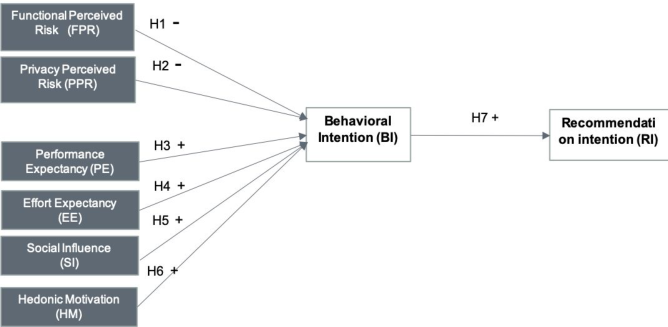
Model and Hypotheses The present study builds on the results of Zaharia & Würfel (2020). The basic model is UTAUT2 (Venkatesh et al. 2012), which was expanded to include the constructs of perceived risk and recommendation intention. The VC applications assessed in the study exist only as prototypes, which surve- yed respondents were shown for the first time in the context of the study. For this reason, the dependent variable is behavioral intention (BI). The users are meant to use the presented VC application during the pre-sale phase. The developed model is depicted in figure 1. It is assumed that the perceived risk (functional risk and data privacy risk) has a negative effect on the intention to use the presented voice application (behavioral intention). The variables of expected benefit, expected level of effort, social influence and hedonic motivation have positive effects on the BI. The behavioral intention of the
Antecedents of Intention to Use Voice Commerce Applications 285
Figure 1: Explanatory model of acceptance of voice commerce applications.
VC application has a positive influence on the intention to recommend the technology.
Perceived risk is defined as the extent to which users believe that the use of a technology will have a negative impact on them; this, in turn, has a negative effect on the intention to use the technology (Martins et al., 2014). It has been shown that consumers have several concerns relating to the use of VAs. An explorative German study names the following barriers to use of VC (Rzepka et al., 2020): limited transparency; low technical maturity; limited control and lack of trust. The various facets of perceived risk can be summarized by the two dimensions of functional risk (FR) and data privacy risk (DPR).
Performance expectancy (PE) denotes the degree to which a consumer expects to experience a benefit (utility) from using a VC application. The benefits consumers, who use VAs experience, relate to comfort and time savings. Moreover, the available functions of the VA positively impact the acceptance of the technology (Zaharia & Würfel, 2020). This leads to the assumption that positive PE raises the BI of the VC application in question.
Effort Expectancy (EE) is defined in the VC context as the degree to which a consumer considers an application to be easy to learn and operate (Zaharia & Würfel, 2020). It is assumed that a lower EE, meaning highly user-friendly VC technology, has a positive influence on BI.
Social influence (SI) is defined as the consumer’s perceived degree of recom- mendation relating to the use of new technology by people that are important to them. In studies, consumers mention an increased interest in VA when they hear about it from a friend (Kessler & Martin, 2017). This leads to the assumption that BI increases when the recommendation to use a VC applica- tion comes from trustworthy people, with whom the consumers have a direct relationship and whose opinion they value.
Hedonic motivation (HM) relates to the perceived enjoyment a consumer will experience when using a technology (Kessler & Martin, 2017). In the voice commerce context, hedonic motivation is defined as the degree to which
286 Zaharia and Adolphs
a consumer sees the use of VAs or voice technology as entertaining, exciting and pleasant (Zaharia & Würfel, 2020). Based on earlier studies, it is assumed that high levels of fun and satisfaction while using a VC application will increase the BI.
Recommendation intention (RI): The success of new apps is largely influe- nced by “word-of-mouth” recommendations from friends and acquaintances (Eling 2018). Recommendation intention represents a facet of loyalty in which a customer has a positive impression of a provider and is prepared to recommend the provider or their services to others (Nerdinger & Neu- mann 2007). Moriuchi (2019) showed that consumers’ positive impression of VA has a positive influence on their loyalty to the provider. In the present study, it is assumed that consumers who intend to use the VC application will also recommend it onwards.
The preceding considerations lead to the following hypotheses: H1: The influence of FR on BI is negative. H2: The influence of DPR on BI is negative. H3: The influence of PE on BI is positive. H4: The influence of EE on BI is positive. H5: The influence of SI on BI is positive. H6: The influence of HM on BI is positive. H7: The BI of VC applications has a positive influence on RI.
Research Design The object of study is a German brand manufacturer in the beauty and cosme- tics sector. The manufacturer does not have its own online shop and sells its products exclusively in retail stores (drug store chains, supermarkets etc.) and online stores (e.g. Amazon or drug store online shops etc.). For this rea- son, the company is not striving to sell its products using VC, but rather to develop a VC application that raises brand and product visibility and draws consumers’ attention to their products early on in the customer journey. For this study, a prototype of a voice application was developed to dialogue with the user and propose individual beauty solutions. With the help of Amazon Skills or Google Actions, the products can then be sold through a coopera- ting online retailer. The VC application provides hair recommendations using visual content and is designed for consumers who are searching for new hair styles and trends. Users can utilize the application on devices with displays, such as smartphones, Google Nest Hub and Amazon Echo Show. The VC application was designed for both the Alexa as well as the Google Assistant VAs.
The present study involved conducting an online survey of German online shoppers. The sample of 281 participants is representative of the brand manu- facturer’s target group: Men (10%) and women (90%) ages 16 to 65 who are open to new technologies (e.g. VC / VA) and have a basic interest in hair sty- ling. The survey begins by presenting the VC application prototype followed by questions about the actual use of VAs and skills/actions. The constructs were measured on a five-point Likert scale (multi-item) from 1 = “strongly disagree” to 5 = “strongly agree”.
Antecedents of Intention to Use Voice Commerce Applications 287
Key Study Results To assess the constructs, the study applied explorative confirmatory factor analysis. The results of the reliability and validity analysis can be summarized as “very good” (see table 1).
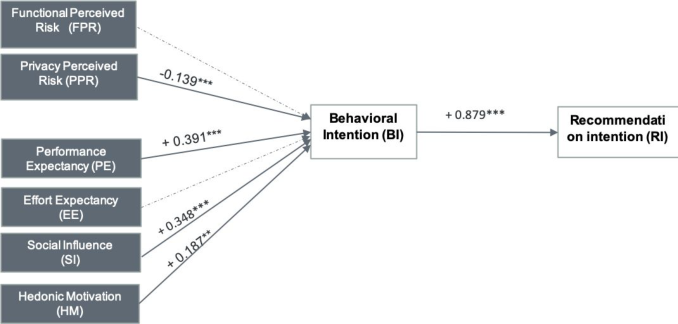
Hypotheses H1 to H6 were tested via multiple regression analysis. The results of the regression analysis (see table 2) show that PE and SI are the factors with the strongest (highly significant) influence on BI. A weaker (highly significant) influence was seen for HM whereas EE has no signifi- cant effect on BI. Regarding the two perceived risks, only DPR had a weak yet highly significant negative influence on BI of the voice application. The perceived functional risk, however, was shown to have no effect.
Hypothesis H7 was tested using regression analysis. The intention to use the VC application had a strong and highly significant effect on recommen- dation intention. In short, those who wish to use the voice application are also likely to recommend the technology and the provider to others.
In summary, the analysis showed that with the exception of H1 and H4, all hypotheses could be maintained (see figure 2).
Practical Implications Based on the results, there are several recommendations for companies seeking to develop a VC application for their products.
Since PE (meaning the user’s expected utility of using the VC application) has the strongest influence on acceptance, the success of the application is highly dependent on its performance. The user rates the voice application first and foremost based on how well it helps him or her find the fitting product. This means that intelligent software must be well equipped to take consu- mer inputs and turn them into the right product suggestions and information details.
SI and word-of-mouth communication are very important for the success of a VC application. The relationship between social influence, intention to use and the intention to recommend can be seen as a key cycle that leads to a positive feedback loop. This loop can be promoted through communication strategies: if companies can convince consumers to use a VC application, then it is very likely that they will recommend the application to others. Word-of-mouth communication in the private realm should be encouraged. A recommendation feature within the app is helpful in this regard.
HM cannot be underestimated either. Marketing and communication should also emphasize the element of fun that users experience when uti- lizing the VC application. To avoid frustrations, companies should seek to ensure high levels of usability and invest in user experience.
Even if the influence of DPR on BI is not particularly strong, it is still important to consider a user’s perceived data risks. Companies should be pro- active about building customer trust regarding data protection and privacy and communicating what the company will do to protect their data.
If brand manufacturers wish to maintain their access to their customers, then VC applications can be an appropriate tool for increasing brand visi- bility and securing customer loyalty. In designing the application, success is
288 Zaharia and Adolphs
(≥0.5)
Commonalities
Factor
(≥0.7)
Loading
to Total
Correlation
(≥0.3 −0.5)
Indicator Item
(in %)
Variance
Explained
Factor
(≥0.6)
Reliability
(≥0.5)
Variance
Extracted
(≥0.5 −0.7) Average
Table 1. Results of the confirmatory factor analysis (incl. limits and quality criteria; Adolphs & Zaharia 2021).
Functional Perceived Risk 0,121 0,097 0,016 * Privacy Perceived Risk −0,150 −0,139 0,001 *** Performance Expectancy 0,423 0,391 0,000 *** Hedonic Motivation 0,208 0,187 0,007 ** Effort Expectancy −0,004 −0,003 0,950 (ns) Social Influence 0,390 0,348 0,000 *** Recommen- dation Intention (ns) = not significant/ *significance on 5%-level/ ** high significance on 1% level/ *** highly significance on 0.1% level
Figure 2: Review of the model largely dependent on an application’s performance as well as the company’s ability to foster a fan base that is motivated to recommend the application to others.
REFERENCES
Adolphs, E., Zaharia S. (2021): Consumers Acceptance of a Voice Commerce Application in FMCG in Germany, U.S. and U.K., in: Nah FH., Siau K. (Ed.) HCII 2021. LNCS, Vol. 12783, S. 1–19, Springer Eling N. (2018): Entscheidungsverhalten bei der Bewertung von Social Apps. In: Der
Wert von Nutzerinformationen aus Anbieter- und Nutzerperspektive. Springer Gabler, Wiesbaden. https://doi.org/10.1007/978-3-658-19546-5_3 Gentner, A., Böhm, K., Esser, R. (2021): Faktencheck Consumer IoT- Das Internet der Dinge im Alltag deutscher Konsumenten, www.bvdw.de Kessler, S. K., & Martin, M. (2017). How do potential users perceive the adoption of
new technologies within the field of Artificial Intelligence and Internet-of-Things? - A revision of the UTAUT2 model using Voice Assistants - Master thesis Lund University, Sweden.
290 Zaharia and Adolphs
Liao, Y.; Vitak, J., Kumar, P., Zimmer, M. & Kritikos, K. (2019). Understanding the Role of Privacy and Trust in Intelligent Personal Assistant Adoption, in: Procee- dings of the 14th International Conference, iConference 2019, Washington, DC, USA, March 31–April 3. Mari A., Mandelli A., Algesheimer R. (2020). The Evolution of Marketing in the
Context of Voice Commerce: A Managerial Perspective. In: Nah FH., Siau K. (eds). HCII 2020. Lecture Notes in Computer Science, vol 12204. Springer, Cham. https://doi.org/10.1007/978-3-030-50341-3_32. Martins, C., Oliveira, T., & Popoviˇc, A. (2014). Understanding the Internet banking adoption: A unified theory of acceptance and use of technology and perceived risk application. International Journal of Information Management, 34(1), 1–13. Moriuchi, E. (2019). Okay, Google!: An empirical study on voice assistants on con-
sumer engagement and loyalty, in: Psychology & Marketing, Vol. 35, Issue 5, May 2019 Pages 489-501, https://doi.org/10.1002/mar.21192 Nerdinger F.W., Neumann C. (2007). Kundenzufriedenheit und Kundenbindung.
In: Moser K. (eds) Wirtschaftspsychologie. Springer-Lehrbuch. Springer, Berlin, Heidelberg. https://doi.org/10.1007/978-3-540-71637-2_8 Olson, C., & Kemery, K. (2019). Voice report: From answers to action: customer adoption of voice technology and digital assistants. https://printkr.hs-niederrhein.de:2069/study/63323/digital-assistant-and-voice- assistant-adoption-2019 Paluch S., Wittkop T. (2020). Voice Marketing – Die Stimme der Zukunft?, in: Bruhn M., Burmann C., Kirchgeorg M. (eds) Marketing Weiterdenken. Springer Gabler, Wiesbaden. https://doi.org/10.1007/978-3-658-31563-4_26. Rzepka, C., Berger, B., Hess, T. (2020). Why Another Customer Channel? Consu-
mers’ Perceived Benefits and Costs of Voice Commerce, in: Proceedings of the 53rd Hawaii International Conference on System Sciences (HICSS 2020), Wailea, Hawaii, USA, January 7–10. Tuzovic, S./Paluch, S. (2018): Conversational Commerce – A New Era for Service Business Development?; in: Bruhn, M./Hadwich, K. (ed.): Service Business Deve- lopment – Strategien - Innovationen - Geschäftsmodelle : Band 1; Wiesbaden, Germany: Springer Gabler; S. 81–100. Venkatesh, V., Thong, J. Y. L., & Xu, X. (2012). Consumer acceptance and use of
information technology: extending the unified theory of acceptance and use of technology. MIS Quarterly, 157–178. Wagner, K., Nimmermann, F., Schramm-Klein, H. (2019). Is It Human? The Role of Anthropomorphism as a Driver for the Successful Acceptance of Digital Voice Assistants, in: Proceedings of the 52rd Hawaii International Conference on System Sciences. Zaharia, S.; Würfel, M. (2020): Voice Commerce - Studying the Acceptance of Smart
Speakers, Proceedings of the IHIET 2020, Springer
LISTED IN THE AHFE DIGITAL BOOKSTORE CATALOGUE
Explore the complete digital volume
Human Factors, Business Management and Society
Read this individual research paper free through the original publisher, or explore the full digital proceedings book.
ISBN 978-1-958651-32-2
Explore this ISBN in the AHFE Bookstore ↗Listed in the July 2026 bookstore catalogue; search by ISBN to confirm current availability · Digital book purchase optional