Ana María Vallina-Hernández, Hanns De La Fuente-Mella, Jose Barrera, Hugo Mansilla (2022). Active Learning Methods to Enhance Higher Education in Business. In: Human Factors, Business Management and Society. AHFE Open Access, vol. 56, pp. 375–380. https://doi.org/10.54941/ahfe1002292
The environment of a knowledge society is dynamic, active, oriented towards innovation. Therefore, the development of skills for the 21st century, such as the fundamental ones, content, and professionals in the Business career, is becoming more critical. Furthermore, the active-cooperative methodologies take more prominence in developing an undergraduate career in business and economics, whose significant increases with the uncertainty, social, and environmental changes that the pandemic is causing.Business education always has the challenge to achieve that student comprehend business dynamics and have the notions of decision-making. Therefore, active learning methods have been used for a long time, especially the case-study method. This research aims to explore the effectiveness of simulation-role playing techniques versus more traditional methods such as lectures. This study analyzes the case of the Business Administration Career at the Pontificia Universidad Catolica de Valparaiso, whose program changed in 2009, including the new approach of design courses under the learning-by-doing philosophy, focusing, in particular, in the course Simulación Empresarial (Entrepreneurship simulation). Thus, researching the effectiveness of this type of experience in higher education is a real contribution to the development of knowledge to obtain a quality education.This subject uses active-cooperative learning methods through simulation and role-playing techniques. The students integrate teams that correspond to a firm in the industry. Each one has an executive occupation. The team has to present “yearly results” and stand up to the company board (the professors). Thus, role-playing, simulation, and TICs are essential parts of the course. This paper explores indicators and relationships that allow comparing alumni performance from both curriculums, the one more focused on traditional methods, called Control Group (CG – generations from 2001-2008)), and the ones identified as Experimental Group (EG – generations 2009-2016). Hence, it will provide a methodology to replicate in other Business Schools or other college careers. Previous research shows that the role-playing methodology allows a more significant commitment of the students with the object of study and the development of the activities of the specialty. In this sense, a role-playing methodology complemented with simulation and TICs involves active-cooperative learning, which integrates all the knowledge and behavior obtained during the career. Furthermore, it implies that the student, in order to be able to deliver appropriate arguments that support his/her decisions as a manager. The methodology applied is quantitative research, using regression analysis. Tree-decision analysis complemented these results. Considering that it is an exploratory analysis, it is necessary to choose an indicator for performance. The dependent variable chosen is the Comprehensive Exam grade; this exam assesses all the career subjects in an integrated manner. The independent variables are related to entry conditions, such as a grade average in secondary education, university selection standardized test score, gender. In addition, grades obtained on the different lines of the study plan were calculated, such as finance, marketing, economics, math -statistics, and others. Finally, as a dichotomic variable, whether the student took the course Entrepreneurship Simulation or not, to identify whether he/she belongs to the control or the experimental group. Results obtained from the regression model are consistent with the ones attained using the tree-decision model. The control and experimental groups are very similar, so the different programs do not depend on their characteristics. The Comprehensive Exam grade depends directly, for both groups, from their performance in Economics and Marketing and negatively to whether they took Entrepreneurship Simulation, considering 95% confidence interval. The entry variables or gender makes no difference in the grade obtained in that examination. The univariate analysis outcome determines that the Comprehensive Exam and Entrepreneurship Simulation grades are not related.Consequently, further research is needed to measure the effectiveness of the subject under study. The exam grade may be significantly lower in younger generations because: it is more consistent with traditional methods; after approving Entrepreneurship Simulation, the students may feel that it is just a mere requirement; they specialize more in the course that they used to do in the previous plan; and, the course may develop more soft competencies that the exam does not measure.
Business education has always faced the challenge of getting students to understand business dynamics and having the notions of decision making. Current environment stresses these requirements even more. Therefore, active learning methods have been used for a long time, especially the case-study method, however developing new and mixed approaches, such as role pla- ying and simulation software for business development improve students’ experiences related to decision making.
The research aims to explore the effectiveness of active learning meth- ods, of simulation-role playing techniques versus more traditional methods such as lectures, using the course Entrepreneurship Simulation. This sub- ject is a 500 course that uses active-cooperative learning methods through simulation and role-playing techniques. The students form teams (Mana- gement Teams) that correspond to a firm in the industry. Each one has an executive occupation. The team has to present “yearly results” and face the company board (the professors). Thus, role-playing, simulation, and ICTs are essential parts of the lecture. This paper explores indicators and relationsh- ips that allow the comparison of graduate performance in both curriculums, one which focused more on traditional methods called the Control Group (CG – generations from 2001–2008), and the other identified as the Expe- rimental Group (EG – generations 2009–2016). Hence, it will provide a
methodology that may be replicated in other Business Schools or other college degrees to evaluate the performance of active courses, using quantitative analysis.
ACTIVE LEARNING AS A FRAMEWORK FOR IMPROVING HIGHER EDUCATION IN BUSINESS The environment of a knowledge society is dynamic, active, and oriented towards innovation. Therefore, the development of skills for the 21st century, such as those that are fundamental to the content and graduate profile of the Business Program, is becoming more critical. Furthermore, active-cooperative methodologies take more prominence in the development of an undergradu- ate program in business and economics (Obi, Eze & Chibuzo, 2021, The Journal of Education for Business), which will have an even greater importa- nce due to the uncertainty and social and environmental changes caused by the pandemic.
There are various teaching methods, from lectures, lectures plus discussion, negotiation and role playing, case studies, facilitation methods and coaching methods (Downey, 2008; Kademia, 2013; Kozlovskyi, 2018; Krychtanovych, 2019; Yavorska, 2005). The approach of negotiation and role playing is an active method, which could be mixed with other techniques to enrich the students’ experience and increase learning opportunities.
Active-cooperative learning is increasingly being adopted, as it is a way of improving the quality of learning due to the possibility of developing critical and creative thinking, better understanding the market development, and the strategies, operations and vicissitudes of companies (Clark & White, 2010; Habib et al, 2021).
The role-play methodology allows greater commitment by the students to the study objective and the carrying out of the activities of the speci- alty (Bowen, 2005), which in the case of business, relates to organizations, decision-making, the relationship among the people that form the company at different hierarchical levels, the customers, and in general, the stakeholders of the organization. In this regard, a role-play methodology, that includes the application of the knowledge and attitudes obtained during the program implies that the student-directive has to “check their learning process invo- lving active learning” (Bowen, 2007), with aims to be able to deliver proper arguments that support their decisions as executives. Additionally, the com- plexities of the social context are incorporated into the development of the course, which according to Bowen (2007), considers incorporating an ethical component.
Also, it is highlighted that the competency assessment has to be, according to Alsina (2011 p. 23): “a dynamic evaluation, an evaluation that places the action in the context, and includes the knowledge, know-how, being and knowing how to be” (2011). Consequently, the development of courses that involves an integral view develops creativity, organization and the ability to make decisions in semi-defined activities, where the students’ initiative and collaborative teamwork are determining factors in reaching expected results in tasks presented in written form, orally and when interacting with software,
Active Learning Methods to Enhance Higher Education in Business 377
contributing positively to the development of transversal and professional skills in higher education (Gonzalez Gonzalez, 2015).
ANALYSIS AND EVALUATION OF THE APPLICATION OF ROLE-PLAYING TO HIGHER EDUCATION IN BUSINESS The course of Entrepreneurship Simulation mixes role-playing with the stu- dents that form the entrepreneurship team with the use of ICTs when using the software Tempomatic (Michelson, 2009) for decision making. It is com- plemented with coaching sessions for the management teams to support them in the analysis of feedback from the Board (professors) with the objective of improving their performance in the next meeting. The course often has four meetings throughout the semester, which correspond to an annual meeting in the simulation.
The objective of this study is to determine whether there is a differe- nce in the effectiveness of the learning process using this active methodology, with the hypothesis that the performance of generations of students who ente- red the Business Program at PUCV after its implementation would be higher than the previous generations.
Method
The research is quantitative. Descriptive statistics and a multivariate econo- metric model were used, contrasted with a decision tree model. The model design includes demographic variables, income condition, average perfor- mance per key subject areas and the time it took to finish the degree. The parameters that were included in the model are: gender (Gen), type of school [(TC): municipal, subsidized or private school], age at degree entry (Age), region of origin (Reg), type of entry [(Tin): regular via standardized test or special, such as a sports scholarship], score of standardized admission test (Ptje) and high school grades (NEM), these are the socio-economic and entry condition variables. With regards to the degree path, the average grades of the following subjects are considered: Management (Adm), Economics (Eco), Finance (Fin), English (Ing), Math and Statistics (MatE), Human Resources (Pers), Marketing (Mark), Operations (Ope), Average of graduation grades (PME) and Graduation Time (TEgr), as well as the dummy that indica- tes if they attended the Entrepreneurship Simulation Course (dumSE). The dependent variable chosen to measure “success” or performance is the grade obtained in the comprehensive exam, as it is the most integrative evalua- tion, where the skills and knowledge acquired during the program have to be applied (ExTit).
First of all, a univariate analysis is performed comparing the value of the means, at the significant figure level, of the control group and the experi- mental group for the quantitative variables. The control group are those students who entered the Business Administration program between 2001 and 2008, when the educational program did not consider a course based on a 100% active methodology such as role-playing and simulation. The experi- mental group are those students who entered the new program in 2009, until the generation that entered in 2016; there are 8 generations per academic
Table 1. Significant and explanatory parameters in the comprehensive exam grade. (Prepared by the authors).
program, with 419 students belonging to the control group and 390 in the experimental group. Those who received their degree with the preparation of a report or who followed special degree programs are not considered.
Afterwards, in order to determine if there are differences in the effective- ness of the teaching methods, a multivariate econometric model will be used, that will be applied to both groups that will be differentiated by a dummy variable that states if they attended the Entrepreneurship Simulation course or not. The variable to measure the performance will be the grade obtained in the Comprehensive Exam, considering the fact that it is a comprehensive evaluation that represents reaching the skill to act as a Business Major. The equation that illustrates the econometric model is presented in the following equation:
This analysis is going to be complemented with a decision tree model, an algorithm is used to find the independent variables that best separate the data into groups, according to the dependent or target variable. One of the main advantages of this model is its interpretability, as the reason that a student gets certain grade in the final degree exam can be explained directly (following the branches). On the other hand, one of the main problems is the tendency to over adjust the training data.
Results
In the results of the analysis for the independent qualitative parameters of the means control and experimental groups, at a level of relevant digits, it is observed that they are equal, except for math and statistics, human resources, English, operations and the GPA, in the last two cases with a difference of only 0.1. Operations is in the only category where the average of the con- trol group is higher. In terms of the relationship between the explanatory parameters, there is a positive correlation between the subjects of economics, finance and operations. Meanwhile, there is a negative correlation between the graduation time and the subjects of management, economics and finance.
In terms of the equation, the following (Table 1) indicators are highlighted as relevant and significant.
Active Learning Methods to Enhance Higher Education in Business 379
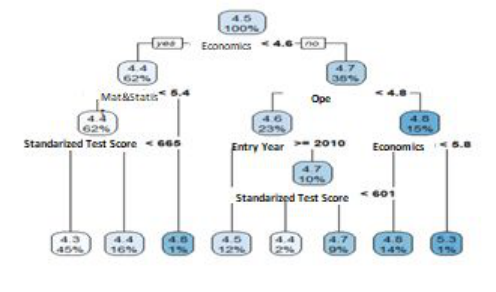
Figure 1: Decision tree for comprehensive exam grade (Prepared by the authors).
Consequently, there is a minimum that the students manage to answer that would be equivalent to 2.2 points of the grade, having attended the Entre- preneurship Simulation course does not ensure a better grade, but would decrease it; having a good result in economics would ensure a better result with 99% confidence and in marketing with 95% confidence. The only socio- economic variable or start condition variable that would affect it would be the score in the university admission standardized test, but the coefficient is practically irrelevant since the grade is given with only one decimal place. Thus, the analysis shows that over the course of the program, any gaps that may exist due to socio-economic issues or starting conditions are overcome and these variables do not affect the result obtained in the comprehensive exam grade, including the fact that there is no gender bias.
When developing the decision tree, the following (Fig. 1) result is obtained: In this case there is certain consistency with the result of the logistic regres- sion, in relation to the grade obtained in economics and the standardized university entrance test score, but also relevant are the grades obtained in mathematics and statistics and operations subjects, as well as studying in your city of origin.
CONCLUSION
For both groups, the Comprehensive Exam grade depends directly on their performance in Economics and Marketing and negatively on whether they attended Entrepreneurship Simulation, considering at least 95% confidence interval. The additional variables that are relevant to the decision tree analysis reiterate a lower grade in this exam if the students attended the Entrepre- neurship Simulation, which is the opposite of the expected result of this research.
The reasons for this finding might be that the dependent variable is not a good indicator for detecting the effectiveness of different teaching methodolo- gies. Due to its structure, it might be more suitable for an education program based mainly on lectures, as this program was until 2008. Also, completing
the comprehensive exam does not capture the honing of soft skills and atti- tudes which might be where there is a significant difference between both programs. There may also be greater specialization than in the other pro- gram in which students take management subjects. Finally, the demands of the Entrepreneurship Simulation are relatively high, so the new generations may consider it more like a procedure to obtain the degree rather than the way of demonstrating the skills they obtained throughout their studies.
In the future, this research should continue, incorporating other depen- dent variables that could measure the preparation that an active methodology course provides, complementing the quantitative analysis with the qualitative to develop a mixed research method. Perhaps, even deepening the performa- nce analysis of the students throughout the program and not only focusing on those who were successful in overcoming all the obstacles present in the completion of a university program.
ACKNOWLEDGMENT
This research received the funding of the Academic Vice-Chancellor’s Office, Pontificia Universidad Catolica de Valparaiso – PUCV,2021.17.INV.FCE.ICA project.
REFERENCES Alsina, J. 2011 “Las competencias transversales: cómo evaluar su aprendizaje” in J Alsina, editor, Evaluaciones por competencia en la universidad: las competencias transversales. Ediciones Octaedro. Bowen, S 2005 “Engage learning: are we all in the same page?” Peer Review 7, N°2,
4+. Clark, J & White, GW 2010 “Experiental learning: A definitive edge in the job market” American Journal of Business Education 3, N°2, 115–118. Downey, M 2008 Effective coaching. Lessonscoach. Moscow: Good Book, 288 p. Gaete-Quezada, R 2011 “El juego de roles como estrategia de evaluación de
aprendizajes universitarios”. Educación y educadores, 14, N°2, pp 289-307. Gonzalez, CSG 2014 “Estrategias para trabajar la creatividad en la Educación Superior: pensamiento de diseño aprendizaje basado en juegos y en proyectos”. Revista de Educación a Distancia, p. 40. Habib, MK, Nagata, F & Watanabe, K 2021 “Mechatronics: Experiental Learning
and the Stimulation of Thinking Skills” Education Science, pp. 11–46. Kademia, MY 2013 “Using interactive learning Technologies” Theory and practice of managing social systems N°3. pp. 125–129. Kozlovskyi, YM 2018 Integration processes in vocational education: methodology,
theory, methods [monograph]. Lviv: Publishing House of the Lviv Polytechnic, 420 p. Krychtanovych SU 2019 “Innovative teaching methods as the basis for the formation of cognitive activity of future managers of physical culture and sport in formation of professional competence” The Scientific Heritage. N°39. P2, pp. 43–46. Michelsen Consulting 2009 TENPOMATIC: Simulación de Gerencia Industrial,
Manual del Participante, Michelsen Consulting Ltd. Obi, BN Eze, TI & Chibuzo, NF 2021 “Experiental learning activities in business education for developing 21st century competencies”. Journal of Education for Business, pp. 1–12. Yavorska J 2005 “Business games and their role in the training of modern specialists”
Bulletin of the Lviv University. No. 19. pp. 315–320.
LISTED IN THE AHFE DIGITAL BOOKSTORE CATALOGUE
Explore the complete digital volume
Human Factors, Business Management and Society
Read this individual research paper free through the original publisher, or explore the full digital proceedings book.
ISBN 978-1-958651-32-2
Explore this ISBN in the AHFE Bookstore ↗Listed in the July 2026 bookstore catalogue; search by ISBN to confirm current availability · Digital book purchase optional