The relevance of youth entrepreneurship education has been growing recently. There is also a growing trend to focus on blended learning. However, there is still a gap of knowledge on how blended learning approach can foster youth entrepreneurship education. The paper examines the preconditions for application of blended learning approach to develop youth entrepreneurship skills at school level. Empirical research is based on the case of Lithuanian–Polish cross-border cooperation project “Business can be simple”. The research revealed that blended learning mentoring was helpful as it led to the development of new innovative products and solution of problems. To achieve a smooth blended learning process, emphasis should be placed on time planning, mutual communication, motivation of students, and experience and competence of educators.
Entrepreneurial activities play a key role in achieving smart, sustainable, and inclusive economic growth. According to OECD (2020), young people are more likely to start a business than to work as employees. However, young entrepreneurs face challenges such as awareness, practical skills, financial resources, and networking. Not everyone can become a successful entre- preneur, but entrepreneurial mindset and competencies are certainly useful both in employment and in personal life (OECD, 2020). Only 6.6 % of wor- king youth (20–29 years old) in the EU were self-employed in 2017. Based on the data provided by Global Entrepreneurship Monitor, only 3 % of young people (18–30 years old) successfully started a new business. Lithu- ania (7.9 %), Latvia (7.7 %), Romania (7.0 %), Netherlands (7.0 %), and Estonia (6.2 %) are the EU countries where youth entrepreneurship was the most active (OECD, 2020). Entrepreneurship education has become a central issue for the government, policy and decision makers. The EU Strategy for the Baltic Sea Region is concerned with improving the quality of education and vocational training through work-based learning and fostering entrepreneu- rial mindsets. It stresses that talents with entrepreneurial mindsets need to be traced early at school. Lithuania was one of the first EU countries that deve- loped entrepreneurship education strategies at the school level. The young generation requires new innovative teaching methods. They are prepared for
learning and improving, are able to operate technologies efficiently, and seek regular feedback. Therefore, educators have to find the most sufficient and reasonable method of entrepreneurship skills development. Blended learning (BL) approach responds to youth learning attitudes and provides the oppor- tunity to mix learning online and face-to-face. Although in recent decades the number of research works focusing on blended learning has been gro- wing, there is still a gap of knowledge on how blended learning approach can be employed to enhance youth entrepreneurship education at school. The paper examines the effects of blended learning approach application for youth entrepreneurship skills development at school level. Empirical research is based on the case of Lithuania–Poland cross-border cooperation project “Business can be simple”.
LITERATURE REVIEW
Entrepreneurship is a multifaceted paradigm analyzed by various schools and authors which still lacks its consistent definition (Iwu, 2021). Entre- preneurship is associated with job creation, motivation to take risks, start and perform a profitable, goal-oriented business (Nicolaides, 2011; Mokaya, Namusonge, and Sikalieh, 2012). The European Entrepreneurship Compete- nce Framework (2018) defines entrepreneurship as “the capacity to act upon opportunities and ideas, and transform them into value for others. The value that is created can be financial, cultural or social” (p. 13). The framework provides 15 entrepreneurship competences that are divided into three areas: 1) Ideas and Opportunities (spotting opportunities, creativity, vision, valuing ideas, ethical and sustainable thinking); 2) Resources (self-awareness and self- efficacy, motivation and perseverance, mobilizing resources, financial and economic literacy, mobilizing others); and 3) Into action (taking the initia- tive, planning and management, coping with uncertainty, ambiguity and risk, working with others, learning through experience). Roblesa and Zárraga- Rodrígueza (2015) present a list of entrepreneurship competencies that can be considered as a key factor in achieving success in business. They emph- asize risk assumption, autonomy/self-determination, search and analysis of information, the quality of work, communication, self-confidence, social networks, dynamism, change management, initiative, innovation, integrity, leadership, results orientation, social mobility, negotiation, troubleshoo- ting, responsibility, and teamwork. Entrepreneurship education includes the development of general and professional skills; it is an important way of developing young people’s innovative skills and personalities, individual cre- ativity, values and lifelong learning attitudes (Wang et al., 2021). According to Wei et al. (2019), youth entrepreneurship education creates preconditions for innovative talent development that creates important positive effects for future development, including social and economic aspects at national and global levels. The development of entrepreneurial competencies is already an integral part of higher education and high school curricula. Entrepreneurial competencies can be acquired through learning and coaching (Jang, 2021; Kynd and Baert, 2015), using theoretical orientation and practice-oriented
Blended Learning Approach to Youth Entrepreneurship Skills Development 153
approach (Piperopoulos and Dimov, 2014), applying simulation entrepre- neurship (Sirelkhatim and Gangi, 2015), and applying mentoring practices (Nabi et al., 2019). Mentoring is meaningful as mentees may acquire pra- ctical knowledge on how to develop a business idea, discover and evaluate the market for new products, determine product viability, plan finances and resources. Most often mentors are experienced entrepreneurs who contribute not only to the development of entrepreneurship skills, but also to personal development (St-Jean and Audet, 2013).
The past decades could be characterized by digital transformations, and nowadays educational institutions more often combine traditional face-to- face teaching methods with online components (Jost et al., 2021; Szadzie- wska, Kujawski, 2017; Okaz, 2015). The result of such integration is the blended learning method. Some scholars refer to it as the “new traditional model” or the “new normal” (Dziuban et al., 2018; Norberg et al., 2011). It emerged as one of the most popular pedagogical concepts at the begin- ning of 2000 (Güzer &Caner, 2014). Blended learning can be defined as the integration of face-to-face sessions at a given time in a physical classroom, online modes of learning delivered via learning platforms, and autonomous study (Bonk and Graham, 2006; Graham, 2006; Graham, 2013; Winstead, 2016). It provides an effective combination of different modes of delivery, models of teaching, and styles of learning, which are exercised in an inte- ractively meaningful learning environment (Kaur, 2013). According to Kaur (2013), there are three main components of blended learning model: 1) lear- ning environment, which can be synchronous or asynchronous; 2) media component for content delivering; and 3) instructional component aligned with learning outcomes that supports the learning. Blended learning courses have the proven potential to enhance both the effectiveness and efficiency of learning experiences, student success and satisfaction (Garrison and Kanuka 2004; Norberg et al., 2011; Kaur, 2013; Winstead, 2016; Szadziewska, Kuja- wski, 2017; Dziuban et al. 2018, Arifin, 2020, Jost et al., 2021; Statnicke et al., 2019). Although the advantages of blended learning are strong and widely recognized, disadvantages should also be revealed. Based on literature analysis, Table 1 summarizes the advantages and disadvantages of blended learning.
Blended learning provides many benefits related to greater audience cove- rage, better access to the teaching materials, a more active and tailored learning process. It is attractive to both the student and the institution which adopts the blended learning approach. On the other hand, there may be some problems and challenges in using learning technologies and platforms, connection problems, plagiarism and credibility problems. Disadvantages of blended learning exist, but they are not invincible. The negative impact can be minimized or even eliminated if the school and the educator keep an eye on student feedback, improve technology skills and infrastructure, and deli- ver quality content. Interest in blended learning is constantly increasing, and the current situation related to COVID-19 pandemic, including home clo- sure, social isolation, and school closures, also contributes significantly to this (Dietrich et al. 2020).
154 ˇCiutien˙e and ˇCiarnien˙e
Table 1. Advantages and disadvantages of blended learning. (Source: own elaboration).
Table available in the original PDF paper.
Advantages of blended learning Disadvantages of blended learning
Temporary increase in the workload (transition phase)
Technology challenge (infrastructure)
Requires a variety of technology- based media
Log-in and connection problems
Download problems
Not enough materials available
No solutions to tests and tasks
Need to have basic technology kno- wledge
User-unfriendly interface
Lower motivation to learn
Lower creativity in searching for information
No direct communication with other participants
Plagiarism and credibility problem
Well-suited for large groups
Increased accessibility to the teaching materials
Advanced collaboration tools, faster and better communication and feedback
Switch from passive to active learning
Opportunity to be either together or apart
Greater flexibility, the ability to learn and access material in a variety of modes
Easier acquisition of knowledge and skills
Better preparation, increased students’ chances of meeting course learning outcomes
Decreased dropout rates
Interactive content
Learning content tailored to the unique needs of different segments of the audience
Self-study of additional tasks
Effective use of lecture time, possibility to set own pace
Reduction in costs
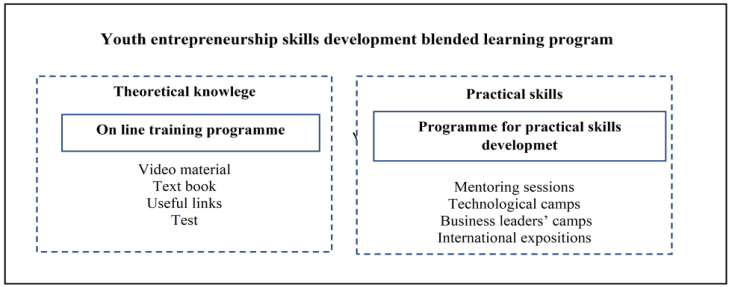
CASE STUDY Case study is based on the project “Business can be simple”, implemented in July 2020 - December 2021 in the Lithuanian–Polish border region. The pro- ject idea is based on the application of blended learning approach to develop youth entrepreneurship skills. During the project, a network of Lithuanian– Polish border mentors was established, mentoring tools and business cases developed, trainings for mentors provided, an online entrepreneurship trai- ning program developed, creative workshops of new product development and a prototyping camp organized. Student teams presented their products at international exhibitions and participated in a camp of business leaders, during which they acquired entrepreneurial skills while playing a business game. Online training material such as a textbook, videos, tests, and cases were combined with face-to-face classes and meetings with teachers and business mentors. The structure of the entrepreneurship skills development program is presented in Figure 1.
More than 200 secondary school students from Lithuanian and Poland border regions participated in the project, and they were taught using the blended learning approach by 9 mentors. At the beginning of the project five
Blended Learning Approach to Youth Entrepreneurship Skills Development 155
Figure 1: The structure of entrepreneurship skills development program (Source: own elaboration).
teams were assigned to each mentor (45 teams in total). However, only 30 teams reached the end of the project and developed a new product prototype or idea. At the end of the project, lessons learned were analyzed. In order to investigate the preconditions for youth entrepreneurship training using blen- ded learning approach, an expert evaluation was conducted. Project business mentors from Lithuania (n = 6) and Poland (n = 3) were chosen as experts as key entrepreneurship educators. For the purposes of the study, a question- naire was developed. The research was carried out in November 2021. Data collection was conducted online, using platform apklausos.lt. Seven complete responses were used for the analysis. For experts’ evaluation, ten statements representing mentoring experience in the blended youth entrepreneurship skills development program were provided. The reliability of the question- naire was evaluated using its internal consistency of the questionnaire items estimating the Cronbach’s alpha value. The calculated Cronbach’s alpha for statements was 0.884, which is adequate for social science research and indi- cates the internal consistency of the questionnaire. The Kendal concordance test (parameter W) was processed to assess the homogeneity in experts’ opini- ons regarding the statements. Calculated Kendall’s coefficient of concordance W was quite low (0.282) yet significant with the probability of 99 percent (p (sig.) is 0.038), which is sufficient, and it means that experts concede with the statements, although the agreement parameter is low. The results let us reveal the most important preconditions for youth entrepreneurship training using blended learning approach (Table 2).
The results of the study revealed that mentoring through blended lear- ning approach was helpful, it allowed to develop new innovative products and solve problems. At the same time, the study revealed the particular importance of time planning, communication, and motivation.
Significant correlations were found between statement 8 and statements 1, 2, 3, and 4; between statement 5 and statements 2, 3, and 4. Significant correlations between precondition statements are presented in Table 3.
Moreover, the reasons why some of the teams dropped out during the pro- ject were analyzed. The experts mentioned the following: lack of time, lack
156 ˇCiutien˙e and ˇCiarnien˙e
Table 2. Preconditions for youth entrepreneurship training using blended learning approach (Source: own elaboration).
Table available in the original PDF paper.
Precondition statement Mean rank
6.36
1. Mentoring has been helpful in product development. 6.93 2. As a mentor, you have helped to solve any problems that arose. 6.36 3. As a mentor, you had enough knowledge to develop the products.
6.36
4. You, as a mentor, had enough time to achieve the result during the project.
4.21
5. The chosen communication platform Zoom was easy to use. 5.71 6. Mentoring activities went smoothly. 5.64 7. As a mentor, you had enough practical mentoring experience. 4.93 8. The time for mentoring was convenient. 4.93 9. Communication between mentors and student teams went smoothly.
3.57
10. The teams you mentored were motivated to get involved in product development activities.
Table 3. Significant correlations between precondition statements (Source: own elaboration).
Table available in the original PDF paper.
St. 1 St. 2 St. 3 St. 4 St. 8 St. 5 St. 2 Pearson correlation 0.645 1 1.000** 1.000** .806* .930** Sig. (2-tailed) 0.117 0.000 0.000 0.029 0.002 St. 3 Pearson correlation 0.645 1.000** 1 1.000** .806* .930** Sig. (2-tailed) 0.117 0.000 0.000 0.029 0.002 St. 4 Pearson correlation 0.645 1.000** 1.000** 1 .806* .930** Sig. (2-tailed) 0.117 0.000 0.000 0.029 0.002 St. 8 Pearson correlation .801* .806* .806* .806* 1 0.615 Sig. (2-tailed) 0.031 0.029 0.029 0.029 0.141 St. 5 Pearson correlation 0.320 .930** .930** .930** 0.615 1 Sig. (2-tailed) 0.484 0.002 0.002 0.002 0.141
of motivation, peculiarities of distance learning, and natural breakout due to internal team disagreements. The experts were also asked to identify the main challenges they faced in mentoring project teams in a blended way. The following challenges were identified:
Online mentoring is a challenge to motivate a team if it has doubts.
Communication with all teams at the same time during joint meetings was complicated as the age and experience of the teams varied greatly.
Some teams wanted to produce a product quickly without regard to its quality; they had to be convinced that quality is especially important for the final result.
Idea generation through distance learning, idea design development, pro- totyping (schools and laboratory were closed), testing to potential users (quarantine time).
Loss of interest and lack of students’ motivation.
Blended Learning Approach to Youth Entrepreneurship Skills Development 157
Some team members were too busy with school-learning.
Some team members did not want to be in business.
Finding business companies interested in cooperation.
CONCLUSION
Youth entrepreneurship education plays a key role in sustainable growth of the country. The blended learning approach fulfils youth learning expecta- tions to balance face-to-face sessions, online modes, and autonomous study. The case of Lithuania–Poland cross-border cooperation project “Business can be simple” disclosed the main preconditions for blended learning in deve- loping youth entrepreneurship skills. Preconditions were identified from the perspective of mentors who contributed to students’ entrepreneurship educa- tion. Empirical research revealed that blended learning mentoring was helpful as it led to the development of new innovative products and solution of pro- blems. To ensure a smooth blended learning process, emphasis should be placed on time planning, mutual communication, motivation of students, and experience and competence of educators.
ACKNOWLEDGMENT
The study is based on the project “Business can be simple” (project No. LT-PL-4R-338) funded by 2014-2020 Interreg V-A Lithuania-Poland Coo- peration Programme.
REFERENCES
Arifin, M. (2020). The Effect of Blended Learning Model with Moodle on the Students’ Writing Achievement. IJEMS: Indonesian Journal of Education and Math- ematical Science. http://jurnal.umsu.ac.id/index.php/IJEMS/article/view/4639/pd f_12 [accessed Jan 05 2022]. Blended learning - the best of both worlds? Advantages and disadvanta- ges. https://www.easy-lms.com/knowledge-center/lms-knowledge-center/blended -learning-advantages/item10386 [accessed Jan 05 2022]. Bonk, C. J., Graham, C. R. (Eds.) (2006). Handbook of blended learning: global
perspectives, local designs. San Francisco, CA: Pfeiffer Publishing. Dietrich, N., Kentheswaran, K., Ahmadi, A., Teychené, J., Bessière, Y., Alfenore, S., Laborie, S., Bastoul, D., Loubière, K., Guigui, C., Sperandio, M., Barna, L., Paul, E., Cabassud, C., Liné, A., Hébrard, G. (2020). Attempts, successes, and failures of distance learning in the time of COVID-19. Journal of Chemical Education, 97(9), pp. 2448–2457. Dziuban, C., Graham, C.R., Moskal, P.D., Norberg A., Sicilia, N. (2018). Blen-
ded learning: the new normal and emerging technologies. International Journal of Education Technology in Higher Education, 15, 3. EntreComp: The European Entrepreneurship Competence Framework (2018). https: //ec.europa.eu/social/main.jsp?catId=1317&langId=en [accessed Jan 10 2022]. Garrison, D. R., Kanuka H. (2004). Blended learning: Uncovering its transfor-
mative potential in higher education. The Internet and Higher Education, 7(2), pp. 95–105.
158 ˇCiutien˙e and ˇCiarnien˙e
Graham, C. R. (2006). Blended learning systems: Definitions, current trends and future directions. In C. J. Bonk, & C. R. Graham (Eds.), The Handbook of blended learning: Global perspectives, local designs (pp. 3–21). San Francisco: Pfeiffer. Graham, C. R. (2013). Emerging practice and research in blended learning. In M.
G. Moore (Ed.), Handbook of distance education, (3rd ed., pp. 333–350). New York: Routledge. Güzer, B., Caner, H. (2014). The Past, Present and Future of Blended Learning: An in Depth Analysis of Literature. Procedia - Social and Behavioral Sciences, pp. 4596 – 4603. Iwu, C.G., Opute, P. A., Nchuc, R., Eresia-Eke, C., Tengeh, R.K., Jaiyeoba, O., Aliyu,
O. A. (2021). Entrepreneurship education, curriculum and lecturer-competency as antecedents of student entrepreneurial intention. The International Journal of Management Education, 19(1), 100295. Jost, N.S., Jossen, S.L., Rothen, N., Martarelli C. S. (2021). The advantage of distributed practice in a blended learning setting. Education and Information Technologies, 26, pp. 3097–3113. Kaur, M. (2013). Blended learning - its challenges and future. Procedia - Social and
Behavioral Sciences, Volume 93, 21, pp. 612–617. Kynd, E., Baert, H. (2015). Entrepreneurial competencies: Assessment and predictive value for entrepreneurship. Journal of Vocational Behavior, Volume 90, pp. 13–25. Mokaya, S.O., Namusonge, M., Sikalieh, D. (2012). The concept of entrepreneur-
ship; in pursuit of a universally acceptable definition. International Journal of Arts and Commerce, 1 (6), pp. 128–135. Nabi, G., Walmsley, A., Akhtar, I. (2021). Mentoring functions and entrepreneur development in the early years of university. Studies in Higher Education, 46(6), pp. 1159–1174. Nicolaides, A. (2011). Entrepreneurship: The role of higher education in South
Africa. Educational Research, 2 (4), pp. 1043–1050. Norberg, A., Dziuban, C. D., Moskal, P. D. (2011). A time-based blended learning model. On the Horizon, 19(3), pp. 207–216. OECD/European Commission (2020). “Policy brief on recent developments in
youth entrepreneurship”, OECD SME and Entrepreneurship Papers, 19, OECD Publishing, Paris, https://doi.org/10.1787/5f5c9b4e-en. Okaz, A. A. (2015). Integrating Blended Learning in Higher Education. Procedia - Social and Behavioral Sciences, Volume 186, pp. 600–603. Piperopoulos, P., Dimov, D. (2014). Burst bubbles or build steam entrepreneurship
education, entrepreneurial self-efficacy and entrepreneurial intentions. J. Small Bus. Manag, 53, pp. 970–985. Robles, L., Zárraga-Rodríguez, M. (2015). Key Competencies for Entrepreneurship.
Procedia Economics and Finance, 23, pp. 828 – 832. Sirelkhatim, F., Gangi, Y. (2015). Entrepreneurship education: a systematic literature review of curricula contents and teaching methods. Cogent Bus. Manag, 2, pp. 1–11. Statnick˙e, G., Savaneviciene, A., Sakys, I. (2019). Career engagement of different
generations: a case study in the information and communication technology (ICT) sector in Lithuania. New trends and issues proceedings on humanities and social sciences. Selected papers of 8th World conference on business, economics and management (BEM-2019), Vol. 6, iss. 3, p. 37–49. St-Jean, E., Audet, J. (2013). The effect of mentor intervention style in novice entrepreneur mentoring relationships. Mentoring & Tutoring Partnership in Learning, 21:1, pp. 96–119.
Blended Learning Approach to Youth Entrepreneurship Skills Development 159
Szadziewska, A., Kujawski, J. (2017). Advantages and disadvantages of the blended learning method used in the educational process at the faculty of management at the University of Gdansk, in the opinion of undergraduate students. 10th annual International Conference of Education, Research and Innovation, ICERI2017 Proceedings, pp. 3938-3946. Wang, C., Mundorf, N., Salzarulo-McGuigan, A. (2021). Entrepreneurship edu-
cation enhances entrepreneurial creativity: The mediating role of entrepreneu- rial inspiration. The International Journal of Management education, 100570, https://doi.org/10.1016/j.ijme.2021.100570. Wei, X., Liu, X., Sha, J. (2019). How does the entrepreneurship education influence the students’ innovation? Testing on the multiple mediation model. Front. Psychol. 10:1557. Winstead, S. (2016). 6 disadvantages of blended learning you have to cope
with. https://myelearningworld.com/6-disadvantages-of-blended-learning/ [acces- sed Jan 05 2022]. Yang, Q., Chen, J., Yang, L., Liu, Z. (2021). How to develop entrepreneurial talent more effectively? A comparison of different entrepreneurship educational methods. Front. Psychol. 12:644113.
LISTED IN THE AHFE DIGITAL BOOKSTORE CATALOGUE
Explore the complete digital volume
Training, Education, and Learning Sciences
Read this individual research paper free through the original publisher, or explore the full digital proceedings book.
ISBN 978-1-958651-35-3
Explore this ISBN in the AHFE Bookstore ↗Listed in the July 2026 bookstore catalogue; search by ISBN to confirm current availability · Digital book purchase optional