Tomasz K. Bednarczyk (2020). Assigning Technology Resources to Innovation Projects in the Aspect of Games Theory – (Managerial Implications of G. Hardin’s “The Tragedy of the Commons”). In: Advances in Science, Technology, Higher Education and Society in the Conceptual Age: STHESCA. AHFE Open Access, vol. 10. https://doi.org/10.54941/ahfe100399
Publisher statistics will load when you open Metrics.
AHFE OPEN ACCESS OPEN ACCESS CONFERENCE PROCEEDINGS PAPER
Assigning Technology Resources to Innovation Projects in the Aspect of Games Theory – (Managerial Implications of G. Hardin’s “The Tragedy of the Commons”)
Many of contemporary businesses depend on the projects and project management. Additionally, most of the companies understand the value of innovations and technological developments. Consequently, the topic of managing the technology projects gets special attention of managers. One of the most interesting areas in the technology projects’ management is resourcing (especially in the context of allocating technology human resources to the tasks).The intent of this article is to understand how to utilize limited resources in most efficient way or to reach maximum gain (payoff). In the article, some assumptions reflecting real life situations were taken into consideration. This should bring the benefit of “practical” implications, that contemporary managers may be interested in.
Looking at the share of the projects from historical perspective, one can realize it has significantly increased since 1800s6,7 (Fig. 1.) and contemporary companies tend to develop into project management type of organizations (Shenhar and Dvir mention that the importance and number of projects go up in the times of so-called “information 1 The article was also published by Warsaw School of Economics as one of the papers related to the conference: „The concept of sustainability as a way to manage a crisis”; the title of published paper: „Poszukiwanie metody optymalnego przypisywania zasobów ludzkich do projektów BiR – zastosowanie wybranych aspektów teorii gier oraz implikacje teorii G. Hardina: The Tragedy of the Commons dla menedżerów działów badań i rozwoju”, authors: Tomasz Bednarczyk, Jerzy Lewandowski 2 Shenhar A.J., Dvir D.: Reinventing Project Management: The Diamond Approach To Successful Growth And Innovation Harvard Business School Press, 2007 3 Lewandowski J.; Bednarczyk T.: „Proces innowacji w przedsiębiorstwie, w warunkach wewnętrznego i zewnętrznego środowiska” (Studia Ekonomiczne Regionu Łódzkiego, nr 8, Wybrane aspekty zarządzania nowoczesną organizacją), Wydawnictwo Oddziału Łódzkiego PTE, 2012 4 For the purpose of this article, the term “technology projects” cover: innovations, inventions, developments, technological improvements. 5 In some publications related to technology projects’ management, the resources are treated just as given –which is not necessarily true. 6 Some of the reasons explaining this trend are e.g.: globalization, information technology, internet revolution. [Shenhar A.J., Dvir D.: Reinventing Project Management: The Diamond Approach To Successful Growth And Innovation Harvard Business School Press, 2007, p.4] 7 Ibid. Technology, Higher Education and Society (2020)
society”8). It is also important to mention that a lot of enterprises pay particular attention to the value that technology projects9 can potentially bring to the organization. Very often firms perceive innovations as a key success factor for their growth10 and as a way to get competitive advantage on the market. This is somehow confirmed by increasing number of patent applications – Fig. 2., Fig. 3.
Fig. 1. “The increasing share of projects”
[Source: Shenhar A.J., Dvir D.: Reinventing Project Management: The Diamond Approach To Successful Growth And Innovation Harvard Business School Press, 2007, p.4]
Fig. 2. “Trend in patent11 applications and patents granted worldwide12” [Source: based on WIPO13 Statistics Database, October 2012;
8 Ibid. 9 For the purpose of this article, the term “technology projects” covers: innovations, inventions, developments, technological improvements. 10 See: Appendix 1. p. 1. 11 The charts refer “patents” to patents for invention [Source: WIPO Statistics Database, October 2012] 12 Note: “World totals are WIPO estimates covering around 115 patent offices. These estimates include patent grants based on direct applications and PCT national phase entry data.” [Source: WIPO Statistics Database, October 2012] 13 World Intellectual Property Organization (WIPO) [http://www.wipo.int/ipstats/en/] Technology, Higher Education and Society (2020)
WIPO Economics & Statistics Series: World Intellectual Property Indicators – 2012 Edition, p. 41-47]
Fig. 3. "Trend in patent14 applications for the top five offices”
[Source: based on WIPO15 Statistics Database, October 2012; WIPO Economics & Statistics Series: World Intellectual Property Indicators – 2012 Edition, p. 41-47]
Knowing that resources are limited, it is important to understand how to allocate them most efficiently. The article of G. Hardin’s (related to the human being behavior to maximize his gain by using as many of available resources as possible – believing the resources are free to everyone, not taking into consideration resources’ limitation, not looking at overall group’s gain/result – which eventually leads to the ruin of entire society) 16 was used as a starting point for further analysis and interpretations.
GAME DESCRIPTION The company “A” – as many of contemporary corporations – sees its growth by delivering new, innovative products to the market fast and efficiently. Modus operandi of the enterprise “A” can be described as: product is a project and it needs to be managed.
The firm consists of various departments (Fig. 4.), and has diversified objectives (although deriving from general strategy: generate and maximize profit) e.g.:
Commercial needs to maximize revenue (through e.g. new products),
Line Management needs to make sure the products generate max profits,
Technology needs to deliver on time, according to Voice of Customer (commercials),
Manufacturing needs to go low in cost.
The game can be described as follows:
14 The charts refer “patents” to patents for invention [Source: WIPO Statistics Database, October 2012] 15 World Intellectual Property Organization (WIPO) [http://www.wipo.int/ipstats/en/] 16 Ibid. p. 2. Technology, Higher Education and Society (2020)
Players (from Line Management department) in co-operation with Sales, want to get realized as many technology projects as possible,
Management takes a decision (regarding allocation of resources to realize Technology project promoted by Line Manager) which can be described in extensive-form17 game (Fig. 5.)18,
Payoffs19 are correlated with the risk of project20: o Safe investment brings payoff: (a),
o High risk investment (Technology resources granted to the complex, innovative project) can create bigger or smaller payoff in reference to (a), which can be described (ā > a > a > 0)
Fig. 4. Company “A” – simplified organizational chart
Due to the fact that the game is game of imperfect information, the solution cannot be found using backward induction21. The game has three Nash equilibriums in pure strategy games:
(a, 0) – Management goes safe and approves the project (player present the critical view)
(a, 0) – Management goes safe and rejects the project (player present the critical view)
(ā, ē) – Management decides to invest in more risky project, hoping for higher payoff (player presents more optimistic view) Management can take a decision, to invest in high risk project when this project is presented more optimistically by
17 See: Appendix 1. p. 3. 18 Karbowski A.: Luka zasobowa w procesie tworzenia innowacji, Organizacja i Kierowanie (Organization and Management), 2(140), Committee on Organizational and Managerial Sciences, Polish Academy of Sciences, 2010, p. 75-85 19 To describe payoffs, following symbols have been used: ā, a, a, 0 20 Karbowski A.: Luka zasobowa w procesie tworzenia innowacji, Organizacja i Kierowanie (Organization and Management), 2(140), Committee on Organizational and Managerial Sciences, Polish Academy of Sciences, 2010, p. 75-85 21 Karbowski A.: Luka zasobowa w procesie tworzenia innowacji, Organizacja i Kierowanie (Organization and Management), 2(140), Committee on Organizational and Managerial Sciences, Polish Academy of Sciences, 2010, p. 75-85 Technology, Higher Education and Society (2020) the player (Management hopes to get higher gain)22. Consequently, this behavior can conclude in resources gap23 – which is the case for further consideration in this article.
Fig. 5.: Extensive-form game for promoting Technology project
[Source: Karbowski A.: Luka zasobowa w procesie tworzenia innowacji, Organizacja i Kierowanie (Organization and Management), 2(140), Committee on Organizational and Managerial Sciences, Polish
Academy of Sciences, 2010, p. 75-85]
ASSUMPTIONS FOR THE GAME ANALYSIS Problem of resource limitations have been already elaborated by G. Hardin in his famous essay: The Tragedy of the Commons. Hardin mentions that people tend to maximize their own gains (payoffs) which can lead to resource limitation or even degradation.
M. Malawski, A. Wieczorek and H. Sosnowska turn Hardin’s essay into following example24:
there are 5 herdsmen, each of them has 2 cows and has 3 potential strategies to follow: o strategy “0” – a herdsman does not add any animal to the pasture;
o strategy “1” – a herdsman adds 1 cow to the pasture; o strategy “2” – a herdsman adds 2 cows to the pasture;
pasture is open to all herdsmen but it has and limited efficiency – let’s say it is: 1225; the efficiency of the pasture decreases when the number of cows goes up (additional animal causes overgrazing – therefore 22 Ibid. 23 Ibid. 24 Malawski M., Wieczorek A., Sosnowska H.: Konkurencja i kooperacja. Teoria gier w ekonomii i naukach społecznych, PWN, Warszawa 2004, p.58-60 25 Assumed efficiency of pasture is 12-Q; Q – total number of cows added to the pasture which indicates that the unit of measure for efficiency is [cows] Technology, Higher Education and Society (2020) degradation – of the pasture which is eventually affecting all the herdsmen)26;
due to the fact that herdsman gets proceeds by each additional animal, he tends to “add another animal to his herd”27 – he is maximizing his individual gain28;
the gain for a herdsman can be calculated as follows: “if first herdsman adds q1 cows to the pasture, the second adds q2 cows to the pasture etc. then the gain for herdsman i29 is qi ∙ [12 - (q1+ q2 + q3 + q4 + q5)]” (Table 1.)30; consequently, the gain (payoff) of a herdsman depends on the decisions of others 31; the gain of herdsman also depends on the available resources (Table 2.).
One can notice that if individuals (players / herdsmen) are treated fairly (each of them has the same amount of cattle at the posture) and they tend to maximize the number of cows (strategy 2), the gain per capita is at the level of 4 units – the payoff vector: (4; 4; 4; 4; 4)32. However, if the herdsmen would follow strategy 1, their individual gain would be 7 – the payoff vector: (7; 7; 7; 7; 7)33 which is optimal in Pareto sense.
The interesting thing to see is what happens if the number of resources are significantly increased (for instance from 12 to 21):
Strategy 2 from Table 2. is more beneficial than Strategy 2 in Table 1. [vector (22; 22; 22; 22; 22) is more optimal than (4; 4; 4; 4; 4)],
Strategy 2 from Table 2. is more beneficial than Strategy 1 in Table 2. [vector (22; 22; 22; 22; 22) is more optimal than (16; 16; 16; 16; 16)] – which is opposite situation to Table 1.: Strategy 2 from Table 1. is less beneficial than Strategy 1 in Table 1. [vector (4; 4; 4; 4; 4) is less optimal than (7; 7; 7; 7; 7)].
Table. 1. Shaded table: of gain (payoff) calculated in the way34: qi ∙ [12 - (q1+ q2 + q3 + q4 + q5)], limited resources: 12, number of players: 5; the rest of the table shows the gain for extended number of projects, from 2 to 10.
[Malawski M., Wieczorek A., Sosnowska H.: Konkurencja i kooperacja. Teoria gier w ekonomii i naukach społecznych, PWN, Warszawa 2004, p.58-60] 26 Hardin G.: The Tragedy of the Commons, Science VOL. 162, 13 December 1968; Department of Sustainability and Environment Forests (Recreation): Regulations 2010. Regulatory Impact Statement September 2009, Victorian Government Department of Sustainability and Environment, Melbourne, October 2009, p.18 27 Hardin G.: The Tragedy of the Commons, Science VOL. 162, 13 December 1968 28 “The gain / payoff is understood as a sum of benefits compared to the situation when nobody is utilizing the pasture” [Malawski M., Wieczorek A., Sosnowska H.: Konkurencja i kooperacja. Teoria gier w ekonomii i naukach społecznych, PWN, Warszawa 2004, p.58-60] 29 (i=1, 2, 3, 4, 5) 30 Malawski M., Wieczorek A., Sosnowska H.: Konkurencja i kooperacja. Teoria gier w ekonomii i naukach społecznych, PWN, Warszawa 2004, p.58-60 31 Ibid. 32 Ibid. 33 Ibid. 34 (i=1, 2, 3, 4, 5) Technology, Higher Education and Society (2020)
[Source: based on Malawski M., Wieczorek A., Sosnowska H.: Konkurencja i kooperacja. Teoria gier w ekonomii i naukach
społecznych, PWN, Warszawa 2004, p.58-60]
Table. 2. Shaded table: of gain (payoff) calculated in the way35: qi ∙ [21 - (q1+ q2 + q3 + q4 + q5)], limited resources: 21, number of players: 5; the rest of the table shows the gain for extended number of projects, from 2 to 10.
[Source: gain (payoff) formula based on M. Malawski, A. Wieczorek, H. Sosnowska]
This is also resulting from the gain (payoff) formula which can be described as inverted-U shaped curve (e.g.: parabolic curve or bell curve). The inverted-U shaped curve shows that after exceeding certain amount of workload (complex tasks, which are usual for Technology departments), the performance can decrease – Fig. 6., Fig. 7.– in relation to Hardin’s theory it can be perceived as “degrading” the resources.
Equation reproduced from the original PDF.
Fig. 6. The summary of approaches to performance (productivity) vs. workload (job pressure, stress) [Source: based on the works of Yerkes R.M., Dodson J.D., Diamond D.M. and subject related websites36]
Fig. 7. “Effect of fatigue on probability of error free” [Source: http://tools.systemdynamics.org/sdm/Handbook-Model-V.html#a30]
Summarizing Hardin’s essay:
36 List of sources:
Yerkes R.M., Dodson J.D.: The relation of strength of stimulus to rapidity of habit-formation. Journal of Comparative Neurology and Psychology, 1908; 18(5):459–482;
Diamond D.M., et al. (2007). The Temporal Dynamics Model of Emotional Memory Processing: A Synthesis on the Neurobiological Basis of Stress-Induced Amnesia, Flashbulb and Traumatic Memories, and the Yerkes-Dodson Law, Neural Plasticity: 33. doi:10.1155/2007/60803 Technology, Higher Education and Society (2020)
“The gain is always greater to each herder than the individual share of the distributed cost”37,38 which leads to the resourcing problem,
“What leads to the tragedy39 in Hardin’s story is not simply that the land is held in common, but that it is subject to an open access regime in which each individual herdsman is free to add as many cows as he or she chooses”40.
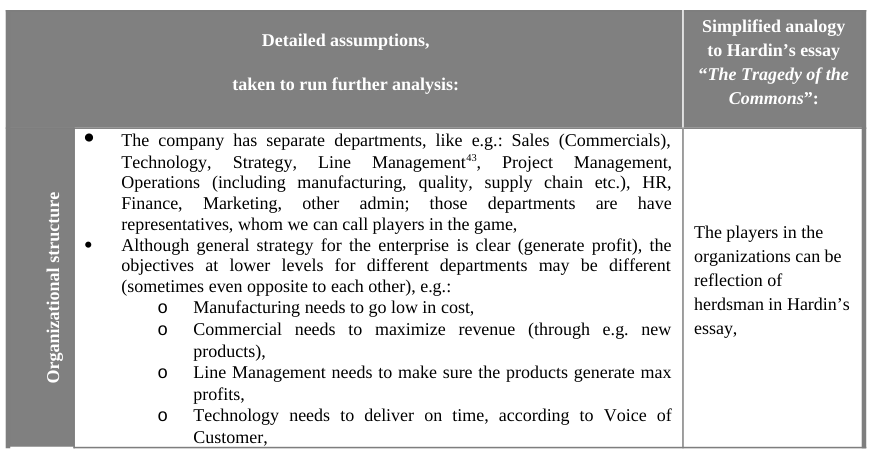
Despite of criticism of Hardin’s essay (App. 2.), it is still possible to find the analogies between Hardin’s theory and today’s resource management issues (Table 3., Table 4.).
37 Department of Sustainability and Environment Forests (Recreation): Regulations 2010. Regulatory Impact Statement September 2009, Victorian Government Department of Sustainability and Environment, Melbourne, October 2009, p.18 38 See: Appendix 1. p. 4. 39 See: Appendix 1. p. 5. 40 Bodansky D.: The Art and Craft of International Environmental Law, Harvard University Press, 2010, p. 51-52 Technology, Higher Education and Society (2020)
Table 3. : Analogies between Hardin’s theory and today’s resource management issues: General assumption for the analysis
General assumptions:
The company is a corporation type of company
The tasks/projects are: “technology projects”: innovations, inventions, developments, technological improvements, product upgrades or customizations; the tasks need to be fully realized (there is no possibility to realize e.g. 75% of task at the moment)
Technology department can assign resources only to the projects which are successfully promoted
The promoters are players in the organizational game (they compete between each other and try to maximize their gain)
The game is game of imperfect information
Players take decisions with certainty; player knows how he will play the game therefore his strategy is pure strategy
Players want to maximize their gain (payoff) , through realizing as many tasks as possible; the players do not necessarily take into consideration the “overall” payoff for the company
Players can perceive they can all access resources and will be treated fairly
Table 4. : Analogies between Hardin’s theory and today’s resource management issues: Detailed assumptions, taken to run further analysis
Table available in the original PDF paper.
41 Bodansky D.: The Art and Craft of International Environmental Law, Harvard University Press, 2010, p. 6. 42 Ibid. p. 7. 43 Ibid. p. 8. Technology, Higher Education and Society (2020)
FINDING OPTIMAL SOLUTIONS To get maximum payoff, one can try to look for most optimal point in the terms of:
number of resources that needs to be used (out of available 21),
number of projects (promoted by players),
number of players that could participate in the game (out of 10).
The task should be started with calculating payoff value e.g. with the same formula as previously 47: qi ∙ [21 - (q1+ q2 + … + q10)]. Then the table of results for single case – e.g.: 21 resources, 10 projects, 10 players – looks very similar 44 Hardin G.: The Tragedy of the Commons, Science VOL. 162, 13 December 1968; Department of Sustainability and Environment Forests (Recreation): Regulations 2010. Regulatory Impact Statement September 2009, Victorian Government Department of Sustainability and Environment, Melbourne, October 2009, p.18 45 Hardin G.: The Tragedy of the Commons, Science VOL. 162, 13 December 1968 46 “The gain / payoff is understood as a sum of benefits compared to the situation when nobody is utilizing the pasture” [Malawski M., Wieczorek A., Sosnowska H.: Konkurencja i kooperacja. Teoria gier w ekonomii i naukach społecznych, PWN, Warszawa 2004, p.58-60] 47 Number of players:10 (i=1, 2, …, 10); number of available resources: 21; number of strategies: 11 Technology, Higher Education and Society (2020) to Table. 2., but it has more columns. The single tables can be calculated for all cases (players from 2 to 10; with various resources utilization from 0 to 21 etc.).
However, it is possible to build one row for each single table/case respecting following rules: payoff value is taken for the number of projects48, where divisibility rule49 is met – Table 5. After calculating polynomial trend lines (Table 6.), and filling empty cells (Table 7.), it is possible to get simple visualization of optimal point of projects per player for maximum payoff – Fig. 8.
Table 5. Payoffs calculated for various number of players scenarios. The figures which are shown meet divisibility rule: (number of projects) needs get divided by (number of game players – 1); maximum values are highlighted; each player has the same amount of projects
Table available in the original PDF paper.
Table 6. Polynomial trend lines for various number of players scenarios.
Table available in the original PDF paper.
Table 7. Payoffs calculated using polynomial trend lines
Table available in the original PDF paper.
Analogically, it is possible to get a visualization of optimal number of players for maximum payoff – Fig. 9. Both charts (Fig. 8., Fig. 9.) indicate that combination of: 2 players, 10 projects under realization (2 players x 5 projects per player) brings highest payoff (55) in the terms of:
number of resources that needs to be used,
number of projects,
number of players that could participate in the game.
48 Remembering that same number of projects can be realized by each player 49 Condition that needs to be met is divisibility rule: (number of projects) needs get divided by (number of game players – 1) Technology, Higher Education and Society (2020)
Consolidated view (payoff; projects per player or resources; number of players) may be presented as 3D chart – Fig. 10. The chart shows the plane (surface) which represents different combinations of projects, players and provided payoffs. Manager can move on the plane to find out optimal situations (combinations) for the moment in time or in specific circumstances.
Fig. 8. Optimal number of projects per player to achieve maximum gain (payoff), at limited resources’ pool; each player has the same amount of projects
Fig. 9. Optimal number of players (with maximum amount of projects they can promote) to achieve highest payoff at limited resources' pool; each player has the same amount of projects
Technology, Higher Education and Society (2020)
Fig. 10. Three dimensional visualization of optimal number of players, with maximum amount of projects, with highest payoff at limited resources' pool; each player has the same amount of projects
CONCLUSIONS
Based on the calculations and analysis presented in the article, following conclusions can be formalized:
Not all project promoters should have the same number of projects under realization (it does not guarantee the most optimal payoff vector in Pareto sense);
Managers need to understand that the players may want to maximize the number of “their” projects realized by Technology team; however the sum of individual gains may not need to be as high as the overall payoff (if the number of projects per promoter is the same);
Not all projects should be fully supported (maybe supporting a project in 75% and spending rest of resources on something else, brings better overall payoff than supporting the same project in 100%);
Adding too many tasks to limited number of people can decrease their performance; on the other hand, increasing the number of resources for the same amount of projects, may not necessarily increase the payoff;
The company should have clear, respected and understood (by people) rules of choosing a project for further investment;
Managers should understand that the projects presented to them by promoters can be shown in over optimistic way – to convince the management to approve resources for project realization; this behavior can be part of organizational game; therefore clear rules of evaluating project should be set and respected; managers should also be able to be more critical and bring the presented “beautified picture” of the project to the actuals, facts and figures (putting adornments aside);
The breakdown of company strategy into the objectives which can be contradictive to each other (depending on the department) may not support team work and can be an inhibitor in regards to realization and maximization of overall benefit;
Managers should understand the portfolio of projects and took the decision with optimal payoff vector for overall company.
SUMMARY Technology, Higher Education and Society (2020)
The article relates to the topic of allocating limited resources to the technology projects in the most optimal way (under conditions of: environment where project promoters play organizational games, the information is often incomplete and resources can be degraded). From this perspective, the article shows innovations from projects and project management perspective, which can be specially interesting for Technology Managers, Project Managers or company Leadership.
In the article – for the purposes of the analysis – some assumptions reflecting real life situations were taken into consideration. This should bring the benefit of “practical” implications, that contemporary managers may be interested in.
LITERATURE Antoniou J., Pitsillides A.: Game Theory in Communication Networks: Cooperative Resolution of Interactive
Networking Scenarios, CRC Press, Taylor & Francis Goup, 2013 Axelrod R.M.: The Evolution of Cooperation. New York: Basic Books, 1984 Barrow C.J.: Environmental Management for Sustainable Development, Taylor & Francis e-Library, 2006 Bodansky D.: The Art and Craft of International Environmental Law, Harvard University Press, 2010 Ciriacy-Wantrup S.V., Bishop R.C., "Common Property" as a Concept in Natural Resources Policy. Nat. Res. J. 15, 1975 Dahlman C.J.: “The tragedy of the commons that wasn't: On technical solutions to the institutions game”,
Population and Environment, SPRING 1991, Volume 12, Issue 3 Department of Sustainability and Environment Forests (Recreation): Regulations 2010. Regulatory Impact Statement September 2009, Victorian Government Department of Sustainability and Environment, Melbourne, October 2009 Diamond D.M., et al. (2007). The Temporal Dynamics Model of Emotional Memory Processing: A Synthesis on the
Neurobiological Basis of Stress-Induced Amnesia, Flashbulb and Traumatic Memories, and the Yerkes-Dodson Law, Neural Plasticity: 33. doi:10.1155/2007/60803 Fudenberg D., Tirole J.: Game theory, MIT Press, 1991 Hardin G.: The Tragedy of the Commons, Science VOL. 162, 13 December 1968 Hardin G.: Whose Common Future? Special Issue. The Ecologist. 22(4), 1992 Karbowski A.: Luka zasobowa w procesie tworzenia innowacji, Organizacja i Kierowanie (Organization and Management), 2(140), Committee on Organizational and Managerial Sciences, Polish Academy of Sciences, 2010 Lewandowski J.; Bednarczyk T.: „Proces innowacji w przedsiębiorstwie, w warunkach wewnętrznego i
zewnętrznego środowiska” (Studia Ekonomiczne Regionu Łódzkiego, nr 8, Wybrane aspekty zarządzania nowoczesną organizacją), Wydawnictwo Oddziału Łódzkiego PTE, 2012 Malawski M., Wieczorek A., Sosnowska H.: Konkurencja i kooperacja. Teoria gier w ekonomii i naukach społecznych, PWN, Warszawa 2004 Pride W.M., Hughes R.J., Kapoor J.R.: Foundations of Business, South-Western College Pub; 2 edition, January 1,
2010 Savory A., Butterfield J.:. Holistic Management: A New Framework for Decision Making (2nd ed.). Washington, D.C.: Island Press, (01-12-1998) 1988) Shenhar A.J., Dvir D.: Reinventing Project Management: The Diamond Approach To Successful Growth And
Innovation Harvard Business School Press, 2007 Whitehead A. N.: Science and the Modern World, Mentor, New York, 1948 World Intellectual Property Organization: Economics & Statistics Series: World Intellectual Property Indicators – 2012 Edition Yerkes R.M., Dodson J.D.: The relation of strength of stimulus to rapidity of habit-formation. Journal of
Comparative Neurology and Psychology, 1908; 18(5)
WWW: Technology, Higher Education and Society (2020) http://epp.eurostat.ec.europa.eu/statistics_explained/index.php/Glossary:Full-time_equivalent http://epp.eurostat.ec.europa.eu/statistics_explained/index.php/Human_resources_in_ science_and_technology#Definitions] http://psychclassics.yorku.ca/Yerkes/Law http://tools.systemdynamics.org/sdm/Handbook-Model-V.html#a30
http://www.springerlink.com/content/wm68g57188j282u4/.15 http://www.wipo.int/ipstats/en/ World Intellectual Property Organization (WIPO)
APPENDIX 1.: Definitions and citations [1] Institute for Technology & Innovation Management, Hamburg University of Technology (TUHH): “Innovations are increasingly seen as a source of economic growth and as a useful instrument to face the competition brought about by globalization. Not surprisingly, innovations have acquired a key-role in the growth and competition strategies of many firms, as indeed of many countries and economic regions” [http://www.global-innovation.net/] [2] G. Hardin is using the example of herdsman who “will try to keep as many cattle as possible on the commons”: “Each man is locked into a system that compels him to increase his herd without limit — in a world that is limited. Ruin is the destination toward which all men rush, each pursuing his own best interest in a society that believes in the freedom of the commons. Freedom in a commons brings ruin to all”. [Hardin G.: The Tragedy of the Commons, Science VOL. 162, 13 December 1968] [3] Extensive form of game: “The extensive form can be used to formalize games with a time sequencing of moves. Sequential games are illustrated on trees. […] Tree (is) illustrating all possible actions that cab taken by all players and indicating all possible outcomes of the game. […] Each node represents a point of choice for a player. One player is specified at each node. The links between nodes represent a possible action for that player. The payoffs are specified at the bottom of the tree.” [Source: Antoniou J., Pitsillides A.: Game Theory in Communication Networks: Cooperative Resolution of Interactive Networking Scenarios, CRC Press, Taylor & Francis Goup, 2013, p.1-2]; additional information available at Fudenberg D., Tirole J.: Game theory, MIT Press, 1991, p. 67 [4] “Crucially, the division of these costs and benefits is unequal: the individual herder gains all of the advantage, but the disadvantage is shared among all herders using the pasture. Consequently, for an individual herder the rational course of action is to continue to add additional animals to their herd. However, since all herders reach the same rational conclusion, overgrazing and degradation of the pasture is its long-term outcome. Nonetheless, the rational response for an individual remains the same at every stage, since the gain is always greater to each herder than the individual share of the distributed cost” [Source: Department of Sustainability and Environment Forests (Recreation): Regulations 2010. Regulatory Impact Statement September 2009, Victorian Government Department of Sustainability and Environment, Melbourne, October 2009, p.18] [5] G. Hardin refers to the Whitehead’s meaning of “tragedy”: “The essence of dramatic tragedy is not unhappiness. It resides in the solemnity of the remorseless working of things. […] This inevitableness of destiny can only be illustrated in terms of human life by incidents which in fact involve unhappiness. For it is only by them that the futility of escape can be made evident in the drama.” [Source: Whitehead A. N.: Science and the Modern World, Mentor, New York, 1948, p. 17; Hardin G.: The Tragedy of the Commons, Science VOL. 162, 13 December 1968]
Technology, Higher Education and Society (2020)
[6] For the purpose of the article, Technology Human Resources (THR) can be defined as: employees of technology department having capabilities (like e.g.: designing, drafting, material knowledge etc.) allowing them to participate and deliver requested task, project or innovation. Eurostat provides following definition: “Human resources in science and technology (HRST) are defined as persons fulfilling at least one of the following two conditions (…):
human resources in terms of education: individuals who have successfully completed a university level education;
human resources in terms of occupation: individuals who are employed in a science and technology occupation as ‘Professionals’ or ‘Technicians and associate professionals’. The group that fulfills both of these criteria is called the HRST core”.
[Source: http://epp.eurostat.ec.europa.eu/statistics_explained/index.php/Human_resources_in_science_and_technolo gy#Definitions] [7] Full-time equivalent (FTE) definition by Eurostat: “A full-time equivalent, sometimes abbreviated as FTE, is a unit to measure employed persons (…) in a way that makes them comparable (…). The unit is obtained by comparing an employee's (…) average number of hours worked to the average number of hours of a full-time worker (…). A full-time person is therefore counted as one FTE, while a part-time worker (…) gets a score in proportion to the hours he or she works (…). For example, a part-time worker employed for 20 hours a week where full-time work consists of 40 hours, is counted as 0.5 FTE. The workforce of an enterprise, activity, or country etc. can then be added up and expressed as the number of full-time equivalents (…).”; [Source: http://epp.eurostat.ec.europa.eu/statistics_explained/index.php/Glossary:Full-time_equivalent] [8] “Line Management position – a part of the chain of command, it is a position in which a person makes decisions and gives orders to subordinates to achieve the goals of the organization” [Source: Pride W.M., Hughes R.J., Kapoor J.R.: Foundations of Business, South-Western College Pub; 2 edition, January 1, 2010, p. 190]
APPENDIX 2.: Examples of criticism on Hardin’s The Tragedy of the Commons essay [1] “Hardin's account of the breakdown of common grazing land was inaccurate, and that such commons were effectively managed to prevent overgrazing”. [Source: Dahlman C.J.: “The tragedy of the commons that wasn't: On technical solutions to the institutions game”, Population and Environment, SPRING 1991, Volume 12, Issue 3, p. 285-296; http://www.springerlink.com/content/wm68g57188j282u4/.15]; this critics also appears in other publications: “Hardin’s views have been widely attacked on several grounds, one being that he was describing more of open-access resource situation than most common property resource exploitation. Harrison (1993) noted that that seldom is use of commons a free-for-all; communities do generally have some controls and manage things”. [Source: Barrow C.J.: Environmental Management for Sustainable Development, Taylor & Francis e-Library, 2006, p.80, 155] [2] Criticism regarding distinguishing between “common property” and “open access resources”; “there was a fundamental mistake in the use of the term «commons»". [Source: Ciriacy-Wantrup S.V., Bishop R.C., "Common Property" as a Concept in Natural Resources Policy. Nat. Res. J. 15, 1975, p. 713-727; Garrett H.: Whose Common Future? Special Issue. The Ecologist. 22(4), 1992, p. 121-210] [3] Some of criticism relates to the Hardin’s statement that all individuals will always behave selfish, which is not necessarily true. And even it is true, then “individuals will often find ways to cooperate, because collective restraint serves both the collective and individual interests”. [Source: Axelrod R.M.: The Evolution of Cooperation. New York: Basic Books, 1984] [4] Savory, Voisin and others challenged Hardin’s understanding of pasture “performance” (“how grass grows under grazing conditions”) which is concluding in “tragedy”; additionally, there is also an aspect of ruined pastures due to “undergrazing” which may happen as often as “overgrazing” (especially in brittle climates) [Source: Savory A., Butterfield J.:. Holistic Management: A New Framework for Decision Making (2nd ed.). Washington, D.C.: Island Press, (01-12-1998) 1988)]
Technology, Higher Education and Society (2020)
LISTED IN THE AHFE DIGITAL BOOKSTORE CATALOGUE
Explore the complete digital volume
Advances in Science, Technology, Higher Education and Society in the Conceptual Age: STHESCA
Read this individual research paper free through the original publisher, or explore the full digital proceedings book.
ISBN 978-1-4951-2110-4
Explore this ISBN in the AHFE Bookstore ↗Listed in the July 2026 bookstore catalogue; search by ISBN to confirm current availability · Digital book purchase optional