Asmaa Alsereidi, Amal Almarzooqi, Saed Amer (2022). Toxic Workplace Environment. In: Social and Occupational Ergonomics. AHFE Open Access, vol. 65, pp. 181–189. https://doi.org/10.54941/ahfe1002674
This study aims to explore environmental toxicity in the workplace. The study highlights essential aspects of the toxicity environment, such as the definitions, causes, and impacts. The breach of contract in an organization is considered an important aspect that affects the employees’ mood and attitude in the workplace. The failure of duties and responsibilities of an organization may greatly significantly affect employees psychologically. The violation of company-employees agreement plays a significant role in changing employees' views and feelings. The research study has shown that the best intervention measures in the workplace help reduce adverse effects of thetoxic environment in an organization. The study suggests that intervention skills such as team- building, cultural diversification helps in reducing social behavior such as harassment, discrimination, and bullying, thus reducing toxicity harm. Several graphs have been used to explain the different types of stress triggered by various aspects such as working nature, workplace relationships, and threats. The organization's code of ethics helps guide the employees and management to make reasonable judgments, thus eliminating unethical issues. The study highlighted some crucial recommendations which when embraced, may enhance a suitable workplace, thus minimizing workplace toxicity.
A toxic workplace can be defined as a work environment that is considered to be harmful and malicious to the employees due to several stressors arising from organizational and social interactions stressors. It can also be defined as an environment that allows, supports, and ignores some abnormal behaviors and attitudes, including discrimination, harassment, and abuse, over a long period of time, and no meaningful and proactive steps were taken by the employer to address the issue and solve it, thus having negative effects on workers’ well-being and the overall performance of the company (Samma, 2021). The effects of workplace toxicity can be drastic for individuals and orga- nizations. For employees who suffer from it, they will experience some major symptoms in many aspects, including emotional where they experie- nce feelings of anger, fear, embarrassment, decreased self-esteem, and lack of motivation. Other symptom includes psychological ones such as burnout and depression. In addition to that, some behavioral and attitudinal symptoms may occur, such as reduced interaction with others, increased complaints and accidents, as well as having low job satisfaction (Anjum, 2018). Also, some cognitive symptoms have been addressed, including memory loss, and
the inability to focus and concentrate on job tasks. Employees who work in a toxic environment have poor physical health and experience pains, aches, and heart attacks. It has a great impact at the organizational level, resulting in high employee absenteeism, deficiency in productivity, higher turnover rates, as well as affording high expenses and losses along with an increase of the legal claims (Wang, 2020).
According to various studies, the sources of workplace toxicity are lea- dership, colleague and customer relations, organizational culture, and work process. They are those who abuse their power to control their employees. Toxic leaders are self-interested people who use their role in an ethical way by manipulating rules and deceiving their employees. They harm their employees in different ways, for example, they don’t demonstrate respect and treat ever- yone fairly. They also have a habit of blaming others for their shortcomings and show little or no appreciation for ideas and suggestions (Nurgul, Budak, 2021). The second source is colleagues and customers. Interpersonal conflicts with other co-workers and customers can lead to unpleasant reactions such as discomfort and disappointment. There are also other behaviors, including spreading rumors, gossiping, bullying, and harassment. Work process is the third source of a toxic workplace environment. Lack of structure of work process, rigid systems and schedules, workload, and insufficient oversight are examples of work process stressors. Organizational culture has a great impact on job quality as well, where it results from effects that accumulate over a long time with high frequency and intensity. Supporting harmful beh- avior while limiting remedial behavior are examples of toxic organizational culture (Kasalak, 2019).
Studies and Statistics Several recent studies have investigated workplace toxicity from diverse angles. In 2019, the Top Social Impact Education Pioneer released the results of a new study showing that toxic behavior, distrust, and resentment, as well as egregious behaviors like harassment, discrimination, and bullying, are all too widespread in today’s workplace. According to some of the survey’s signi- ficant findings, many companies are not proactively developing a healthy culture for their employees, which could be attributable in part to mana- gement’s lack of skills and leadership. While 66% of respondents feel their employers will listen to their concerns, only 20% believe they will be addres- sed. Additionally, 25% of respondents say they have disagreements with management, and 28% say they have unpleasant interactions with their supe- riors. According to the study, 54% of respondents, state that negative stress, as well as high rates of toxic workplace environments, are frequent in the workplace. Only 38% of respondents believe their company’s executives take proactive steps and strategies to build positive work cultures for employees. The surveyed employees with 53% state that their companies do nothing to change, and they don’t address workplace toxicity, and 48% say they don’t allocate funding to promote a healthy workplace.
Another study conducted by SHRM (Society for Human Resource Mana- gement) aimed to evaluate the high cost of a toxic workplace culture revealed
Toxic Workplace Environment 183
that 44% of employees are fulfilled at work, compared to 56 % who are dis- satisfied. Employees’ engagement plays a vital role in their job satisfaction as well as the overall productivity of the company. The results from Gallup show a 41% reduction in absenteeism and a 70% decrease in the number of employee safety incidents from engaged workers compared to those not engaged. Moreover, a 17% improvement in productivity is achieved when a person is engaged in the company. The findings revealed that managers are the primary reason for 58% of employees quitting their jobs due to workplace culture. Companies that care for their employees and engage them reported a 21% increase in profits, and a 20% rise in sales.
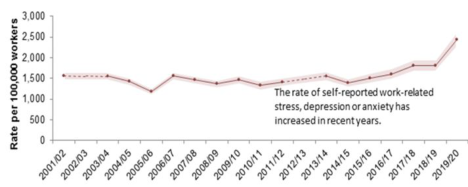
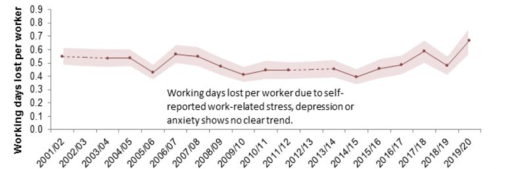
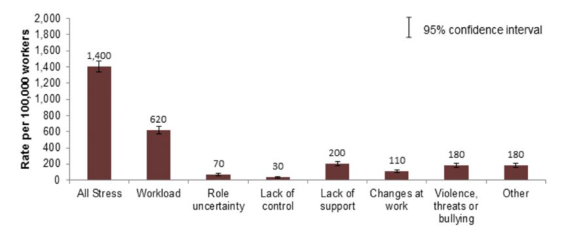
Figures 1 and 2 represent the effects of the toxic workplace environment, where the first one shows that the reported mental health illnesses related to work such as stress, anxiety, and depression have increased over the years, and the second represents the workday lost due to self-reported cases. We can see the massive impact on the individual and the company as well. One of the main aspects that the survey should include is investigating the main reasons behind the fact that the employees are suffering from mental illness. There are, several reasons, as indicated by Figure 3, all stress due to work, whether they are related to the nature of the work or the organizational stress, lack of support, violence, threats, or bullying, are considered to be the main reasons behind workplace toxicity. (Bryan, 2022)
Figure 1: Estimated prevalence rates of self-reported stress, depression or anxiety caused or made worse by work.Figure 2: Working days lost per worker due to self-reported work-related stress, depression or anxiety, for people working in the last 12 months.
A number of HSE standards were followed and referred to in order to arrive at the best optimum solution, which is the ISO 9000 family of
Figure 3: Estimated prevalence rates of self-reported stress, depression or anxiety in Great Britain, by how caused or made worse by work.
occupational health and safety standards, which provide the best guidelines for quality management. Moreover, ISO 26000 was followed and provides guidelines to individuals who understand that societal and environmental respect are crucial success factors in every entity. The last code of standard is ISO 45000, which provides guidelines on the safest practices to prevent injuries and illnesses.
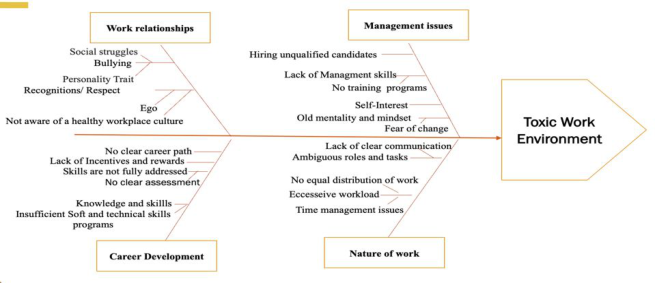
Fishbone Diagram Fishbone diagram analysis, which is also called (the Ishikawa Diagram), was used as a useful tool for finding the root causes of this problem. to determine the main root causes leading to the toxic workplace environment (Shinde, Ahirrao, and Prasad, 2018). The main causes have been captured in Figure 4 from previous research and from through interviewing with employees to get a sense of what might be the reasons for workplace toxicity.
Figure 4: Fishbone diagram of workplace toxicity.
METHOD
To test and evaluate the main factors and reasons leading to workplace toxicity, a survey was generated where different employees from different companies were targeted. The survey covered the main four areas of inve- stigation, which are: pressure from management, pressure from a different
Toxic Workplace Environment 185
individual inside the company including customers and work colleagues, workplace comfort and workload, career development, and job security. A total of 31 questions were asked and 51 responses were collected.
RESULTS AND DISCUSSION
The first area of the survey covered pressure from management. The results showed some main key findings and results. This section was introduced to give an idea and make a judgment on how leaders deal with and treat their employees and how that affects job quality. The critical results were identified. The results showed that 37.3% of respondents “Agree” that their managers always try to keep them updated with company’s rules, policies, employee’s rights and responsibilities, but the majority, 39.2%, “Disa- gree.”Recognition from management is considered one of the main things that employees need and look for, as it helps them see that their company values their contribution to the success of the team and helps them build security in their value, as well as motivates them to do their best. The results show that the majority of the responses, representing 44%, “Sometimes” receive recognition for the work they do, while 30% responded that receiving recognition is “Seldom” where they don’t get the recognition as they wish to push them to work harder, and about 10% responded that they “Never”. Managers who create an open and trusting environment can have a positive impact on their employees’ performance, as it can enhance work quality, col- laboration among the employees, efficiency, decrease the level of stress and improve the alignment of the organization. The results show that 43.1% have this environment “Some of the time”, and 27.5% chose “seldom.”
Another two important factors were studied in this category. The first one is whether management is responsive to employees’ ideas and suggestions and how they react to them. The biggest present, which is 56%, said that their management is “Sometimes” responsive to the ideas and suggestions they provide. 16% chose “Often”, 24% stated “Seldom”, and 4% responded with never. The other important factor is to check if employees are all being treated fairly and respectively. Results were as follows: 29.4% “Agree” that they are treated accordingly and fairly, whereas 49% “Disagree” The results show a red flag that should be taken into consideration. Studies show that when employees feel unfairly treated, they are less productive, less motivated, and they are more likely to engage in deceptive behaviors and show some violent attitudes that may affect themselves, their colleagues, and the company, such as hatred and anger (Syed, Naseer, and Bouckenooghe, 2021).
The second area of investigation is the pressure from different individuals inside the company, including customers and colleagues, which showed some significant results. The employees were asked if they treat each other in a respective manner. 13.7% answered that they “Occasionally” receive respect from colleagues and customers. Some regulations, rules, and recommenda- tions can be implemented to ensure that everyone receives the respect they deserve. Bullying in the workplace can be seen as verbal, physical, social, or psychological abuse by managers, co-workers, and customers, which leads to a high rate of turnover and stress. Bullying may cause mental problems
for the employees, such as frustration, depression, and anxiety. Furthermore, they can develop physical symptoms, including sleeping and appetite issues, and other psychosomatic symptoms such as headaches, family tension and stress, and low productivity (Hamre, 2021). The study shows that 11.8% of the employees face bullying “Occasionally”and 7.8% select “Always”. These two percentages can’t be neglected and have to be addressed and solved since employees are not supposed to face any bullying experience from anyone in the workplace. Some of the bullying experiences that employees suffered from the most in the study were verbal bullying, management underestimation, trust issues, negligence, and unfairness.
The third area was workplace comfort and workload. There were three main major points that were observed. When employees were asked whe- ther they experience an excessive workload, 27.5% stated that they “Often” suffer from an excessive workload and 56.9% answered “Sometimes”. The statistics also revealed that 7.8% stay “Often” for overtime and 47.1% do stay for “Sometimes” to finish the assigned tasks causing the excessive wor- kload. Further investigation was made to check if they got paid for staying overtime. 58.8%, representing the heist percentage, stated they “never” get paid and 19.6% said they “Rarely” do.
The fourth area of investigation into the main factors of workplace toxi- city is workplace comfort and career development. It is important to have a career that helps employees develop the needed soft and technical skills. When employees were asked if their jobs constantly helped them develop their skills and knowledge, 41.2% chose “Occasionally”, 13.7% answered “Rarely” and 7.8% chose “Never” The data shows that companies don’t invest in developing the skills of their employees. A clear path for career deve- lopment is an essential milestone in the employees’ job journey. Having it can lead them to devote their full potential toward their success and the success of the company, and they will be able to build a healthy workplace environment. When they were asked whether they have this clear career path, 56.9% answ- ered with “Less than I would like”. 29.4% chose “About Right.” That is also considered one of the leading factors causing toxicity. It is very important for employees to feel safe and secure at work, and companies should be aware of the fact that providing job security will improve the company’s bottom line and increase employee satisfaction. Employees were asked if they believed their company could lay them off and dispense their services at any time. The results were shocking, 52.9% answered “Yes” and 47.1% said “No”. The huge percentage indicates that most of them don’t feel secure in their jobs. In addition to that, having financial security after retirement is very impor- tant when employees are asked 51% of them state that they don’t have the financial support that would help them after retirement.
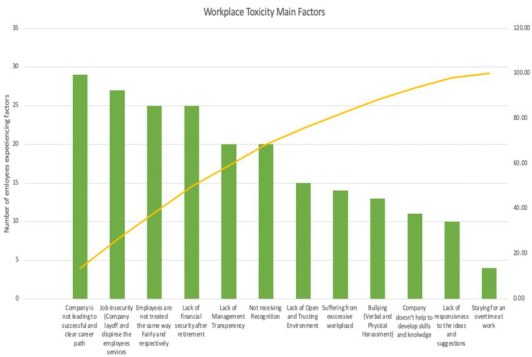
After collecting the data and analyzing the results of the most critical areas affecting workplace toxicity, a Pareto Chart was introduced, which indica- tes the frequency of workplace toxicity experienced among the employees, as well as its cumulative impact. It is a very important tool to observe the greatest overall improvement and impacts. Using it, we can solve 80% of the problems by only handling and tackling 20% of the overall problems, where we can use time, money, and effort to solve or at least mitigate the harmful
Toxic Workplace Environment 187
Figure 5: Main factors leading to workplace toxicity.
effects of them, therefore reducing the severity of the problem. Figure 5 shows the Pareto chart generated for this purpose.
It can be concluded that the main reasons for workplace toxicity from the study are that the company is not leading to a successful career path with 79%, job insecurity, laying off, and service dispenses with 75%, and not treating employees the same way fairly and consistently with a lack of financial security representing 66% of the cumulative percentage.
Employees Welfare Management Team An optimum solution was created to tackle and deal with the main factors leading to workplace toxicity. The proposed solution is cost-effective since it will not cost the company a huge budget and will benefit everyone in the company. The solution is to have a team group consisting of six mem- bers who are a selected manager, sociologist, HSE councilor, worker, human resource specialist, and coordinator. This team will represent all the emplo- yees in the company, and they have many responsibilities to fulfill in order to ensure a healthy workplace where everyone is satisfied and the successful business continuity of the company. The team is responsible for the following duties: creating plans and training programs for employees’ career develo- pment purposes; performing a periodic survey (daily/weekly/monthly/yearly) to discover if there is a work-related problem and to find the critical areas, and following-up with the employee’s overall performance. The company provides career counseling services to all employees. Provide mental health support and psychological safety and awareness. Set regulations and rules in addition to the ones already created by the company that will be able to save employees’ rights and support their work outcomes, performance, and work relationships. Moreover, the other responsibilities include providing extra facilities. Employees from the study stated that there is an urge to have facilities such as a kids’ nursery, a gym, ergonomic desks and chairs, and spe- cial parking lots. Suggest and provide development ideas and activities that will successfully ensure a strong career path for each individual. Provide a
solid bridge between the employee and the management. Investigate the root causes of the toxic workplace by applying the best available techniques. Set rewards and incentives for different criteria. Ensure the employees have their overtime paid. Ensure employee engagement in every field of the company.
CONCLUSION
Workplace environmental quality should be at the top of the company’s pri- orities. It should be studied and analyzed in a periodic manner because it has a very huge impact on the business company in terms of productivity, pro- fits, and reputation. In addition to that, personal effects are developed due to these abusive kinds of environments that develop certain physical health issues like injuries and some other mental issues like depression, anxiety, fear, and stress, which may arise due to many factors, including the leaders, co-workers, and customers, as well as the work process and organizational culture. Many types of research have been conducted to study the different aspects of this matter, and all of them agree on the massive importance and the huge efforts the companies should dedicate in order to solve the issue. Our approach to solving this problem was to conduct a survey that would cover the most important areas and identify the main causes of the problem. The solution has been proposed, which is that the Employees Welfare Manage- ment Team has the ability to reduce the harmful effects of it and can save the companies lots of losses as well as ensure the employees’ welfare. In addition to that, the solution will not require a huge budget from the compa- nies since the members of the committee are already working there. Further development can be implemented in the study by increasing the sample size and conducting further studies to determine other causes of this phenome- non. For the development of the solution, we can extend the experience by sharing the key findings across the companies and sharing the results with business experts to evaluate the companies’ performance and with scientists and psychologists to study how the work environment affects the health of the employees, creating a unified system for a data base where local and inter- national companies can share their experiences regarding their companies’ culture.
ACKNOWLEDGMENT
I owe my thanks to the department of industrial and System Engineering in Khalifa University for Scince and technology for their continues support.
REFERENCES
Anjum, A. ( 1 ) et al. (2018) ‘An empirical study analyzing job productivity in toxic workplace environments’, International Journal of Environmental Research and Public Health, 15(5). doi: 10.3390/ijerph15051035. Bryan Robinson, P., 2022. Toxic Workplace Culture 10 Times More Likely
To Drive Employees Away, Study Shows. [online] Forbes. Available at: https://www.forbes.com/sites/bryanrobinson/2022/02/03/toxic-workplace-cu lture-10-times-more-likely-to-drive-employees-away-study-shows/ [Accessed 10 December 2021].
Toxic Workplace Environment 189
Hamre, K. V. et al. (2021) ‘Preventing and Neutralizing the Escalation of Workplace Bullying: the Role of Conflict Management Climate’, International Journal of Bullying Prevention: An official publication of the International Bullying Prevention Association, pp. 1–11. doi: 10.1007/s42380-021-00100-y. Kasalak, G. (2019) ‘Toxic Behaviors in Workplace: Examining the Effects of
the Demographic Factors on Faculty Members’ Perceptions of Organizational Toxicity’, International Journal of Research in Education and Science, 5(1), pp. 272–282. Available at: https://search-ebscohost-com.libconnect.ku.ac.ae /login.aspx?direct=true&db=eric&AN=EJ1198186&site=eds-live&scope=site (Accessed: 14 February 2022). Law and Regulation, https://www.osha.gov/laws-regs Nurgul Erdal and Olkan Budak (2021) ‘The mediating role of organizational trust in the effect of toxic leadership on job satisfaction’, International Jour- nal of Research In Business and Social Science, 10(3), pp. 139–155. doi: 10.20525/ijrbs.v10i3.1144. Pmq.shrm.org. 2022. [online] Available at: https://pmq.shrm.org/wp-content/upload
s/2020/07/SHRM-Culture-Report_2019-1.pdf [Accessed 12 December 2021]. Samma Faiz Rasool et al. (2021) ‘How Toxic Workplace Environment Effects the Employee Engagement: The Mediating Role of Organizational Support and Employee Wellbeing’, International Journal of Environmental Research and Public Health, 18(2294), p. 2294. doi: 10.3390/ijerph18052294. Shinde, D. D., Ahirrao, S. and Prasad, R. (2018) ‘Fishbone Diagram: Application to
Identify the Root Causes of Student-Staff Problems in Technical Education’, Wire- less Personal Communications, 100(2), pp. 653–664. doi: 10.1007/s11277-018- 5344-y. Syed, F., Naseer, S. and Bouckenooghe, D. (2021) ‘Unfairness in stressful job environments: the contingent effects of perceived organizational injustice on the relationships between job stress and employee behaviors’, The Journal of general psychology, 148(2), pp. 168–191. doi: 10.1080/00221309.2020.1747968. Wang Z et al. (2020) ‘Exploring the Relationships Between a Toxic Workplace
Environment, Workplace Stress, and Project Success with the Moderating Effect of Organizational Support: Empirical Evidence from Pakistan’, Risk Management and Healthcare Policy, ume 13, pp. 1055–1067. Available at: https://search-ebs cohost-com.libconnect.ku.ac.ae/login.aspx?direct=true&db=edsdoj&AN=edsdo j.128399a9c4094a378c6d933b3f589310&site=eds-live&scope=site (Accessed: 14 February 2022).
LISTED IN THE AHFE DIGITAL BOOKSTORE CATALOGUE
Explore the complete digital volume
Social and Occupational Ergonomics
Read this individual research paper free through the original publisher, or explore the full digital proceedings book.
ISBN 978-1-958651-41-4
Explore this ISBN in the AHFE Bookstore ↗Listed in the July 2026 bookstore catalogue; search by ISBN to confirm current availability · Digital book purchase optional