Driving accidents continue to be a major global concern, with many fatalities linked to human-factor limitations such as cognitive strain, fatigue, distraction, and other behavioral or physiological impairments. Although tools like Intelligent Speed Adaptation (ISA), GPS alerts, and driver-behavior programs help manage external road risks, they often do not address the internal driver-state conditions that trigger unsafe behaviors, including speeding, drifting out of lane, delayed braking, or reduced hazard awareness. This paper introduces an integrated, intelligence-based safety framework that combines Automatic Fatigue and Distraction Detection (AFDD) with a Dynamic Failure Mode and Effects Analysis (FMEA) model to more effectively reduce accident risk. The AFDD system continuously monitors physiological, behavioral, and environmental cues to identify early signs of driver impairment. These real-time observations are then fed into the dynamic FMEA, which updates the Occurrence and Detection ratings and produces a more accurate, continuously refreshed Risk Priority Number (RPN). Experimental results show that this combined approach can lower RPN values by 42–62% across several driver-related failure modes, including those associated with fatigue, distraction, visibility challenges, cognitive workload, and unsafe driving behaviors. By replacing static risk assessments with a real-time predictive approach, the framework enables safety decisions to be made more rapidly and with improved accuracy. This approach not only enhances human-centered transportation safety but also sets the stage for future improvements, including integration with V2X networks and fleet-wide risk management.
Driving accidents remain a major global public health and economic burden (Soole et al., 2023), with human-factor impairments such as fatigue, distraction, cognitive overload, delayed reactions, and other behavioural or physiological limitations playing a leading role in traffic fatalities (Vecchiato et al., 2022). The World Health Organization reports that about 1.19 million people die each year due to road traffic accidents. Such impairments undermine hazard perception, lane keeping, braking performance, and overall vehicle control. Human behaviour is consistently recognized as a dominant contributor to crashes (Butt et al., 2020), particularly failures in attention, decision-making, and reaction timing, which further illustrates the importance of road-transport systems that proactively address human-factor risks and respond to changing driver conditions (Razzaghi et al., 2024).
This study aims to determine the effectiveness of integrating Automatic Fatigue and Distraction Detection (AFDD) with FMEA for a more responsive and comprehensive approach to managing and enhancing driver safety. We expect the combination of predictive risk analysis and real- time behavioural monitoring to reduce accident rates and enhance overall transport safety in the UAE.
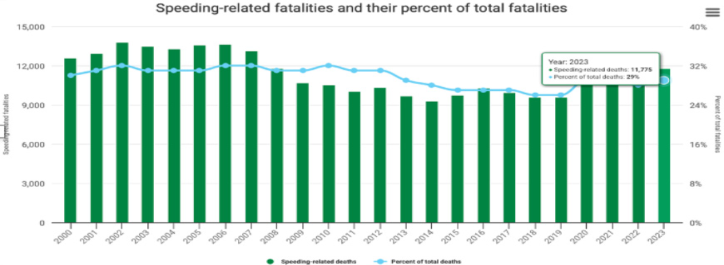
Figure 1: Speeding fatalities per year (The U.S. National Safety Council, 2023).
METHODOLOGY
This study adopts a data-driven and analytical approach to develop a dynamic driver risk management framework by integrating Automatic Fatigue and Distraction Detection (AFDD) with Failure Mode and Effects Analysis (FMEA).
AFDD is an AI-based system that monitors driver condition using multimodal inputs, including facial features, steering behaviour, and environmental conditions. It operates through data acquisition, feature extraction, and real-time classification of driver state (Hu et al., 2024).
The system generates a fatigue/distraction score (AF) and a confidence score (C), which are used to determine driver risk levels and trigger appropriate interventions such as alerts, speed reduction, or lane assistance. A range of recent studies (Guptaa, 2024), global road safety reports, and published research on driver behaviour (Uddin et al., 2025) were reviewed to identify the primary human-factor causes of driving incidents. These include fatigue, distraction, cognitive overload, delayed reaction, aggressive driving, and impaired visibility.
Based on this review, the most critical failure modes contributing to road accidents were defined and categorized. These failure modes form the foundation for the FMEA model. A baseline FMEA was constructed by assigning Severity (S), Occurrence (O), and Detection (D) ratings to each identified failure mode using expert judgment supported by literature. The Risk Priority Number (RPN) was calculated as: RPN = S × O × D
Fatigue Incomplete rest, circadian misalignment, post-nap grogginess To address the limitations of static FMEA, AFDD outputs were integrated into the risk evaluation process. The AFDD system continuously monitors driver state using multimodal inputs such as eye movement, head position, steering behaviour, and environmental conditions (Vecchiato et al., 2022) Based on these inputs, a fatigue/distraction risk score (AF) and a confidence level (C) are generated in real time. These values are used to dynamically adjust the Occurrence (O) and Detection (D) ratings in the FMEA model.
Using AFDD inputs, a new dynamic RPN is calculated continuously during driving. This enables risk levels to reflect actual driver conditions rather than static assumptions (Phan et al., 2023). Unlike traditional systems where safety actions are triggered only when a fixed threshold is exceeded, the proposed framework allows for continuous risk evaluation. This dynamic assessment enables more appropriate and proportional safety interventions, such as gradual alerts, adaptive speed control, or automated assistance, depending on the severity of the detected risk.
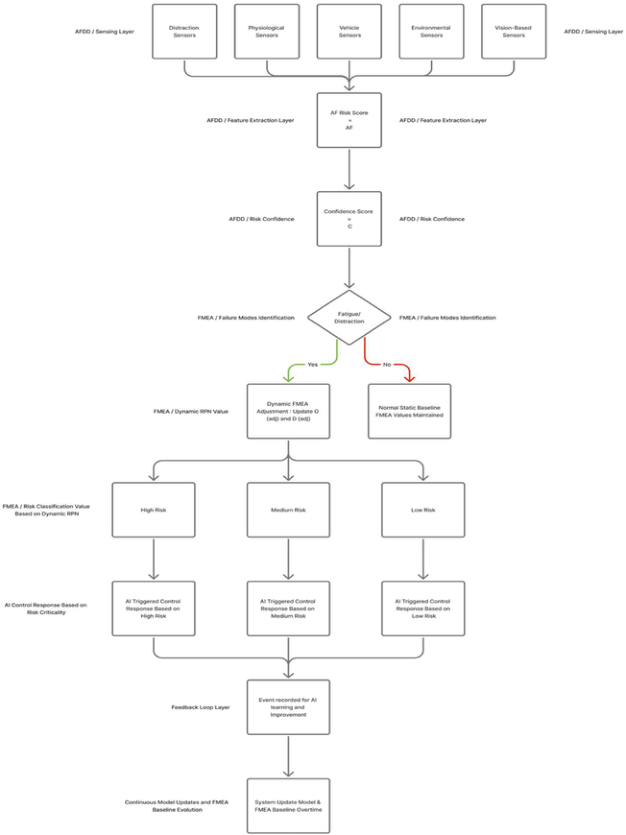
The dynamically updated RPN values are classified into risk levels (low, medium, high), which determine the type and intensity of intervention (Mangal et al., 2025) This ensures that safety responses are adaptive and context-aware, improving effectiveness compared to static, condition-based systems. The system consists of five layers: sensing, feature extraction, risk scoring, control response, and feedback learning. Multimodal sensors collect driver and environmental data, which are processed into risk indicators (Li et al., 2025). Dynamic FMEA updates risk levels, and the control layer executes interventions based on risk classification (low, medium, high). A feedback loop continuously improves system performance.
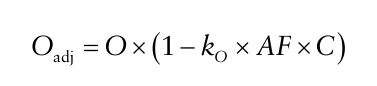
Equation 1: O adj
Equation reproduced from the original PDF.
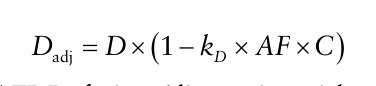
Equation 2: D adj
Equation reproduced from the original PDF.
AF represents the AFDD fatigue/distraction risk score (0–1), C denotes the confidence score (0–1), and kO and kD determine how strongly AFDD inputs influence the Occurrence and Detection metrics. The dynamic Risk Priority Number is then calculated as: Equation 3: RPN dynamic
Equation reproduced from the original PDF.Figure 2: Framework process flow diagram.
RESULTS
Upon simulating the integrated FMEA framework with AFDD systems, the data obtained from previous research are showcased for the purpose of validating the effectiveness of adding a dynamic detection to the cases presented.
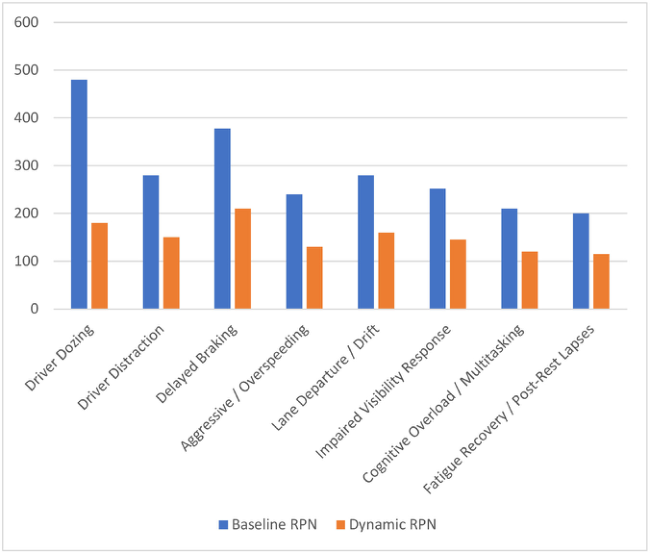
Figure 3 depicts the baseline versus dynamic RPN values for each failure mode, highlighting the absolute reduction in risk levels. Driver dozing shows the largest improvement, with an RPN reduction of 62%, indicating the effectiveness of AFDD in real-time monitoring of severe fatigue events.
Figure 3: Effect of AFDD-dynamic FMEA integration on RPN reduction.
These results confirm that dynamically updating Occurrence and Detection scores based on AFDD outputs enables FMEA to represent real- time driver risk more accurately than traditional static scoring (Xu et al., 2024). By continuously adapting to driver state variations, this integrated approach not only reduces the RPN for high-risk failure modes but also enhances proactive risk mitigation strategies, thereby improving overall road safety outcomes. Table 2 showcases how the RPN is reduced during the simulated cases.
Table 2: Baseline vs. dynamic RPN values for driver-related failure modes.
Despite the promising outcomes of the proposed AFDD–Dynamic FMEA framework, several limitations must be acknowledged. First, the accuracy and reliability of the system are highly dependent on sensor performance (Li et al., 2025). Vision-based and physiological sensors may be affected by poor lighting conditions, occlusions (e.g., sunglasses, masks), or hardware limitations, potentially reducing detection accuracy. This can lead to false positives, where normal driver behaviour is incorrectly classified as impaired, or false negatives, where actual fatigue or distraction is not detected. Such inaccuracies may result in either unnecessary interventions or missed critical warnings, both of which can impact user trust and system effectiveness (Mangal et al., 2025).
Second, the study relies on simulated data derived from existing case studies and literature rather than real-world experimental deployment. While this approach demonstrates the feasibility of the framework, it may not fully capture the complexity, variability, and unpredictability of real driving environments. Factors such as diverse driver behaviours, cultural differences, and varying road conditions could influence system performance (Lin and Zuo, 2024).
Additionally, the dynamic adjustment of FMEA parameters is based on predefined mappings between AFDD outputs and risk ratings, which may oversimplify the relationship between human behaviour and accident risk. Environmental constraints, such as extreme weather or sensor interference, may further limit system reliability.
Future work should focus on real-world validation, improved sensor fusion techniques, and adaptive calibration methods to enhance robustness, reduce false detections, and ensure broader applicability of the framework.
CONCLUSION
Human Systems Integration (HSI) is becoming a critical piece of complex systems. This study demonstrates that integrating Automatic Fatigue and Distraction Detection (AFDD) with Dynamic Failure Mode and Effects
Dynamic Driver Risk Management: Integrating AFDD and FMEA 191 Analysis (FMEA) provides a proactive framework for improving driving safety. AFDD enables continuous monitoring of driver impairments such as fatigue, distraction, and cognitive overload, while FMEA offers a structured method for quantifying and prioritizing risks. By dynamically updating Occurrence and Detection scores using real-time AFDD data, the framework reduces Risk Priority Numbers (RPN) and enables timely interventions before hazards escalate.
This approach shifts safety management from reactive to predictive, allowing for adaptive interventions such as lane-keeping assistance, speed regulation, and multimodal alerts based on risk level. Continuous feedback and system learning further enhance detection accuracy and reduce unnecessary alerts over time.
Overall, the framework supports both immediate risk reduction and long- term system improvement, with strong potential for future integration of additional human-factor indicators and advanced connectivity solutions in next-generation driver safety systems.
REFERENCES
Bener, A. and Crundall, D. (2005) ‘Road traffic accidents in the United Arab Emirates compared to Western countries’, Advances in Transportation Studies, Section A (6), pp. 5–12. Butt, F.M. et al. (2020) ‘Bibliometric analysis of road traffic injuries research in
the Gulf Cooperation Council region’, F1000Research, 9, p. 1155. Available at: https://doi.org/10.12688/f1000research.25903.2 Guptaa, N.R. (2024) ‘Distracted driving: Its causes and effects’, International Journal for Research Publication and Seminars, 15(2), pp. 117–129. Available at: https:// doi.org/10.36676/jrps.v15.i2.16 Hu, S. et al. (2024) ‘Efficient detection of driver fatigue state based on all-weather
illumination scenarios’, Scientific Reports, 14(1). Available at: https://doi. org/10.1038/s41598-024-67131-5 Li, T. et al. (2025) ‘Development and application of a generalized fatigue driving monitoring system for open-pit mining vehicles: A case study in a Myanmar copper mine’, Results in Engineering, p. 105206. Available at: https://doi.org/10.1016/j. rineng.2025.105206 Lin, N. and Zuo, Y. (2024) ‘Advancing driver fatigue detection in diverse lighting
conditions for assisted driving vehicles with enhanced facial recognition technologies’, PLoS ONE, 19(7), p. e0304669. Available at: https://doi. org/10.1371/journal.pone.0304669 Mangal, B. et al. (2025) ‘Deep learning approaches for driver distraction detection using driver facing cameras: Literature review and empirical study using CNN classifiers on a 100-driver image dataset’. Available at: https://doi.org/10.22541/ au.174836947.76820044/v1 Miller, T.R. et al. (2019) Cost of motor vehicle crashes to employers – 2019.
Network of Employers for Traffic Safety and National Highway Traffic Safety Administration (NHTSA). Available at: www.trafficsafety.org Phan, A.-C. et al. (2023) ‘Driver drowsiness detection and smart alerting using deep learning and IoT’, Internet of Things, 22, p. 100705. Available at: https://doi. org/10.1016/j.iot.2023.100705
Razzaghi, A. et al. (2024) ‘Distraction and related risk factors among professional and non-professional drivers’, Heliyon, 10(11), p. e31530. Available at: https:// doi.org/10.1016/j.heliyon.2024.e31530 Soole, D. et al. (2023) ‘Using GPS probe speed data to estimate the attribution of
speeding on casualty crashes: A case study in Queensland’, Journal of Road Safety, 34(1), pp. 39–48. Available at: https://doi.org/10.33492/jrs-d-22-00003 U.S. National Safety Council (2023) ‘Speeding’, Injury Facts. Available at: https:// injuryfacts.nsc.org/motor-vehicle/motor-vehicle-safety-issues/speeding/ Uddin, M.A. et al. (2025) ‘Abnormal driving behavior detection: A machine and deep
learning based hybrid model’, International Journal of Intelligent Transportation Systems Research, 23, pp. 568–591. Available at: https://doi.org/10.1007/s13177- 025-00471-2 Vecchiato, G., Ahlström, C. and Chuang, L.L. (2022) ‘Cognitive mechanisms for safe road traffic systems’, Frontiers in Neuroergonomics, 3, p. 897659. Available at: https://www.frontiersin.org/articles/10.3389/fnrgo.2022.897659/full Xu, J. et al. (2024) ‘Cognitive load and task switching in drivers: Implications
for road safety in semi-autonomous vehicles’, Transportation Research Part F: Traffic Psychology and Behaviour, 107, pp. 1175–1197. Available at: https://doi. org/10.1016/j.trf.2024.11.005
LISTED IN THE AHFE DIGITAL BOOKSTORE CATALOGUE
Explore the complete digital volume
Industrial and Systems Engineering
Read this individual research paper free through the original publisher, or explore the full digital proceedings book.
ISBN 978-1-964867-95-3
Explore this ISBN in the AHFE Bookstore ↗Listed in the July 2026 bookstore catalogue; search by ISBN to confirm current availability · Digital book purchase optional