Anne Gemeiner, Uwe Dombrowski, Tim Mielke (2026). Employee Perceptions of Lean Production System Implementation: Linking Method Integration and Perceived Success with Occupational Health and Safety Outcomes. In: Industrial and Systems Engineering. AHFE Open Access, vol. 219, pp. 175–184. https://doi.org/10.54941/ahfe1007788
Publisher statistics will load when you open Metrics.
AHFE OPEN ACCESS OPEN ACCESS CONFERENCE PROCEEDINGS PAPER
Employee Perceptions of Lean Production System Implementation: Linking Method Integration and Perceived Success with Occupational Health and Safety Outcomes
Manufacturing companies operate in increasingly volatile and turbulent market environments, requiring the implementation of effective organizational and operational measures to remain competitive. Lean Production Systems (LPS) have evolved into a widely adopted management framework in manufacturing, providing structured principles and methods to enable continuous improvement across the entire value chain. In Germany, the technical guideline VDI 2870 serves as a reference framework for LPS implementation and reflects the current state of the art in terms of Lean principles and methods. Beyond efficiency gains, Lean offers significant advantages such as improved process stability, enhanced quality, waste reduction, and increased organizational adaptability. However, despite the central role of employees in manufacturing systems, the human dimension of LPS implementation is insufficiently addressed in existing integration approaches. To investigate this gap, a systematic literature review was conducted to analyze employee perceptions of LPS implementation. The findings reveal substantial variation in how employees experience Lean transformations. A key result is the strong relationship between the degree of systematic method integration and perceived implementation success. Organizations that implement LPS in a coherent and structured manner report more positive employee perceptions, higher engagement, and improved occupational health and safety outcomes. In contrast, fragmented or isolated application of Lean methods often fails to produce sustainable improvements and may increase psychosocial stressors. The results indicate that employee perception serves as an early and sensitive indicator of the quality and sustainability of Lean implementation, highlighting from a Human Factors perspective that long-term success depends not only on technical-methodological integration but also on social coherence and employee sensemaking.
Manufacturing companies increasingly operate in volatile and turbulent market environments shaped by intensifying global competition, rapid technological change, shortened product life cycles, and rising customer expectations (Christopher, 2016; Porter, 2008). The German economy in particular is currently facing significant challenges associated with recessionary pressures, including high energy prices, elevated interest rates, and weak global and domestic demand (BMWE 2025). As a consequence, nearly 22,000 companies filed for insolvency in 2024, with similarly high levels projected for 2025 (Obst 25). Against this backdrop, companies must continuously enhance efficiency, flexibility, and quality while maintaining stable and safe working conditions.
Lean Production Systems (LPS) have become one of the most widely adopted organizational frameworks for addressing these challenges in manufacturing (BMWE 25). Lean Production aims to eliminate waste, stabilize processes, and maximize customer value through standardized work, continuous improvement, and flow-oriented production principles (Dombrowski and Mielke, 2015; Ohno, 1988). In Germany, LPS implementation is commonly guided by the technical guideline VDI 2870, which conceptualizes Lean Production as an integrated system of principles, methods, and tools applied across all organizational levels (VDI 2870–1). While this guideline reflects the state of the art in Lean design from a technical and organizational perspective, the human dimension of Lean implementation remains insufficiently addressed (Dombrowski et al., 2019). Employees, although central to production performance, are frequently treated as passive recipients rather than active contributors to Lean transformation processes. Existing research demonstrates that Lean implementation can have divergent effects on employees’ work experience, well-being, and safety (Brawner et al., 2022). Some studies report increased job satisfaction, improved ergonomics, and enhanced safety awareness, whereas others identify higher work intensity, psychosocial strain, and negative perceptions of occupational health and safety (OHS) (Brawner et al., 2022). These mixed findings indicate that Lean Production is neither inherently beneficial nor detrimental; rather, outcomes depend strongly on implementation design, particularly the degree to which Lean methods are embedded within a coherent socio-technical system. From a Human Factors perspective, employee perceptions provide a critical lens for assessing the success, sustainability, and safety implications of Lean transformations. Therefore, this study systematically examines how employees experience LPS implementation and how the degree of method integration relates to perceived implementation success and OHS outcomes across different industrial and national contexts.
Lean Production Systems and Occupational Health and Safety Lean Production Systems (LPS) were first conceptualized by Krafcik (1988) in the context of the International Motor Vehicle Program conducted at the Massachusetts Institute of Technology, which compared automotive manufacturing practices in the United States, Europe, and Japan. This research
Employee Perceptions of Lean Production System Implementation 177 introduced the term lean production, which subsequently evolved into the broader concept of Lean Production Systems (Krafcik, 1988; Womack et al., 1991). Today, LPS are understood as coordinated socio-technical frameworks aimed at improving manufacturing performance through the systematic elimination of waste, process stabilization, and continuous improvement (Dombrowski and Mielke, 2015).
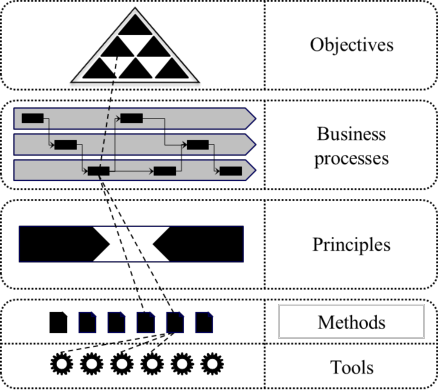
In Germany, the design and implementation of LPS are guided by the technical directive VDI 2870–1, issued by the Verein Deutscher Ingenieure, which defines Lean Production as an enterprise-specific methodological system aligning all processes toward customer value and organizational objectives (VDI 2870–1). The guideline emphasizes systematic method integration and identifies seven classical waste categories: overproduction, waiting, transport, overprocessing, inventory, motion, and defects. These forms of waste reduce productivity and profitability and therefore constitute primary targets of Lean improvement efforts. Rather than a collection of isolated tools, LPS represent an integrated system in which principles, methods, and tools are aligned across organizational levels. Core principles include customer orientation, flow, pull, standardization, and continuous improvement, operationalized through practices such as standardized work, visual management, and employee involvement (VDI 2870–1). Figure 1 shows the different levels and elements of an LPS.
Figure 1: Structure of lean production systems (VDI 2870).
The VDI framework structures LPS across four hierarchical levels: objectives, business processes, principles, and methods/tools. Strategic goals (e.g., quality, lead time, or cost) are translated into process-level targets, supported by guiding principles such as zero-defect orientation, and implemented through specific methods including statistical process control or poka-yoke (VDI 2870–1). This hierarchical logic highlights that sustainable performance improvements depend on coherent system design rather than isolated tool application.
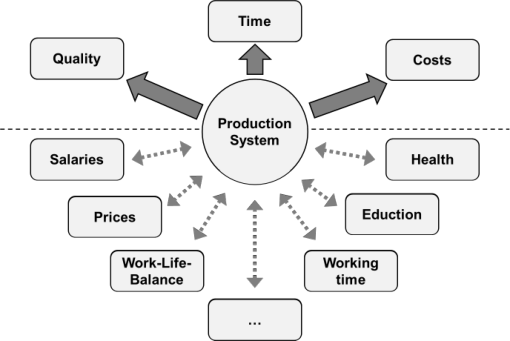
While the guideline acknowledges employees as key contributors to process stability and improvement, its primary focus remains on structural and procedural system design (Dombrowski et al., 2019). From a Human Factors perspective, however, employees represent a central determinant of system performance due to their value-adding activities, adaptive capabilities, and experiential knowledge (Schlick et al., 2018). Accordingly, production systems influence not only economic performance dimensions such as quality, cost, and delivery reliability, but also work organization, workload, autonomy, and skill utilization, all of which directly affect employee health and well- being (Dombrowski, 2015). Figure 2 illustrates these interrelationships and highlights the multidimensional impact of production systems on both organizational performance and employee outcomes.
Figure 2: Relationship between production systems and organizational performance and employee outcomes (Dombrowski 2015).
The interaction between Lean implementation and occupational safety and health (OSH) is therefore of critical importance. Lean measures such as standardization, visual management, and ergonomic workplace design can contribute to improved process transparency, reduced physical strain, and enhanced safety awareness. At the same time, poorly designed Lean implementations—particularly those emphasizing efficiency without adequate consideration of human workload and recovery—may increase work intensity, psychosocial stress, and perceived job demands. Consequently, OSH represents a complementary and necessary dimension of sustainable Lean implementation.
The World Health Organization defines occupational safety and health as promoting and maintaining the highest degree of physical, mental, and social well-being of workers (WHO 2025). In addition, regulatory frameworks such as the EU OSH Framework Directive issued by the European Commission and standards enforced by the Occupational Safety and Health Administration require organizations to systematically ensure safe and healthy working conditions (European Commission 2026; OSHA 2026). Consequently, many organizations attempt to integrate Lean and OSH practices to improve both productivity and employee well-being.
Employee Perceptions of Lean Production System Implementation 179 However, empirical research reports heterogeneous outcomes of such integration (Koukoulaki, 2014). While some studies identify positive effects such as reduced accident rates, improved ergonomics, and greater employee involvement, others report increased work pressure, reduced recovery opportunities, and negative perceptions of safety and health. These mixed findings indicate that the impact of Lean on occupational safety and health is not inherent to Lean itself but depends strongly on implementation design, particularly the degree of socio-technical integration and the consideration of human-centered system factors.
Systematic Review of Impact of Lean Production Systems on Occupational Health and safety Lean Production Systems (LPS) are widely implemented to enhance productivity and systematically reduce waste across multiple levels of organizational processes. Typically, companies define performance objectives and evaluate their business processes to identify improvement potentials. As LPS interventions directly modify work structures, workflows, and task characteristics, they inevitably influence the work environment and, consequently, employee- related outcomes.
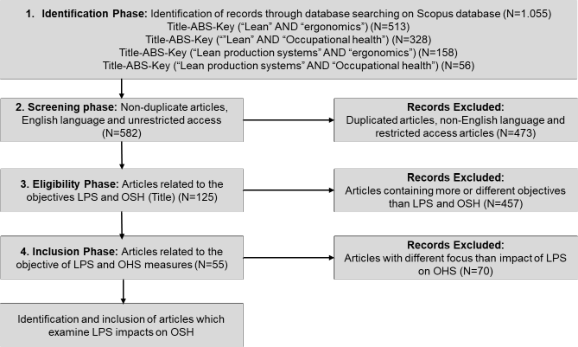
To systematically identify and synthesize these employee-related effects, a systematic literature review was conducted. The study is based on a structured review and synthesis of empirical research examining employee perceptions in the context of Lean Production System implementation. A comprehensive database search was performed using Scopus, one of the largest multidisciplinary scientific databases. The overall review procedure is illustrated in Figure 3.
Figure 3: Four-step methodology to identify relevant articles regarding the impact of LPS on OSH.
The review followed the PRISMA methodology (Preferred Reporting Items for Systematic Reviews and Meta-Analyses) as proposed by Moher et al. (2009). The database search was conducted between August 11th, 2025, and January
26th, 2026. Search strings were defined to ensure broad coverage of relevant literature at the intersection of Lean Production and occupational health- related factors. The following keyword combinations were applied within Title– Abstract–Keywords fields: (1) “Lean” AND “ergonomics”, (2) “Lean” AND “occupational health”, (3) “Lean production systems” AND “ergonomics”, and (4) “Lean production systems” AND “occupational health”.
The initial search yielded 1,055 records. During the screening phase, duplicate entries were removed, and articles were limited to English-language publications with accessible full texts, resulting in 582 retained studies and 473 exclusions. In the eligibility phase, titles and abstracts were assessed against predefined exclusion criteria. Studies were excluded if they (1) addressed non-manufacturing sectors (e.g., healthcare or construction), (2) focused on purely medical or clinical health assessments, (3) examined COVID-19- specific production effects, (4) evaluated isolated Lean derivatives emphasizing sustainability (e.g., Green Lean, Lean Six Sigma), or (5) concentrated on digital or simulation-based tool validation (e.g., virtual reality or modeling studies). Application of these criteria resulted in 125 eligible articles (see Figure 3).
In the final inclusion phase, full-text assessments were conducted to ensure explicit relevance to LPS implementation and occupational safety and health (OSH). This step led to the exclusion of 70 articles, yielding a final sample of 55 studies for qualitative synthesis.
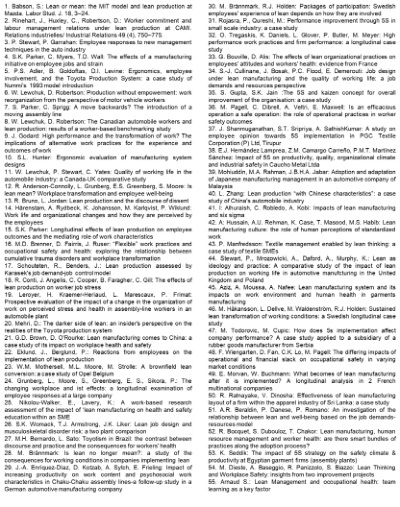
Evaluation of the Study and Insights Subsequently, the 55 articles identified through the systematic literature review were analyzed in depth. Figure 4 presents an overview of the included publications to ensure transparency and traceability of the data corpus.
Figure 4: Overview of the included publications.
Employee Perceptions of Lean Production System Implementation 181 The literature analysis yielded several key insights. First, the included studies were categorized according to the economic sectors of the investigated companies. Sectoral classification could be established for the majority of the identified articles. The analysis revealed that 18 studies examined companies within the automobile manufacturing sector. This concentration is consistent with the historical origin of Lean Production Systems (LPS), which emerged from the Toyota Production System and were initially adopted by automotive manufacturers. Consequently, early empirical investigations predominantly focused on automobile production environments, facilitating foundational research on the organizational and human impacts of LPS implementation.
The second most represented sector was textile manufacturing, with six studies explicitly addressing the effects of LPS on employees’ health. This distribution suggests that Lean principles have progressively diffused into additional industrial domains. Textile manufacturing, characterized by repetitive processes and flow-oriented production structures, provides conditions conducive to the implementation of Lean practices. The increasing adoption of LPS within this sector has therefore attracted corresponding research interest. Another relevant category comprised automotive suppliers, which were examined in four studies. Given the structural and procedural similarities to automobile manufacturers, suppliers frequently adopt LPS frameworks, thereby extending Lean-related research into upstream production contexts.
Second, the studies were analyzed with respect to publication period and geographical focus. The reviewed articles were published between 1993 and 2021. Temporal and regional analysis indicates that, until approximately 2010, empirical research was predominantly conducted in Western industrialized countries, including the United States, France, and Sweden. This pattern reflects the early concentration of Lean implementation within Western automotive production sites, such as General Motors and Volvo. After 2010, an increasing number of studies originated from emerging economies, including India, China, and Egypt. This shift corresponds with the globalization of Lean adoption, particularly within textile manufacturing, and the expansion of multinational automobile production into these regions.
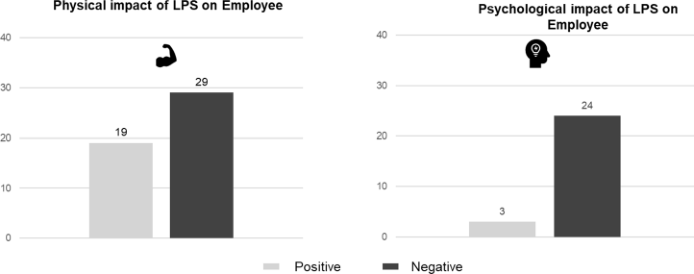
The third major insight concerns the reported impacts of LPS on employee health. Most studies differentiated between physical and psychological dimensions. Of the included articles, 36 focused exclusively on either physical or psychological effects, whereas 18 examined both dimensions. The distribution of impact categories is illustrated in Figure 5.
Figure 5: Physical and psychological impact of LPS on employee’s health.
As shown in Figure 5, both positive and negative effects of LPS implementation were reported. The majority of assessments were based on employee self-reports, often collected before and after the introduction of Lean measures. Regarding physical impacts, 29 studies identified predominantly negative employee perceptions. These outcomes were frequently associated with increased workload, higher task intensity, and elevated physical demands. Conversely, 19 studies reported positive perceived physical effects, commonly linked to reductions in accident rates or improvements in perceived workplace safety. These findings suggest that employees may evaluate Lean interventions positively when safety improvements are salient, even if accompanied by higher workload.
Psychological outcomes exhibited a different distribution. Only three studies reported positive effects on employees’ psychological well-being, primarily attributed to reduced stress levels resulting from improved work organization or enhanced working conditions. In contrast, 24 studies identified negative psychological impacts, with increased work-related stress cited as a central factor. Frequently reported stressors included heightened performance pressure, reduced recovery opportunities, and the elimination of informal or “hidden” breaks.
CONCLUSION
The literature review indicates that automobile manufacturers constitute the primary context for Lean Production System (LPS) implementation, reflecting the historical origins of Lean within this sector. Consequently, these organizations exhibit comparatively higher LPS maturity levels and provide a substantial empirical basis for understanding both organizational and employee-related effects of Lean practices. The multi-site structures typical of automobile manufacturers facilitate the transfer of best practices and the systematic refinement of Lean interventions. In contrast, textile manufacturers represent a more recent yet growing field of Lean adoption. This sector benefits from accumulated methodological experience and early research insights derived from automotive applications, suggesting that certain implementation barriers may be mitigated through cross-sectoral learning. Together, these sectors offer a robust foundation for further investigation, particularly with regard to the differential effects of specific Lean methods.
The temporal and geographical distribution of studies reveals an evolution from early research predominantly conducted in Western industrialized countries (e.g., USA, France, Sweden) toward an increasing number of investigations in emerging economies (e.g., India, China). This shift reflects the global diffusion of Lean practices and underscores the necessity of examining contextual factors. Future research should therefore systematically analyze sectoral and regional differences, as economic conditions, cultural factors, and regulatory environments may influence employee perceptions and implementation outcomes.
A central conclusion concerns the impact of LPS on employees’ perceived health. While physical effects have long been a focal point of research, psychological dimensions—particularly work-related stress—have gained
Employee Perceptions of Lean Production System Implementation 183 prominence in recent years. The findings suggest that the degree of systematic Lean integration plays a critical role in shaping stress levels and overall employee well-being. Poorly coordinated or fragmented implementations are more frequently associated with negative outcomes, including increased workload and psychosocial strain. Organizations should therefore anticipate potential stress-related effects and proactively implement mitigating measures, such as participatory design, workload balancing, and human-centered work organization.
Overall, Lean Production is fundamentally designed to enhance value creation, process stability, and operational performance. However, from an employee perspective, Lean interventions may generate both positive and negative consequences depending on implementation quality. Sustainable Lean success thus requires not only technical-methodological excellence but also the deliberate integration of Human Factors and occupational safety and health considerations. Continued research and deeper analysis of specific Lean practices will enable organizations to better align productivity objectives with employee health, engagement, and long-term system resilience.
ACKNOWLEDGMENT
The authors would like to thank their supervising professors for their valuable academic guidance, insightful discussions, and continuous support throughout the research process. This contribution was developed in the context of a doctoral dissertation.
REFERENCES
Brawner, Joel G. Harris, Gregory A. Davis, Gerard A. (2022). Will the real relationship between lean and safety/ergonomics please stand up? Applied Ergonomics, Volume 100. BMWE – Bundesministerium für Wirtschaft und Energie (2025). Konjunktur und
Wachstum. Leichte Konjunkturbelebung zum Jahresende. Bundesministerium für Wirtschaft und Energie Website: https://www.bundeswirtschaftsministerium.de/ Redaktion/DE/Dossier/konjunktur-und-wachstum.html Christopher, M. (2016). Logistics & Supply Chain Management (5th ed.). Pearson, Harlow. Dombrowski, Uwe. Mielke, Tim, ed. (2015). Ganzheitliche Produktionssysteme. Berlin,
Heidelberg: Springer Verlag. Dombrowski, Uwe. Gemeiner, Anne. Mindt, Nadja (2019). Das neu(nt)e Gestaltungsprinzip im Ganzheitlichen Produktionssystem. Zeitschrift für wirtschaftlichen Fabrikbetrieb Volume 114 Issue 11, pp. 725–729. European Commission (February 8, 2026). Health and safety at work. European
Commission Website: https://employment-social-affairs.ec.europa.eu/policies- and-activities/rights-work/health-and-safety-work_en Krafcik, J.F. (1988). Triumph of the Lean Production System. Sloan Management Review, Volume 30 Issue 1, pp. 41–52. Koukoulaki, Theoni (2014). The impact on lean production on musculoskeletal
and psychosocial risks: An examination of sociotechnical trends over 20 years. Applied Ergonomics, Volume 45, Issue 2, pp. 198–212.
Moher, David. Liberati, Alessandro. Tetzlaff, Jennifer. Altman, Douglas G. (2009).
Preferred reporting items for systematic reviews and meta-analyses: The PRISMA statement. PLoS medicine, Volume 6, Issue 7. Obst, Thomas. Röhl, Klaus-Heiner (2025) Unternehmensinsolvenzen steigen kräftig.
Grund zur Sorge oder Normalisierung nach den Pandemiejahren? Köln: Institut der deutschen Wirtschaft Köln e.V. Ohno, T. (1988). Toyota Production System: Beyond Large-Scale Production.
Productivity Press, Portland. Porter, M.E. (2008). The Five Competitive Forces That Shape Strategy. Harvard Business Review, 86(1), 78–93. Schlick, Christopher. Bruder, Ralph. Luczak, Holger, ed. (2018). Arbeitswissenschaft.
Berlin, Heidelberg: Springer Vieweg. United States Department of Labor (February 8, 2026). OSH Act of 1970. U.S. Department of Labor Website: https://www.osha.gov/laws-regs/oshact/completeoshact VDI 2870–1 (2012). Ganzheitliche Produktionssysteme – Grundlagen, Einführung
und Bewertung. VDI – Verein Deutscher Ingenieure e.V., ed. Berlin: Beuth Verlag. Womack, James P., Jones, Daniel T., Roos, Daniel (1991) The machine that changed the world. The story of lean production. New York: Harper Perennial. World Health organization (January 26, 2026). Occupational health. World Health
Read this individual research paper free through the original publisher, or explore the full digital proceedings book.
ISBN 978-1-964867-95-3
Explore this ISBN in the AHFE Bookstore ↗Listed in the July 2026 bookstore catalogue; search by ISBN to confirm current availability · Digital book purchase optional