Beata Fabisiak, Robert Kłos, Anna Jankowska, Jasna Hrovatin, Ryann Deloso (2023). Good practices in implementing senior-friendly design in selected public institutions across the European Union. In: Design for Inclusion. AHFE Open Access, vol. 75, pp. 221–230. https://doi.org/10.54941/ahfe1003343
1 Pozna ´n University of Life Sciences, Faculty of Forestry and Wood Technology, Department of Furniture Design, Wojska Polskiego 28, 60–637 Pozna ´n, Poland ↗
2 Pozna ´n University of Life Sciences, Faculty of Economics, Department of Economics and Economic Policy in Agribusiness, Wojska Polskiego 28, 60–637 Pozna ´n, Poland ↗
3 Faculty of design, Dunajska 129, 1000 Ljubljana, Slovenia
4 Satakunta University of Applied Sciences, Department of Technology, Satakunnankatu 23, 28130, Pori, Finland ↗
Societies in various parts of the world face social and economic challenges caused by a silver tsunami. Nonetheless, the accelerated aging processes also constitute a trigger for a positive change in the way public and private spaces are designed. The research task aimed to identify and analyze good practices in the design of furniture and interior design elements in selected public spaces adapted to the needs of seniors in selected countries of the European Union. The geographical scope included: Poland, Lithuania, Latvia, Estonia, Finland, Sweden, Denmark, Germany, Slovakia, and Slovenia. Taking into account the principles of universal design, field research was carried out in selected public institutions. Existing solutions were assessed in the context of their accessibility and safety for seniors. Photographic documentation was prepared, which constituted the source material. Moreover, interviews with owners and creators of the spaces have been performed. Based on the research a set of good practices was identified to support the process of designing furniture and interior design elements adapted to the needs of seniors, taking into account both functional and aesthetic aspects. These good practices do not only serve seniors but also other public space users with diverse abilities and needs.
In view of the observed demographic changes, both private households and public institutions would need to apply inclusive design when shaping the infrastructure of their internal and external spaces. Taking into account the needs of seniors in the created products and services teaches how to be more attentive to the needs of other vulnerable social groups, e.g., people with disabilities, and thus can be beneficial for the whole society (Fabisiak and Deloso, 2021). As Steinfeld and Maisel (2012) pointed out this is a process
that enables and empowers a diverse population by improving human per- formance, health, wellness, and social participation. In senior-friendly design, a special focus should be placed on the challenges resulting from the aging process of the human body. Activities that seniors previously performed effi- ciently and quickly take more time in later years of life. Fatigue, backache, problems with eyesight, hearing, balance, or bending also occur more often. At the same time, many research results point out the problem of loneliness among seniors, highlighting the significance of mutual integration of seni- ors, not only with people of their age but also with the younger generations (Brunes, 2019, Pettigrew and Roberts, 2008, Perlman, 2004). Furthermore, studies indicate that for the good mental and physical condition of seniors, it is very important to maintain contact with nature (Wen et al., 2018), an appropriate level of physical activity (Afonso et al., 2001), and the opportu- nity to develop their hobbies (Mackowicz and Wnek-Gozdek, 2016) despite the difficulties that may arise with age. All this is made possible by a well- designed and accessible public space, which by eliminating physical barriers and improving the aesthetics will encourage both older and younger resi- dents to use it longer and more frequently. When a public space is attractive for both younger and older users, a multigenerational encounter could take place which has also a positive impact on the well-being of seniors.
There is a number of initiatives taking place in various locations around the world that aim to create more accessible and more beautiful surroundings for all. The successful operation of such solutions could be a source of inspiration for other spots. Nevertheless, often those valuable case studies are kept at a local or regional level, not reaching macro-regional dissemination. Thus, the aim of the research task was to identify and analyze good practices in the design of furniture and interior design elements in selected public spaces adapted to the needs of seniors taking into consideration a broad scope of 10 European Union (EU) countries.
METHODOLOGY
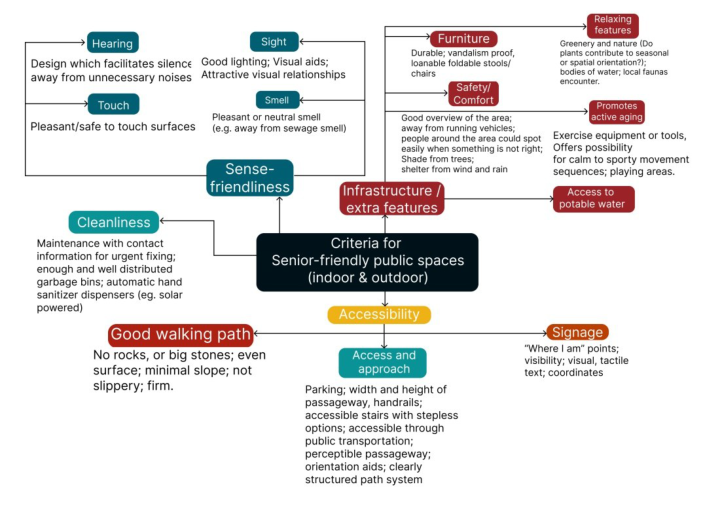
The research was based on the methodology developed by the internatio- nal team of experts representing various fields of study: design, engineering, wood technology, geriatrics, etc., cooperating within the BaltSe@nioR 2.0 project. It was focused on supporting public institutions in providing more senior–friendly public spaces. Based on a set of accessibility criteria, in coo- peration with foreign partners, public institutions with solutions friendly to seniors and people with disabilities were identified in selected countries. The accessibility criteria included both indoor and outdoor spaces (see Figure 1). The geographical scope included: Poland, Lithuania, Latvia, Estonia, Fin- land, Sweden, Denmark, Germany, Slovakia, and Slovenia. In each country, an accessibility expert was assigned to support the research team in the sele- ction process and evaluation. Taking into account the principles of universal design, field research was carried out in selected public institutions. Existing solutions were assessed in the context of their accessibility and safety for seni- ors. Photographic documentation was prepared, which constituted the source
Good Practices in Implementing Senior-Friendly Design 223
Figure 1: The accessibility criteria taken into consideration while the selection process. (Own elaboration).
material. Moreover, interviews with owners and creators of the spaces have been performed.
RESULTS AND DISCUSSION
Based on the research, a set of good practices was identified to support the process of designing furniture and interior design elements adapted to the needs of seniors, taking into account also functional and aesthetic aspects. In the paper, we present a number of good practices for both indoor and outdoor spaces that take into account the needs of the aging population and may be a source of inspiration for designers and owners of public spaces. Analysis of good examples facilitates the implementation of positive changes when creating accessible public spaces.
The design process that considers the needs of seniors is a very challenging one, as it should be noted that people aged 60+ constitute the most hete- rogeneous group in society in terms of requirements. Thus, it is beneficial to implement universal design principles in order to assure the best possi- ble functionality (Magnusson et al., 2018, Mustaquim, 2015, Østergaard, 1994, Timlin and Rysenbry, 2010). Good examples of universal design can be easily seen especially in the Scandinavian countries as the Design for All concept has strong and long traditions there (Bendixen and Benktzon, 2015). Nevertheless, with the case studies presented in this paper, we would like to illustrate that inspiring examples can be found in various countries across the European Union constituting valuable actions to make Europe more friendly to all.
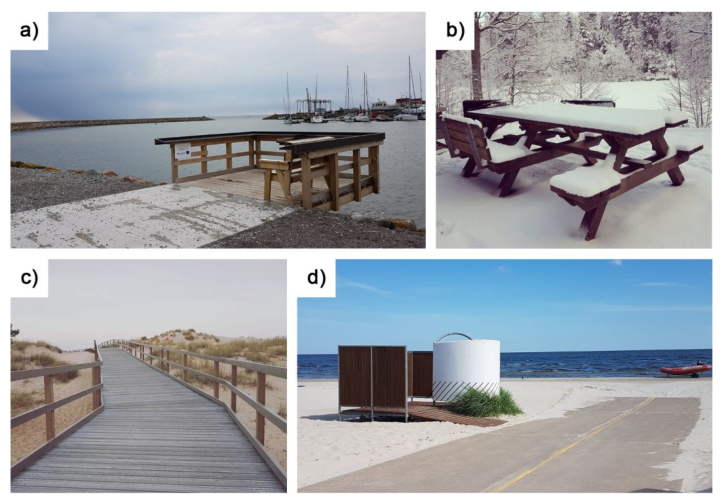
The first principle of universal design concerns equitable use. That means that the designed solution should be useful and marketable to people with diverse abilities. This is of key importance, especially in view of the hetero- geneity of the 60+ age group mentioned above. For example, on Saaremaa Island (Estonia) citizens will find a number of accessible fishing spots. They were created within the EU co-funded project entitled “Nature Access to All” and now they enable wheelchair users to go fishing in various locations on the island (see Figure 2a). An inspiring example can be found in Sweden, in Åsbotorpsjön in the City of Skövde where the design of outdoor dining fur- niture allows not only users in wheelchairs but also parents with strollers to have a joint meal (see Figure 2b). The Finnish City of Pori took care of easy access to nature for all and provided an accessible entrance to the Yyteri beach (see Figure 2c). Also, the Latvian City of J¯urmala spotted the needs of all local people and tourists visiting its coastline, including those in whe- elchairs and using strollers. Beach changing rooms that are located on the Kauguri beach are beautiful, functional, and most importantly accessible to all (see Figure 2d).
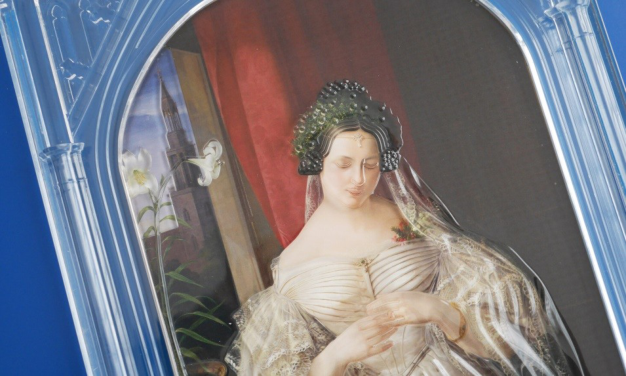
One must remember that the various abilities of visitors of public space are not concentrated only around the mobility aspect. Equitable use for peo- ple suffering from visual impairment means exploring the public space with sound and tactile experiences. The Jewish Museum in Berlin is Europe’s lar- gest Jewish museum and simultaneously an inspiring example of universal design in providing the space and objects accessible to all. It applies not only
Figure 2: An example of an accessible a) fishing spot on Saaremaa Island, Estonia, b) outdoor dining furniture in Skövde, Sweden, c) entrance to the beach in Pori, Finland, d) beach changing room in J ¯urmala, Latvia. (Own elaboration).
Good Practices in Implementing Senior-Friendly Design 225
to tactile maps of the museum but also to pieces of art (see Figure 3). That allows blind and visually challenged people to explore the full potential of the museums’ collections.
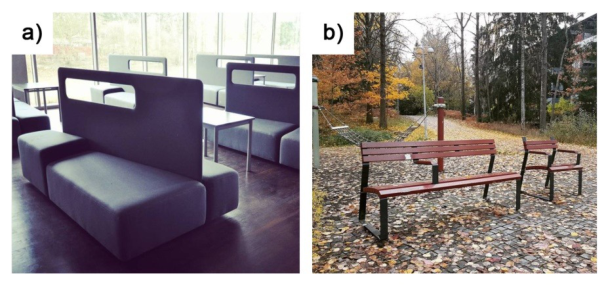
The next principle of universal design includes flexibility in use. It allows for a wide range of individual preferences and abilities. A good example of implementing this principle demonstrates the lobby of Porta Posnania Heri- tage Interpretation Center in Pozna´n, Poland. Sofas located in the lobby have seats at various heights so the visitors may choose the level of the seat that is the most comfortable for them. A high backrest with a hole provides an element for having some playful time for the children and at the same time ensures support when sitting down and getting up from the furniture for the seniors (see Figure 4a). Another interesting example is an outdoor space in Helsinki (Finland). The space is equipped with a number of varied pieces of furniture including a bench for one person and two persons, a single chair,
Figure 3: An example of making art accessible for visually challenged people - The Jewish Museum in Berlin, Germany. (https://inkl.design/projekt/jmb/).Figure 4: An example of accessible sitting furniture providing various options of use a) in Poland b) in Finland. (Own elaboration).
and a hammock (see Figure 4b). All of them are unified in color, so they are aesthetically pleasing, simultaneously offering a range of possibilities for usage.
Additionally, when implementing universal design, it is important to con- sider the principle of simple and intuitive use. According to this principle, the use of design should be easy to understand, regardless of the users’ expe- rience, knowledge, language skills, or concentration level. In Holbæk Public Library in Denmark, in order to make it easier for the visitors to find the cate- gory of books they are interested in, the sides of the bookshelves are covered with large format photos presenting the categories. In one of the retail chains in Germany, the shopping trolleys are equipped with a magnifying glass. It facilitates the purchase process not only for seniors but actually for all, as in many cases the texts on the packages are written in small font sizes.
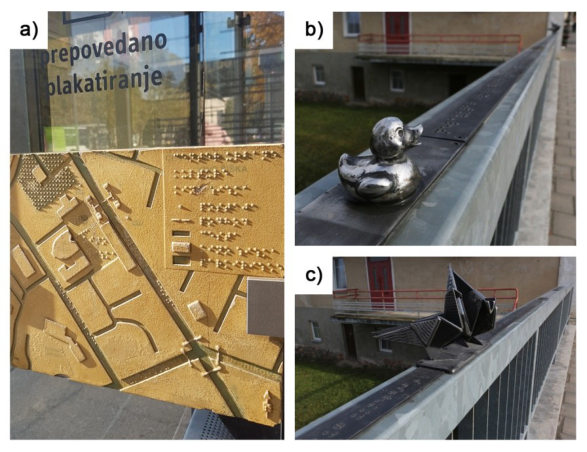
The fourth principle applies to perceptible information that communica- tes effectively to the user, regardless of distractions in the environment or the user’s sensory abilities. The public transport stops in Ljubljana, Slovenia are equipped with tactile maps that allow travelers with vision challenges to easier recognize the space where they arrived with the public transport (see Figure 5a). At the same time, it is also a great convenience for tourists visi- ting Ljubljana. In the Lithuanian city Ukmerg˙e information about the works of art located in the outdoor public space is placed on the city’s bridges and adapted for visually challenged people. 3D models and descriptions in Braille are available on the railings (see Figure 5b-c).
The next principle is associated with tolerance for error. It aims at mini- mizing hazards and the adverse consequences of accidental or unintended actions. In the case of furniture located in public spaces that issue is connected
Figure 5: An example of perceptible information a) at the bus stop in Ljubljana, Slovenia, and b) on the city’s bridges in Ukmerg˙e (Lithuania). (Own elaboration).
Good Practices in Implementing Senior-Friendly Design 227
with e.g., bumping into it. Therefore it is recommended that visible corners and protruding parts are rounded, without burrs and sharp edges (e.g., R ≥5 mm) or e.g., chamfered 5 mm, angle of 45
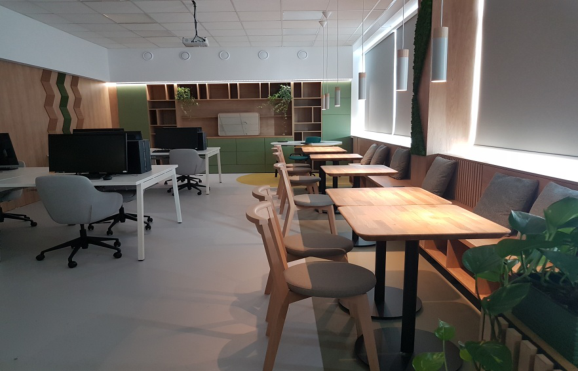
. There should be no open pipes in furniture. All other edges and corners of furniture, accessible during use shall be free from burrs and sharp edges. In a senior-friendly classroom of the Uni- versity of the Third Age operating at the Pozna´n University of Life Sciences, the edges of the tables have been rounded and chamfered (see Figure 6). Fur- thermore, in this classroom, a special type of chair has been presented. Those chairs have a swivel seat that enables the user to turn around and receive support while getting up by grabbing the profiled backrest of the chair from one side, and the table from the other side. Thus, despite not having arm- rests they provide support while getting up. The results of an international study indicate that 76% of the surveyed people aged 60+ admitted that it is easier for them to stand up and sit down when the chair is equipped with armrests (Fabisiak et al., 2021). Consequently, this is a valuable feature to be considered in furniture for sitting located in public spaces.
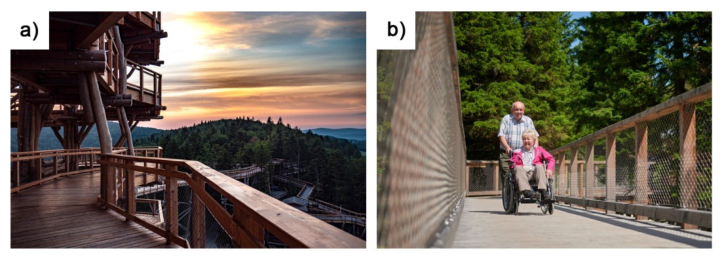
A key issue when designing for seniors is also to apply the principle of low physical effort. It indicates that the product should be used efficiently and comfortably with minimum fatigue. That applies e.g., to touristic routes. In Krynica-Zdrój in Poland, a wooden observation tower almost 50 meters high has been opened. An educational and natural path in the crown of trees leads to its top, providing a unique panorama of the surrounding nature. The tower does not only display the landscape and other attractions of the region but also serves as a tourist attraction “without barriers”, friendly to people with young children, seniors, and people with disabilities. The low slope of the path leading to the Observation Tower (approx. 5%) makes it accessible to a variety of visitors. They can admire the scenery without the need to exert excessive physical effort that might negatively impact the overall experience (see Figure 7a). A similar solution was built on Rogla mountain
Figure 6: An example of a senior-friendly and student-friendly classroom at the Pozna ´n University of Life Sciences (Poland). (Own elaboration).Figure 7: An example of an all-friendly touristic route a) in Krynica-Zdrój, Poland, (https://wiezawidokowa.pl/krynica-zdroj/) and b) on Rogla mountain, Slovenia. (https://www.potmedkrosnjamipohorje.si/).
in Slovenia. The route is fully barrier-free in its full length and is adapted for riding strollers and wheelchairs, with a maximum climb of 2–6 %. There are transparent meshes along the sides of the trail to ensure the best possible visibility for both wheelchair users and young children (see Figure 7b).
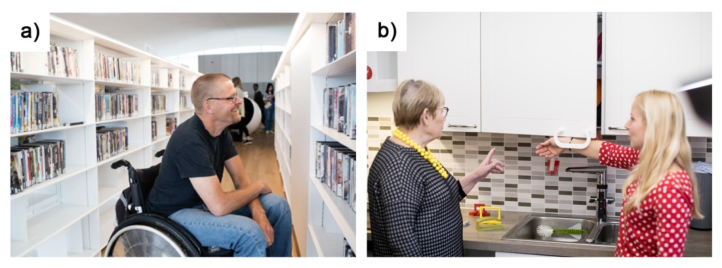
Last but not least is the principle of size and space for approach and use. The products designed according to this principle should allow for reach, manipulation, and use regardless of the user’s body size, posture, or mobi- lity. It is important to provide access to any component of the space and/or product both in seating and standing position. Furthermore, it is essential to consider various hand and grip sizes. A good case study of implementing this principle is the Oodi Public Library located in Helsinki (Finland) and consi- dered one of the most accessible public spaces in the whole Baltic Sea region. All the bookshelves are designed in a way that also people in wheelchairs can reach even the highest shelf (see Figure 8a). As far as various sizes of hand and grip are considered a good example is a range of 3D printed furniture handles developed by the Satakunta University of Applied Sciences to enable various manners of opening the cabinets (see Figure 8b).
Figure 8: An example of a) an all-friendly indoor public space in Oodi Public Library in Helsinki, Finland, (Haavisto, 2020) and b) 3D printed furniture handles developed at the Satakunta University of Applied Sciences. (Jakub Wittchen for BaltSe@nioR project).
Good Practices in Implementing Senior-Friendly Design 229
CONCLUSION
The article constitutes a review of exemplary good practices in implemen- ting senior-friendly solutions across various countries of the European Union. They have been presented through the perspective of universal design princi- ples to help to illustrate them in a more practical manner. Disseminating the knowledge about inspirational case studies proves how taking into consi- deration senior-friendly design can actually leverage the overall quality and accessibility of public spaces for the benefit of all.
ACKNOWLEDGMENT
These examined issues constitute a part of the project: BaltSe@nioR 2.0: Innovative solutions to support BSR in providing more senior-friendly public spaces due to increased capacity of BSR companies and public institu- tions. This work was part-financed by the European Union (European Regional Development Fund and European Neighbourhood and Partnership Instrument).
REFERENCES
Afonso, C., Graca, P., Kearney, J. M., Gibney, M. J. and De Almeida, M. D. (2001).
Physical activity in European seniors: attitudes, beliefs and levels. The Journal of Nutrition, Health & Aging, 5(4): 226–229. Bendixen, K., Benktzon, M. (2015). Design for All in Scandinavia - a strong concept.
Applied ergonomics, 46 Pt B: 248–57. doi:10.1016/j.apergo.2013.03.004 Brunes A., B. Hansen M., Heir T. (2019). Loneliness among adults with visual impairment: prevalence, associated factors, and relationship to life satisfaction. Health Qual Life Outcomes 17, 24. doi:10.1186/s12955-019-1096-y Fabisiak, B., Deloso, R. (2021). A guide to senior-friendly public spaces, Poznan,
Poland. Fabisiak, B., Jankowska, A., Kłos, R., Knudsen, J., Merilampi, S., Priedulena, E.
(2021). Comparative study on design and functionality requirements for senior-friendly furniture for sitting. Bio Resources, 16(3): 6244–6266. doi: 10.15376/biores.16.3.6244–6266 Haavisto, T. (2020). Helsinki City Library, a Cornucopia of Urban Culture and Learning. MONOGRAPH: 75–79. Mackowicz, J. and Wnek-Gozdek, J., (2016). “It’s never too late tolearn”–How does
the Polish U3A change the quality of life for seniors?. Educational Gerontology, 42(3): 186–197. Magnusson, C., Anastassova, M., Paneels, S., Rassmus-Gröhn, K., Rydeman, B., Randall, G., Ortiz, Fernandez L., Bouilland, S., Pager, J., Hedvall, P. O. (2018). Stroke and Universal Design. Studies in health technology and informatics, 256: 854–861.
Mustaquim, M. M. (2015). A study of universal design in everyday life of elderly adults. Procedia Computer Science, 67: 57–66. doi:10.1016/j.procs.2015.09.249 Østergaard, P. (1994). Fornuften i højsædet: Møbler for alle. Christian Ejlers’ Forlag. Perlman, D. (2004). European and Canadian studies of loneliness among seni-
ors. Canadian Journal on Aging/La Revue canadienne duvieillissement, 23(2): 181–188. Pettigrew, S. and Roberts, M. (2008). Addressing loneliness in later life. Aging and Mental Health, 12(3): 302–309. Steinfeld, E., Maisel, J. L. (2012). Universal design: creating inclusive environments.
New Jersey: John Wiley & Sons, Inc., Hoboken. Timlin, G., Rysenbry N. (2010). DESIGN FOR DEMENTIA. London: HelenHamlyn Centre, Royal College of Art. Wen, C., Albert, C., Von Haaren, C. (2018). The elderly in green spaces: Exploring
Read this individual research paper free through the original publisher, or explore the full digital proceedings book.
ISBN 978-1-958651-51-3
Explore this ISBN in the AHFE Bookstore ↗Listed in the July 2026 bookstore catalogue; search by ISBN to confirm current availability · Digital book purchase optional