Yourim Kim, Wonseuk Jang (2023). Usability Evaluation of Intravascular Administration Set with Safety Lock Regulator to Prevent Medication Error. In: Healthcare and Medical Devices. AHFE Open Access, vol. 79, pp. 254–260. https://doi.org/10.54941/ahfe1003494
The safety lock regulator is part of an intravascular administration set with a safety lock to control the infusion rate of fluid and prevent accidents in which fluid is excessively injected due to unexpected events. This study aims to evaluate the usability and satisfaction of intravascular administration set with a safety lock regulator through a usability test. In the usability test, consisting of 22 tasks and 5 scenarios, experienced nurses with an average experience of 6.6 years or more participated to perform tasks and evaluate satisfaction. we collected a number of observational data such as task completion, task completion with an issue and not completion as well as subjective data such as user satisfaction scores and comprehensive opinions. As a result of the evaluation, the success rate of the entire task was 96%, and there were almost no use errors at 4%. The root causes of the observed use errors were low risk due to the lack of understanding of the tasks. The user satisfaction with the 10 questionnaires evaluated on the 5-point Likert scale showed 4.7 scores for the user manual and 4.4 scores for the intravascular administration set. In addition, comprehensive opinions such as user improvement requirements for medical devices and specific reasons for satisfaction were collected. This study confirms that users can safely perform tasks of the use scenario without serious use errors and that safety was improved by preventing operations of the non-medical person by making it difficult to unlock the safety lock regulator. In future studies, it is expected that it will be possible to develop an intravascular administration set that further improves usability and safety by deriving user requirements from the collected comprehensive opinions.
Most patients in hospital settings need Intravenous fluid therapy for several reasons, such as changes in fluid intake, increased fluid loss, or electrolyte imbalance. In other words, intravenous fluid therapy is an essential part of patient treatment during hospitalization (Mousavi et al., 2012). In IV fluid therapy, incorrect selection of IV fluid type, dose, concentration, and errors in fluid and electrolyte administration rates can increase patient morbidity and mortality (Mousavi et al., 2012). In particular, the most common errors associated with fluid therapy are inaccurate infusion rates (Han et al., 2005,
Usability Evaluation of Intravascular Administration Set with Safety Lock Regulator 255
Rooker and Gorard, 2007), and clinical complications such as pulmonary edema, heart failure, or volume depletion have been reported due to errors in fluid administration rate (Mousavi et al., 2012).
In intravenous fluid therapy use the intravascular administration set that is composed of needles, catheters, flow regulators, drop carriers, filters, stoppers, tubes, connectors, and connecting needles. the intravascular admi- nistration set that is a medical device used to administer medical fluid by inserting a needle or catheter in the vein (MFDS, 2022, FDA, 2022). This study aims to evaluate the usability and satisfaction of medical devices and collect opinions on devices through usability testing of intravascular admi- nistration set with a safety lock regulator developed to prevent drug fluid infusion rate error.
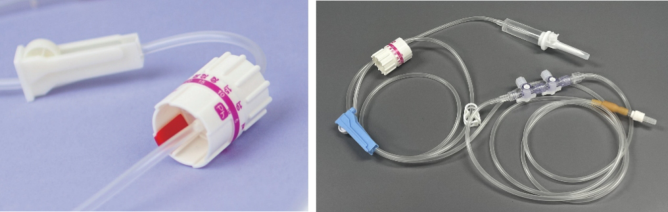
INTRAVASCULAR ADMINISTRATION SET WITH SAFETY LOCK REGULATOR The safety lock regulator (SLR) is a part of an intravascular administra- tion set with a safety lock (stopper) to control the infusion rate of fluid and prevent accidents in which fluid is excessively injected due to unexpe- cted events. Figure 1 shows the SLR and an intravascular administration set (IV set).
Figure 1: Safety lock regulator and intravascular administration set.
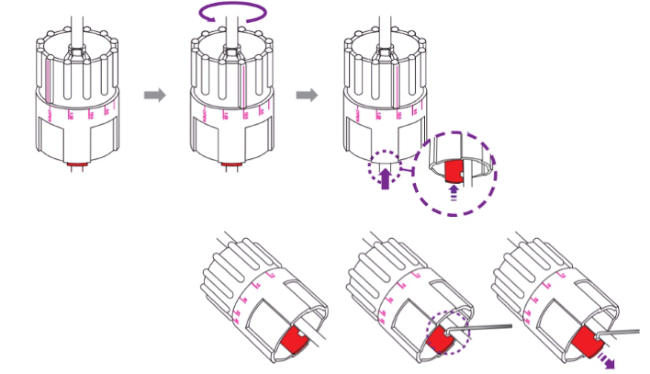
The method of using the SLR is shown in Figure 2. The fluid administra- tion rate is adjusted by rotating the scale of the flow regulator, and the lock can be activated by pressing the stopper on the part shown in the figure. When the lock is activated, the maximum fluid infusion rate of the intra- vascular administration set cannot be adjusted to more than 150 ml/h. To deactivate the lock, insert the tip of the pointed object into the groove inside the stopper, and push the stopper outward. In this way, it is designed to limit the administration rate of the fluid through the safety lock to prevent over- infusion accidents and to prevent accidents caused by non-medical person manipulation by making it impossible to unlock easily when the safety lock is activated.
256 Kim and Jang
Figure 2: Methods of activating and deactivating the safety lock.
USABILITY EVALUATION OF INTRAVASCULAR ADMINISTRATION SET WITH SAFETY LOCK REGULATOR We conducted usability testing and satisfaction assessment questionnaires to assess the usability of the intravascular administration set with a SLR. Since the appropriate number of subjects required for the summative evaluation is 15 (American National Standard, 2018), 15 participants were recruited for nurses with more than 2 years of experience in using the intravascu- lar administration set. Participants performed five use scenarios consisting of a total of 22 tasks: Checking the user manual, unpacking the medical device, priming, Using the SLR function, and Using the Pinch clamp and 3-way stopcock function. Use scenarios and task descriptions are shown in Table 1.
While the participant was performing the task, the observer recorded the success level of the performance of the task. Task success level is divided into three categories: task completion (C), task completion with Issue (CI), and not completion (Privitera, 2019). Ultimately, the task success rate was evaluated, and task success rate refers to the ratio of task completion and task completion with issue to the total number of participants.
After participants completed the tasks, a satisfaction assessment que- stionnaire was conducted on the user manual and intravascular admi- nistration set. The satisfaction assessment questionnaire consisted of a total of 10 questions, including 4 questions for the user manual and 6 questions for the IV set. The satisfaction assessment questionnaire used a 5-point Likert scale with affirmations in the extremes “Strongly disa- gree” (1) and “Strongly agree” (5)(Likert, 1932). The satisfaction asses- sment questionnaire provided a freeform comment section for detailed feed- back on the improvement and satisfaction opinions of the intravascular administration set.
Usability Evaluation of Intravascular Administration Set with Safety Lock Regulator 257
Table 1. Use scenario and task description.
Table available in the original PDF paper.
Use scenario No. Task description
Task 1 Check the precautions for use in the user manual.
Check the user manual
Task 8 Lock the roller clamp completely.
Task 2 Check the pre-use preparation in the user manual. Task 3 Check how to use the medical device in the manual. Task 4 Check the storage conditions of the medical device in the manual. Task 5 Check the disposal method of the medical device in the manual. Unpack the IV set Task 6 Check the model’s name, date of manufacture, duration of use, and packaging condition before unpacking the medical device. Task 7 Remove the packaging of the medical device and check its appearance before use. Remove air (priming)
Task 18 Lock the pinch clamp and check if the fluid administration stops
Task 9 Connect the IV set to the saline solution bag. Task 10 Fill the chamber with saline solution. Task 11 Open the roller clamp and remove air from the IV set. Use SLR function Task 12 After checking the type of fluid to be used, set the fluid administration rate of the SLR to 40 ml/h. (In this evaluation, only normal saline solution is used.) Task 13 Open the roller clamp and check whether the saline solution flows. Task 14 Activate the lock Task 15 Turn the SLR and check the maximum infusion rate of the fluid. Task 16 Deactivate the lock Task 17 Turn the SLR and check the maximum infusion rate of the fluid. Use Pinch clamp and 3-way stopcock function Task 19 Open the pinch clamp and check if the fluid is administered Task 20 Adjust the 3-way stopcock so that saline does not flow. Task 21 Adjust the 3-way stopcock so additional drug injection through the cap is impossible and only saline flows. Task 22 Adjust the 3-way stopcock so additional drug injection through the cap is possible and saline flows.
258 Kim and Jang
RESULT
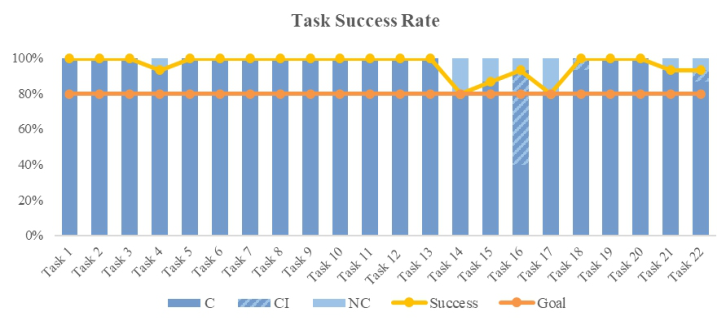
The success rates of 22 tasks performed by 15 nurses in the usability test are shown in Figure 3. When the goal was 80% for the task success rate, the success rate of all tasks was above the goal.
When analyzing the success rate for each scenario (see Table 3), the success rate of the scenario to check the user manual was 99%, and the success rate of unpacking and air removal(priming) was 100%. In addition, the success rate was 90% in scenarios using the SLR function of the product, and 97% in
Figure 3: Task success rate and test goal.Table 2. Satisfaction assessment questionnaire.
Table available in the original PDF paper.
Category No. Satisfaction assessment questionnaire User manual Q1 Is it possible to use it without difficulty according to the method described in the user manual? Q2 Is it easy to check the method of storage and disposal? Q3 Is it easy to check the precautions for use? Q4 Is it easy to see the no reuse or re-sterilization mark? IV set Q5 Is it easy to see the no reuse or re-sterilization mark? Q6 Is it easy to read the scale on the SLR and adjust the SLR? Q7 Isn’t there any difficulty in activating/deactivating SLR? Q8 Do you think using SLR can prevent over-infusion incidents? Q9 Do you think using SLR can prevent arbitrary manipulation by third parties? Q10 Do you feel safer using SLR than using a general flow regulator?
Do you have any brief thoughts or general opinions you felt during the evaluation?
Satisfaction or improvement comments
Usability Evaluation of Intravascular Administration Set with Safety Lock Regulator 259
Table 3. Scenario success rate.
Table available in the original PDF paper.
Use scenario Scenario success rate Overall Check the user manual 99% 96% Unpack the IV set 100% Remove air (priming) 100% Use SLR function 90% Use Pinch clamp and 3-way stopcock function 97%
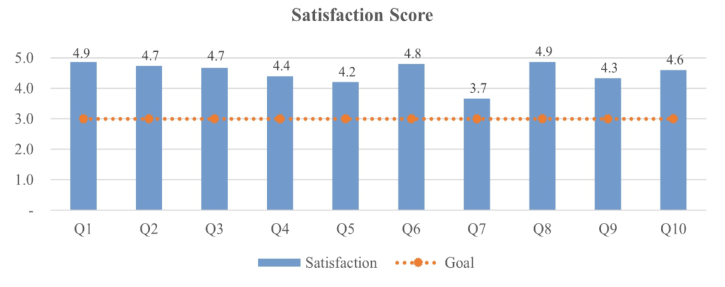
Figure 4: Satisfaction score.
scenarios using the Use Pinch clamp and 3-way stopcock function. the success rate of the entire task was 96%, and the rate of use error was 4%.
The use errors observed in relation to SLR with a 90% scenario success rate include attempting to deactivate the safety lock in the task of activating the safety lock, locking the pinch clamp instead of the stopper, and not activating the safety lock. The root cause of this use error was a lack of understanding of the described task, which is a low risk of severity because it can be resolved if the task description is clearly stated.
Satisfaction assessment results are shown in Table 2. When the satisfaction score goal was 3 scores, all questionnaires were scored above the goal. The satisfaction with the user manual composed of 4 questionnaire items was 4.7 scores, and the satisfaction with the use of the IV set composed of 6 questionnaire items was 4.4 scores. The satisfaction score was the highest in Q1 and Q8, with 4.9, which means that users can use it as described in the instructions for use without difficulty, and that SLR can prevent over- infusion incidents. Q7 showed the lowest satisfaction score of 3.7. Q7 is a satisfaction assessment questionnaire on whether there is any difficulty in activating/deactivating SLR, and it seems to be an appropriate score because SLR was designed to make it difficult to unlock the safety lock to prevent manipulation of lay person.
In the comprehensive opinion, there was an opinion that it was easy to use intravascular administration set. Regarding SLR, there were opinions that it was difficult to deactivate the safety lock, that it would be easy to use once you get used to the device. participant knew that it is made for safety and
260 Kim and Jang
one nurse who was using a similar product provided an opinion that the number of medication infusion incidents decreased significantly after using the medical device. In addition, there were some improvement opinions that it would be nice if there was a dedicated tool used to deactivate the stopper of SLR and that the unlocking method would be changed in another way.
CONCLUSION
In conclusion, both task success rate and satisfaction assessment question- naire achieved the target values of 80% and 3 score. We confirmed that users can safely perform tasks of the use scenarios without serious use errors through the usability test. In addition, we confirmed that safety was impro- ved by preventing operations of the non-medical person by making it difficult to unlock the safety lock regulator.
Therefore, it seems that medical incidents caused by over-infusions can be reduced by preventing the manipulation of non-medical persons or patients. It is also expected that the intravascular administration set with safety lock regulator evaluated in it study can be useful for intravenous injection therapy in the medical field. In future studies, it is expected that it will be possible to develop an intravascular administration set that further improves usability and safety by changing the design from the collected comprehensive opinions to the unlocking method of SLR that reflects user requirements.
ACKNOWLEDGMENT
The authors would like to thank nurses from the severance hospital, Gan- gnam severance hospital and the yongin severance hospital for participating in the study.
REFERENCES
American national standard 2018. ANSI/AAMI HE75: 2009/(R)2018 Human factors engineering - Design of medical devices. American National Standard. FDA 2022. Code of Federal Regulations Title 21, Volume 8, Part 880 General
Hospital and Eneral Hospital and Personal Use Devices, 880.5440 Intravascular administration set. Food and Drug Administration. Han, P. Y., Coombes, I. D. & Green, B. 2005. Factors predictive of intravenous fluid administration errors in Australian surgical care wards. Quality and Safety in Health Care, 14, 179–184. Likert, R. 1932. A technique for the measurement of attitudes. Archives of psycho-
logy. MFDS 2022. Regulation on Medical Device Groups and Class by Group. Medical Device Products and their Assigned Classes. Ministry of Food and Drug Safety. Mousavi, M., Khalili, H. & Dashti-Khavidaki, S. 2012. Errors in fluid therapy in
medical wards. International Journal of Clinical Pharmacy, 34, 374–381. Rooker, J. C. & Gorard, D. A. 2007. Errors of intravenous fluid infusion rates in medical inpatients. Clin Med (Lond), 7, 482–5.
LISTED IN THE AHFE DIGITAL BOOKSTORE CATALOGUE
Explore the complete digital volume
Healthcare and Medical Devices
Read this individual research paper free through the original publisher, or explore the full digital proceedings book.
ISBN 978-1-958651-55-1
Explore this ISBN in the AHFE Bookstore ↗Listed in the July 2026 bookstore catalogue; search by ISBN to confirm current availability · Digital book purchase optional