Johanna Närväinen, Juha Kortelainen, Timo Urhemaa, Mikko Saajanlehto, Kari Bäckman, Johan Plomp (2023). HealthGate: unobtrusive home monitoring of vital signs, weight and mobility of the elderly. In: Healthcare and Medical Devices. AHFE Open Access, vol. 79, pp. 43–50. https://doi.org/10.54941/ahfe1003472
This paper will discuss the feasibility of a monitoring setup HealthGate, designed to monitor the mobility, vital signs, and weight of an elderly person living in her own apartment. The versatile sensor setup will allow more comprehensive insights than what is currently available. Continuous home monitoring will enable early interventions and actions in e.g. suspected dehydration, mobility problems, and non-optimal or missed medication. The data can be used to form indices of e.g. frailty and sleep quality, to detect changes in health and behavior, and to alert the person, relatives or caregivers of detected and impending problems. Instead of interaction with the user, the setup seeks total unobtrusiveness: invisible or integrated sensors as well as automated measurements and data transmission. This is crucial with persons suffering from severe cognitive impairment: the operation does not rely on user actions and the setup is safe from a curious user. On the other hand, tailored reports can be provided to people who can and want to investigate their own status. The custom-made monitoring system uses three sensor types: a mm-range imaging FMCW radar (1), a seat foil sensor (2), and a novel four-element weight sensor array. The seat and weight sensors are positioned in a favorite armchair and the radar cabinet faces the chair, typically positioned next to the TV. The key events from which the data are recorded are the transitions to and from the chair and the moments sitting still in the in, typically watching TV. The system will monitor heart and breathing rate (both radar and seat foil), weight, and dynamic weight distribution across the sensors under the legs of the chair, as well as movement at and near the chair (radar). Sleep is monitored using a commercial sleep sensor (VTracker 2.0, eLive Ecosystem Ltd., Finland) placed underneath the topping mattress. As the chairs used in individual homes will vary making inter-subject comparisons more difficult, during each home monitoring period, the participants will also perform a guided sitting, standing-up and walking protocol using a similar setup but with a test chair. The 25 participants are residents of a senior community, living independently in their rental apartments but using home care services. The data are collected during a series of two two-week monitoring periods, five participants at a time, starting in November 2022. We will describe the setup and data collection solution as well as show the first multisensor data comparisons and the proposals for characteristic mobility parameters for a sit down - stand up sequence and walk. The quality, reliability and limits of the biosignals and movement parameters derived from the radar data will be discussed. The data will be compared to standard measures of frailty, collected in a controlled test session, consisting of grip force, walking speed, timed sit down – stand up, and agility tests, as well as the frailty index (3) computed from the interRAI-HC assessments collected bi-annually. The daily patterns, biosignal data and daily weight variation will be compared against sleep data and interview data on acute illnesses and other conditions influencing behavior and well-being. Finally, the usability and acceptability of the setup are discussed, based on the interview data collected from the participants and home care nurses.(1) M. Mercuri et al., (2016). Biomedical wireless radar sensor network for indoor emergency situations detection and vital signs monitoring. IEEE Topical Conference on Biomedical Wireless Technologies, Networks, and Sensing Systems (BioWireleSS), pp. 32-35(2) Anttonen, J., & Surakka, V. (2005, April). Emotions and heart rate while sitting on a chair. In Proceedings of the SIGCHI conference on Human factors in computing systems (pp. 491-499).(3) Faller JW, et al. (2019) Instruments for the detection of frailty syndrome in older adults: A systematic review. PLOS ONE 14(4): e0216166
The population is aging and the pressure to enable the elderly to continue living in their own homes, despite their age-related problems, increases con- stantly. One enabler is technology: various assistive solutions, automated adjustments and anomalies of the ambience, and monitoring of the status quo and events in health and behaviour. A recent systematic literature review (Maswadi 2020) provides a comprehensive list of review articles analysing different aspects of the technologies used to assist and protect the elderly. In Lunardini et al (2019), the concept of continuous monitoring in a smart home was proposed in practical terms: sensors, data flow and actions.
For care givers and relatives, continuous information of health and mobi- lity of a person reduces the need for check-up appointments and allows fast intervention in case of problems. There are a lot of consumer products that can be used to monitor physiology and physical activity: rings, wristbands and watches, chest bands (e.g., Jalal 2019, Al-khafajiy 2019). However, the elderly tend to regard wearable sensors invasive and unpleasant, suggesting that remote or embedded monitoring devices would be more acceptable in this focus group (Grossi 2020).
A comprehensive model for unobtrusive home monitoring was presented in a review by Wang et al. (2021). The target of monitoring of a person and the ambience can be classified into physiological (vital signs, weight…), movement and functional ability (activity, gait, food intake, daily activities), emergency detection (falls, severe acute health problems), security (fire, water or gas leak, intruders) and social behaviour (phone calls and messaging, visitors).
In this paper, we introduce the HealthGate (HG) setup designed to unobtrusively monitor physiology and function of an elderly person living independently. The setup is described and the first results of implementa- tion in private apartments, guided test sessions and end-user appraisals are presented.
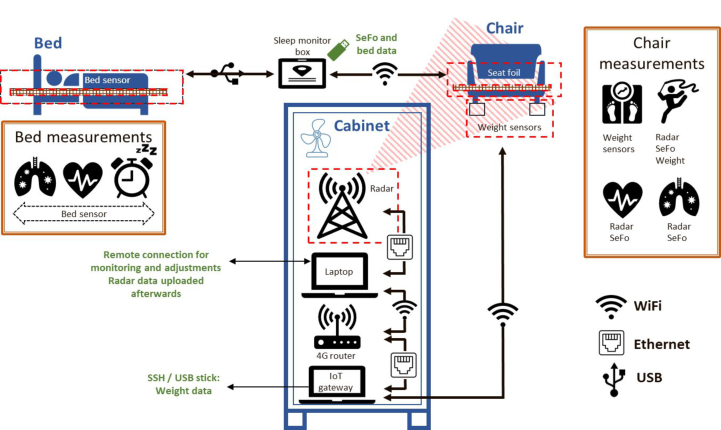
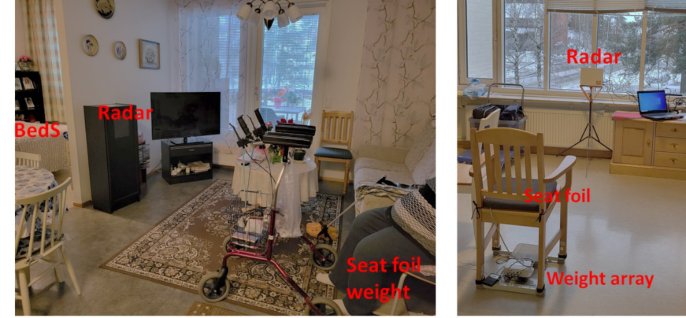
HEALTHGATE IMPLEMENTATION The two main principles in HG design are unobtrusiveness and protection of privacy. Contact sensors are not used, and the system does not record voice or video data. HG uses three sensor types: a 2D imaging radar, a four-sensor weight array at seat and piezoelectric force sensor arrays both at seat (Sefo) and at bed mattress. The sensors are monitoring the favourite chair in living room and the bed (Figures 1 and 2).
The house-made radar (VTT, Finland; Forstén 2020) operates at mm- range (60 GHz) with Frequency Modulated Continuous Wave sweep mode (FMCW). The radar has eight transmit (TX) and eight receive (RX) antennas resulting in 64 virtual channels. Frequency-division multiplexing generates
Figure 1: The setup used in the apartments. The measurements take place when the person is sitting in the chair (weight, mobility, heart rate and breathing) and in bed (heart rate, breathing, movements and sleep time). The remote control and data export is shown in green.
HealthGate: Unobtrusive Home Monitoring of Vital Signs, Weight, and Mobility 45
Figure 2: Implementation in an apartment (left) and for the controlled tests (right).
nonoverlapping frequency sweeps for each TX antenna so that each transmit signal can be separated from the received signals. This provides simultaneous sampling of the 2D image frames and enables monitoring of moving targets. The spatial mapping by range-FFT operations results in a 2D image of 160
by 20 m (horizontal x distance) with angular resolution of 3.5
and distance resolution of 30 mm. The radar signal was analysed in detail over a region around the chair and the seated person (ca. 20
by 1.0 m). The heart rate and breathing rate for a seated person were derived as in Turppa 2020.
Prototype of the weight array system (Benete Ltd, Turku; Sensoan Ltd, Finland; VTT, Finland) has four weight sensors attached into the corners of an adjustable H-frame onto which a 4-legged chair can be positioned. Indi- vidual sensor acts like a strain gauge which can translate up to 500 N into an electrical signal. All four sensors are attached to a sensor box (IoT node) where pre-processed sensor signals are transmitted wirelessly to a gateway box (IoT gateway). Communication protocol is based on Wirepas Massive IoT architecture developed by Wirepas Ltd.
The bed and seat sensors (eLive Ecosystem Inc., Finland) detect ballisto- cardiographic signals. A patented multi-channel method is applied for the on-line processing of the vital signs (Kortelainen, 2007). The seat foil sensor has four sensor elements (area 35 × 30 cm2) and the bed sensor has eight (35 × 60 cm2). The seat sensor is mounted in the seat cushion, placed on top of the seat. Both seat and bed sensor provide motion activity, heart rate and respiration analysis, added with the overnight sleep analysis from the bed sensor.
The apartments were monitored for a 2-week period. A controlled test was arranged close to the monitoring period in order to collect uniform data. The baseline physical condition was measured using standard functional, balance and strength tasks. To compare radar, weight array and seat foil data with each other and to inertia sensors, placed on chest and around both ankles (Movesense HR+, Suunto Ltd, Vantaa, Finland), a fixed movement protocol was used. It consisted of periods of sitting still in the chair, walking ca. 5 meters away and back, and a sequence of three stand up - sit down sequences
with 10 s delays in both ends. The physical condition test results are not discussed in this paper.
The participants were interviewed at the end of the monitoring period for their health and sleep as well as for their opinions about the setup and its future use possibilities.
THE PRELIMINARY RESULTS AND DISCUSSION The experiments started in December 2022 and at the moment, eleven sub- jects of the target N of 25 have completed the monitoring period and six of them have participated the controlled tests. Data acquisition will go on until spring 2023.
In the next chapters, the first data from controlled tests are presented and some practical aspects and participant viewpoints are discussed. More detai- led analysis and inter-sensor validation will be done as the data accumulates. The analysis of home monitoring data is in process.
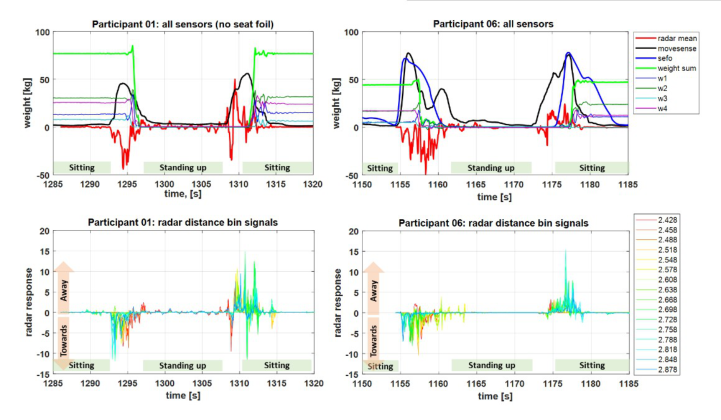
Controlled Tests The multisensory data recorded during sit-stand-sit sequence from two parti- cipants is shown on the top row in Figure 3. For the agile participant (left), the transitions between seated and standing are sharp and there is little swaying back and forth. For the participant suffering from poor mobility (right), the
Figure 3: Integrated sensor data (top row) and movement direction from radar at diffe- rent distances between the radar and reflection site (bottom row) during stand up – sit down sequence. Data for two participants is shown: an agile person (01; left) and a person with challenges in getting in and out of the chair (06; right). The y-axis scale is for weight only. The sitting/standing labels in the graphs are indicative only, based on the accelometer reference data (movesense). In the bottom row graphs, the sign of the values indicates the movement direction, and the values of radar distance (in meters) are shown in the corresponding legend.
HealthGate: Unobtrusive Home Monitoring of Vital Signs, Weight, and Mobility 47
movement is slower and less smooth. The different sensors reflect different aspects or the movement. The weight sum provides the weight of the person and reports the moment the weight leaves/enters the chair. Single weight sen- sors can detect the shifts between the end and front of the chair, or in the lateral direction, monitoring any swaying. The responses in radar, seat foil and accelometer are broader, reflecting the movement before the weight is lifted off or placed back on the chair.
Analysis of the distance bins of the radar signal for the direction of the movement (Figure 3, bottom row) provides more details of the movement. During standing up, the location of the movement shifts gradually towards the radar. In a smooth transition, the distance between the person and the radar decreases monotonously. Any swaying or pumping motion is visible as well.
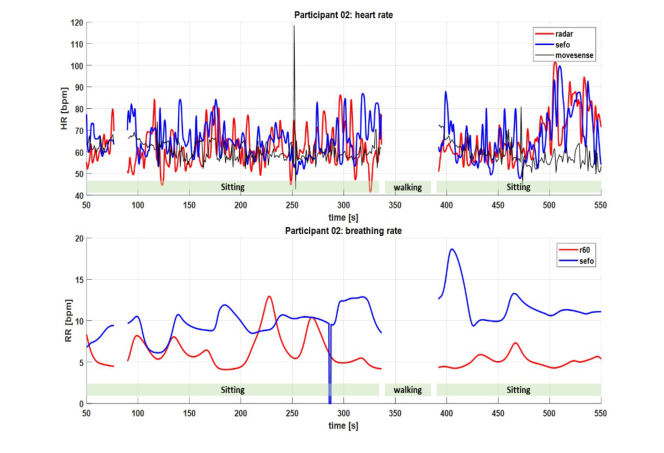
The extraction of biosignals from the radar and seat foil data is shown in Figure 4. In this case, HR in well in line with reference HR, yet noisier. This is typically the case when the participants are immobile (our data and Turppa 2020). For BR, the agreement between the radar and seat foil particularly after the walk sequence is poor, possibly due to talking.
The standard deviation on the radar signal, indicating movement, was used to compute the stand-up and sit-down times (beginning and end of the movement gradient) and maximum speeds (maximum of the derivative of the movement gradient). The values in Table 1 are mean ± std of the three trials. As the data in Figure 3 suggests, the onset and end of movement is often ambiguous and uncertain. For the two participants (01 and 06) shown in Figure 3, the stand-up times are similar but the maximum speed for the less agile person (06) is much slower than for the agile person (06). In sitting down, the speeds do not differ.
Figure 4: Heart rate (top) and respiration rate (bottom) data computed from data acquired during sitting still.Table 1. Duration and maximum speed of the standing up and sitting down, as estimated from radar signal. The values presented are mean ± std of the three trials for each direction.
User Viewpoints In interviews, the setup was considered interesting and, once in full use, the data it collects was considered important for feeling safe. The lack of video and audio recording was considered a benefit, reducing the feeling of intrusiveness. However, a few participants said they would not like to use it themselves, unless they had a severe health problem requiring monitoring, such as cardiac problems.
The access to the data should be given to the person herself and, with consent, to her healthcare professionals and to chosen relatives. The direct involvement of companies was considered somewhat suspicious; the service was considered more trustworthy if it comes through the public or private healthcare provider.
The participants live independently but some of them suffer from mode- rate dementia. Among them, the cabinet sometimes caused confusion as they didn’t quite remember what it was and if they should somehow change their routines because of it. It is important to provide contact information, prefe- rably written on the device itself, so that the resident, visiting family members or caregivers can reach the researchers.
Practical Observations and Future Direction Typical to a pilot study in real life setting, the data loss has been quite high, due to both technical and practical reasons. There have been issues with run- ning stability of the radar acquisition PC over the two weeks monitoring period. Some participants unplugged power cords. In some setups, the weight sensors could not be installed: the person only had a sofa or the non-sliding, heavy weight sensor frame was impractical for the dining chair the person preferred. With some, the computer and cabinet fan noise disturbed sleep and the radar acquisition had to be stopped.
For easier setup and more reliable measurements, both in monitoring and in test sessions, the devices should be integrated, and a convenient way to see if all devices are alive and acquiring should be arranged. Also, the system should be easier to control and reboot remotely. This is one of the next steps in device development. There are some technical improvements needed, too, particularly in the weight array that was considered bulky, difficult to fix securely and too high.
HealthGate: Unobtrusive Home Monitoring of Vital Signs, Weight, and Mobility 49
The data analysis presented in this paper is preliminary and mostly qua- litative. The development will now focus on extracting parameters that are relevant for assessing the functional status: characteristics of the dynamics of the weight and seat foil data during standing up, distance information from the radar near the chair and while walking. Besides conventional data analy- sis for each sensor, we will investigate whether AI methods could be used to model the integrated sensor data, using accelometer data and test results as target of classification. The parameters and models created for test session data could then be used to understand and analyse the data recorded in the apartments.
CONCLUSION
The real-life implementation of the health gate setup was successful, even if several practical development needs were discovered and the data loss in the first monitoring periods was reasonably high. The sensors used in HG provide complementary information of the biosignals and mobility of a per- son. The results from controlled sessions will provide basis for analysing the monitoring data.
Developing the HG towards a tool to monitor an elderly person will require deeper collaboration with caregivers and medical professionals. The relevant parameters and events need to be identified and thresholds for alerts need to be defined. The experiments presented here provide a good starting point for the work.
ACKNOWLEDGMENT
The NextPerception project has received funding from the ECSEL Joint Undertaking (JU) under grant agreement No 876487. It receives support from the European Union’s Horizon 2020 research and innovation programme and national funding from Finland, Spain, Italy, Germany, Czech Republic, Bel- gium, and The Netherlands. We also thank City of Kuopio and the personnel at Mäntylä assisted living facility, Finland for providing a platform for this pilot study.
REFERENCES
Al-Khafajiy, M., et al. (2019) “Remote health monitoring of elderly through wearable sensors” in. Multimedia Tools and Applications, 78(17), pp. 24681–24706. Forstén, H., et al. (2020) “Scalable 60 GHz FMCW frequency-division multiple-
xing MIMO radar”, in IEEE Transactions on Microwave Theory and Techniques, 68(7), pp. 2845–2855. Grossi, G., et al. (2020) “Positive technology for elderly well-being: A review”, in Pattern Recognition Letters, 137, pp. 61–70. Jalal, A., et al. (2019) “A wrist worn acceleration based human motion analysis and
classification for ambient smart home system”in Journal of Electrical Engineering & Technology, 14, pp. 1733–1739. Kortelainen J. and Virkkala J. (2007) “FFT averaging of multichannel BCG signals from bed mattress sensor to improve estimation of heart beat interval”, in 29th
Annual International Conference of the IEEE Engineering in Medicine and Biology Society pp. 6685–6688. Lunardini, F., et al. (2019) “The movecare project: Home-based monitoring of frailty”, in 2019 IEEE EMBS International Conference on Biomedical & Health Informatics (BHI) pp. 1–4. Maswadi, K., et al. (2020) “Systematic literature review of smart home monitoring
technologies based on IoT for the elderly”, in IEEE Access, 8, pp. 92244–92261. Turppa, E., et al. (2020) in “Vital sign monitoring using FMCW radar in various sleeping scenarios”, in Sensors, 20(22), p. 6505. Wang, J., et al. (2021) “Unobtrusive health monitoring in private spaces: The smart
home”, in Sensors, 21(3), p. 864.
LISTED IN THE AHFE DIGITAL BOOKSTORE CATALOGUE
Explore the complete digital volume
Healthcare and Medical Devices
Read this individual research paper free through the original publisher, or explore the full digital proceedings book.
ISBN 978-1-958651-55-1
Explore this ISBN in the AHFE Bookstore ↗Listed in the July 2026 bookstore catalogue; search by ISBN to confirm current availability · Digital book purchase optional