Keiko Toya (2023). International Comparison on Obstacles to Service Conversion of Manufacturing Industries. In: Human Aspects of Advanced Manufacturing. AHFE Open Access, vol. 80, pp. 171–177. https://doi.org/10.54941/ahfe1003519
This study is an international comparison of Japan and Scandinavia regarding necessary conditions in manufacturing industries that are undergoing servitization.With the shift of developed economies to services, there has been a noticeable trend toward the shift of manufacturing industries to services. However, Japanese manufacturing industries lack service personnel in all aspects, including service planning, management, and front-line operations, because their operations differ from those of traditional manufacturing industries. The shortage of human resources is a phenomenon, and it is necessary to address the structural issues that prevent the development of human resources. Toya (2016, 2020, 2022) identified the obstacles to Servitization in the Japanese manufacturing industry as: a seed-oriented organizational culture, lack of medium- and long-term evaluation of business and human resources, low mobility of human resources, and, by extension, a lack of the industry structure, and attitudes toward the way they work. At the same time, we have conducted structural and time-series analyses based on large-scale fixed-point survey data on the status of servicization. An international comparison focusing on the unique manufacturing culture of the Japanese manufacturing industry and institutional issues related to human resource development and mobility, as revealed by these previous studies, was necessary.This study quantitatively compares Japan and the Nordic countries in terms of the elements and structures that impede the shift to manufacturing services. Specifically, a survey will be conducted simultaneously with manufacturing management in four Nordic countries (Sweden, Finland, Norway, and Denmark) and Japan for comparative analysis. The survey is currently underway and the results and discussion will be presented at a later date.
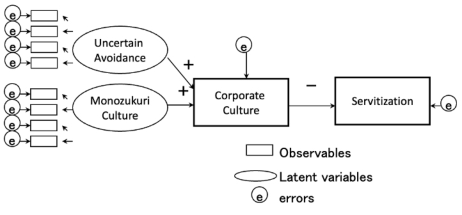
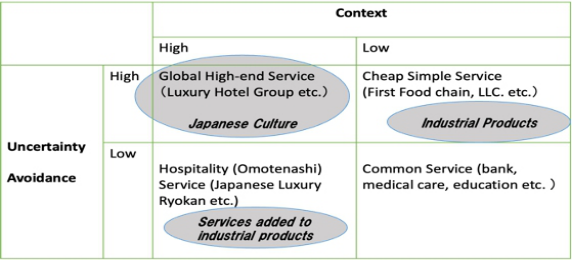
One of the obstacles to Servitization in the manufacturing industry is custo- mers’ reluctance to pay for services. From interviews with Japanese manu- facturers seeking to service their products, many respondents indicated that unlike in the West such as US. UK. and EU countries, Japanese customers do not accept paying for services (Toya et al. 2016). While other countries have similar problems (Gebauer et al., 2005; Barquet et al., 2013; Malle- ret, 2006; Mo, 2012; Bititci, 2006), Japanese manufacturers’ arguments are very strong. Japan is a high-context culture that endorses tacit understan- ding, and at the same time, it is a highly uncertainty-avoidance culture. This cultural background is thought to influence the attitudes and behaviours of manufacturing employees.
Figure 1: Corporate culture and servitization conceptual model.
THEORETICAL BACKGROUND Cultural Comparative Perspective
Hofstede’s six-dimensional cultural scale (Hofstede, 1983; Money, Gilly, and Graham, 1998; Roth, 1995; Bergiel, Bergiel and Upson, 2012) indicates that cultures with high uncertainty avoidance tend to be anxious about uncertain situations and the unknown future, conservative and homogene- ous, and dependent on others and organizations. Asian countries, especially Japan, have high uncertainty avoidance (with Singapore and Hong Kong being exceptions), while Scandinavian countries and the UK have low, and North American countries have slightly lower than them. Comparisons have also been made in terms of high-context and low-context cultures (Korac- Kakabadse et al., 2001; Nguyen et al., 2007). In high-context cultures, communication is subtle, inclusive, and people read between the lines. In low- context cultures, communication is direct, simple, and people often repeat for clarification.
Relationship Between the Nature of Goods and Cultural Comparison Services, as intangible goods (so-called plural services), which have been provided by manufacturing companies as after-sales services added to their products, have inherent uncertainty due to their intangible, heterogeneous, indivisible, and vanishing nature. The labour of service employees is referred to as emotional labour, in which managing emotions is “sold in exchange for wages” (Hochschild, 1983). Ambiguity is inevitable as long as human beings, a resource whose quality is insecure, are in charge of service operation of the value creation.
Conversely, in the case of physical goods, the elimination of uncertainty implies high quality, and standardization has been promoted (e.g., ISO) to establish clear quality criteria. For physical goods, the manufacturing pro- cess is clarified and documented at the design stage, with extensive use of numerical values and mathematical formulas. Japanese manufacturers have had successful experiences in excelling in quality by making manufacturing low context, contrary to their culture.
Japan’s Unique View of Service Some believe that hospitality services in Asia, particularly in Japan, carry different meanings than those in the West (Inui et al., 2015). In the West,
International Comparison on Obstacles to Service Conversion 173
Figure 2: Uncertainty-avoidance culture and high/low context related with servitization.
hospitality in closely tied to corporate profits through higher prices for qua- lity service, with employees benefiting from personal skill development and tips. In Japan, however, employees are driven by a sense of pride in their since- rity, which indirectly benefits the company through repeat use and brand enhancement. As a result, in the Japanese hospitality sector, Omotenashi, an expression of sincerity, is typically provided free of charge (Hara, 2016; Goantara, 2019). This is because it is believed that attempting to put a price on something as priceless as hospitality would diminish its value. Alth- ough the term hospitality is commonly used in the BtoC hospitality industry, employees of BtoB firms receive services as individual consumers and reco- gnize it as part of their culture, which may apply to their own work. For example, a manufacturer of industrial machinery is expected to rush to the customer’s site in the event of a breakdown, even if it is in the middle of the night, on a holiday, or even when repairs cannot be made.
The following is a cultural comparison of the above, the nature and culture of goods, and the unique concept of service in Japan. Current manufacturing Servitization involves the integration of industrial products and services, with co-creation of value with the customer being incorporated. The question is how to provide services that are appropriate for Japan’s high-context and high-uncertainty-avoidance culture.
QUALITATIVE SURVEY AND RESULT The three companies have been successfully adopted business models that allow them to receive monetary and non-monetary compensation for their services.
When customers are not willing to pay for services, the companies either absorb the cost of the service or make it free of charge, or they pass on the cost to the product price. Additionally, they may keep the product price to the distributor low or split the cost and revenue from the service with the distributor, instead of outsourcing the service process to them. That is the case for Yamaha (case1).
In some cases, the companies allow customers to perform the service pro- cess themselves, either for free or at a low price. That is the case for IKEA (case2). The companies also use various strategies to encourage customers to participate in co-creating value. One strategy involves recruiting customers
174 Toya
to act as sales agents. Another strategy involves recruiting potential agents who desire emotional benefits from clients and outsourcing their work for free, while branding the role as a form of non-monetary co-creation value. The former strategy is a form of sharing results as a collaborator, while the latter two strategies encourage customers to voluntarily provide labour. The main difference between the latter two strategies is that the second strategy provides emotional value but charges a fee to clients who do not like it, while the third strategy recruits potential agents who desire emotional value from clients and outsources their work for free. That is the case for Nestlé (case3).
Overall, these strategies demonstrate that the companies are focused on creating non-monetary co-creation value.
Case 1: Yamaha Motor Co. / Sea-Style Yamaha Motor Co., Ltd. operates a membership-based pleasure boat rental business in partnership with 140 marinas nationwide. Yamaha, a manufactu- rer that has suffered a decline in pleasure boat ownership in recent years, and the marinas that serve as its distributors, have created a new market through cooperation. Marinas purchase boats for rental at a low price, about half the regular price, through a subsidy from Yamaha, and offer the rental business. After three years of rental use, the boats can be freely sold as used boats. Even operators who have not made much profit in the rental business can break even at that point, and the business will be profitable. The company has established a system that allows ordinary consumers, who used to think that pleasure boats were only for the wealthy, to casually enjoy marine leisure by renting boats at any of 140 marinas nationwide. The number of members has reached 20,000, contributing to the revitalization of the pleasure boat market.
Case 2: IKEA IKEA, which originated in Sweden, maintains low prices by establishing a DIY process based on the premise that customers do the work to improve their home interiors themselves, as opposed to furniture stores that sell pre- finished furniture, against the backdrop of Scandinavian culture where DIY is very popular. Customers identify the components they need, collect them from the stockroom, account for them, transport them, and do the work themselves at home. The product line includes everything from simple furni- ture assembly to relatively large home remodeling projects such as flooring installation. The company incorporates various mechanisms for customer self-containment, such as illustrated manuals that anyone can understand rather than text. For customers who do not prefer DIY, the company offers transportation and assembly services for a fee.
Case 3: Nestlé Japan K.K. / Nescafe Ambassador and IKEA Nestlé Japan provides coffee makers free of charge to employees who volun- tarily serve coffee in the office and periodically sends coffee-related products for a fee. The company has named its organizers “Nescafe Ambassadors” to meet the needs of workers who want to drink good coffee in the office at
International Comparison on Obstacles to Service Conversion 175
a low price (20 yen per cup), activate office communication through coffee, and connect with others. There is no monetary compensation for the Ambas- sadors, but the desire for self-recognition from being useful to colleagues in the workplace is a major motivator, and 500,000 people in Japan have alre- ady become Ambassadors by 2020. This system not only contributes to coffee product sales, but also helps to gather customer needs from the ambassadors.
FINDINGS This study demonstrates the potential positive implications of the interna- tionalization of the service industry. Japanese firms can gain experience from their interactions with different markets and different business models through their activities abroad. These findings are consistent with prior rese- arch on the domestic focus of Japanese services (e.g., Ström and Mattsson, 2006) and the challenges experienced by Japanese firms in relation to pricing various types of service solutions, often referred to as Servitization or product service systems. This finding could also be seen as an example of what is refer- red to as the Asian variety of service capitalism (Jones and Ström, 2018), as the dynamics within the Japanese service economy and its connection to Asia may not function exactly as seen in mature Western economies. This calls for further research to facilitate an empirical conceptualization of Asia. Resea- rch findings also show how Japan’s service economy can contribute to the transition to a green economy. Long-term perspectives on service activities, such as sharing, circular economy, and more efficient use of services in indu- strial processes, are beneficial for both business development and the green economy (Ström, 2020).
CONCLUSION
One of the obstacles to Servitization in manufacturing is the difficulty of converting to paid services. As a theoretical contribution, the novelty of this study is that it examined attitudes toward billing in terms of the relationship between the characteristics of services and goods and culture, and was able to obtain directions for Servitization in forms other than billing.
As a practical contribution, we suggest that manufacturers consider vari- ous pricing strategies rather than rushing into service billing in Japan, where uncertainty avoidance orientation is strong. This could include the long-term experience (Bramklev and Ström, 2011) of Japanese companies in creating various service solutions, such as within product-package combinations. It is important to understand the value that customers want and combine this with a long-term relationship-building approach, to create a mecha- nism for co-creating value by involving customers, and to find a pricing model that is compatible with this mechanism. Companies based on shareh- older capitalism have sought to secure short-term sales and profits, but given Japan’s high context cultural background, the market may not welcome the direct conversion from high context to low context of charging. In this case, the finding that it is also effective to seek the path of Servitization, which
176 Toya
aims to increase non-financial value through co-creation, makes a significant practical contribution.
ACKNOWLEDGMENT
This work was supported by the Servitization Consortium. (https://unit.aist. go.jp/harc/servitization-conso/conso_overview.html.)
REFERENCES
Barquet, Ana Paula Bezerra, et al. 2013. Employing the business model concept to support the adoption of product–service systems (PSS). Industrial Marketing Management 42(5): 693–704. Bititci, U. S., Mendibil, K., Nudurupati, S., Garengo, P. and Turner, T. 2006.
Dynamics of performance measurement and organisational culture. International Journal of Operations & Production Management. 26(12):1, 325-1, 350. Gebauer, H., Fleisch, E. and Friedli, T. 2005. Overcoming the Service Paradox in Manufacturing Companies. European Management Journal. 23: 14–26. Goantara, L. O. 2019. Analysis on Japanese Hospitality Spirit of Omotenashi: Does
it Work in Other Countries? A Case of its Implementation in Indonesia. Master’s thesis, Lund University. Hara, Y., Maegawa, Y., Yamauchi, Y. 2016. Sustainability and Scalability in Japanese Creative Services. In: Kwan, S., Spohrer, J., Sawatani, Y. (eds) Global Perspectives on Service Science: Japan. Service Science: Research and Innovations in the Service Economy. Springer, New York, NY. Hochschild, A. 1983. Comment on Kemper’s” Social Constructionist and Positivist
Approaches to the Sociology of Emotions”. American Journal of Sociology. 89(2): 432–434. Hofstede, G. 1983. The Cultural Relativity of Organizational Practices and Theories.
Journal of International Business Studies. 14:75–89. Inui, H., and Matsukasa, H. 2015. A Study on the Differences between the Hospitality Offered in Europe and the US with that of Asia. Journal of Industry and Management of Industrial Management Institute. 47: 1–13. Jones, A., and Ström, P. 2018. Asian varieties of service capitalism? Geoforum. 90:
119–129. Korac-Kakabadse, N., Kouzmin, A., Korac-Kakabadse, A. and Savery, L. 2001.
Low- and high-context communication patterns: towards mapping cross-cultural encounters. Cross Cultural Management: An International Journal. 8(2): 3–24. Malleret, V. 2006. Value creation through service offers. European Management Journal. 24(1): 106–116. Mo, J. 2012. Performance Assessment of Product Service System from System
Architecture Perspectives. Advances in Decision Sciences. 12. Money, R. B., Gilly, M. C., and Graham, J. L. 1998. Explorations of national culture and word-of-mouth referral behavior in the purchase of industrial services in the United States and Japan. Journal of marketing. 62(4): 76–87. Nguyen, A., Heeler, R. M. and Taran, Z. 2007. High-low context cultures
and price-ending practices. Journal of Product & Brand Management. 16(3): 206–214. Roth, M. S. 1995. The effects of culture and socioeconomics on the performance of global brand image strategies. Journal of marketing research. 32(2): 163–175.
International Comparison on Obstacles to Service Conversion 177
Ström, P. 2020. The European Services Sector and the Green Transition. European Parliament. Directorate-General for Internal Policies: Brusseles. Belgium. Ström, P., and Mattsson, J. 2006. Internationalisation of Japanese professional
business service firms. The Service Industries Journal. 26(3): 249–265. Toya, K., Watanabe, K., Tanno, S., and Mochimaru, M. 2016. INTERNAL AND EXTERNAL OBSTACLES OF SERVITIZATION IN JAPANESE MAJOR MANUFACTURES. Spring Servitization Conference 2016. Manchester.
LISTED IN THE AHFE DIGITAL BOOKSTORE CATALOGUE
Explore the complete digital volume
Human Aspects of Advanced Manufacturing
Read this individual research paper free through the original publisher, or explore the full digital proceedings book.
ISBN 978-1-958651-56-8
Explore this ISBN in the AHFE Bookstore ↗Listed in the July 2026 bookstore catalogue; search by ISBN to confirm current availability · Digital book purchase optional