Liu Lian (2023). Systematic design and construction strategy of subway public art based on urban spirit. In: Human Dynamics and Design for the Development of Contemporary Societies. AHFE Open Access, vol. 81, pp. 18–28. https://doi.org/10.54941/ahfe1003529
AbstractWith the acceleration of urbanization around the world, subway space has become a special and necessary public space. The complexity of the subway environment, the diversity of passenger needs, and the integration of urban culture have brought new problems to the future development of subway space. Development is increasingly using design as a means to address social development issues. This paper conducts online or field research on representative subway stations in New York, Stockholm, Shenzhen and other cities, and discusses the feasibility of subway public art design based on urban spirit and the necessity of systemic design thinking intervention research. The material carrier of publicity and urban spirit, analyzing the path and elements of subway public art system design, from the macro level (theme planning and station classification strategy), the meso level (site selection strategy of multi-point layout) and the micro level (design elements generation) to propose a systematic design strategy at three levels.Research BackgroundThe early 20th century had seen the commencement of public art research. After a century of growth, its study subfields have been honed, and several studies on public art in subways have surfaced.Public art is an important medium to create a subway space atmosphere, which is the most intuitive embodiment of a city subway different from other cities. At present, although there have been many studies on the relationship between subway public art and urban spirit, most of the creative themes of subway public art are the translation and presentation of cultural elements, and most of them are based on the individuality of a station, lacking the integrity and continuity of the expression of urban spirit from the perspective of the lack of layout of the whole line of the subway network. There are scattered creations, and the integrity of the public's understanding of the urban spirit has not yet been formed. A system that promotes memory reinforcement.A statement of the objectiveThe research takes the promotion of the city spirit as the starting point, strengthens the city people's cognition, memory, understanding and recognition of the city spirit as the goal, takes the advantage of the wide coverage, tight connection and many nodes of the urban subway network space, takes the subway public art as the material carrier of publicity and the city spirit, analyzes the elements of the subway public art systematic design,and puts forward the subway public art systematic construction strategy based on the city spirit.A statement of the significanceA public art work is composed of multiple design elements, including the theme concept, scale, form of expression, technical means, shape, color and material of the work. The manifestation of urban spirit by the work is the embodiment of urban spirit by the design elements. The significance of this topic is shown in the following four aspects: 1. Taking the city spirit as the starting point, it provides practical methods for improving the city's soft power and strengthening the construction of social spiritual civilization.2."Metro+Public Art" "As the research object, give full play to the advantages of space and design expression, improve the civilization of the urban public, and give the possibility of diversified subway journeys. 3.Run through the research path with systematic design thinking, and provide systematic guidance and suggestions for the planning and design of urban public art. Methods4.use digital technology as a means to provide more innovative options for the presentation form of subway public art and the way to spread the city spirit.Methods:A.Literature analysis method: through summary and induction, we can clarify the research trends of domestic and foreign scholars on this topic, and analyze the existing problems at this stage.B. Case analysis method: analyze subway public art cases around the world to provide basis for the generation of design framework and strategy.C. Inductive and deductive method:The "strategy proposal part" of this study has used inductive and deductive method for many times.D.Propose the systematic design framework of subway public art based on the urban spirit, and propose the transformation method of design elements:1. Transformation method based on entity metaphor2. Transformation method based on structural metaphor3. Transformation method based on location metaphorResultsThe systematic design strategy is proposed from the macro level (theme planning and site grading strategy), the meso level (multi-point layout location strategy) and the micro level (generation of design elements).
The early 20th century had seen the commencement of public art research. After a century of growth, its study subfields have been honed, and several studies on public art in subways have surfaced. Public art is an important medium to create a subway space atmosphere, which is the most intuitive embodiment of a city subway different from other cities. Rita Ochoa, based on a public art project put forward at the Lisbon World Expo in 1998 in Portugal, reconnects the Tagus River with a depressed area, and creates a new set of spaces, aiming to explore the relationship between public art and urban renewal dynamics at the end of the 20th century (Ochoa, 2022). Henriette Steiner told the stories of 9 cities including New York, Paris and Beijing, and believed that cities have unique spirit and character (Steiner, 2012). Kortbek believes that the focus of the current urban cultural development policy is to use public art as a tool for the future development of the city, and placema- king will intervene and influence art in public space (Kortbek, 2018). John McCarthy’s case study of public art schemes in Manchester’s North End and Belfast’s cathedral district shows that public art can indeed make a significant contribution to ‘regional culturally led’ regeneration, while also providing a
Systematic Design and Construction Strategy of Subway Public Art Based on Urban Spirit 19
link using historical links A valuable instrument of image and identity, linking public art to local identities (McCarthy, 2006). Yamamoto cites an artist-led tourism program initiated by the Los Angeles County Metropolitan Tran- sportation Authority as an example of a contemporary art practice rooted in relational aesthetics. Taking rides as a lifestyle choice puts ephemeral experie- nces above material products and further promotes community participation in the transportation environment (Yamamoto, 2018). According to the pre- vious literature research, domestic and foreign researchers have gradually increased their attention to urban spirit and public art. Most foreign litera- ture on urban spirit focuses on the field of architecture and public art, and it is recognized that the subway is suitable for displaying the city’s image and cul- tural spirit; the relationship between the spatial visual image of the subway and urban culture; the relationship between public art and local historical context and place spirit Integration; Emphasis on the complementary relati- onship between urban spirit and public art, while foreign scholars pay more attention to participatory public art, encourage public participation, encou- rage creativity under the leadership of regional culture, research on urban spirit public art in the subway field less.With regard to systematic theoretical application, there are not many research and practice projects on public art applied to the spirit of metro cities, and their influence and scale are relati- vely limited. The application of public art planning, system design and system concepts in subway public art planning and construction needs to attract the attention of the academic community.
At present, although there have been many studies on the relationship between subway public art and urban spirit, most of the creative themes of subway public art are the translation and presentation of cultural elements, and most of them are based on the individuality of a station, lacking the integrity and continuity of the expression of urban spirit from the perspe- ctive of the lack of layout of the whole line of the subway network. There are scattered creations, and the integrity of the public’s understanding of the urban spirit has not yet been formed. A system that promotes memory reinforcement.
This study aims to explore the innovative methods and paths of urban spi- rit, public art, and public aesthetic education in the new era, focusing on the unique advantages of the criss-crossing of subway lines and the strength of communication, and finally constructing the content of public art, Elements and related areas of the overall subway public art framework system, and put forward specific and effective implementation strategies in terms of systema- tic design, which not only meet the requirements of art display and social services in function, but also highlight the specific urban spirit.
URBAN SPIRIT AND THE METRO PUBLIC ART DESIGN The Subway Public Art Design Concept
The term Public Art Design emerged in the United States in the 1960s from activities promoted by the National Endowment for the Arts and the Public Service Administration, which included Art in the Public Domain, Art in the field of architecture” and so on, and it was closely integrated with the image
20 Liu
of the government in the era of The Great Society. Therefore, public art, as a theoretical term, has a certain political background and ideological color since its birth. The subway public art limits the display space of public art within the entire subway field, and the form of expression will vary according to the carrying medium and space factors in the subway.
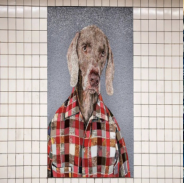
Metro public art is an art form that exists in the subway space and serves the public. Common forms include: painting, sculpture, art exhibits and stru- ctures of various styles (see Figure 1). It is a social behavior projected by the spirit, the ultimate purpose of its construction is not only to present the mate- rial form, but also to meet the spiritual and behavioral needs of the people inspired by the urban spirit, to use the subway public art as the medium of urban cultural transmission, and to shape the cultural image of a city in people’s minds.
Figure 1: The form of public art works in New York, Stockholm, and Shenzhen subways.
Feasibility and Advantages of Being Rooted in the Spirit of the City Urban spirit and public art share common features of publicity and culture. Political theorists Dainel A. Bell and Avner regard urban spirit as a kind of bottom-up civic spirit, emphasizing close contact with civic life (Zi et al. 2021). Public art itself is the art of the masses, and its most important pre- mise in the construction of contemporary cities is the appeal for publicity (Lili, 2013), which is directly reflected in the close connection between the theme of the work and the real society.
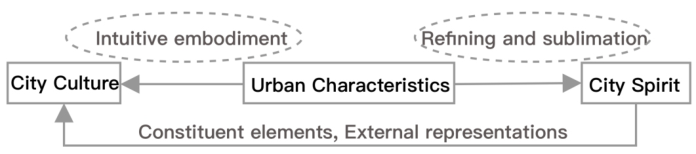
Compared with the urban spirit, people have a wider understanding of urban culture and a deeper feeling, because urban culture is particularly spe- cific in the daily life of urban residents. For example, the food culture revealed in three meals a day, the dialect culture reflected in oral conversation, the folk culture reflected in festival activities, the historical culture precipitated in places of interest and so on. When the excellent cultures in all aspects of the city cohere with each other, a spiritual quality that is shared by urban residents can be formed. The ancients said, “Everything is born, but only knows its roots.” The urban culture contains the genes of the urban spi- rit. Looking at the relationship between urban spirit and urban culture with urban characteristics as a link (see Figure 2), urban spirit is the condensation and sublimation of urban characteristics, and urban culture is the intuitive manifestation of urban characteristics.
Systematic Design and Construction Strategy of Subway Public Art Based on Urban Spirit 21
Figure 2: The relationship between urban spirit and urban culture.
Therefore, urban culture is the most important constituent element and appearance of urban spirit. In terms of representation, it has rich connotati- ons and is easier to be understood and recognized by the public. The urban spirit plays a leading role in the development of urban culture. At the same time, the use of excellent cultural themes is an effective means to promote the urban spirit. The two support and drive each other.
Analysis of the Particularity of Metro Public Art Design Display (1) Particularity of subway space As a comprehensive public place, the subway provides multiple functions. The selection of the subway as the carrying space of public art is based on the particularities of the subway space. First of all, as a means of transpor- tation, as a transportation space, the subway needs to provide people with safe, convenient and efficient travel services; as a public art of the subway, it is limited by the special nature of the underground transportation platform. In addition to the safety of lighting and the guidance of signs, it is possible to fully consider the higher-level needs of passengers such as physical and mental and aesthetics. The expression form of public art is also subject to the spa- tial form and functional demands of the subway. Compared with the ground, its expression form will be relatively simple, mainly including murals, ceiling decorations or display decorations. Therefore, there are many particularities in the space environment of the subway, no matter from the physical level, the subway area, space and operation need smooth flow of people.
The particularity of the physical level, or the lack of space-time informa- tion in underground space.
(2) The particularity of the information level The biggest difference between the subway space environment and the ground space environment is mainly reflected in factors such as the density of information, the compulsion of information transmission, and the narra- tive nature of space. Compared with the subway space, the ground space can be in contact with nature. The rich natural elements provide information on time and orientation such as day and night changes, orientation differences, and seasonal changes; while the subway space is completely enclosed under- ground space, it is isolated from nature. The resulting lack of time and space information and the standardized interior make it easy for passengers to get lost, fatigued and depressed, and even cause claustrophobia.
22 Liu
(3) Progressiveness of user demands Based on the characteristics of the geographical environment of the subway space, most of the subways in China are built underground. In terms of space, due to the lack of reference objects such as ground buildings, vegetation, and landmarks, it is difficult for passengers to judge the spatial orientation in the subway space, which leads to direction confusion. Lost, followed by fear and panic; secondly, due to the lack of natural phenomena such as day, night, and sunlight as a reference, it is difficult for passengers to judge the weather and time outside in the subway environment; in addition, the subway environ- ment is dark Humidity, high flow of people, occlusion and strong sense of depression, etc., coupled with the design of some subway spaces are chaotic and disorderly, so that passengers in it are prone to negative emotions such as anxiety, confusion, bewilderment, and irritability. From the perspective of artistic aesthetics, this sense of “disorder” in space does not come from old public facilities or interior furnishings, but from the sense of visual chaos and disorder. Due to the short construction time of subway space, the conveni- ence of transportation is the primary purpose of subway construction, thus ignoring other elements of human social existence. Based on Maslow’s hiera- rchy of needs, the needs of passengers in the subway space are physiological needs-basic travel level, safety needs-safety and convenience level, emotional needs-fitting with public emotions, cultural identity level-promoting regional culture, Spiritual creation layer—shaping the value of space.
Table 1. Specific features of the particularity of subway public art design.
Table available in the original PDF paper.
Particularity of subway space Specificity of information
Progressiveness of user demands
Safe and convenient
Fluidity of space Information density Basic travel Awareness of space Compulsory delivery of information Spatial continuity Narrative of space Fit the public sentiment Circularity of space Promote regional culture Shape space value
SYSTEMATIC DESIGN INVOLVED IN SUBWAY PUBLIC ART DESIGN The Necessity of Systems Thinking Intervention
System thinking originated in the 1940s and originated in the field of biology. It is a theory that takes nature or organisms as a system. The so-called system is a whole composed of certain elements with a certain level and structure, and has a relationship with the environment (Goldberg, 1969). A system refers to a whole with specific functions formed by a number of interrelated and interacting elements in a certain structural form. It is in a specific position and plays a specific role, so that the system as a whole has new functions that no element has.
Subway public art is one of the elements in the urban public art system, and its design should first meet the overall requirements of urban public art, that
Systematic Design and Construction Strategy of Subway Public Art Based on Urban Spirit 23
is, to pursue the optimal solution within the scope of upper-level planning. Subway public art refers to the collection of all public art works placed in the subway space. Even if it is a single work, the theme, scale, form, shape, color, material, technology, etc. are its elements, and its design, we cannot rely solely on the artist’s personal inspiration and skills, because in addition to the works, the subway space environment, passenger behavior psychology, and other public art works are all related elements, so it is necessary to regard the subway public art as a system.
Basic Structure of the Subway Public Art System Design The public art system of a city is a complex hierarchical system, and the subway public art belongs to one level, and there are multiple levels under the subway public art. Any level other than the topmost level is part of, and is subject to, the level above it. Based on different perspectives and dimensions, the hierarchical sequence of the system is not the same. Since the space and scale can be quantified intuitively, the layering of elements in the system based on it is more efficient.
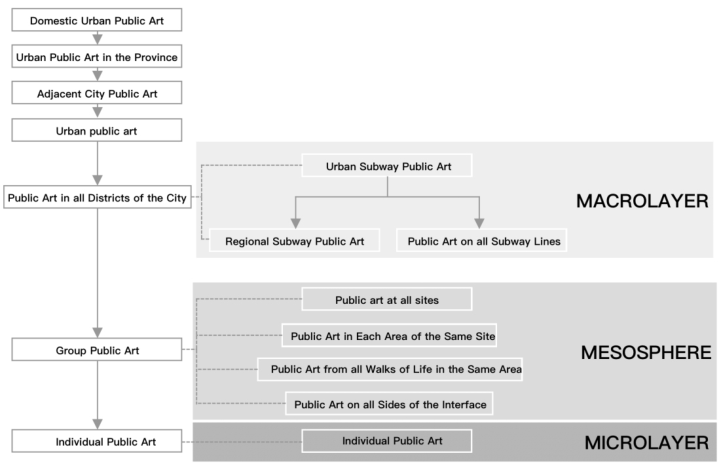
The left part of Figure 3 shows the relationship between urban public art and its upper and lower levels, and the regional division standards in “public art in each district of the city” need to be determined according to the actual application, such as division according to administrative districts, functions, natural features, and culture, “group public art” is the lower level of “public art in various districts of the city”, and its scale range is more variable, such as a tourist scenic spot, a historical and cultural block, a square, etc.
The right part of Figure 3 shows the lower-level hierarchical relationship of the urban subway public art system. If the entire city map is regarded as
Figure 3: Basic structure of subway public art system.
24 Liu
the bottom, the subway space is scattered in the form of points and connected in series with the path of lines. Therefore, it can be The urban area divides the subway space, and the subway space can also be divided by the line as a unit, and then there are two levels of “subway public art in each region” and “public art in each subway line”, and the two are in a parallel relationship. In the “public art of each station” level, there are also differences between stations. Based on the intersection of lines and passenger flow, they can be divided into standard stations, transfer stations, and core stations. Based on the existing decoration conditions of stations, they can be divided into stan- dard stations. Stations and Featured Stations. In the level of “public art in each area of the same station”, the division standard of the area is also chan- geable theoretically, but since the essence of the subway space is to ensure the normal operation of the subway and provide people with subway services, its spatial form is relatively There are few single and immaterial contents, so the subway station space can be divided into station halls, platforms, passages, functional rooms, entrances and exits and other areas directly according to the spatial structure or function. In the level of “public art of each interface in the same area”, based on the orientation relationship, the interface can be divided into ground, wall elevation, column elevation, top surface, etc.
Basic Design Path Combined with the basic structure of the subway public art system, the syste- matic design path of the subway public art proposed in this study is shown in the Figure 4. The path covers the macro, meso and micro levels of the public art system. The macro level includes two design strategies of “theme partition” and “site classification”. Among them, “theme partition” mainly solves the theme planning problem of urban subway public art. Characte- rize the location of the city to form a spiritual and cultural map of the city, so as to guide the theme and conception of public art at each station; The quantity and the spiritual and cultural characteristics of the location form the rating standard for subway public art sites. The mesoscopic level inclu- des the “point distribution” design strategy, which mainly solves the problem of location selection of public art in the same site, based on the narrative rela- tionship of the content of the works, passenger behavior habits, and pleasant scales.
Figure 4: Subway public art design path.
Figure available in the original PDF paper.
CONCLUSION
A systematic design strategy is proposed from three levels: macro level (theme planning and site classification strategy), meso level (site selection strategy for multi-point layout) and micro level (generation of design elements).
Systematic Design and Construction Strategy of Subway Public Art Based on Urban Spirit 25
Macro Layer: Theme Planning and Site Classification Strategy According to the previous research and analysis, the macro-planning and design of subway public art cannot directly follow the decoration strategies of “one station, one scene”, “one line, one scene”, “one line, multiple scenes”, “one line, one color” and other decoration strategies of the existing subway space. This study believes that the urban space should be divided into seve- ral regions, not in the way of administrative divisions, but in the center of the spiritual and cultural representatives of each city. The boundaries of the regions are relatively vague and overlapping. Spiritual and cultural characte- ristics, as the theme of subway public art creation in this area. The reasons for implementing this method are as follows: First, the excavation and sor- ting out of the city’s spiritual and cultural characteristics can take time as the scale or space as the scale. Obviously, subway public art cannot be displayed like cultural relics exhibits in museums to explain a history. Therefore, it is more reasonable to use space as the scale to sort out the urban spiritual cul- ture by dividing regions. In addition, the historicity of spiritual culture can be manifested in the superposition of space, that is, the elements of spiritual culture in a certain urban area are stacked from multiple historical periods, and its external manifestations are diverse. Therefore, with the help of intui- tive map It is easier to sort out, richer and more diverse spiritual and cultural elements. Secondly, for urban residents, especially office workers, the stati- ons where they usually take the subway to get in and out of the station are relatively fixed, as well as the stations around their residences, transfer sta- tions, and destination stations. In many cases, the characteristic stations in the existing subway planning are not Not included, which makes it difficult for these residents to access the public art of the subway even if they often take the subway. By dividing the area, we can pay attention to those stati- ons with relatively weak surrounding characteristics, expand the coverage of subway public art construction, give full play to the continuity of subway space, make subway public art truly penetrate into the lives of residents, and improve the sense of identity of residents in various regions of the city and a sense of belonging.
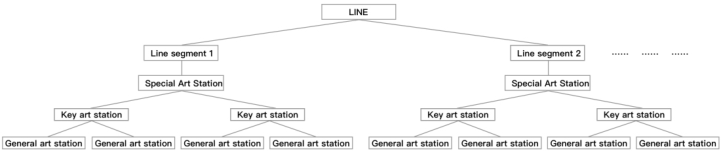
After section division, the cultural areas and line sections of each subway station are clarified. For the stations in each line section, classification work is needed to plan the construction scale of public art at each station, and then generate specific themes of public art at each station. There is a clear hierarchical relationship between lines, line segments, and stations (see Figure 5).
Figure 5: Hierarchical relationship among lines, line segments, and stations.
26 Liu
Among them, subway stations can be divided into three levels: special key art stations, key art stations, and ordinary art stations. Within the same line segment, lower-level stations. It can be regarded as an extension of the upper level station. For special key art stations, the scale of public art can be exten- ded to the architectural level, that is, special architectural structures, global lighting arrangements, etc. can be used to create subway art spaces. For key art stations, the scale of their public art can cover larger-scale interfaces in the subway station space, such as using characteristic ceilings, large murals and other forms to create large-scale art interfaces. For ordinary art stations, the scale of public art is limited to small-scale decoration and embellishment, such as adding artistic atmosphere to the subway station space through small sculptures and patterns.
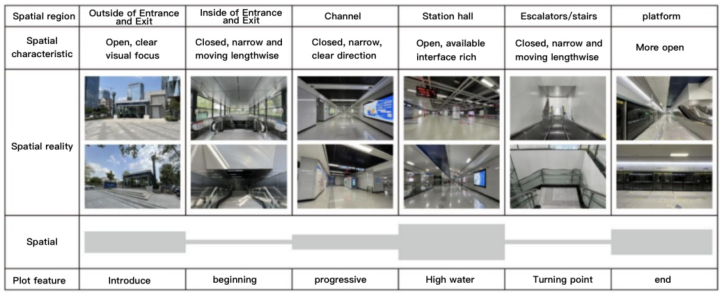
Mesolevel: Site Selection Strategy for Multi-Point Layout The presentation effect of public art is deeply influenced by its environment. The same work is placed in different places, and the meaning it conveys may even be quite different. Emphasizing the relationship between works and sur- roundings is also a major feature of public art that differs from traditional sculpture art or installation art, so site selection is an essential link in public art design. The subway space is divided into several areas such as the exterior of the entrance and exit, the interior of the entrance and exit, the passage, the station hall, the escalator/stairs, and the platform, and summarizes its spa- tial characteristics, spatial sequence, and plot characteristics, as shown in Figure 6. Aiming at the location design of subway public art, this research advocates a multi-point system layout method, using each area in the subway space as the display location of public art works, so that multiple works can be connected to each other in the subway space, and form a series Form one or more continuous landscapes, juxtapose one or more complete narratives in terms of content. The word “plot” is generally used in literary dramas. A group of spaces can be regarded as a period of time, which itself also has a plot, that is, a space plot. The main object of spatial experience is space and
Figure 6: Spatial characteristics, spatial sequences, and plot characteristics of each region in subway space.
Systematic Design and Construction Strategy of Subway Public Art Based on Urban Spirit 27
its structural characteristics. Spaces of different shapes and scales are conne- cted to form a spatial sequence. This spatial sequence is an important factor that affects the succession and transition of the spatial plot. Spaces with dif- ferent characteristics in the subway space are connected to each other. Even in the absence of pavement, lighting and facilities, the spatial sequence itself has a plot, compared to the influence of pavement, lighting and facilities on the plot of the space, this kind of plot formed by spatial sequence is more definite and stable.
Micro Level: Generation of Design Elements A public art work is composed of multiple design elements. The design ele- ments include the theme concept, scale, expression form, technical means, shape, color and material of the work. The urban spirit, as the condensed and sublimated characteristics of various aspects of the city, in the process of its promotion and publicity, its surface meaning is mostly abstract, so the main purpose is to highlight the urban spirit, whether it is for the plan- ning of the public art system or for individual works The creation of each requires a process of translating the spirit of the city into design elements (see Figure 7). The first step in the translation process is to decompose the contained elements of the urban spirit, and these elements of the urban spi- rit can not only be used as the theme of the subway public art creation, but also can be used as the creation of individual public art works through further translation methods. Inspiration and materials provide guidance for the site selection, shape, material selection, color and other aspects of the work.
Figure 7: The translation process of urban spirit to design elements.
ACKNOWLEDGMENT
Sincere thanks the organizing committee of the International Conference on Applied Human Factors and Ergonomics and the Affiliated Conferences and relevant staff of the AHFE meeting. And I’m so appreciate the staff of the organizing committee for your hard work and active preparation to make this meeting go smoothly. Thank the experts and scholars of the General Assembly Committee for their hard work day and night to guide each speaker to better improve ours writing and speech. And thanks to the School of Art and Design of Wuhan University of Technology and Wuhan Metro Group for their help and support to this study.
28 Liu
REFERENCES
Goldberg, A. I. (1969). General System Theory: Foundations, Development, Applications. Archives of General Psychiatry, 21(2), 251. Kortbek, H. B. (2018). Contradictions in Participatory Public Art: Placemaking as
an Instrument of Urban Cultural Policy. The Journal of Arts Management, Law, and Society, 49(1), 30–44. Lu Shaoming. (2007). Architectural Experience——Plots in Space. Architecture and Culture (12), 1. Mccarthy, J. (2006). Regeneration of Cultural Quarters: Public Art for Place Image
or Place Identity? Journal of Urban Design, 11(2), 243–262. Ochoa, R. (2022). The “Expo”and the Post-”Expo”: The Role of Public Art in Urban Regeneration Processes in the Late 20th Century. Sustainability, 14(2), 985. Steiner, H. (2012). The Spirit of the City: Why the Identity of a City Matters in a Glo-
bal Age by Daniel A. Bell and Avner de-Shalit/Losing Site: Architecture, Memory and Place by Shelley Hornstein. Home Cultures, 9(3), 333–338. Yamamoto, Z. L. (2018). Transforming the Transportation Customer Experience through Contemporary Artistic Practice: A Case Study in Strategic Implementa- tion. Transportation Research Record: Journal of the Transportation Research Board, 2672(8), 220–229. Yin Zi & Zhang Lian. (2021). The embodiment of the spirit of place in the creation
of urban public art——Taking the “Dayu Mythical Garden” in Wuhan Jiangtan as an example. Art Research (04), 123–126. Zhang Lili. (2013). Research on Design and Management of Metro Public Space (PhD Dissertation, ShanghaiUniversity). https://kns.cnki.net/kcms2/article/abst ract?v=LZqzfHN4DsWdCSwTGsnHzMHCGbgFTFiuNbkQY8GqpOplJCxatBs YSc8Atf02H3Q908WDGs9xp39nieXfYEW5HfrFxgANuNld1unPTZkyxeCT RWc6NSxh_w==&uniplatform=NZKPT&language=CHS
LISTED IN THE AHFE DIGITAL BOOKSTORE CATALOGUE
Explore the complete digital volume
Human Dynamics and Design for the Development of Contemporary Societies
Read this individual research paper free through the original publisher, or explore the full digital proceedings book.
ISBN 978-1-958651-57-5
Explore this ISBN in the AHFE Bookstore ↗Listed in the July 2026 bookstore catalogue; search by ISBN to confirm current availability · Digital book purchase optional