Maritzol Tenemaza, Roger Laza, Jonathan Vargas, Sergio Luján-Mora (2023). Tourist Recommendation Systems: solving mobility in a private vehicle with support for parking. In: Human Factors and Systems Interaction. AHFE Open Access, vol. 84, pp. 150–158. https://doi.org/10.54941/ahfe1003600
At present, tourists have all the facilities to travel, but they face the difficulty of establishing the itineraries of visits and the routes to follow, the reason is the numerous attractions and the complexity of the Metropolitan cities, Gavalas [1] .In previous works by this author, algorithms for the generation of intelligent itineraries have been published. Likewise, surveys carried out with end users have clarified some additional requirements, which were observed as future work. One of them is the requirement to search for parking spaces when the tourist moves by vehicle from the place where he is located. and when you need it.The tourist can move in a city on foot, or can hire a private vehicle and a third option, move through the Metropoli-tano transit network. But, when a user hires a vehicle, they have the question of whether it will be easy to find parking spaces and how to get to each one of them in the city, which is unknown to tourists in itself, in addition to the fact that the search of parking affects the en-vironment, and therefore affects the tourist due to the additional use of fuel and wasted time.In this document, the solution to the problem of finding parking lots from any place where the user is, the routes to get to each one of them, identifying infor-mation about the parking lot, if it is open and if there are spaces available, will be presented. The solution to this problem is of public interest and we differ from other researchers in that we include the option of identifying empty spaces in nearby parking lots, this information is presented in real time, the study is carried out in a specific city.To solve the problem, a tourist recommendation system will be presented that will include a preliminary study of the interests of that user from comments and reactions on tourist images published on the Facebook network, which will be subjected to sentiment analysis, to characterize the interest or not.Once the user's interests are identified, and in order to enrich the itinerary, the best POIs with tourist value in the city, evaluated by other users, are offered in the geographical area where the user is located.The presentation of the routes and itineraries will be done on a two-dimensional map, you can choose routes on foot or by vehicle. In addition, if the user de-cides to stop anywhere, they will have the option to identify parking spaces and how to get to them.Finally, an experiment will be carried out with end users, to measure both the ease of use and the utility of the proposal. As future work, the option of park-ing reservations in real time will be included. Another job that is related is mo-bility through the Metropolitan transportation system in a specific city. [1]Gavalas, D., Kasapakis, V., Konstantopoulos, C., Pantziou, G., Vathis, N., & Zaroliagis, C. (2015). The eCOMPASS multi-modal tourist tour planner. Expert systems with Applica-tions, 42(21), 7303-7316.
At present, tourists have all the facilities to travel. Metropolitan cities are generally desired destinations for many of them. In general, these cities have all the services required by tourists, such as hotels, transport services and various attractive points of interest (POI) for tourists. However, one difficulty that these large cities usually have is the lack of parking spaces, because many times these are full, but it could also happen that their parking prices are too
Tourist Recommendation Systems: Solving Mobility in a Private Vehicle 151
high. Tourists usually have three means of getting around a city: on foot, by private vehicle and through the metropolitan transit network. But, when a user uses a private vehicle, they are left with the question of whether it will be easy to find parking spaces and how to get to each one of them in the city, which is unknown to tourists. It may happen that the parking lot identifies, but when they arrive there are no spaces available, this problem involves wasted time and resources. Therefore, if the tourist decides to move in a private vehicle, it is necessary to easily identify parking spaces and in advance to know if there is space to leave the vehicle and the cost of parking the vehicle. The other mobility options through the metropolitan transit system are not covered in this document.
To solve this problem, a tourist recommendation system (TRS) will be pre- sented, which will include a preliminary study of the interests of that user from comments and reactions on tourist images published on the Facebook social network, which will be subjected to sentiments analysis, to characte- rize the profile of tourist interests. In addition, the user will be able to find parking lots, and will have information about them: they will find out if the parking lot is open at the required hours, if there is space available, its cost and the routes to get to each one of them. The solution to this problem is of public interest and we differ from the other researchers in that we include the option of identifying empty parking spaces and the cost of that parking lot. In addition, this information is presented in real time.
To carry out the interest identification process, a natural language classifier server called AUTOML from Google Platform was used, through supervised learning in which algorithms use labeled data to predict the category of a phrase. On the other hand, the TRS is a mobile application that with the user’s permission activates the GPS to identify where the user is and accesses the social network Facebook to infer interests from the texts, reactions on images of tourist value. By applying a 2D map, the routes on foot or by vehicle are presented, and the user can search for parking lots for which their information and parking availability are presented.
The rest of the article is organized as follows: in the Related Works section, related research is presented to justify the importance of this proposal. The proposed method presents the development of the TRS. Next, Analysis of results are exposed; and finally, Conclusions are presented.
RELATED WORKS In previous works, (Tenemaza, Luján-Mora, et al. 2020), throughout this research, we present algorithms applying different technologies to solve the characterization of the interest profile of the tourist. In this document we add a new option to infer interests. In addition, we propose a modification to the genetic algorithm to optimize itineraries for several days of visiting a city. In questionnaires answered by tourists, the need to present parking services with relevant information for the user or tourist was obtained.
We have observed some relevant authors in TRS. In the (Gavalas and Kenteris 2011; Souffriau et al. 2008) they TRS addresses tourism personali- zation by allowing the selection of tourism content, and offers personalized
recommendations considering the user’s location, current time, weather con- ditions and the user’s mobility history, and allow users to assess POIs without activating GPS, through a system of wireless sensors. This proposal offers a solution for walking tours, despite being a robust TRS, it does not consider vehicle tours and fewer parking search systems.
In addition, in (Gavalas et al. 2014; Ricci 2010), coincide in the analysis and present a study of services that must be offered by the TRS to the user. The services identified are restaurants, hotels, transportation services, infor- mation offices depending on the season of the year, and other options that make the TRS interesting. In addition, they mention modes of transportation such as walking, cycling, bus, tram, subway. In the same way it is observed that the solution does not go by the identification of parking lots.
On the other hand, in (Klotz et al. 2017) analyzes aspects for drivers based on services available on the web, such as views, points of interest and activi- ties, the purpose is to recommend places and activities considering the driving context. They propose accommodation, vehicle amenities, events, gastro- nomy, and points of interest. And we once again observe that analysis of parking in metropolitan cities is not included.
The proposal of this work has value, in the sense that the user will have an important service since the informed search for parking spaces solves a problem that tourists face in metropolitan cities.
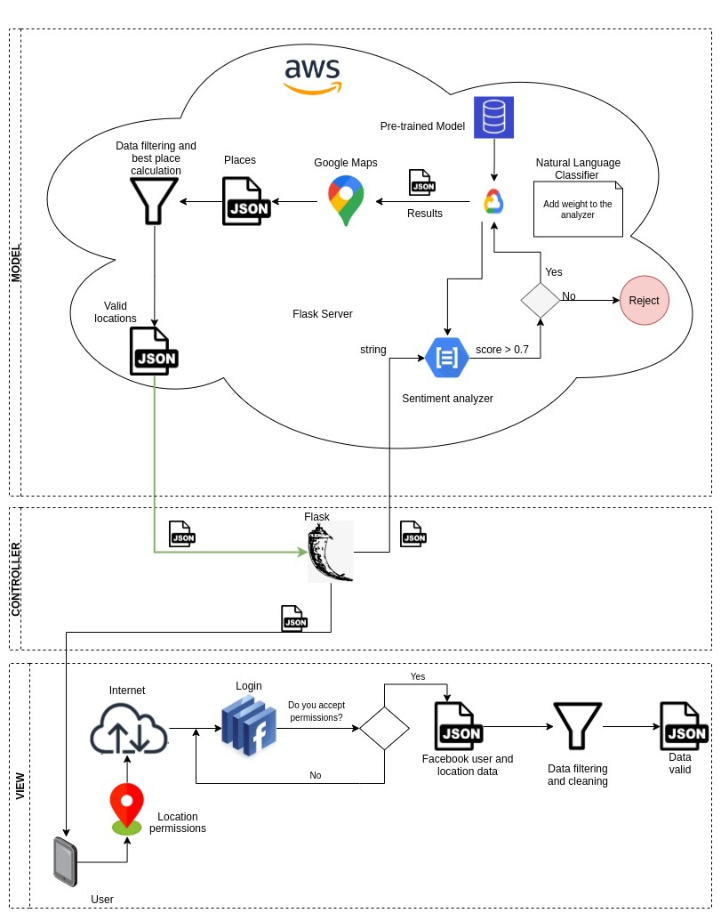
PROPOSED METHOD In this section the method of our TRS is proposed: a) Preparation of the Natural Language Classifier AUTOML server of Google Cloud Platform b) Inference of tourist interests analyzing reactions on tourist photos from the social network Facebook, it is included in Sentiment Analyzer Server to verify if the comment associated with a photograph is positive, in order to verify if the place exposed in the photograph is of tourist value, c) Identification and presentation of parking lots according to the context of the user’s vehicle; in addition to the routes to reach any of them; all this information is presented on a 2D map. Figure 1 shows the architecture used to implement the proposed method.
Natural Language Classifier Server Preparation
Figure 1, the architecture in the Model Unit shows the preparation and trai- ning of a Natural Language Classifier AUTOML server from Google Cloud Platform, to obtain a model capable of predicting the type of POI correspon- ding to a phrase. To train the server, phrases mostly used by tourist groups were collected from Facebook social network; each phrase requires a label that identifies it. For investigative purposes, the search for phrases focused on parks, museums, churches, and restaurants; 80% of phrases were used for training and the remaining 20% collected were used to test the server. Table 1 shows phrases classified expressed by tourist groups and classified by AUTOML.
Tourist Recommendation Systems: Solving Mobility in a Private Vehicle 153
Figure 1: Architecture system.Table 1. Example of phrases classification.
Table available in the original PDF paper.
Phrases Types The mountain inspires me freedom Park Excellent weather to have a good time Tourist-attraction The best beach, enjoying it Tourist-attraction Very good food Restaurant Admiring the works of the actor Museum
Inference of Tourist Interests Analyzing Reactions on Tourist Photos From the Social Network Facebook The next step is to identify tourist interests. Figure 1 in the unit “Vista “an application is created, through an interface which asks the user for autho- rization to activate the device’s GPS and to access its data on the Facebook social network. If the user authorizes, they bring his personal information, such as name, photo, email and his last 25 publications from the Facebook social network that have to do with tourism. If the user does not authorize, it is presented with the best POIs evaluated by other tourists.
In Figure 1, the “Model”shows a sentiment analyzer server; sentences with a score greater than or equal to 0.7 are considered, that is, those that are clearly positive.
Equation 1 shows the formula applied to express the interest in percentage value on each type of POI, the sum of all the prediction scores is them ade- quately divided by the number of times that the type of POI was identified, multiplied by 100. Table 2 shows the results of this process.
Pn
i = 1 (scorei) interestPOIi = n ∗100 Equation 1: Interest for each POI Where: i = POI to analyze interest POIi = degree of interest in percentage value score = score assigned to each type of POI n = number of times that type of POI is mentioned.
Identification and Presentation of Parking Spaces According to the Context of the User’s Vehicle According to the user’s location and where the user requires it, the user can request the closest parking lots with a radius between 1 km to 20 km around where he is, the user can filter the radius to choose. Once the parking lots are displayed at the top of the application, the user can verify the existence of space and the costs that using said parking lot would imply. The user can choose the parking lot that interests him the most and it immediately present how to go to that parking lot by vehicle. The information of each parking lot is presented, that is, the name of the parking lot, its location, and information on whether there is space available at the time of the query and the parking cost. This information can change in real time, as many times as the user
Table 2. Prediction results.
Table available in the original PDF paper.
Type of POI Interest POI Museum 0.9775 Church 0.0193 Tourist-attraction 0.0016 Park 0.0011 Restaurant 0.0003
Tourist Recommendation Systems: Solving Mobility in a Private Vehicle 155
requires it and where he is and when he needs it. To carry out this parking service, it is necessary to use services or microservices that are published, many are free.
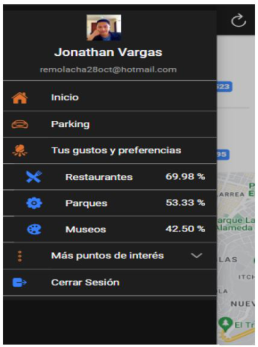
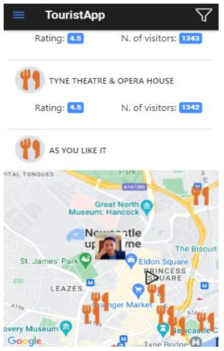
RESULTS ANALISIS As reported, a mobile application was developed, where the inferred inte- rests will be presented, the POIs that represent them, the route to each one of them and the assistance to parking lots. The application will be tested in the city of Newcastle, which is in the United Kingdom. The results start with the request for permission to access the data of the user and extract the posts from the users Facebook account. Figure 2 to the left shows the infer- red interests and allows the user to include other interests to later present as POIs. Figure 3 shows at the top the best POIs deduced from the inferred and specified interests.
Figure 2: Like preferences.Figure 3: The best POIs.
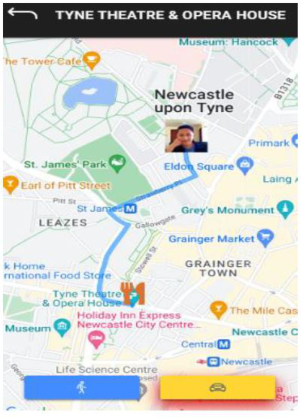
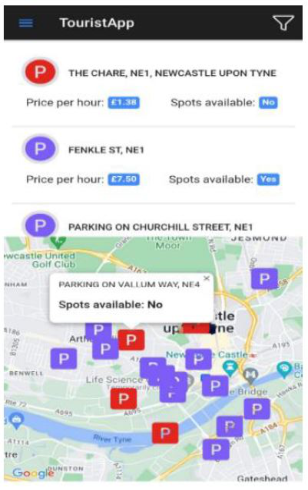
Once the tourist chooses the POI to visit, they have two visit options, on foot or by vehicle; Figure 4 shows the route by vehicle. They can toggle betw- een the two alternatives, and the route is recalculated as specified by the option. If the user requires parking spaces, Figure 5 at the bottom shows all the parking spaces within a radius of 1 to 20 km. Next, the parking spa- ces that are full are shown in red and those that have them in gray parking availability.
Figure 4: Vehicle route.Figure 5: Parking space found.
Tourist Recommendation Systems: Solving Mobility in a Private Vehicle 157
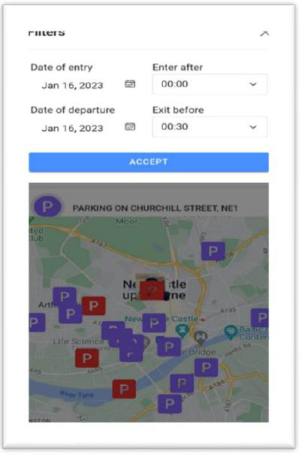
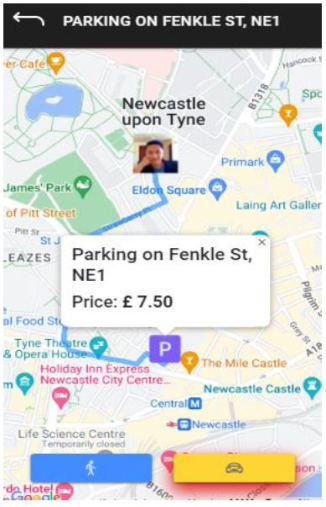
Figure 6 shows the request for the necessary data to calculate the price that the use of the chosen parking lot would imply, it is necessary to specify the date and time of entry and exit. With these data, Figure 7 shows the route and the cost of using that parking lot.
Figure 6: Data specification to calculate parking price.Figure 7: Price of parking.
CONCLUSION
In conclusion, it should be noted that an TRS cannot be raised if some form of identification of the user’s interests is not observed. The way we have exposed is interesting because it is an alternative that we have not found in any other document, since it specifically identifies user interests in real time. Additionally, the possibility that the user can change the route to be traveled on foot or by vehicle is an important alternative for a tourist. Complementa- rily, the alternative of identifying parking spaces that can be analyzed in real time to identify available spaces in the chosen parking lot and required costs has been presented.
It is important to clarify that the offer of available parking spaces is subject to the existence of services published in real time; the non-availability of this service limits the proposal presented.
REFERENCES
Gavalas, Damianos, and Michael Kenteris. 2011. “A Web-Based Pervasive Recommendation System for Mobile Tourist Guides.” Personal and Ubiquitous Computing 15(7):759–70. doi: 10.1007/s00779-011-0389-x. Gavalas, Damianos, Charalampos Konstantopoulos, Konstantinos Mastakas, and Grammati Pantziou. 2014. “Mobile Recommender Systems in Tou- rism.” Journal of Network and Computer Applications 39:319–33. doi: 10.1016/j.jnca.2013.04.006. Klotz, Benjamin, Pasquale Lisena, Raphaël Troncy, Daniel Wilms, and Christian Bonnet. 2017. “DriveSCOVER: A Tourism Recommender System Based on External Driving Factors.” in ISWC (Posters, Demos & Industry Tracks). Ricci, Francesco. 2010. “Mobile Recommender Systems.” Information Technology & Tourism 12(3):205–31. doi: 10.3727/109830511X12978702284390. Souffriau, Wouter, Pieter Vansteenwegen, Joris Vertommen, Greet Vanden Berghe, and Dirk Van Oudheusden. 2008. “A PERSONALIZED TOURIST TRIP DESIGN ALGORITHM FOR MOBILE TOURIST GUIDES.” Applied Artificial Intelligence 22(10): 964–85. doi: 10.1080/08839510802379626. Tenemaza, Maritzol, Loza-Aguirre Edison, Myriam Peñafiel, Zaldumbide Juan,
Angelica de Antonio, and Jaíme Ramirez. 2020. “Identifying Touristic Interest Using Big Data Techniques.” pp. 169–78 in Advances in Artificial Intelligence, Sof- tware and Systems Engineering, Advances in Intelligent Systems and Computing, edited by T. Ahram. Cham: Springer International Publishing. Tenemaza, Maritzol, Sergio Luján-Mora, Angélica De Antonio, and Jaime Ramírez.
2020. “Improving Itinerary Recommendations for Tourists Through Metah- euristic Algorithms: An Optimization Proposal.” IEEE Access 8: 79003–23. doi: 10.1109/ACCESS.2020.2990348.
LISTED IN THE AHFE DIGITAL BOOKSTORE CATALOGUE
Explore the complete digital volume
Human Factors and Systems Interaction
Read this individual research paper free through the original publisher, or explore the full digital proceedings book.
ISBN 978-1-958651-60-5
Explore this ISBN in the AHFE Bookstore ↗Listed in the July 2026 bookstore catalogue; search by ISBN to confirm current availability · Digital book purchase optional