Akihiko Goto, Naoki Sugiyama, Tomoko Ota (2023). Motion analysis of drone pilot operations and drone flight trajectories. In: Human Factors in Robots, Drones and Unmanned Systems. AHFE Open Access, vol. 93, pp. 68–75. https://doi.org/10.54941/ahfe1003749
This study compares the piloting practices and drone flight trajectories of skilled and novice drone pilots. Markers for 3D movement analysis were attached to the fingers that move the control stick. Similarly, drones were also marked and the flight movement of the drones analyzed. These two sets of data were cross-checked to examine the characteristics of the subjects. As a result, the following results were obtained.・The expert pilot did not adjust the position of the object directly in front of the object to be photographed, but at a distance of about 90 mm in the lateral direction.・The expert moved the drone in both the first axis and the second axis directions
Currently, drones are expected to be used in a wide variety of fields (KUBO, 2017). A drone control can be roughly divided into two methods, manual method and program control. Manual method requires a certain amount of techni- ques, but it is highly versatile and the mainly drone control method. However, it is not possible to acquire the control techniques for work as soon as possi- ble. These techniques are tacit knowledge that cannot be expressed in words. Therefore, inexperienced pilots spend a lot of time acquiring techniques to become expert pilots. Thus, we have analysed from the viewpoint of kinema- tics for the purpose of explicit knowledge such tacit knowledge (SUGIYAMA et al., 2022). Differences of fundamental drone movements between expert and beginners were revealed with 3d motion capture.
In this study, we examined the drone movement and position adjustment during photographing in more detail.
METHOD
The participants were one expert with a drone license and two beginner students.
The dominant hand of all participants was the right hand. All partici- pants were given a detailed explanation of the content before joining in the experiment. All participants provided informed consent, and the study was approved by the Ethics Committee of Osaka Sangyo University.
Motion Analysis of Drone Pilot Operations and Drone Flight Trajectories 69
The drone was used the MAVIC MINI(manufacturing SZ DJI Technology co.,ltd)in experiment. Operation of drone was performed an attachment con- troller and iPhone. The mode of remote control was set Mode 1, which is the mainstream in Japan (SUZUKI, 2018).
The set drone task was to photograph three subjects. The task includes taking off, going straight, turning, and photographing, which are the basic drone operations. An object and a box were placed in the flight area of the drone. Participants performed the task without crashing the drone into an object and a box. An Object and a box dimensions were 26.3 cm × 26.3 cm × 64.6 cm and 25 cm × 19.8 cm × 16 cm. The three subjects were pasted one by one on the side of the box.
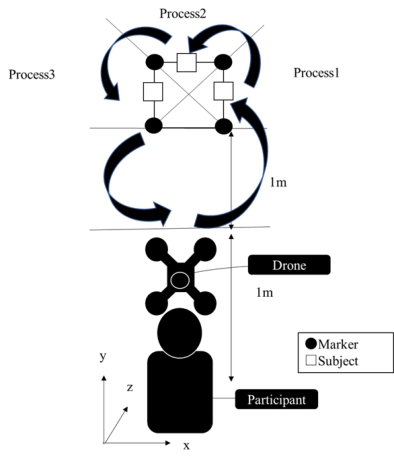
The subjects were a square (3.2 cm × 3.2 cm) black sticker with white handwritten numbers. Regarding the location of the subjects, the first sub- ject was attached to the right side of the box, the second was attached to the back of the box, and the third was attached to the left side of the box, based on the participant’s standing position. Participants were instructed to photo- graph the subjects from the front. No time limit was set for the task. Figure 1 shows an illustration of the positional relationship during measurement and the processes. The processes were divided by straight lines calculated from markers placed on the box. Thereby, the process was divided in the middle of moving to the photographing location.
Process I consists of taking off, photographing the first subject, and moving to the next photographing location.
Process II is moving to the next photographing location, photographing the second subject, and moving to the next photographing location.
Figure 1: An illustration of the positional relationship during measurement and the processes.
Process III consisted of moving to the next photographing location, photographing the third subject, moving to the takeoff point, and landing.
The movement of the drone during the task was measured by MAC 3D system of optical motion capture (manufacturing Motion analysis).
One infrared reflective marker was attached to the drone because drone movement was measured.
RESULTS
Table 1 shows the time spent for each process and the ratio based on expert.
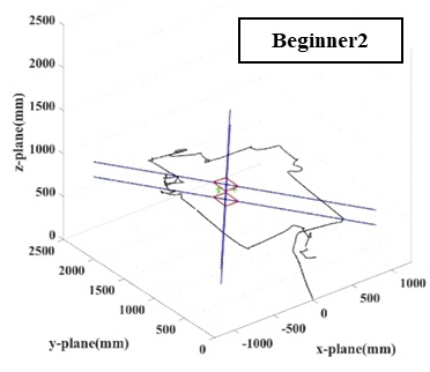
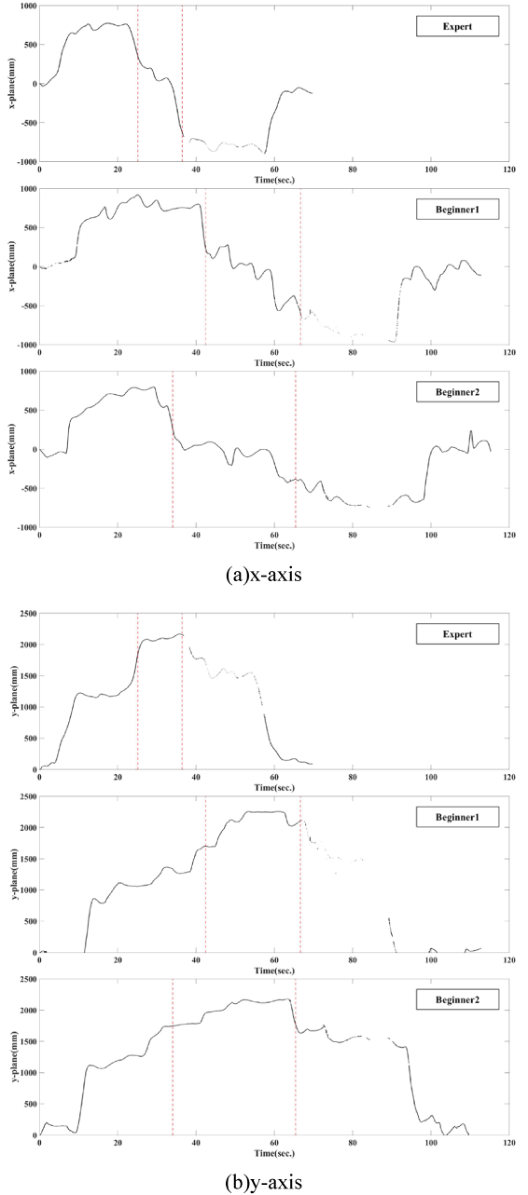
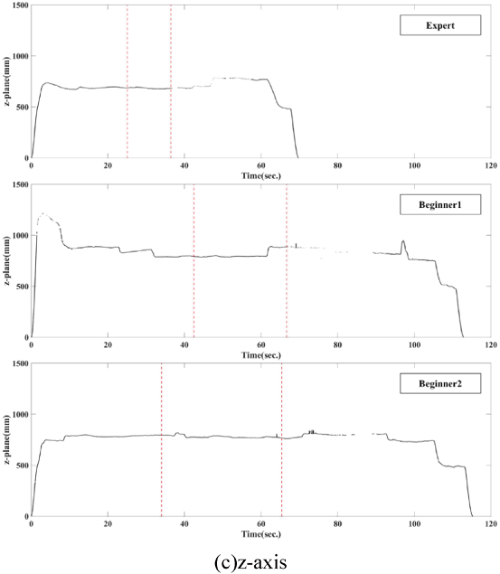
All participants spent time on processes 3, 1, and 2 in that order. However, expert’s task time was 1.6 times shorter than Beginners. In particular, process 2 resulted in a large difference between expert and beginners. Fig. 2 shows the trajectory of the drone in all processes, and Fig. 3 shows the displacement in each axis.
In the graph of Fig. 2, red indicates the upper and lower sides of the box, blue indicates the area line of the process, and green indicates the subjects. Fig. 3 shows the relationship between time and displacement on each axis. The red dotted lines are divided by process in the graphs. These graphs were adjusted zero- point on the basis of start position.
When moving to next photo point, Expert was observed a more curvilinear movement than Beginners. In addition, several waveforms were confirmed with displacement graphs. It is considered that this was due to drone position adjustment.
The number of these waveforms were higher for beginners than for expert. Especially, Beginners made adjustments in the x-axis direction many times in process 2. The z-axis of expert changed only when it was adjusted to the altitude of the subjects.
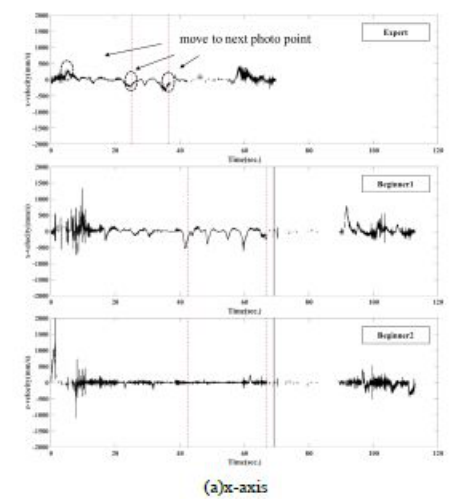
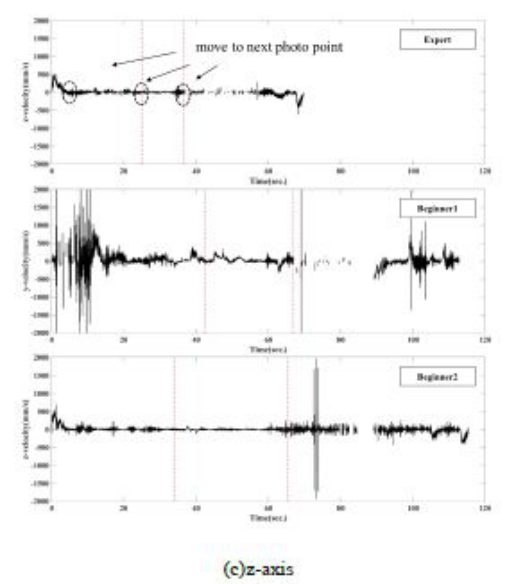
Figure 4 shows the change in velocity. The velocity in the x and y axis directions when moving to next photo points were higher for beginner than for expert. However, the velocity of expert was observed at the same time on x-axis and y-axis. Therefore, in terms of moving distance, expert is considered to be larger than beginners.
Table 1. The time spent for each process and the ratio based on expert.
Motion Analysis of Drone Pilot Operations and Drone Flight Trajectories 71
Figure 2: The trajectory of the drone in all processes.Figure 3: Continued.
Motion Analysis of Drone Pilot Operations and Drone Flight Trajectories 73
Figure 3: The displacement in each axis.Figure 4: Continued.Figure 4: The change in velocity.
Motion Analysis of Drone Pilot Operations and Drone Flight Trajectories 75
REFERENCES
Taiseke KUBO, “Technology Development History of Unmanned Aircraft Systems- Drones”. Journal of the Society of Instrument and Control Engineers, Vol. 56, No. 1, pp. 12–17, 2017. Naoki SUGIYAMA, Tomoko OTA, Akihiko GOTO. “Analysis of techniques in
operating a drone”. Mechanical Engineering Congress, 2022 Japan (MECJ-22). Hideo SUZUKI. “A Proposal on a Syllabus of “Drone Safety Engineering” in an University Class: Toward Will-be Drone Pilots and Drone Operating Managers”. Journal of Tokyo University of Information Sciences, Vol. 22, No. 1, pp. 123–131, 2018.
LISTED IN THE AHFE DIGITAL BOOKSTORE CATALOGUE
Explore the complete digital volume
Human Factors in Robots, Drones and Unmanned Systems
Read this individual research paper free through the original publisher, or explore the full digital proceedings book.
ISBN 978-1-958651-69-8
Explore this ISBN in the AHFE Bookstore ↗Listed in the July 2026 bookstore catalogue; search by ISBN to confirm current availability · Digital book purchase optional