Valentina Gorobets, Roman Billeter, Rolf Adelsberger, Andreas Kunz (2024). Automatic transcription of the Methods-Time Measurement MTM-1 motions in VR. In: Human Interaction and Emerging Technologies (IHIET-AI 2024): Artificial Intelligence and Future Applications. AHFE Open Access, vol. 120, pp. 250–259. https://doi.org/10.54941/ahfe1004575
We concentrate our research on using VR technology for the automatic transcription of basic human motions in the Methods-Time Measurement (MTM) system. It is a predetermined motion time system that consists of a list of predefined basic motions and the mean time values corresponding to those motions. This system is used to analyze manual workplaces. Currently, the MTM analysis is conducted manually. The working process that needs to be analyzed is video captured and further analyzed by dividing it into a sequence of basic MTM motions. There are various MTM systems that differ by their granularity level, such as MTM-1, MTM-2, MTM-UAS, etc.We propose and evaluate an approach of the automatic transcription of the MTM-1 basic motions. Here are the MTM-1 basic motions our algorithm transcribes that are grouped by the involved body parts. Hand motions: Grasp, Release, Position, Disengage, Apply pressure. Arm motions: Reach, Move, Crank, Turn. Body motions: Sit, Bend, Kneel one knee, Kneel both knees. Leg motions: Step, Leg gestures.Methodology: For our research, we use Unity software to create the virtual environment (VE) and interactions within it. Additionally, we use the HTC Vive tracking system and Sensoryx VRfree data glove that enable body- and hand-tracking. Additionally, the MTM-1 system distinguishes between different grasping types, therefore, using hand-tracking technology instead of controllers becomes essential. To visualize the VE, an HTC Vive Pro headset is used. Our automatic transcription algorithm employs four decision trees that run simultaneously, each dedicated to transcribing hand, arm, body, and leg motions in real time.Hand motions occur when objects are grasped or released. Therefore, the trigger for the hand motion decision tree is the beginning or end of touching an object. Hand motions were observed to commonly occur in the following order: Grasp -> Disengage -> Position -> Apply pressure -> Release. The grasp and release motions are always present in a cycle. The motions disengage, position, and apply pressure are optional in a cycle and are performed while holding an object, so between grasping and releasing.Arm motions decision tree is triggered by obtaining the output of the hand motion decision tree. It is transcribed backward, using the recorded information. The body motions category consists of bending, sitting, and kneeling motions. The assumed initial state of the user is the standing position. These motions occur sequentially, so to transcribe a kneeling motion, the threshold values for the sit (T_sit) and bend (T_Bend) motion must also be achieved.The leg motions consist of step motions and leg gestures. A leg gesture is a motion where only the leg and/or foot move, for example, pressing a pedal. The metric chosen to detect these motions is the velocity of the foot. Results: We conducted the user study with 33 participants, which performed a total of 2738 motions. 2670 of them were true positives (TP), and 176 were false positives (FP). 68 of the motions performed by the users were not captured by the algorithm and represent the false negatives (FN). Additionally, we introduced precision and recall metrics.Precision = sum(TP)/(sum(FP)+sum(TP))=0.938; Recall = sum(TP)/(sum(FN)+sum(TP))=0.975Besides overall statistics, we also calculated statistics separately for every basic motion type.
Due to the increased availability of Virtual Reality (VR) technologies, they become more popular in industrial settings. This is driven by the increasing digitalization in industry, recently boosted by the “Industry 4.0” initiatives. With this, new approaches such as using different variations of digital twins (Jones, 2020) appear, that were not used previously in the industry.
For these digital twins, VR serves as a great visualization tool, since the spatial representation of objects significantly increases the sense of presence and immersion in comparison to the normal screen (Shu, 2019). Additionally, it enables intuitive interactions with the virtual objects, as well as easy track- ing data acquisition. Therefore, VR is predestined for assessment purposes, such as the evaluation of workplaces. Measuring the movements of a person at a virtual workplace could help to optimize its layout prior to the physical implementation.
Automatic Transcription of the Methods-Time Measurement MTM-1 Motions in VR 251
Methods-Time Measurement Methods-Time Measurement (MTM) is a predetermined motion time system used to analyze manual processes. It was first introduced by L.H. Maynard & L.B. Stegemerten (Maynard, 1948). The MTM system analyses human motions by dividing them into a sequence of so-called basic motions, that are defined in this system. Every basic motion had a predetermined time value. Those time values are measured in so-called Time Measurement Units (TMUs).
There are various MTM systems, which differ by their granularity level. MTM-1 is considered to be the most detailed system, followed by the MTM-2, MTU-UAS, and MTM-MEK systems. Table 1 presents the list of categorized basic MTM-1 motions. The disadvantage of more detailed systems is the time and effort to perform MTM analysis.
Table 1. List of MTM-1 basic motions.
All MTM systems suffer from either requiring an already existing work- place, or a mock-up of it resembled by cardboard. A worker’s movements are then video recorded and manually analyzed by multiple MTM experts, which is a time-consuming and error-prone process. Consequentially, automating this analysis will reduce effort and costs.
The most common use case for MTM systems is the ergonomics improve- ment of the workplace (Laring, 2002). Additionally, MTM can be used for the process planning (Morlock, 2017), as well as training progress tracking (Muller, 2016).
RELATED WORK
One of the possible approaches suggests using additional sensors and RFID tags (Fantoni, 2020). However, their method measures times at certain positions instead of detecting basic motions. Another research proposes an approach utilizing a single camera with the convolutional neural network to detect MTM-1 hand motions (Riedel, 2021). Due to the limited field of view of the employed camera, their work detects hand motions only, while all other body movements are not evaluated. Both works have in common that the users’ actions were only performed in real environments.
Previous research (Gorobets, 2021) confirms the feasibility of conducting an MTM analysis in VR. It compares results obtained by a direct motion observation and MTM-2 analysis in identical setups in VR and reality. It concludes that TMU times obtained from MTM-2 analysis in VR correspond to the values obtained by conducting MTM-2 analysis in reality.
Some researchers (Bellarbi, 2019; Andreopoulos, 2022) proposed their approaches to detect MTM-2 basic motions in VR. However, automatic tran- scription of the MTM-1 basic motions in VR has not yet been investigated.
Research Gap In our research, we concentrate on enhancing the virtual MTM-1 by intro- ducing an automatic transcription approach. This approach is beneficial for non-existing workplaces, as it allows to avoid building a physical workplace or mock-up of it, but utilizes its virtual model instead.
METHODOLOGY
Setup Hardware: To visualize an interactable virtual environment (VE), we used the HTC Vive Pro system. It consists of one head-mounted display (HMD), three trackers, and two base stations. To track hand gestures, we used the VRfree data gloves provided by Sensoryx. This system consists of a head module that is attached to the HMD and the data gloves. A head module tracks the wrist position. To track finger positions, inertial measurement units (IMUs) in the gloves are used. For tracking participants’ motions we used the setup described as follows. Head motions are tracked using the HTC Vive Pro HMD. Hand motions are tracked with the VRfree glove. Lower body motions are tracked with three HTC Vive Trackers: one placed on the hip of the user and two placed on the feet.
Software: For creating the VE and interactions within, we use Unity 3D version 2021.3.13f1. Additionally, we use the Sensoryx SDK to enable integration of the VRfree gloves in Unity 3D. To create a realistic human avatar, we use the Make Human modelling software. Additionally, we use the VRIK Unity asset that animates the avatar based on the inversed kinematics principle.
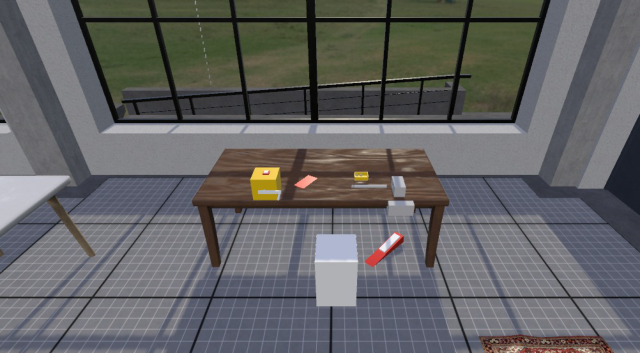
VE design: The virtual workplace consists of several objects on a table that need to be grasped, assembled, and placed again back on the table, while the user is seated. The workplace integrated also other motions like cranking and foot motion. Other areas of the workplace also required step motions and kneeling. Due to the lack of an eye tracker and the low TMU contribution of eye movements, we did not integrate this MTM-1 class into our evaluation procedure. The overall layout for the seated operations is shown in Fig. 1.
Experiment design: To test that our algorithm transcribes possible MTM- 1 motions, we developed a VE that has various tasks to perform. For this, we split up the study tasks into two groups: actions preformed while the users were seated, and actions preformed while the users in a standing position. The seated area aims to concentrate on the upper body motions and foot motions, while the standing position aims to automatically recognize other actions like step and kneel.
User study procedure: The user study starts with a brief introduction of the experiment goals. It is followed by the task explanation as well as famil- iarization with the VR equipment. Lastly, a participant completes the task in VR.
Automatic Transcription of the Methods-Time Measurement MTM-1 Motions in VR 253
Figure 1: VE design, seated area. The cube represents a chair that participants are sitting on.
Automatic Transcription To deliver the MTM-1 basic motions from the motions sequence performed by a user, we decided to use a decision-tree approach. The benefit in compar- ison to machine learning is that it does not require preliminary training of the network. Moreover, the decision tree approach is highly advantageous in the context of MTM-1 motions, considering to the pre-defined nature of these movements. Additionally, in VR initial information about the environment and virtual objects is available, and it reduces the complexity associated with detecting motions.
Our decision-tree approach consists of four decision trees that run simul- taneously for (i) arm motions, (ii) hand motions, (iii) body motions, and (iv) leg gestures. Each of them transcribes one subgroup of the MTM-1 basic motions (see Table 1). Below, we will describe the working principle of each of them.
Upper Body Motions Recognition This part consists of two decision trees: one for hand motions and one for arm motions.
The hand motions decision tree is triggered when an object has been grasped or released. Therefore, the trigger for the start of the hand motion decision tree is the beginning or end of touching a virtual object. Every moment of time, our algorithm checks whether a virtual object was touched or not. We observed that hand motions appear in the following sequence (see Fig. 2).
The arm motions decision tree is triggered by the end of the Grasp or Release hand motion. As arm motions precede hand motions, we use the pre-recorded tracking information in order to deliver correct transcription. Firstly, we check whether the hand action that triggered this decision tree is Release. If yes, then a preceding arm motion is either Crank, or Move. If
the released virtual object had a label crank, we transcribe performed arm motion as Crank. If it was a different object, we transcribe Move motion. If the hand action that triggered the arm decision tree was not Release, it means that it was triggered by the transcribed hand motion Grasp. Therefore, the preceding arm motion was Reach.
Figure 2: Hand motions cycle in MTM-1. The dashed motions are optional in a cycle. The names on the arrows represent the arm motions that make a transition between corresponding hand motions.
The Turn motion does not intuitively fit into the arm motions category. Its definition is the turning of the wrist during a reach or move motion. As Turn motion is always performed during Reach or Move arm motions, we integrated it into the arm motion decision tree, as it cannot be considered as an independent hand motion.
Lower Body Motions Recognition This part consists of two decision trees: one for general body motions and one for leg gestures.
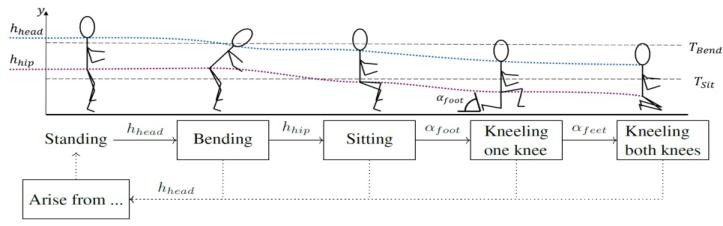
The body motions decision tree is triggered when a head position (hhead) is lower than the predefined threshold TBend. Similarly to the hand motions, we observed the sequential nature of the body motions (see Figure 3). Starting from the neutral standing position, lowering the head identifies the begin- ning of the Bending motion. Additionally, if the hip position is also getting below a threshold value TSit, we are transcribing the performed action as Sit. To transcribe Kneeling motions, we are considering the relative angle (αfoot) between the trackers that are located on the feet and the floor. After detection of one of the above-mentioned motions, participants return to their neutral standing position by performing an Arise motion. Arise motion is detected using the hhead and TArise threshold: TArise < hhead , TBend < TArise.
Figure 3: Body motions. The body motions are sequential and tracker metrics are used to detect the motions.
Automatic Transcription of the Methods-Time Measurement MTM-1 Motions in VR 255
Threshold definition: The thresholds TBend and TSit were defined empirically and are both 20 cm lower than the height of the head and hips in the neutral Standing position: TBend = hhead,standing – 20 cm, TSit = hhip,standing – 20 cm.
The threshold for kneeling angle TKneel is also obtained empirically and is 50
.
The TArise threshold should be set below hhead,standing to ensure it is achieved, and above TBend to avoid multiple detection of a Bending motion. Empirically we set TArise threshold at the midpoint between these two values:
Equation reproduced from the original PDF.
Leg gestures consist of two subgroups: different Step variations and Foot and Leg motions. An example of the second subgroup is pressing a pedal. These two subgroups can be very similar and traditionally are differentiated by the estimate of the MTM expert. Due to this similarity, we decided to distinguish between those two subgroups by making an assumption that Foot and Leg motions happen only while seated.
The Leg gesture decision tree operates continuously throughout the entire algorithm’s runtime, without being reliant on specific triggering events. It uses velocity of the foot (vfoot) to detect leg gestures.
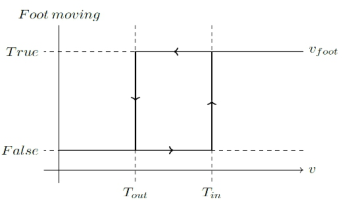
Figure 4 depicts the logic of the hysteresis loop for the detection of the foot moving to avoid false Leg gesture detection. We empirically define two thresholds for vfoot:
Tin defines the start of the leg gesture;
Tout defines the end of the leg gesture.
Figure 4: Hysteresis for detecting leg gestures.
These thresholds are used to filter out the noise caused by the tracking sys- tem. As it is common for hysteresis loops, these thresholds should be clearly separated (Tout < Tin) to avoid repeated detection of the same leg gesture. When the vfoot rises, it follows the lower path. If it exceeds Tin, the foot is considered to be moving. If, after that, vfoot lowers again, it follows the upper path, and if it drops below Tout, the foot stopped moving, and we consider it as the end of the leg gesture.
Threshold definition: We define Tin and Tout separately for detecting Step (Tin,step, Tout,step) and Foot and Leg motions (Tin,foot/leg, Tout,foot/leg). How- ever, we use the same procedure to define the thresholds for both subgroups. We record and analyse the velocity of the foot of a test user performing either Step or Foot or Leg motions.
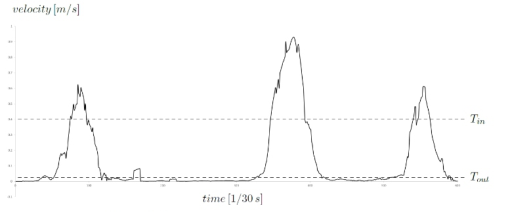
Figure 5 illustrates the test user’s foot velocity performing three steps over time. Based on our empirical analysis, we define two thresholds for detecting Step motions: Tin,step = 0.3 m/s, Tout,step = 0.05 m/s. Similarly, we define the Foot and Leg motion thresholds: Tin,foot/leg = 0.1 m/s, Tout,foot/leg = 0.05 m/s.
Figure 5: Velocity of the foot of a test user performing 3 steps over time.
Therefore, the leg gestures decision tree has the following logic. Firstly, we check whether a motion is performed seated or upright. If the motion was performed upright and we detect a foot moving, we transcribe one of the Step motions. If the foot’s turning angle along the floor is between 45
and 90
, Turn Step is transcribed. Otherwise, if the foot travels less than 60% in the forward direction of the foot, it is considered a Side Step, and if not, normal Step is transcribed.
If the motion was performed seated and we detect a foot moving, we transcribe either Foot or Leg Motion. A Leg Motion is transcribed if the disposition of the feet is above 10cm, and a Foot Motion if it is below.
RESULTS AND DISCUSSION
To assess the results received by the proposed algorithm, we are using the following metrics. Firstly, every automatically delivered basic motion was labeled as True Positive (TP), False Positive (FP), or False Negative (FN). Positive stands for a transcribed motion and negative for the absence of a transcription. True stands for the correctly recognized motion by the algorithm and false for the incorrect recognition. Therefore:
TP - The algorithm correctly transcribed a motion that was performed by the user.
FP - The algorithm transcribed a motion that was not performed by the user.
FN - The algorithm did not transcribe a motion even though the user performed one.
Automatic Transcription of the Methods-Time Measurement MTM-1 Motions in VR 257
Based on those metrics, we additionally introduce Precision and Recall: Precision = 6TP 6FP + 6TP; Recall = 6TP 6FN + 6TP (1)
Precision is the ratio of true positive results to the total number of positive results. It measures the accuracy of the algorithm in identifying true positives. Recall is the ratio of true positive results to the total number of relevant results. It measures the completeness of the model in identifying all relevant results.
General Results In the user study, 2846 motions were transcribed by the algorithm. 2670 of them are TPs, 176 are FPs, and 68 are FNs. The overall Precision and Recall of the transcription algorithm are: Precision = 0.938, Recall = 0.975.
Below, we give a summary of the results for all transcribed basic motions.
Table 2. Summary of the results for transcribed hand motions.
As it is seen from the general results, our algorithm has a good overall per- formance. The majority of TPs in Grasp (see Table 2) are caused by tracking problems. Additionally, they lead to TPs of Release motion, as Grasp and Release are interdependent motions.
Leg Motion and Foot Motion transcription (see Table 5) can be improved by additional trackers attached to each leg. As we only used two trackers on the feet, it is difficult to distinguish between those two motions. Addition- ally, redefining empirically found parameters for different step types can also improve precision and recall for different Step variations.
Table 4. Summary of the results for transcribed body motions.
Table available in the original PDF paper.
Body Motions
Sit Arise from Sit Bend Arise from Bend TP 64 62 33 33 FP 0 0 0 0 FN 1 2 0 0 Precision 1 1 1 1 Recall 0.985 0.969 1 1
In this paper, we presented a decision tree approach to automatically tran- scribe MTM-1 basic motions in VR. We discussed all the potential benefits of using VR for the MTM analysis. We presented our user study procedure as well as a thorough explanation of the decision tree approach we proposed. We finalized our paper by presenting and discussing the results of our study.
For future work, the setup could be enhanced by additional trackers on the legs to improve Foot and Leg motion recognition, as well as an eye tracker to detect Eye motions. The algorithms could be improved by redefining thresh- olds for Side step and Turn step motion. Finally, the study procedure in terms of realistic tasks could be improved by using the algorithm in an already existing industrial workplace.
ACKNOWLEDGMENT
We would like to express our gratitude to Sensoryx for providing the tracking space and continuous support with the glove. Additionally, special thanks to Thomas Nescher for providing the virtual model of the industrial building.
Automatic Transcription of the Methods-Time Measurement MTM-1 Motions in VR 259
REFERENCES
Andreopoulos, E., Gorobets, V. and Kunz, A. (2022), ‘Automatic MTM- Transcription in Virtual Reality Using the Digital Twin of a Workplace’, (preprint). Bellarbi, A., Jessel, J.-P. and Dalto, L. D. (2019), ‘Towards Method Time Measurement Identification Using Virtual Reality and Gesture Recognition’, 2019 IEEE International Conference on Artificial Intelligence and Virtual Reality (AIVR), IEEE, 2019. Fantoni, G., Al-Zubaidi, S. Q., Coli, E. and Mazzei, D. (2020), ‘Automating the
process of method-time-measurement’, International Journal of Productivity and Performance Management 70(4), 958–982. Gorobets, V., Holzwarth, V., Hirt, C., Jufer, N. and Kunz, A. (2021), ‘A VR-based approach in conducting MTM for manual workplaces’, The International Journal of Advanced Manufacturing Technology 117(7-8), 2501–2510. Jones, D., Snider, C., Nassehi, A., Yon, J. and Hicks, B. (2020), ‘Characterising
the Digital Twin: A systematic literature review’, CIRP Journal of Manufacturing Science and Technology 29, 36–52. Laring, J., Forsman, M., Kadefors, R. and Örtengren, R. (2002), ‘MTM-based ergonomic workload analysis’, International Journal of Industrial Ergonomics 30(3), 135–148. Maynard, H. B., Stegemerten, G. J., & Schwab, J. L. (1948). Methods-time
measurement. Morlock, F., Kreggenfeld, N., Louw, L., Kreimeier, D. and Kuhlenkötter, B. (2017), ‘Teaching Methods-Time Measurement (MTM) for Workplace Design in Learning Factories’, Procedia Manufacturing 9, 369–375. Müller, B. C., Nguyen, T. D., Dang, Q.-V., Duc, B. M., Seliger, G., Krüger, J. and
Kohl, H. (2016), ‘Motion Tracking Applied in Assembly for Worker Training in different Locations’, Procedia CIRP 48, 460–465. Riedel, A., Brehm, N. and Pfeifroth, T. (2021), ‘Hand Gesture Recognition of Methods-Time Measurement-1 Motions in Manual Assembly Tasks Using Graph Convolutional Networks’, Applied Artificial Intelligence 36(1). Shu, Y., Huang, Y.-Z., Chang, S.-H. and Chen, M.-Y. (2018), ‘Do virtual reality
head-mounted displays make a difference? A comparison of presence and self- efficacy between head-mounted displays and desktop computer-facilitated virtual environments’, Virtual Reality 23(4), 437–446.
LISTED IN THE AHFE DIGITAL BOOKSTORE CATALOGUE
Explore the complete digital volume
Human Interaction and Emerging Technologies (IHIET-AI 2024): Artificial Intelligence and Future Applications
Read this individual research paper free through the original publisher, or explore the full digital proceedings book.
ISBN 978-1-958651-96-4
Explore this ISBN in the AHFE Bookstore ↗Listed in the July 2026 bookstore catalogue; search by ISBN to confirm current availability · Digital book purchase optional