Akihiro Ohnishia, Masato Takanokurab, Atsushi Sugamaa (2018). Suitable Interhandle Distance on a Roll Box Pallet during Turning Task. In: Advances in Physical Ergonomics and Human Factors: Part II. AHFE Open Access, vol. 2. https://doi.org/10.54941/ahfe100068
1 Human Engineering and Risk Management Research Group National Institute of Occupational Safety and Health, Japan (JNIOSH) Tokyo, Kiyose Umezono 1-4-6, Japan ↗
2 Department of Industrial Engineering and Management, Faculty of Engineering, Kanagawa University, Yokohama, 221-8686, Japan ↗
Roll box pallets (RBPs) are manual material-handling equipment with four swivel wheels, used in Japan. Although they are widely used in almost all industries, many RBP-related operator accidents have occurred in the transportation industry, usually involving injuries to the hands or feet. To decrease the likelihood of hand injuries, it is important to install special handles situated toward the inside of the frames. This study aimed to determine a suitable RBP interhandle distance for turning movements. Six healthy young males were asked to move the RBP (height, 170 cm; depth, 80 cm; width, 60 cm) by 90° at a normal speed using handles with four different interhandle distances (40, 50, 60, and 80 cm) and two loading conditions (0 and 50 kg) for approximately 1.4 m. A three-axis accelerometer attached to the lower part of the RBP was used to measure motion. Then maximum combined values of the longitudinal and lateral directions (horizontal plane) and maximum upward values were analyzed during the initial response phase. Operability was evaluated by the acceleration data, handling process duration, and subjective evaluation. Operating duration was approximately 5 s. It was longer for the 50-kg loading condition for all interhandle distances, and significant differences between interhandle distances were not observed with both loads; however, the duration tended to be shorter with wider interhandle distances in the 50-kg loading condition. Subjective evaluation ratings were similar in RBP movement durations. The maximal acceleration on the horizontal plane showed varied with different interhandle distances, probably because horizontal acceleration tends to affect RBP movement in tasks combining lateral movement and rotation. In contrast, maximum upward acceleration increased with increased loads, but was not affected by an increase in the interhandle distance. This indicates that the upward acceleration probably corresponded to the lifting of the handles while applying lateral force. The results suggest that a wider interhandle distance, e.g., 80 cm, would be suitable for RBP movements, including lateral movement and rotation.
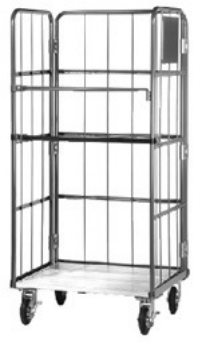
Roll box pallets (RBPs) are manual material handling equipment having a box-shaped carriage resting on four casters, which also functions as the pallet. RBPs improve the efficiency of logistics and protect cargo from damage (Figure 1). They commonly are used in the transportation, wholesale, and retail industries, among others. However, there have been industrial accident reports of workers’ hands or feet being crushed by RBPs (Ohnishi and Shimizu, 2012; Ohnishi, 2013). With regard to an ergonomic study for wheeled carts, the exerted forces and physiological load during pushing and pulling of a wheeled cage by postal workers were evaluated (Van der Beek, Kluver, Frings- Dresen, and Hoozemans, 2000), and the study demonstrated that the initial movement of a cage peaks during pushing and pulling. Van der Beek et al. (2000) concluded that forces exerted during the initial movement of pushing and pulling exceed the maximum acceptable values less than 250 kg established by Mital, Nicholson, and Ayoub (1997), who stressed the importance of measures to decrease the risk of musculoskeletal disorders associated with wheeled cage handling. However, no study has examined a suitable interhandle distance for the handling of wheeled cages such as RBPs. We considered, on the basis of characteristics such as upper limb muscle activity while pushing and pulling a RBP in a straight line, the need for special handles on the carriage frame and devised an easily operable system with two handles placed 40 cm apart (Ohnishi, Sugama, and Takanokura, 2012). This narrow 40-cm interhandle distance may, however, actually decrease operability when turning or rotating RBPs. In this study, we examined the relationship between lateral operability and interhandle distance by assessing turning of RBPs, including lateral movement and rotation, which mimic RBP handling in actual work conditions.
Figure 1. Typical roll box pallet (RBP)
METHODS
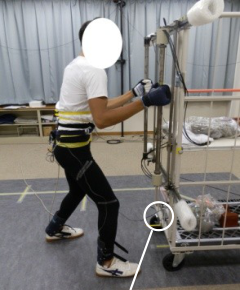
Participants and experimental task The participants in the study were six young males (age: 22.0 ± 1.1 years, height: 170.5 ± 6.9 cm, posterior shoulder width: 44.8 ± 2.8 cm, weight: 61.2 ± 6.1 kg) with no history of orthopedic conditions in the past year. They were all right handed. The experimental RBP (CTN-20S6; DAIFUKU, Osaka, Japan) used in this study had the following dimensions: height, 170 cm; depth, 80 cm; and width, 60 cm. The experimental task involved moving the RBP equipped with handles of variable interhandle distance in a 90° arc from a predetermined position as shown in Figure 2(a). Four interhandle distance conditions were set 40, 50, 60, and 80 cm. The minimum standard distance between both bars in JIS Z 0610 (Japanese Standards Association, 1998) was regulated to 60 cm. After a pretrial, the heights of the handles were set at a position between the shoulder and elbow that was suitable for each participant to operate. Figure 2(b) shows an example of the experiment. The participants placed both legs in front of the RBP at the start position and moved the RBP by 90° at a normal speed (Figure 2(a)), and the distance of RBP movement was approximately 1.4 m. Two load conditions, 0 and 50 kg, were set for the loaded weight, and each of the four interhandle distances was tried three times for a total of 24 trials. Informed consent was obtained from all participants prior to the experiment after each received an explanation of the purpose of the study verbally and in writing. This study was approved by the Research Ethics Committee of the National Institute of Occupational Safety, Japan.
Accelerometer
Figure 2. Experimental set-up
Duration of RBP operation To determine the duration of RBP operation from the beginning to stopping, a motion capture system (ARENA; NaturalPoint, Corvallis, OR, USA) including 16 infrared cameras (OptiTrack FLEX: V100; NaturalPoint) was used to measure five infrared reflection markers attached to the RBP at a sampling frequency of 100 Hz.
Subjective operability To subjectively evaluate operability, the participants were instructed on a 5-point scale prior to the experiment: 1, very difficult to operate; 2, difficult to operate; 3, neutral; 4, easy to operate; and 5, very easy to operate. They verbally indicated the ease of operation corresponding to the degree of RBP operability immediately after each trial.
Measurement and analysis of acceleration A three-axis accelerometer was attached (DL-111; S&ME, Tokyo, Japan) to the base of the RBP as shown in Figure 2(b). Signals from the meter were saved after sampling at 200 Hz using an AD converter (TRIAS; DKH, Tokyo, Japan), and then the obtained acceleration signals were passed through a 4-Hz low-pass filter to analyze only the spectrum accurately representing the motion of the RBP. We analyzed the maximum absolute values obtained by combining both the longitudinal and lateral directional (horizontal plane) movements that represented the motion of the RBP while initially moving in a horizontal plane, and the maximum value of the upward direction that reflected the movement when the participants pushed up on these handles.
Statistical analysis Analysis of variance (ANOVA) for within-participant factors was used to evaluate suitable interhandle distance conditions using SPSS software. The ANOVA was performed using the following design: interhandle distance (40, 50, 60 cm, or 80 cm) × load (0 kg or 50 kg). Post-hoc Tukey tests were used to examine the differences between each interhandle distance.
RESULTS
Duration of RBP operation
Table 1 shows the duration of RBP operation according to interhandle distance and load. Operating duration was approximately 5 s. The duration tended to be shorter when the distance between handles was wider in the 50-kg load condition (a difference of 0.44 s between 80-cm and 40-cm interhandle distances). There was no reported effect of interhandle distance for a load of 0 kg. The main effect of load was statistically significant (p < 0.05).
Table 1. Operating duration to move the RBP according to interhandle distance and load
Figure 3 shows subjective operability evaluation ratings for each condition. The ratings decreased as the loaded weight increased, whereas the ratings increased as the interhandle distance increased. ANOVA indicated that the main effects were significant for both load (p < 0.01) and interhandle distance (p < 0.01). The 80-cm interhandle distance for the 50-kg load was judged to be more operable than the 40-cm (p < 0.01) and 50-cm (p < 0.05) interhandle distances.
5
* **
0 kg
50 kg
4
3
2
1
40 cm 50 cm 60 cm 80 cm 40 cm 50 cm 60 cm 80 cm
Figure 3. Subjective evaluation ratings of RBP operation
Figure available in the original PDF paper.
Rating unit: point, mean ± standard deviation *:P < 0.05, **:P < 0.01
Horizontal and upward accelerations
Figure 4(a) shows the maximum acceleration on a horizontal plane and subjective evaluation ratings for each condition. The subjective evaluation ratings decreased as the loaded weight increased, whereas the ratings increased as the interhandle distance increased. Also, the horizontal plane acceleration increased as the interhandle distance increased, and ANOVA indicated that the main effect of interhandle distance was significant (p < 0.05). For the 0- kg load, horizontal acceleration was larger with the 80-cm interhandle distance than with the 40-cm interhandle distance (p < 0.05); however, no statistically significant differences were observed for the 50-kg load. The maximum acceleration values in the upward direction, which differed from those in the horizontal direction, had smaller overall values with a heavy load of 50 kg (Figure 4(b)). The main effect of load was significant (p < 0.01); however, there was no statistically significant effect of interhandle distance.
Figure 3. Maximum acceleration of RBP and subjective evaluation ratings
Figure available in the original PDF paper.
Acceleration unit: m/s2, Rating unit: point, mean ± standard deviation *:P < 0.05
DISCUSSION
This examination of the relationship between interhandle distance and the operating duration for an RBP revealed no significant correlation. However, the operating duration decreased with a load of 50 kg when the interhandle distance was increased. The RBP movement of approximately a 1.4 m may not have been sufficient to determine a statistically significant relationship with operating duration; thus, clear differences in duration with different interhandle distances were not observed. However, with a 50-kg load, participants may be restricted to less than the necessary range of motion for their shoulders and elbows while operating the RBP with a narrow interhandle distance, resulting in a longer operative duration because it was more difficult to apply force to the handles. Hence a wider interhandle distance might be better for operability in terms of the duration to turn the RBP 90°, which is different from the effects while moving a RBP in a straight line (Ohnishi, Sugama, and Takanokura, 2012).
When we examined whether acceleration and subjective evaluation ratings followed the same trend, there was common trend that with the 80-cm interhandle distance acceleration in a horizontal plane was the largest in both weight load conditions, which was thought to be related to the direction of movement (longitudinal and lateral movement, and rotation) in the present experiment. In contrast, the maximum horizontal acceleration was not associated with the load, because the force applied in the horizontal plane to compensate for the difference in interhandle distance differed, such as movement resulting from the recoil from pulling the RBP towards the body. This result indicated that this component of acceleration reflected when the participant applied to the force on the horizontal plane regardless of the load; therefore, horizontal acceleration might appear to have an impact on RBP movement task combining lateral movement and rotation. The maximum upward acceleration increased with an increase in load; however, it did not change with an increase in interhandle distance. In other words, the upward acceleration showed a trend exactly opposite to the horizontal acceleration. In our previous study, it was observed that the handles were pushed up following muscle activity from flexion of both shoulders and elbows while pushing and pulling the RBP in a straight line (Ohnishi, Sugama, and Takanokura, 2012). This result indicates the handles were also pushed up in a manner similar to that mentioned above when the lateral force was applied to the handles. When this pushing motion is strong, gravity (load) acts to negate this power, which can decrease frictional force between the caster and the floor, thereby assisting movement of the RBP. We can infer that this movement was used because the force applied to the horizontal plane was greater than that with a 0-kg load.
The above findings indicated that this study could not conclude whether the horizontal or upward acceleration component of RBP operation was appropriate for evaluating the operability of RBPs in 90° movement. However, the fact that horizontal acceleration, operating duration, and subjective evaluation showed a matching trend suggested that a wide 80-cm interhandle distance might be suitable. Further adjustment with narrower interhandle distances suitable for movement in a straight line will be necessary.
CONCLUSIONS
This study examined the relationship between duration of RBP operation and operability and interhandle distance by assessing the task of turning an RBP, including lateral movement and rotation that mimic RBP handling. As a result, the operating duration was shorter and the subjective operability ratings were better with wider interhandle distances. In addition, the acceleration in the horizontal plane appeared to have an impact on RBP movement and showed a similar trend with interhandle distance. These results indicated that a wider interhandle distance, such as 80 cm, would be suitable for handling RBPs, including lateral movement and rotation.
REFERENCES
Japanese Standards Association (1998), “Japanese Industrial Standards (JIS Z 0610)” (written in Japanese) Mital, A., Nicholson, A. S., and Ayoub, M. M. (1997), “A guideline to manual materials handling, Second edition.” Taylor & Francis. Ohnishi, A., and Shimizu, S. (2012), “Existing state and features of relatively minor industrial accidents related to the use of roll
box pallets (RBPs),” Journal of Occupational Safety and Health Volume 5 No. 5. pp. 73-77 (written in Japanese) Ohnishi, A., Sugama, A., Takanokura, M. (2012), “Relation between handle width and upper limb motion while pushing and pulling roll box pallets,” The NES2012 Proceedings (USB). Ohnishi, A. (2013), “Actual situation and features of industrial accidents related to use of roll box pallets (RBP),” The Japanese
Journal of Ergonomics Volume 49 No. 4. pp. 175-182 (written in Japanese) Van der Beek, A.J., Kluver, B.D.R., Frings-Dresen, M.H.W. and Hoozemans M.J.M. (2000), “Gender differences in exerted forces and physiological load during pushing and pulling of wheeled cages by postal workers.” Ergonomics Volume 43 No. 2. pp. 269-281
LISTED IN THE AHFE DIGITAL BOOKSTORE CATALOGUE
Explore the complete digital volume
Advances in Physical Ergonomics and Human Factors: Part II
Read this individual research paper free through the original publisher, or explore the full digital proceedings book.
ISBN 978-1-4951-2105-0
Explore this ISBN in the AHFE Bookstore ↗Listed in the July 2026 bookstore catalogue; search by ISBN to confirm current availability · Digital book purchase optional