Andrew Dilanchian, Michael Prevratil (2023). Predicting Presence using Environment-Activated Motion in Immersive Virtual Reality. In: Human Factors in Virtual Environments and Game Design. AHFE Open Access, vol. 96, pp. 39–46. https://doi.org/10.54941/ahfe1003865
Immersive virtual reality (IVR) has shown promise in being an effective method for a variety of interventions across a multitude of disciplines. Indeed, IVR allows researchers to place participants in realistic three-dimensional environments with a level of control that may not have been feasible in physical environments. Additionally, IVR elicits a higher sense of presence than computer-based interventions. Evidence suggests that presence, defined as the “sense of being there”, is a key factor in the success of these interventions. The relationship between presence and hardware and software factors have been extensively investigated. Behavioral factors have comparatively received little attention. While these system factors are important to investigate, behavioral differences across users may preclude them from engaging in meaningful IVR interventions, regardless of the hardware and software solutions applied. Therefore, this study investigated how an individual’s interaction with the virtual experience may influence their sense of presence. More specifically, we wanted to probe the relationship between environment-activated motion (EAM) and presence in IVR. EVM can be described as any motion within the experience initiated by the user or the environment. This is activated by user-activated motion (i.e., a user looks around) or environment-activated motion (i.e., a virtual dog moves within view). 80 younger adults (22 male, 1 non-binary) completed a 10-minute IVR experience in Vesper Peak using the HTC Vive IVR system. The experience consisted of playing with a virtual robot dog (ex., petting and playing fetch) and teleporting to different areas of the mountain. The session was screen captured using OBS. EVM data were collected by analyzing the videos via OpenCV’s implementation of Dense Optical Flow (DOF). Presence was collected via the IGroup Presence Questionnaire (IPQ, Cronbach’s ⍺ = 0.87). Five data were removed due to corruption, resulting in a final sample size of 75. A regression was conducted with EVM as the predictor and presence as the predictand. The overall model was non-significant (R2 = 0.04, RSE = 5.87, F(1,73) = 12.61, p = 0.054). These results suggest that environment-activated motion may not play a significant role in presence during IVR experiences. Future IVR-based interventions may not have to control for environment-activated motion and can focus more on user interaction and environment design. Further research is needed to look into how environment-activated motion and user-activated motion separately may affect presence in different ways.
Immersive virtual reality (IVR) has become increasingly available and popu- lar as prices drop and accessibility rises. Consequently, investigations into this technology as an intervention and research medium have boomed. There is evidence for IVR to be an effective intervention medium across a variety of domains. IVR has been considered for use with a wide range of mental disorders (Freeman et al., 2017; Geraets et al., 2021). IVR has also been utilized with patients with physical pain from a range of causes including cancer (Pittara et al., 2021; Chow et al., 2021) and aging (Benham et al., 2019). Crucially, IVR has been used with community-dwelling older adults. This population has seen success with IVR interventions for general health outcomes (Dermody et al., 2020), some success with mobility and bala- nce (Neri et al., 2017; Pacheco et al., 2020), and enrichment (Baker et al., 2020; Thach et al., 2020). With such a wide range of effects found in a diverse set of populations, it is important to consider the mechanisms behind these observed effects. For this, we look at the construct of presence in IVR experiences.
Presence, commonly defined as the “subjective sense of being in a vir- tual environment” (Schubert, 2003), is a vital aspect to IVR experiences. Indeed, in the cognitive psychology domain, evidence suggests that prese- nce was a strong predictor of social and behavioral outcomes (Kalantari et al., 2022; Dilanchian et al., 2021; Yang & Zhang, 2022). Similarly, presence has been shown to predict the success of IVR-based exposure the- rapy (Gromer et al., 2019; Felnhofer et al., 2019). Even still, there is evidence for presence to affect neurophysiological arousal in IVR experie- nces (Uhm et al., 2019). Consequently, research into what may facilitate or inhibit presence during an IVR experience has been at the forefront of design-centered IVR research. When looking at design factors, visual realism (Hvass et al., 2017; Newman et al., 2022; Stefan et al., 2021; Gonça- lves et al., 2022) and hardware (Kreimeir et al., 2019; Seltzer et al., 2019; Melo et al., 2022) have been found to influence presence. Human factors in IVR experiences have also garnered significant interest. Cybersickness is one of the most common correlates of presence, showing a negative rela- tionship (Weech et al., 2019). Emotional responses, such as anxiety, have also consistently related to measures of presence across different VR para- digms (Riches et al., 2019; Diemer et al., 2015). Video game experience is another factor that has been investigated in the literature (Dilanchian et al., 2021). Another design factor that has been investigated is how users interact with IVR environments. Different methods of locomotion have been studied as to their effect on presence with mixed results, though methods that required physical input (e.g., walking-in-place, real walking) tended to have higher reports of presence (Clifton & Palmisano, 2020; Freiwald et al., 2021; Soler- Domínguez et al., 2020). This last finding is particularly interesting to us, as it raises the question of how users are moving in IVR experiences and how this impacts various outcomes.
Predicting Presence Using Environment-Activated Motion in Immersive Virtual Reality 41
PROTOCOL The current investigation focused on understanding how people interact within IVR experiences and how those interactions can affect presence. These individual behaviors may have significant implications for how human factors relate to design factors. Partly due to its existing relationship with pre- sence and cybersickness (Ng et al., 2020; Caserman et al., 2021), we focused on motion within the IVR space. Specifically, we looked at environment- activated motion (EAM). We define EAM as visual change caused by the environment moving in the visual field. EAM may be elicited through user actions (ex., a user moving around the environment), motion caused by entities in the environment (ex., a dog crossing in front of the user), or a com- bination of the two. For the current study, our primary hypothesis was that higher measurements of EAM will result in higher levels of presence. That is, higher rates of EAM during the experience should elicit higher reported levels of presence after the experience. Additionally, we aim to explore the relation- ship between cybersickness and presence to confirm the negative relationship observed in current literature (see Weech et al., 2019 for a review).
Methods
Eighty younger adults were recruited to participate in the study (22 male, 1 non-binary). Participants consisted of undergraduate students at Florida State University taking general Psychology and upper-division Psychology courses. Before going into the IVR experience, participants were asked to fill out a brief demographics survey and virtual reality experience survey. Follo- wing that, participants were familiarized with IVR using the SteamVR Home software. In this, they were taught how to interact with objects (picking up, throwing, etc.) and how to teleport. After this brief training session, parti- cipants were asked to engage with The Lab: Vesper Peak, a low-intensity IVR experience. For ten minutes, participants were given no direct goal and were informed of the possible interactions within the IVR experience. This included playing with a robot dog and teleporting to different spots on the mountain face. During this time, we used OBS, a screen-capture software, to record videos of the participants within the experience. This resulted in one, ten-minute video per participant. After the experience ended, participants were asked to complete the IGroup Presence Questionnaire (IPQ, Schubert et al., 2001) as well as the Simulator Sickness Questionnaire (SSQ, Kennedy et al., 1993).
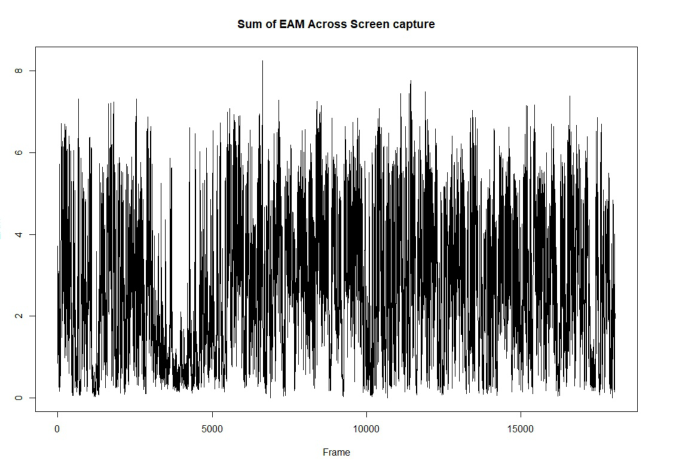
Analysis In order to accurately quantify EAM, we turned toward Farneback’s (2003) dense optical flow (DOF) algorithm. DOF computes an optical flow vector for every pixel in the frame. From this, we extracted the magnitude of change per pixel, summed the values in each magnitude vector, and calculated the mean of each composite vector across all pixels. This resulted in an average magnitude per frame of the screen capture (see Figure 1). This was further condensed into an average magnitude across all frames per participant. Pre- sence was collected via the IGroup Presence Questionnaire (α = 0.87). The
42 Dilanchian and Prevratil
Figure 1: Sum of EAM magnitude per frame of the screen capture for one participant. Stronger movements are represented by higher peaks.
IPQ consists of three subscales: spatial presence, realism, and involvement along with a single general presence item. Scores across all subscales were summed into a composite score per participant. Five data were removed due to corruption, resulting in a final sample size of 75.
Results
In order to test our hypothesis that EAM will predict presence, we utilized a regression analysis. This was conducted with EAM as the predictor and pre- sence as the predictand. The overall model was non-significant (R2 = 0.04, RSE = 5.87, F(1,73) = 3.83, p = 0.054). That is, we were not able to predict the reported presence levels of participants using EAM. This finding sug- gests that motion induced by the environment has no impact on a user’s feelings of presence. Toward adding to the VR literature, we also explored the correlation between cybersickness (recorded via the SSQ) and presence. We conducted a correlation analysis using cybersickness scores and presence scores. In contrast to the literature, we found no correlation between cybersi- ckness and presence (r = 0.097). On average, participants reported low levels of cybersickness (M = 21.12) and high levels of presence (M = 49.29).
CONCLUSION
IVR has the potential to be utilized across a plethora of domains in a variety of ways. IVR-based interventions show promise in being an accessible and effective technology. Additionally, researchers have demonstrated the versa- tility of IVR as a medium for interventions. Indeed, IVR’s ability to immerse
Predicting Presence Using Environment-Activated Motion in Immersive Virtual Reality 43
a user in a three-dimensional environment with a high amount of control allows researchers to test many different paradigms and interventions. Pre- sence, a key factor of IVR, has proven to be a crucial determinant of the success of these IVR-based solutions. To be able to isolate and manipulate this factor may prove useful. Indeed, with its influence on the success of many IVR applications, it is important to maximize presence and minimize factors that would reduce it. While many studies have investigated poten- tial design properties of presence (resolution, headset form-factor, real and abstract environments, etc.), less attention has been paid to the individual- factors of presence. This is a crucial aspect to investigate as designs have the potential to be generalizable if we can pinpoint the behavioural factors of presence. With that, this study aimed to investigate how EAM would influe- nce presence. We predicted that EAM would be able to significantly predict reported levels of presence for participants. Instead, we found this relation- ship to be non-significant. Additionally, we aimed to explore the correlation between cybersickness and presence to bolster existing IVR literature. Surpri- singly, we found no correlation between these two factors. This could be due to the low levels of reported cybersickness. Overall, these findings suggest that EAM does not play a role in the formation and maintenance of presence in low-intensity experiences. This may have implications when designing IVR experiences for those who experience higher degrees of cybersickness due to increased EAM, making IVR potentially more accessible. These findings may be specific to low-intensity IVR experiences. Further research is needed to generalize these results to higher intensity IVR interventions.
REFERENCES
Baker, S., Waycott, J., Robertson, E., Carrasco, R., Neves, B. B., Hampson, R.
and Vetere, F., 2020. Evaluating the use of interactive virtual reality techno- logy with older adults living in residential aged care. Information Processing & Management, 57(3), p. 102105. Benham, S., Kang, M. and Grampurohit, N., 2019. Immersive virtual reality for the management of pain in community-dwelling older adults. OTJR: occupation, participation and health, 39(2), pp. 90–96. Camp, N., Lewis, M., Hunter, K., Johnston, J., Zecca, M., Di Nuovo, A. and
Magistro, D., 2021. Technology used to recognize activities of daily living in community-dwelling older adults. International Journal of Environmental Research and Public Health, 18(1), p. 163. Caserman, P., Garcia-Agundez, A., Gámez Zerban, A. and Göbel, S., 2021. Cybersickness in current-generation virtual reality head-mounted displays: systematic review and outlook. Virtual Reality, 25(4), pp. 1153–1170. Chow, H., Hon, J., Chua, W. and Chuan, A., 2021. Effect of virtual reality therapy
in reducing pain and anxiety for cancer-related medical procedures: a systematic narrative review. Journal of Pain and Symptom Management, 61(2), pp. 384–394. Clifton, J. and Palmisano, S., 2020. Effects of steering locomotion and teleporting on cybersickness and presence in HMD-based virtual reality. Virtual Reality, 24(3), pp. 453–468. Cotten, S. R., 2017. Examining the roles of technology in aging and quality of
life. Journals of Gerontology Series B: Psychological Sciences and Social Sciences, 72(5), pp. 823–826.
44 Dilanchian and Prevratil
Damant, J., Knapp, M., Freddolino, P. and Lombard, D., 2017. Effects of digital engagement on the quality of life of older people. Health & Social Care in the Community, 25(6), pp. 1679–1703. D’Onofrio, G., Sancarlo, D., Ricciardi, F., Panza, F., Seripa, D., Cavallo, F., Giuliani,
F. and Greco, A., 2017. Information and communication technologies for the acti- vities of daily living in older patients with dementia: a systematic review. Journal of Alzheimer’s Disease, 57(3), pp. 927–935. Dermody, G., Whitehead, L., Wilson, G. and Glass, C., 2020. The role of virtual reality in improving health outcomes for community-dwelling older adults: systematic review. Journal of medical internet research, 22(6), p. e17331. Diemer, J., Alpers, G. W., Peperkorn, H. M., Shiban, Y. and Mühlberger, A., 2015.
The impact of perception and presence on emotional reactions: a review of research in virtual reality. Frontiers in psychology, 6, p. 26. Dilanchian, A. T., Andringa, R. and Boot, W. R., 2021. A pilot study exploring age differences in presence, workload, and cybersickness in the experience of immersive virtual reality environments. Frontiers in Virtual Reality, 2, p. 736793. Farnebäck, G., 2003. Two-frame motion estimation based on polynomial expansion.
In Image Analysis: 13th Scandinavian Conference, SCIA 2003 Halmstad, Sweden, June 29–July 2, 2003 Proceedings 13 (pp. 363-370). Springer Berlin Heidelberg. Felnhofer, A., Hlavacs, H., Beutl, L., Kryspin-Exner, I. and Kothgassner, O. D., 2019.
Physical presence, social presence, and anxiety in participants with social anxi- ety disorder during virtual cue exposure. Cyberpsychology, Behavior, and Social Networking, 22(1), pp. 46–50. Freeman, D., Reeve, S., Robinson, A., Ehlers, A., Clark, D., Spanlang, B. and Slater, M., 2017. Virtual reality in the assessment, understanding, and treatment of mental health disorders. Psychological medicine, 47(14), pp. 2393–2400. Freiwald, J. P., Schenke, J., Lehmann-Willenbrock, N. and Steinicke, F., 2021.
Effects of avatar appearance and locomotion on co-presence in virtual reality collaborations. In Proceedings of Mensch und Computer 2021 (pp. 393–401). Garattini, C., Wherton, J. and Prendergast, D., 2012. Linking the lonely: an exploration of a communication technology designed to support social interaction among older adults. Universal Access in the Information Society, 11(2), pp. 211–222. Geraets, C. N., Van der Stouwe, E. C., Pot-Kolder, R. and Veling, W., 2021. Advances
in immersive virtual reality interventions for mental disorders: A new reality?. Current opinion in psychology, 41, pp. 40–45. Gromer, D., Reinke, M., Christner, I. and Pauli, P., 2019. Causal interactive links between presence and fear in virtual reality height exposure. Frontiers in psychology, 10, p. 141. Hvass, J., Larsen, O., Vendelbo, K., Nilsson, N., Nordahl, R. and Serafin, S.,
2017, June. Visual realism and presence in a virtual reality game. In 2017 3DTV Conference: The True Vision-Capture, Transmission and Display of 3D Video (3DTV-CON) (pp. 1–4). IEEE. Ibarra, F., Baez, M., Cernuzzi, L. and Casati, F., 2020. A systematic review on technology-supported interventions to improve old-age social wellbeing: lone- liness, social isolation, and connectedness. Journal of healthcare engineering, 2020. Kalantari, S., Xu, T. B., Mostafavi, A., Dilanchian, A., Kim, B., Boot, W. and Czaja, S.,
2022. Using Immersive Virtual Reality to Enhance Social Interaction among Older Adults: A Multi-site Study. arXiv preprint arXiv:2210.04954.
Predicting Presence Using Environment-Activated Motion in Immersive Virtual Reality 45
Kennedy, R. S., Lane, N. E., Berbaum, K. S. and Lilienthal, M. G., 1993. Simulator sickness questionnaire: An enhanced method for quantifying simulator sickness. The international journal of aviation psychology, 3(3), pp. 203–220. Kreimeier, J., Hammer, S., Friedmann, D., Karg, P., Bühner, C., Bankel, L. and Götzel-
mann, T., 2019, June. Evaluation of different types of haptic feedback influencing the task-based presence and performance in virtual reality. In Proceedings of the 12th acm international conference on pervasive technologies related to assistive environments (pp. 289–298). Melo, M., Coelho, H., Gonçalves, G., Losada, N., Jorge, F., Teixeira, M. S. and Bessa, M., 2022. Immersive multisensory virtual reality technologies for virtual tou- rism: A study of the user’s sense of presence, satisfaction, emotions, and attitudes. Multimedia Systems, 28(3), pp. 1027–1037. Neri, S. G., Cardoso, J. R., Cruz, L., Lima, R. M., De Oliveira, R. J., Iversen, M. D.
and Carregaro, R. L., 2017. Do virtual reality games improve mobility skills and balance measurements in community-dwelling older adults? Systematic review and meta-analysis. Clinical Rehabilitation, 31(10), pp. 1292–1304. Newman, M. A. R. K., Gatersleben, B., Wyles, K. J. and Ratcliffe, E., 2022. The use of virtual reality in environment experiences and the importance of realism. Journal of environmental psychology, 79, p. 101733. Ng, A. K., Chan, L. K. and Lau, H. Y., 2020. A study of cybersickness and sen-
sory conflict theory using a motion-coupled virtual reality system. Displays, 61, p. 101922. Pacheco, T. B. F., de Medeiros, C. S. P., de Oliveira, V. H. B., Vieira, E. R. and De Cavalcanti, F. A. C., 2020. Effectiveness of exergames for improving mobility and balance in older adults: a systematic review and meta-analysis. Systematic reviews, 9, pp. 1–14. Pittara, M., Matsangidou, M., Stylianides, K., Petkov, N. and Pattichis, C. S., 2020.
Virtual reality for pain management in cancer: a comprehensive review. IEEE Access, 8, pp. 225475–225489. Prothero, J. D., Parker, D. E., Furness, T. and Wells, M., 1995, November. Towards a robust, quantitative measure for presence. In Proceedings of the conference on Experimental Analysis and Measurement of Situation Awareness (pp. 359–366). Riches, S., Elghany, S., Garety, P., Rus-Calafell, M. and Valmaggia, L., 2019. Factors
affecting sense of presence in a virtual reality social environment: a qualitative study. Cyberpsychology, Behavior, and Social Networking, 22(4), pp. 288–292. Schubert, T. W., 2003. The sense of presence in virtual environments: A threecomponent scale measuring spatial presence, involvement, and realness. Z. für Medienpsychologie, 15(2), pp. 69–71. Schubert, T., Friedmann, F. and Regenbrecht, H., 2001. The experience of presence:
Factor analytic insights. Presence: Teleoperators & Virtual Environments, 10(3), pp. 266–281. Schuemie, M. J., Van Der Straaten, P., Krijn, M. and Van Der Mast, C. A., 2001.
Research on presence in virtual reality: A survey. Cyberpsychology & behavior, 4(2), pp. 183–201. Siegel, C. and Dorner, T. E., 2017. Information technologies for active and assisted living—Influences to the quality of life of an ageing society. International journal of medical informatics, 100, pp. 32–45. Selzer, M. N., Gazcon, N. F. and Larrea, M. L., 2019. Effects of virtual presence and
learning outcome using low-end virtual reality systems. Displays, 59, pp. 9–15.
46 Dilanchian and Prevratil
Soler-Domínguez, J. L., de Juan, C., Contero, M. and Alcañiz, M., 2020. I walk, therefore I am: A multidimensional study on the influence of the locomotion method upon presence in virtual reality. Journal of Computational Design and Engineering, 7(5), pp. 577–590. Thach, K. S., Lederman, R. and Waycott, J., 2020, December. How older adults
respond to the use of Virtual Reality for enrichment: A systematic review. In Proceedings of the 32nd Australian Conference on Human-Computer Interaction (pp.303–313). Thakur, N. and Han, C. Y., 2021. A review of assistive technologies for activities of daily living of elderly. arXiv preprint arXiv:2106.12183. Uhm, J. P., Lee, H. W. and Han, J. W., 2020. Creating sense of presence in a virtual
reality experience: Impact on neurophysiological arousal and attitude towards a winter sport. Sport Management Review, 23(4), pp. 588–600. Weech, S., Kenny, S. and Barnett-Cowan, M., 2019. Presence and cybersickness in virtual reality are negatively related: a review. Frontiers in psychology, 10, p.158. Weber, S., Weibel, D. and Mast, F. W., 2021. How to get there when you are there alre-
ady? Defining presence in virtual reality and the importance of perceived realism. Frontiers in psychology, 12, p.628298. Yang, S. and Zhang, W., 2022. Presence and flow in the context of Virtual Reality storytelling: what influences enjoyment in virtual environments?. Cyberpsycho- logy, Behavior, and Social Networking, 25(2), pp. 101–109.
LISTED IN THE AHFE DIGITAL BOOKSTORE CATALOGUE
Explore the complete digital volume
Human Factors in Virtual Environments and Game Design
Read this individual research paper free through the original publisher, or explore the full digital proceedings book.
ISBN 978-1-958651-72-8
Explore this ISBN in the AHFE Bookstore ↗Listed in the July 2026 bookstore catalogue; search by ISBN to confirm current availability · Digital book purchase optional