Xinyue Yi, Zhizheng Liu (2023). A visual analysis of VR user experience based on bibliometrics Background of the selection. In: Human Factors in Virtual Environments and Game Design. AHFE Open Access, vol. 96, pp. 74–82. https://doi.org/10.54941/ahfe1003869
In recent years, User experience of VR products (hereinafter referred to as UEO-VRP ) has received increasing attention. Therefore, it is necessary to further summarise and analyse the current situation of UEO-VRP and existing research results, in order to better apply VR technology to modern science display design and enhance user experience.However, this literature is very voluminous and has strong interdisciplinary properties, involving knowledge from multiple disciplines. It is difficult to objectively analyse the changes in research hotspots and development dynamics in this field by relying solely on traditional literature review methods, and even more difficult to accurately grasp the classical theoretical foundations of VR user experience research. Bibliometrics helps to identify potential patterns and information in the large amount of literature data. Therefore, the UEO-VRP-related literature included in the WOS database is used as the data source in the study, and the retrieved data is visualised and analysed for knowledge structure through scientific bibliometrics.Study design[Data source]: In this study, the Web of Science core database was searched with a search strategy of TS= ((virtual reality OR VR) AND (user experience OR UE OR UX)) and the three major citation indexes, SSCI, SCI-Expanded and A&HCI, commonly used in the WOS database were selected as the search sources. The search results were exported as txt files in the format of "full records and cited references", and articles that deviated from the research topic, missing field information, duplicate data and other interfering articles were excluded. A total of 606 articles were obtained for further quantitative analysis.[Research Methodology]: Bibliometrics refers to the quantitative analysis of various types of literature to discover underlying patterns and information in large amounts of literature data, and was first proposed by Pritchard in 1969. In order to obtain more rigorous and comprehensive data indicators, the study used a combination of CiteSpace (V1.6.18) and VOSviewer (V6.1.R3) software to conduct keyword co-occurrence analysis and literature co-citation analysis on the cited literature, and to map the corresponding scientific knowledge.[Research findings]: UEO-VRP has a general upward trend in the output of time-series papers, but the growth trend is slow. Not many countries/regions, scholars and institutions are prolific, with developed Western countries being more influential in international research; kim, jinmo, kim, mingyu, lee, jiwon, riva, giuseppe and montagud, mario are the core authors in the international community; institutions of higher learning are the main institutions of research, with korea univ, univ valencia, chung ang univ, zhejiang univ and seoul natl univ are the core institutions. The keyword clustering reveals that the knowledge base of UEO-VRP in international research can be divided into three categories: design environment and evaluation, concept and usability, and emerging technologies. An analysis of the hotspot evolution of UEO-VRP reveals that most scholars currently focus on environments, augmented reality and virtual-reality, with social vr, streaming media and metaverse being the next research priorities.
User experience runs through the first, middle and last stages of a systema- tic service, encompassing user behaviour, perception, cognition, emotions, preferences, psychology and physiology. The user experience in a virtual environment can be deepened into the audience’s experience in a physi- cally controlled simulated environment with three important characteristics: immersion, interactivity and conceptualisation. Therefore, it is necessary to further summarise and analyse the current status of UEO-VRP and existing research results, in order to better apply VR technology to modern science display design to enhance user experience.
However, this literature is very voluminous and has strong interdisciplinary properties, involving knowledge from multiple disciplines. It is difficult to objectively analyse the changes in research hotspots and development dyna- mics in this field by relying solely on traditional literature review methods, and even more difficult to accurately grasp the classical theoretical foundati- ons of VR user experience research. Bibliometrics helps to identify potential
A Visual Analysis of VR User Experience Based on Bibliometrics Background 75
patterns and information in the large amount of literature data. Therefore, the study uses the UEO-VRP-related literature included in the WOS database as the data source, and visualises the knowledge structure of the retrieved data through scientific bibliometrics to uncover the current state of application of the User experience of VR products (hereafter referred to as UEO-VRP) in the international design research field The purpose of this paper is to pro- vide scholars in the field with a reference and overall overview. This paper examines the application of UEO-VRP by answering the following three questions: (1) UEO-VRP application subjects, who are the people and institutions working on the VR user experience at an international scale?
(2) UEO-VRP application themes, what are the main research subjects and what are the hot research topics in international papers on the application of VR user experience in various fields?
(3) UEO-VRP application impact, high impact literature research themes and their research paradigms in the international field of design studies on VR user experience?
DATA AND METHODS Data Sources
The bibliometric records were retrieved from WOS, which is considered an ideal data source for bibliometric surveys, with approximately 12,000 leading journals worldwide. For this study, we have selected the Science Citation Index Expanded (1981 to 2022), Social Sciences Citation Index (2006 to 2022) and Art & Humanities in the Web of Science core database. The three major citation indexes, Science Citation Index Expanded (1981 to 2022), Social Sciences Citation Index (2006 to 2022) and Art & Humanities Citation Index (1975 to 2022), were used as literature search sources, and the search strategy was set to TS=((virtual reality OR VR) AND (user experience OR UE OR UX)). The search results were exported as TXT files in the format of “full records and cited references”, and interfering articles such as deviations from the research topic, missing field information, and duplicate data were excluded. The search yielded a total of 606 articles, which were then exported in plain text format for further quantitative analysis.
Research Methodology To obtain more rigorous and comprehensive data indicators, the study uses a combination of CiteSpace (V5.6.R5) and VOSviewer (V1.6.18) software to conduct keyword co-occurrence analysis and literature co-citation analysis of the cited literature, and to draw the corresponding scientific knowledge map. Through further analysis of the knowledge maps and statistical results, information on the knowledge structure, research frontiers, research hot- spots, subject area structure and research trends of the disciplines to which the literature belongs can be obtained.
76 Yi and Liu
ANALYSIS OF RESULTS Accordingly, the analysis of the results is presented on the following basis.
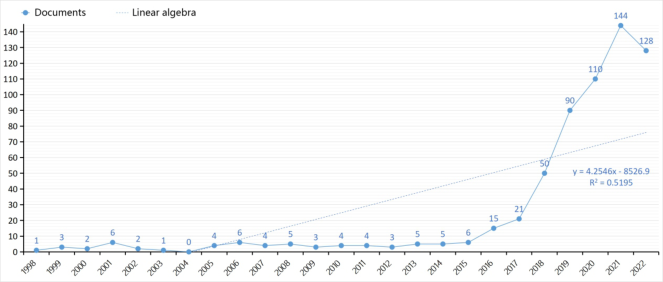
Distribution and Sources Literature Research Output and Country Distribution The pattern of change in the output of academic literature over time is an important measure of trends in research topics, and looking at the volume of research output in the literature over time can provide a useful assessment of the research dynamics of the discipline. The annual distribution of UEO-VRP literature publications by field extraction of data retrieved over a twenty-four year period is shown in Figure 1. as can be seen from the WOS publication profile, the first article within the search was published in 1998. Since 1998- 2022, the annual number of articles published has increased from 1 in 1998 to 144 in 2021, with an overall continuing upward trend in literature output. From 1998 to 2015, the overall trend was little changed, with an average of 4 articles published per year; from 2016 to 2022, the annual publication of UEO-VRP showed a sharp increase due to the rapid development of the social science and technology industry, with a large peak in 2021, when its total annual publication reached at least 144 articles (as 2022 is not a full year, the The full upper limit of the data for 2022 has been retained). The literature output shows that the research topic of UEO-VRP is evolving, has been the focus of scholarly attention in recent years, and will remain a high-profile research point in the years to come.
The number of publications and the number of citations by country/region in the dataset describe the highly productive countries in the research field and their impact. In terms of country/regional output, a total of 63 coun- tries/regions worldwide contribute to this research area. Of these, the top 10 countries account for over 69.11% of the total number of publications. China is the most productive country in the UEO-VRP with 125 publications (14.79% of total publications), ranking 1st in terms of total publications, fol- lowed by the USA (123 publications, 14.56% of total publications), followed
Figure 1: Number of UEO-VRP publications indexed by Web of Science from 1998 to 2022.
A Visual Analysis of VR User Experience Based on Bibliometrics Background 77
by Korea (76 publications), UK (62 publications) and Germany (42 publica- tions). In terms of the number of publications, both the US and China have more than 100 publications, while other countries have far fewer in compa- rison. In addition, both countries also ranked high in terms of citations, with both countries having over 1,000 citations.
Distribution of Literature Sources Knowledge graphs can provide information on specialist journals relevant to a particular research area, thus facilitating researchers to find key literature. Journal co-citation maps with journal co-citation frequencies and centrality were used in this study to find the most influential journals contributing to the UEO-VRP.
Among the academic journals, Virtual Reality is the most published jour- nal in this research area, with 39 articles, which can be considered as the core journal in the field of UEO-VRP. The top 10 sources are Virtual Reality (39 articles), Applied Sciences-Basel (31 articles) and IEEE Transactions on Visualization and Computer Graphics (25 articles).
Research Collaboration Institutional Cooperation 929 research institutions worldwide conducted research related to the UEO- VRP from 1998-2022. The number of nodes is 231, as shown in Figure 3, by running VOSviewer and setting the node threshold to 2 by selecting Organi- sations in Citation. The table shows that the top three high-impact research institutions are Korea University, the University of Valencia and Chung-Ang University, with Korea University ranking first with 12 articles in the search.
Table 1. Top 5 institutions participating in the UEO-VRP.
Table available in the original PDF paper.
Ranking Institutions Country Publications Number of citations 1 Korea University Korea 12 168 2 University of Valencia Spain 11 242 3 Chung-Ang University Korea 8 567 4 Zhejiang University China 8 48 5 Seoul National University Korea 7 194
Author Collaboration The authors are direct contributors to UEO-VRP, and this paper identifies the more active scholars in this field worldwide by examining the authors’ co-citations. The statistics show that there are not many productive authors, with Kim Jinmo from Hansung University having the most articles, ranking first with 10 articles in the search, followed by Kim Mingyu from Teneleven Inc (8 articles), Lee Jiwon from Korea Advanced Institute of Science & Tech- nology (6 articles), and Lee Joon from the UEO-VRP. Lee Jiwon from Korea Advanced Institute of Science & Technology (6 articles). The most prolific author with the highest total citations is Professor Riva Giuseppe of the Uni- versity of the Sacred Heart, with 6 articles and 639 citations in the search,
78 Yi and Liu
and is considered to be the representative of UEO-VRP. In addition, colla- borative research among scholars is not close and mostly sporadic between institutions, which is the current status of UEO-VRP.
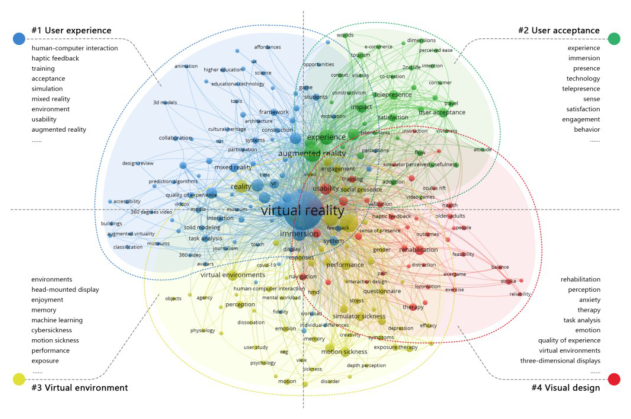
Research Topics Analysis of Research Hotspots The keywords in the literature are a high distillation of the author’s research results, usually containing the research object, research perspective and rese- arch methods, etc. The high frequency co-occurrence of keywords reflects the long-standing research hotspots of UEO-VRP. A total of 2,652 keywords were found in the 606 documents searched, and the frequency of keyw- ord co-occurrence was set to 4 by running Vosviewer, and the keyword co-occurrence clusters formed by screening and merging 235 keywords with synonyms are shown in Figure 2. The keywords with the same colour in the figure are the same clusters, forming four main clusters, #1 User experience, #2 User acceptance, #3 Virtual environment and #4 Visual design.
Combining the clustered sub-networks, cluster #1 - User experience con- tains 77 members, mainly including human-computer interaction, haptic feedback, training, acceptance, simulation, and mixed reality. In the UEO- VRP study, the keywords human-computer interaction and haptic feedback appear in the co-occurrence clustering network, which directly reflect the integration and development of UEO-VRP with various fields. Cluster #2 - User acceptance contains a total of 38 cluster members, mainly containing the keywords experience, immersion, presence, technology, telepresence and sense. The clusters reflect the core functions of the virtual reality user expe- rience, i.e. to enhance and complement existing experience models and to enhance the immersive experience of the user in the environment. Cluster 3 -
Figure 2: Cooccurrence clustering of keywords in the UEO-VRP literature.
A Visual Analysis of VR User Experience Based on Bibliometrics Background 79
Virtual environment contains a total of 64 cluster members, mainly consisting of environments, head-mounted display, enjoyment, memory and machine learning. The clusters reflect the direction and themes of the main applica- tion research in the UEO-VRP and can be found in the areas of environment, human-computer interaction and emotional communication to deepen the application of the UEO-VRP and to get a better design output for their individual needs. Cluster 4, Visual design, contains 56 clusters, including rehabilitation, perception, anxiety, therapy, task analysis and emotion.
Combining the characteristics of high-frequency keywords, the research hotspots of Cluster 4 can be summarised as follows: the development of UEO-VRP design methods has gone through three stages, from function- based decomposition to task-oriented decomposition to user-centred design; at the same time, the technical routes adopted in different design modes are different. In the UEO-VRP process, scholars mainly combine the research frameworks and research hotspots of their related fields, statistically analyse the importance of their application perceptions and design needs, and thus adjust the design research direction or determine the design methods and key design essentials of the research areas.
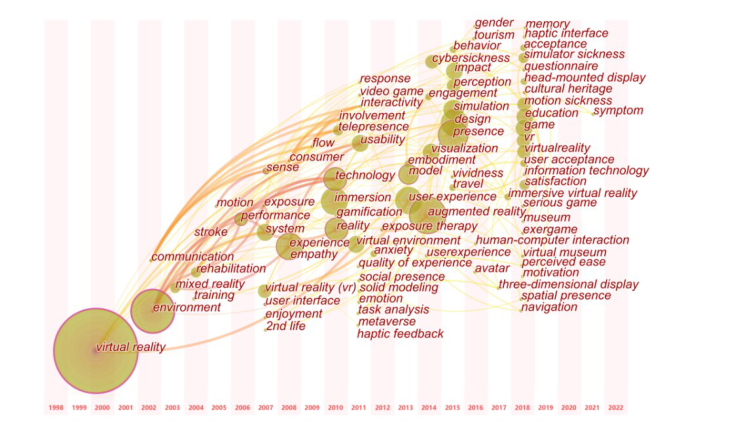
Analysis of Trends at the Research Frontier The keyword evolution trend combined with the Burst keyword high density emergence and the time-keyword clustering overlay plot shows that the keyword distribution of UEO-VRP in international design research has been showing thematic changes, which is also consistent with the results of the time zone plot (Figure 3). 2011–2019 has the highest density of high frequ- ency keywords, reflecting that this time period is the prime research period of UEO -VRP’s prime research period. The main high frequency keywords
Figure 3: Cooccurrence clustering of keywords in the UEO-VRP literature.
80 Yi and Liu
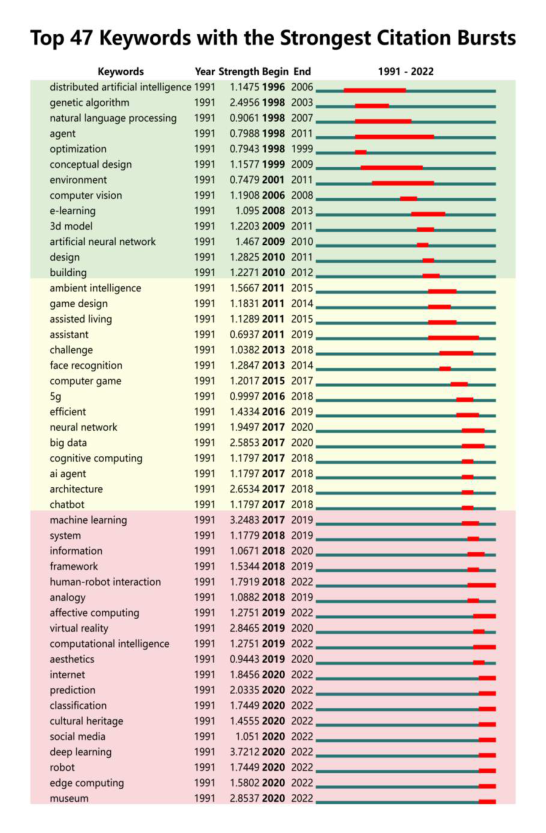
in this interval are environments (77 times), augmented reality (71 times), user experience (69 times), immersion (47 times) and education (33 times). Combined with the time zone map (Figure 3) and the trend of high frequency keywords in the Burst high density emergence (Figure 4), it can be predicted that the future applications of UEO-VRP will focus on education, virtual environments, user satisfaction and augmented reality.
Analysis of High-Impact Literature In order to further analyse the research paradigm of UEO-VRP, this paper provides an in-depth analysis of the content of the retrieved literature itself.
Figure 4: UEO-VRP keyword burst term.
A Visual Analysis of VR User Experience Based on Bibliometrics Background 81
Table 2. Top 5 most cited references in the surveys participating in the UEO-VRP.
Table available in the original PDF paper.
Ranking Author Year Literature Number of citations
976
1 Kiran Ijaz
2020 Player Experience of Needs Satisfaction (PENS) in an Immersive Virtual Reality Exercise Platform Describes Motivation and Enjoymen
447
2 Giuseppe Riva
2007 Affective Interactions Using Virtual Reality: The Link between Presence and Emotions
382
3 D. Freeman
2017 Virtual reality in the assessment, understanding, and treatment of mental health disorders
314
4 Lasse Jensen
2018 A review of the use of virtual reality head-mounted displays in education and training
235
2010 Beyond virtual museums: Experiencing immersive virtual reality in real museums
5 Marcello Carroz- zino
The literature related to UEO-VRP within the search was ranked by total cita- tions and the top fifteen literature ranked by total citations per year in the international academic community in the last decade were extracted respecti- vely, as shown in Table 2. The majority of these highly cited journals are from JCR journals in SCI Q1, International Journal of Human-Computer Intera- ction, Cyberpsyhology & Brhavior, Psychological Medicine, Education and VRP. Psychological Medicine, Education and Information Technologies and Journal of cultural heritage, Science and Robotics.
Overall, there is also a greater emphasis on innovative research from diffe- rent perspectives in the overall content of UEO-VRP, as well as a combination of qualitative and quantitative features and a richer range of indicators for data analysis and processing. For example, in his paper Affective Interactions Using Virtual Reality: The Link between Presence and Emotions, Giuseppe Riva analyses the possible use of virtual reality as an emotional medium and the relationship between presence and emotion. Marcello Carrozzino, in his article Beyond virtual museums: Experiencing immersive virtual reality in real museums, identifies the main problems that prevent the real application of these technologies in museums. the main problems that prevent the real wide- spread use of these technologies and outlines proposals for a more general and effective use of immersive VR for cultural purposes, among others.
CONCLUSION AND DISCUSSION (1) UEO-VRP research is generally on the rise in terms of literature out- put, and has been growing rapidly in the last five years. The team of Kim Jinmo, Kim Mingyu, Lee Jiwon and other authors are the main UEO-VRP application team.
(2) The keyword clustering shows that the UEO-VRP research content is comprehensive and diverse, and the applications are mainly distributed in the “application research” category. The research hotspots can be divided into
82 Yi and Liu
four major categories, namely #1 User experience, #2 User acceptance, #3 Virtual environment, #4 Visual design, etc. Combined with the time zone map and the high frequency keyword distribution trend in the Burst high density emergence, it can be predicted that the future applications of UEO-VRP will The focus is on education, virtual environment, user satisfaction, etc.
(3) The UEO-VRP has produced an influential body of highly cited lite- rature in the international research arena. The literature is mainly from the International Journal of Human-Computer Interaction and Cyberpsyhology & Brhavior, which represent the science and robotics category. The highly cited literature also focuses on virtual environments, science education, and applied technology, and is an important contribution to the development of the UEO-VRP’s subsequent research.
REFERENCES
Carrozzino M, Bergamasco M. Beyond virtual museums: Experiencing immersive virtual reality in real museums [J]. Journal of cultural heritage, 2010, 11(4): 452–458. Freeman D, Reeve S, Robinson A, et al. Virtual reality in the assessment, understan-
ding, and treatment of mental health disorders[J]. Psychological medicine, 2017, 47(14): 2393–2400. Ijaz K, Ahmadpour N, Wang Y, et al. Player experience of needs satisfaction (PENS) in an immersive virtual reality exercise platform describes motivation and enjoy- ment [J]. International Journal of Human-Computer Interaction, 2020, 36(13): 1195–1204. Jensen L, Konradsen F. A review of the use of virtual reality head-mounted displays in
education and training [J]. Education and Information Technologies, 2018, 23(4): 1515–1529. LI H. Evolutionary Features of Academic Articles Co-keyword Network and Keywords Co-occurrence Network: Based on Two-mode Affiliation Network [J]. Physica A: Statistical Mechanics and its Applications, 2016, 450: 657–669. Rebelo F, Noriega P, Duarte E, et al. Using virtual reality to assess user experience
[J]. Human factors, 2012, 54(6): 964–982. Rhiu I, Kim Y M, Kim W, et al. The evaluation of user experience of a human walking and a driving simulation in the virtual reality[J]. International Journal of Industrial Ergonomics, 2020, 79: 103002. Riva G,Mantovani F,Capideville C S,et al. Affective interactions using virtual reality:
the link between presence and emotions[J]. Cyberpsychology & behavior, 2007, 10(1): 45–56. Schott C, Marshall S. Virtual reality for experiential education: a user experience exploration [J]. Australasian Journal of Educational Technology, 2021, 37(1): 96–110. Van Leeuwen, T. The application of bibliometric analyses in the evaluation of social
science research. who benefifits from it and why it is still feasible. Scientometrics 2006, 66, 133–154. [CrossRef].
LISTED IN THE AHFE DIGITAL BOOKSTORE CATALOGUE
Explore the complete digital volume
Human Factors in Virtual Environments and Game Design
Read this individual research paper free through the original publisher, or explore the full digital proceedings book.
ISBN 978-1-958651-72-8
Explore this ISBN in the AHFE Bookstore ↗Listed in the July 2026 bookstore catalogue; search by ISBN to confirm current availability · Digital book purchase optional