Shun Coney, Yasunobu Ito (2023). The role of nonhuman actors in contributing to filmmaking solidarity: Ethnography of independent filmmaking in Japan. In: The Human Side of Service Engineering. AHFE Open Access, vol. 108, pp. 140–151. https://doi.org/10.54941/ahfe1003115
The purpose of this paper is to clarify how nonhuman actors contribute to solidarity in independent new film production. Specifically, it examines independent new film productions from a relationalist perspective, using actor-network-theory (ANT), which considers humans and nonhumans as equivalent actors and analyzes phenomena based on their interactions with each other. The research method used was ethnography with a focus on participant observation. One of the authors, a filmmaker and researcher, observed the inner workings of the filmmaking activity, while the other author observed the observer from an anthropologist’s perspective. In a previous paper, we found from the process of translation that the two nonhuman actors of the film’s original story and funding are inextricably linked, and the agency of the human actors surrounding them interacts with and transforms the nonhuman actors (Coney and Ito, 2021). In the present study, we analyzed the interaction with the solidarity among human actors in the process of film production by closely following the linkage of nonhuman actors such as provisional publicity materials, in addition to funds and scripts. In the process of filmmaking, the nonhuman actors often encounter unforeseen circumstances such as budget adjustments and filming postponement, but despite the setbacks, the nonhuman actors form a network in which they accept each other’s roles, and filmmaking is promoted by solidarity as human actors of the film become more interdependent through the agency working as an inclusive collective. The results of the study revealed that the human actors in film are interdependent and that their solidarity promotes filmmaking.
Two types of film exist in the industry: major motion pictures and independent films. Independent films are produced in a very different way from well-funded major motion pictures. Since the planning and financing are done from scratch with no fixed theatres in which to release the film, the process of filming, completion, and release not only requires a great deal of
The Role of Nonhuman Actors in Contributing to Filmmaking Solidarity 141
time and effort, but also carries the risk of the film itself not being completed or not being released.
Yamashita and Yamada (2003) focused on the relationship between the producer and the director, both of whom play a central role in film production, to examine creativity in film production, and clarified the building of a relationship between the two that mediates the organization. The challenge with this discussion is that actors other than the director and producer are not on the table for discussion. Coney and Ito (2022) conducted a study focusing on nonhuman actors in addition to the director and producer. In the paper, the authors used ethnography to investigate how actors transformed their relationships with one another to form solidarity and carry out projects, while capturing the existence of nonhuman actors in addition to the director and producer.
As a specific case study, a new film directed by one of the authors (hereinafter referred to as “the new film”), which is to be released in theatres, was used as the subject matter. The film is about Parkinson’s disease (hereinafter referred to as “PD”) and focuses on the work and living environments of PD sufferers, capturing their anguish and conflicts and interpreting the existence of the intractable disease from multiple perspectives. The perspectives on how to interpret the inescapable fate of this intractable disease, which at first glance appears to be a negative existence, are not consistent with the unified way we perceive social events. Latour (2005), a main proponent of ANT, argues that the “social” is not homogeneous, but shows traces of cooperative relations among heterogeneous elements, and that the goal of ANT is to deconstruct and reconstruct the state of power and structure in traditional sociology, where various activities and relations are lumped together. Foregrounding the heterogeneous element of PD and examining how filmmaking brings actors such as crew, cast, funds, and script together in a collaborative manner have practical significance for examining the multifaceted mechanisms of solidarity in the film industry. In addition, one of the authors, a filmmaker who has been engaged in independent filmmaking activities for about 20 years, and the other author, a cultural anthropologist, worked together from the perspective of “observing the observer” in the present research, where the distance between the researcher and the subject is eliminated with “ethnography of the 1.5 order” (Kimura et al., 2019), which has academic significance in opening up new possibilities.
METHOD
The study was conducted between January 2020 and December 2022. The research targeted a wide variety of actors (human and nonhuman) involved in the production of the new film. The research method used was ethnography (participant observation and interviews). The research was carried out at the director’s office, in outside meeting places, at the shooting location, and on Zoom, an online meeting app. Auto-ethnography, which is the process of writing down one’s own experiences and feelings, was partially used.
142 Coney and Ito
The obtained data were analyzed using ANT, which describes how actors involved in filmmaking form networks to produce films. According to the ANT concept, social events are networks of heterogeneous interactions among people, things, ideas, technologies, and other actors (Law, 1992). Callon (1986) calls the process of changing and adapting relationships between actors to fulfill the purpose of the network while maintaining mutual action, “translation” (Coney and Ito, 2021).
Callon (1986) organizes the “translation” process as consisting of four stages: (1) “problematization,” in which the problem is raised; (2) “interessement,” in which the main actor brings up material of interest to other actors; (3) “enrollment,” in which roles in the cooperative are coordinated and determined; and (4) “mobilization,” in which representative actors are selected and various actors are prepared to work together fully as a cooperative. Through the process of translation, when each actor succeeds in involving and retaining various actors in order to achieve its own objectives, the constructed fact becomes indispensable and becomes an “obligatory passage point (OPP)” (Latour, 1987: 132) for all actors involved in the network. Thus, translation is an adaptive process for the practice of cooperation where the actors’ practices and conduct through their interactions with one another are defined in order to achieve specific objectives. However, the world of the actor network constitutes relationships based solely on the actors formalized by the translator’s view.
RESULT
In our paper published in 2022, we examined the progression of the new film project from its inception in 2020 to January 2022, specifically from the time the film was conceived until before it started shooting (Coney and Ito, 2022). The present paper investigates the process of film production from January 2022 to December 2022, from pre-production to post-production and pre-release.
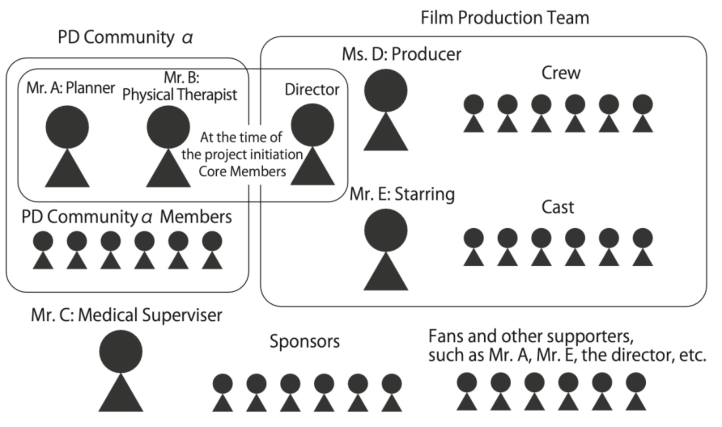
Starting in January 2020, the director worked with Mr. A, who was the planner and also a PD patient, and Mr. B, a physical therapist who presided over the “PD Community α” to which Mr. A belonged, to plan the film; Mr. A took the initiative in raising funds. While interviewing Mr. A, Mr. B, and Mr. C, a neurologist and medical supervisor, the director expanded his knowledge of PD and produced the original story and screenplay (in general, the “story”). As the story of the film improved, the scale of the film changed from a short film to a medium-length film and then to a feature film. In January 2021, the director brought in Ms. D, a film professional who was essential for the team, as the first tag-team producer. In February 2022, Mr. E, a PD patient and singer, agreed to be in charge of the theme song for the movie and to star in the film. Mr. E, a well-known singer in the PD community, was very empathetic to the social significance of the film. The director was struck by the fact that Mr. E, through his singing career, was practicing a mindset that did not view PD negatively while facing PD, and wrote the screenplay based on his image of Mr. E (see Figure 1).
The Role of Nonhuman Actors in Contributing to Filmmaking Solidarity 143
Figure 1: Relationships among human actors in film production.
By February 2022, a budget of US$112,000 had already been raised. Since we were about US$235,000 short of our original budget, we decided to shoot the film in June 2022, while considering ways to reduce the cost of filming. In March 2022, while preparations for filming were underway, Mr. A suddenly passed away from a stroke. The backbone of the film production was lost, and the director was left with the sole responsibility for the production of the film. After repeated discussions with Mr. B and Ms. D, they agreed to bring Mr. A’s legacy to fruition in the form of a film; in light of the funds that had been raised by that time, they decided to continue preparations for filming with US$154,000 less field costs. The shortfall in production costs and the film’s post-completion publicity and distribution costs were calculated at an approximate total of US$46,000. The director told Ms. D that US$46,000 could be raised by negotiating with sponsors after filming was completed and indicated that he would first aim to carry out the filming successfully. Around this time, as one of the fundraising measures, the director created temporary publicity materials that included the background of Mr. A’s plan for the new film and distributed in various places.
Due to location availability, progress in fundraising, and filming preparations, filming was delayed by approximately two months, from the end of July to early August 2022. The shooting period lasted for 10 days, but part of the shooting was postponed for one month due to Mr. E and his staff contracting COVID-19 during the shooting period. Consequently, the budget for the extra cost ballooned to nearly US$77,000, which was unforeseen for us. After filming, the director met with Ms. D and the company negotiating to put the film in theatres, in order to calculate the budget for publicity and distribution, but based on previous experience and the possibility that the budget could grow unexpectedly, the budget was set at the original target of US$347,000 (see Table 1).
144 Coney and Ito
after: US$186,000
after: US$247,000
after: US$89,000
(approxmately) Deficit
is US$116,000. US$27,000 before: US$19,000
feature film. US$46,000 before: US$70,000
Table 1. Production process, financing and budget for the new film (through December 2022).
Table available in the original PDF paper.
Time Major Event Fundraising
Early/Nov/2019 Mr. A holds a screening of the director’s previous film in α.
Early/Dec/2019 Mr. A brings the project to the director.
Early/Jan/2020 The director approaches Mr. A about creating a draft. As a short film, the goal is to have a total budget of US$46,000. US$3,000 US$43,000
Early/Mar/2020 Mr. A submits the draft to the director.
Late/Mar/2020 The director submits the original work to Mr. A.
May/2020 The director interviews the PD parties belonging to α, as well as Mr. B, a physical therapist, and Mr. C, a medical supervisor.
Early/Jun/2020 The director submits a revised version of the original work to Mr. A.
Jul/2020 The project changes from a short film to a medium-length film. The target total budget for the medium-length film
Early/Sep/2020 The director submitts the first draft of the script to Mr. A.
Middle/Oct/2020 The director submits the third draft of the script to Mr. A.
Late/Oct/2020 A physician who is the world’s leading authority on PD becomes the first of the supporters.
Nov/2020-
Jan/2021 The director creates a teaser video.
Middle/Nov/2020 Preparations for crowdfunding begins.
Late/Nov/2020 The project changes from a medium-length film to a feature film. A total budget of US$232,000 is targeted for the
Late/Dec/2020 The logo for the film is completed.
Early/Jan/2021 Producer D participates in the project.
Late/May/2021 The director submits the 4th draft of the script to Mr. A and others.
Late/May/2021 The total budget is changed from US$232,000 to US$347,000. US$100,000 before: US$132,000
Middle/Jun/2021 The director has his first meeting with the manager and president of the singer, Mr. E.
Middle/Jul/2021 The director meets Mr. E for the first time in Kumamoto and asked him to sing the theme song.
Middle/Jul/2021 Mr. A participates in the Tokyo Olympics 2020 torch kiss.
Late/Aug/2021 Together, the director and Mr. E begin work on the film’s theme song.
Early/Sep/2021 The theme song composed by Mr. E is released. US$102,000 US$245,000
Early/Jan/2022 Mr. E is asked to play the leading role. US$112,000 US$235,000
Early/Feb/2022 Mr. E agrees to play the lead role.
Middle/Mar/2022 Mr. A passes away.
The Role of Nonhuman Actors in Contributing to Filmmaking Solidarity 145
after: US$89,000
US$200,000 after:
US$46,000
festival entry fees. US$250,000 US$97,000
Late/Dec/2022 Editing, Multi-Audio, First-preview
Late/Dec/2022 Total budget is returned to US$347,000 in light of additional editing costs, music production, publicity/distribution costs, and film
Table 1. Continued.
Table available in the original PDF paper.
Middle/Apr/2022 The decision is made to lower the estimated production budget of US$347,000 to US$193,000. US$147,000 before:
May/2022-
Jul/2022 Staffing and casting US$162,000 US$31,000
Late/Jul/2022 Start filming
Early/Aug/2022 The lead actor and crew contract Covid-19 and the remaining filming is postponed.
Late/Aug/2022-
Middle/Sep/2022 The postponed filming takes place.
Middle/Sep/2022 The production budget is raised by US$77,000 because filming has been postponed. US$181,000 before: US$12,000
146 Coney and Ito
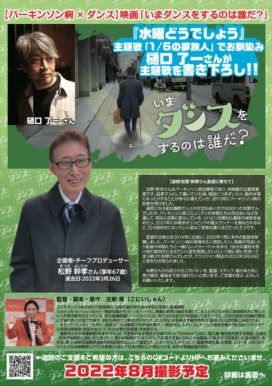
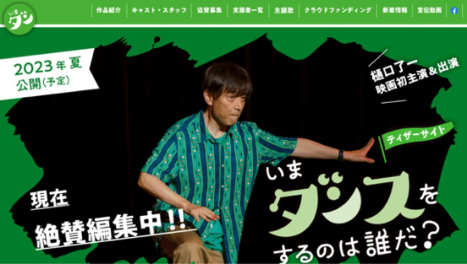
As of December 2022, Mr. B withdrew from production activities due to his wife’s busy schedule, including childbirth and childcare. The director continued to be involved with Mr. C, Ms. D, and Mr. E, and worked on editing and fundraising. Due to the significant shortage of funds, Mr. C was actively engaged in promotional activities for the completion of the film, including provisional publicity materials and teaser websites (see Figure 2 and Figure 3).
DISCUSSION
The new film discussed in the present paper began with Mr. A’s desire to broaden the social awareness of PD, and he approached the director about making a film about PD. Raising a large sum of money was a difficult task for Mr. A, who was trying his hand at film for the first time. This paper uses ANT to analyze how this fundraising, which could not have been achieved by Mr. A alone, was facilitated toward the achievement of the goal.
Figure 2: Tentative flyer, promotional material for a new film.Figure 3: Teaser website, a promotional material for the new film.
The Role of Nonhuman Actors in Contributing to Filmmaking Solidarity 147
Existence of Nonhuman Actors to Generate Funds As mentioned above, fundraising is a major obstacle for independent films, and in many cases, if a film fails to raise funds, the company may go bankrupt. However, even if the producer has ample funds, a film with little substance cannot fulfill its mission to convey the producer’s message or theme to a large audience. Therefore, it is important to produce good story content.
In this project, the director initially developed an original story about PD based solely on his own knowledge, but the initial submission to Mr. A and others did not reach an acceptable score. The director then interviewed a large number of people suffering from PD and collected information on the disease, and the quality of the original story improved significantly, which was well received by Mr. A and his colleagues. This effort, in addition to the collection of data necessary for the elaboration of the original story, formed a relationship of trust with the PD patients, as well as understanding and respect for their creative activities.
A good film story enhanced the image of the film’s feasibility for the film’s supporters, represented by Mr. A and Mr. B, and made them feel proud of their participation in the film. This facilitated fundraising, and as the funds built up sequentially, the story pushed the scale of the film from short to medium and then to feature length. The feature-length film brought in a well- known singer, Mr. E, to play the lead role, and the buzz generated attracted new supporters to the film production, providing funds and spreading the word.
The new member, Mr. E, became the actor to inherit Mr. A’s passion for the new film after his sudden death, and the human actor, Mr. A, disappeared, but was replaced by a nonhuman actor, publicity materials, that spelled out Mr. A’s intentions for the film production, which increased interdependence with the story and the fund-raising. The director became the representative actor in place of Mr. A, and transformed himself into the film’s supervisor, creating solidarity among the human actors.
As Callon and Law (1995) argue, ANT takes on a nested perspective where fixed resources such as people and objects are not the starting point or goal, but actors who have the agency are delegated to a network of predecessors; similar to the way the story, the funding, and the publicity materials were mutually transformative, mobilizing the human actors around them; and the network grew in relational cohesion and breadth.
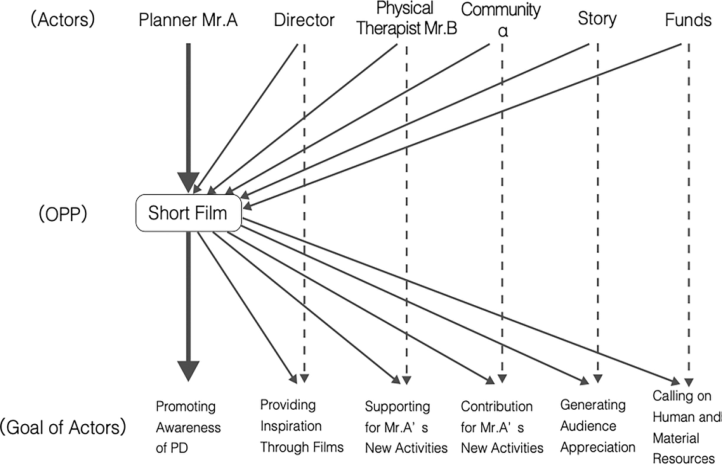
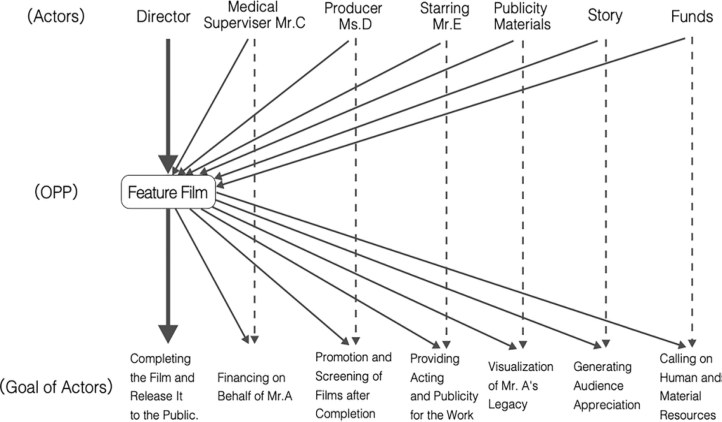
Actor Substitution and the Obligatory Passage Point (OPP) Taking the film (short film) initiated by Mr. A as the OPP, each actor set an issue that they could face as their own problem (“problematization”). Mr. A wanted to spread awareness of PD in society through film, and he himself became responsible for the production of the film. Mr. A was initially a passive participant, but as he deepened his relationship with the PD patients, he realized the importance of the social role of films and began to participate more deeply, believing that he could encourage people suffering from PD through films. Mr. B wanted PD sufferers to gain the opportunity to face their lives in a future-oriented way through the film, and the PD
148 Coney and Ito
Community α developed a sense of usefulness in accompanying Mr. A in the challenges of the film project. The story of the film was intended to be appreciated by the audience and to make them feel empathy for the work. The intensity of the story allowed those involved to imagine the finished film and the emotional impact it would have on the audience in the theatre. Funds are necessary to summon human and material resources to produce the film, and like Lucifer, the lack of funds also encompasses the ordeal of the film not being completed (see Figure 4).
As the film’s story becomes more substantial and funding proceeds in a hierarchical way, the funding and the story grow in a complementary manner, deepening the relationship surrounding Mr. A. (“interessement”). Through this process, the film is scaled from a short film to a medium-length film to a feature-length film, depending on the actors’ desire and expectation to touch more people. This led from the director’s initial involvement in the project as a contract job, to the director becoming more aware of his responsibility as a producer for fundraising. Through crowdfunding, a large number of new supporters were obtained for the fundraising. A new producer, Ms. D, who would lead the film to a release, which the director could not have handled alone, was involved in establishing the relationship and each actor was functioning with clarity (“enrollment”).
Who plays the lead role in a film is an important factor that determines the film’s box office. Audiences are not simply satisfied with a lead actor just because he or she is a popular actor; acting ability and unfathomable enthusiasm for the work are also important. Therefore, the director chose Mr. E, who was making his first attempt at acting, for the lead role, after careful discussions and consultations with Mr. A and Ms. D, as well as careful
Figure 4: Translation at the time of the short film.
The Role of Nonhuman Actors in Contributing to Filmmaking Solidarity 149
negotiations with Mr. E’s manager, before Mr. E became a serious participant of the film.
Many expert actors and new supporters of Mr. E’s fans gathered to encourage him, as he faced PD and made his first film appearance. A few months before filming was to take place, Mr. A passed away suddenly, and Mr. B withdrew from full involvement in the production of the film due to the childbirth of his own wife and the childbirth of a company employee. The unforeseen circumstances of the film production caused by COVID-19 swelled the restrained budget by nearly US$154,000, including post-editing costs. Consequently, the director became a representative in the network, by coordinating roles and accepting partnerships in solidarity with each actor (“mobilization”).
The director, who inevitably became the representative actor in the network after the death of Mr. A, faced the challenge of insufficient funds, and when the director disclosed this challenge to Mr. C, a medical supervisor, Mr. C approached the medical professionals around him and called for their support for the film, thereby extending his role as a producer. Mr. C had been a medical supervisor who pointed out the director’s story from various perspectives as a medical doctor, and he fully understood the value of the newly provided publicity materials, and proactively deepened the collaborative relationship. The fact that Mr. A voluntarily took on the role of fundraising himself suggests that the agency as an aggregation of nonhuman actors has given birth to the new role of a producer in charge of fundraising for Mr. C. This is a clear indication of the importance of the “translation” strategy (see Figure 5).
This suggests that translation strategies (Callon, 1986) need to extend its strategy to capture the actors’ variable aspects rather than fixed aspects. As they face uncertain events they encounter, translation is performed and
Figure 5: Translation updated as a feature film.
150 Coney and Ito
updated from time to time among actors. This indicates that the interaction between actors is an elastic kinetic entity, and that filmmaking is organized by a multi-layered heterogeneous network.
CONCLUDING REMARKS In the paper published in 2022, we found in the translation process that the two nonhuman actors, the film’s original story and funds, were inextricably linked, and that the agency of the human actors surrounding them interacted with the nonhuman actors and was transformed. In this study, we found that the network was constituted by nonhuman actors demonstrating their value and agency to each other in facing issues, which in turn deepened the solidarity of the human actors and recursively improved their stories and funding. In the process of production, Mr. A’s sudden death and Mr. B’s wife’s pregnancy caused Mr. B to leave the project, and these factors resulted in the postponement of filming and stalled the progress; but this transformed Mr. C from a medical supervisor to a producer, and a network was formed by new supporters who appeared from the periphery; and the boundary between the old and new networks was shaken, to nurture a mutually beneficial ecosystem. The existence of actors is thus fluid and even extinguishable, but the solidarity of nonhuman actors, such as the story, funds, and publicity materials, can be of value in sustaining the uncertainties of filmmaking. While funding alone makes the agency a weak force, solidarity with other nonhuman actors enhances the agency’s capacity to drive the project forward.
Since this study was conducted prior to the completion of the new film, we will continue to investigate how films are co-created with nonhuman actors.
ACKNOWLEDGMENT
We would like to acknowledge the support of many people involved in the new film industry, as well as the PD patients and independent filmmakers who provided data for this study. This work was supported in part by JSPS KAKENHI Grant Numbers JP 22H00770.
REFERENCES
Callon, M. (1986). “Some Elements of a Sociology of Translation: the Domestication of the Scallops and the Fishermen of St Brieuc Bay”, in: Power, Action and Belief: A New Sociology of Knowledge, London: Routledge and Kegan Paul, Law, John (Ed.) pp. 196–223. Callon, M. and Law, J. (1995). “Agency and the hybrid collectif”, South Atlantic
Quarterly, Volume 94, pp. 481–507. Coney, S., Ito, Y. (2022) “The Production Process of Films from a Relational Perspective: A Case Study of Independent Film about Parkinson’s Disease in Japan”, C. Leitner, et al eds., Proceedings of the 13th International Conference on Applied Human Factors and Ergonomics (AHFE 2022) pp. 167–175. Kimura, S., Ito, Y., and Naitoh, N. (2019). “What 1.5-order Ethnography Poses:
A Collaborative Reflection on the Ways of Doing”, Anthropology Journal of cultural anthropology, Volume 20, pp. 104–118 (in Japanese).
The Role of Nonhuman Actors in Contributing to Filmmaking Solidarity 151
Latour, B. (1987). Science in Action: How to Follow Scientists and Engineers Through Society, Milton Keynes: Open University Press. Latour, B. (2005). Reassembling the Social: An Introduction to Actor-Network
Theory, Oxford: Oxford University Press. Law, J. (1992). Notes on the Theory of the Actor Network: Ordering, Strategy and Heterogeneity, Systems Practice, Volume 5, pp. 379–393. Yamashita, M., and Yamada, J. (2013). “The Role of Entrepreneurs’ Career
Solidarity toward Innovation: An Irreplaceable Relationship in Career Capital Pyramid”, the Routledge International Handbook of Innovation Education. pp. 617–637.
LISTED IN THE AHFE DIGITAL BOOKSTORE CATALOGUE
Explore the complete digital volume
The Human Side of Service Engineering
Read this individual research paper free through the original publisher, or explore the full digital proceedings book.
ISBN 978-1-958651-84-1
Explore this ISBN in the AHFE Bookstore ↗Listed in the July 2026 bookstore catalogue; search by ISBN to confirm current availability · Digital book purchase optional