Chiaki Oshiyama, Ichiro Ishiwata, Takuichi Nishimura (2023). Visualization of nursery teacher’s tacit knowledge using knowledge structuring - For efficient acquisition of childcare skills. In: The Human Side of Service Engineering. AHFE Open Access, vol. 108, pp. 197–204. https://doi.org/10.54941/ahfe1003121
Skilled professionals work implicitly. Even in the field of childcare, childcare education is said to be an invisible educational method, and the ability to perform the action is implicit. A previous study on experts in educational settings (Leinhardt & Smith, 1998) found that, compared to beginners, experts have a more elaborate and structured schema for educational content, and use fixed procedures and routines for educational methods. It has been clarified that there is a complex integration of teaching materials and techniques, and that there is complexity in knowledge. In addition, prior research on decision-making (Shavelon & Stern, 1981) has revealed that there are many procedures and strategies, but few goals. However, the content of proficiency in childcare professional development is not clearly indicated. This time, by structuring knowledge in a goal-oriented manner, we planned research to clarify each action of beginners and experts, and to search for tacit knowledge by structuring it in a certain way. Subjects: Two childcare workers with 2 years and 31 years of childcare experience who work at a free daycare kindergarten in B City, A Prefecture. Step 1: A 40-minute interview was conducted individually with each child in a conference room in the nursery school. First, we asked the question, ``What would you do for <do free daycare on a rainy day?> We proceeded with the interview while asking them to decide the subject of the action, the order of action, and so on. Step 2: Each piece of knowledge used to achieve a goal was purpose-oriented and structured using a method developed by Nishimura et al. (Nishimura et al., 2013).[Results] By clarifying each action of childcare and structuring it in a goal-oriented manner, we were able to visualize strategies for achieving the goals of both beginner and expert. The beginner mentioned concrete methods. On the other hand, the structured knowledge of experts covered a wide range of areas of childcare, such as child assessment, how to deal with troubles, how to deal with parents, and kindergarten policies. It was thought that the knowledge of expert was wide and abundant. On the other hand, beginner was limited to specific childcare methods and temporary problem-solving methods. Expert are thought to integrate knowledge and procedural knowledge that they have acquired from past experience and adopt strategies to achieve their goals in a procedural manner. It is speculated that the strategy for problem solving is being elaborated in this. On the other hand, it was beginner tended to search for and implement concrete solutions to the problems in front of them. Previous studies have suggested the following. Beginners follow the superficial similarities of problems, but experts focus on the structural features of problems and use analogies effectively (Novick, 1988). Experts approach problems in a qualitatively different way than beginners Solving (Chi et al., 1988). Experts reason forward from the information given in the problem, whereas novices reason backwards (Patel & Groen, 1986). The present results are consistent with the suggestions of those previous studies.
A seasoned expert works implicitly. In the field of childcare as well, childcare education is said to be an invisible educational method (Bernstein B, 1985). A previous study on experts in educational settings (Leinhardt & Smith, 1998) found that, compared to beginners, experts have a more elaborate and stru- ctured schema regarding educational content, and use fixed procedures and routines regarding educational methods. The complex integration of teach- ing materials and techniques, and the complexity of knowledge. In addition, previous research on decision-making (Shavelon & Stern, 1981) has revealed that there are many procedures and strategies but few goals. However, the content of proficiency in childcare professional development has not been clearly shown.
In this study, we used Charm (Nishimura et al., 2013) developed by Nishi- mura et al. to structure knowledge in a goal-oriented manner, clarifying each action of beginners and experts, and structuring them in a certain way. In addition, Nishimura et al. conducted a workshop for nurses and visualized knowledge, including tacit knowledge, by organizing knowledge (Nishimura et al., 2017). We planned a research to search for tacit knowledge by making it into something. This research aims to visualize the tacit knowledge of experts by structuring the thoughts and strategies of childcare beginners and experts to achieve their goals, and to exploratory examine the common parts and differences between beginners and experts.
METHOD OF STRUCTURE KNOWLEDGE Subjects: Two nursery teachers with 2 years and 31 years of chil- dcare experience who work at a child-care kindergarten in B City, A Prefecture.
Procedure 1: We conducted a 40-minute interview with each person indi- vidually in a conference room in the park. The interviews were conducted in the form of asking questions according to the goal-oriented knowledge structuring method developed by Nishimura et al. First, we asked the que- stion, “What do you do to perform free childcare on rainy days? rice field. We proceeded with the interview while asking them to decide whether they need both, or which one is necessary, the subject of the action, the order of the action, and so on.
Procedure 2: Each piece of knowledge used to achieve a goal was purpose- oriented and structured using a method developed by Nishimura et al.
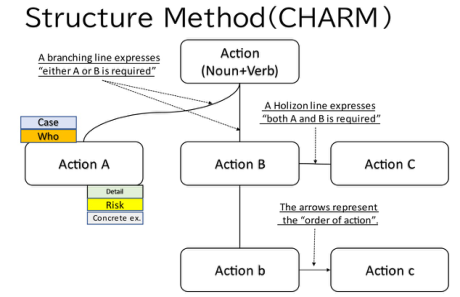
METHOD OF STRUCTURING The method developed by Nishimura et al. (Nishimura et al., 2013). Display the goal you want to achieve in the top action node. To achieve TOP, either branching [Action A] or [Action B] is required. Both [Action B] and [Action C] connected by a horizontal line are required to achieve TOP. In order to achieve [action B], [action c] is necessary after [action b]. [Case] [Risk] [Details of noun/verb] [Concrete example of noun] etc. are described as conditions.
Visualization of Nursery Teacher’s Tacit Knowledge Using Knowledge Structuring 199
Figure 1: Structure method (CHARM). Basic structure consists of purpose-oriented (Nishimura et al., 2013).
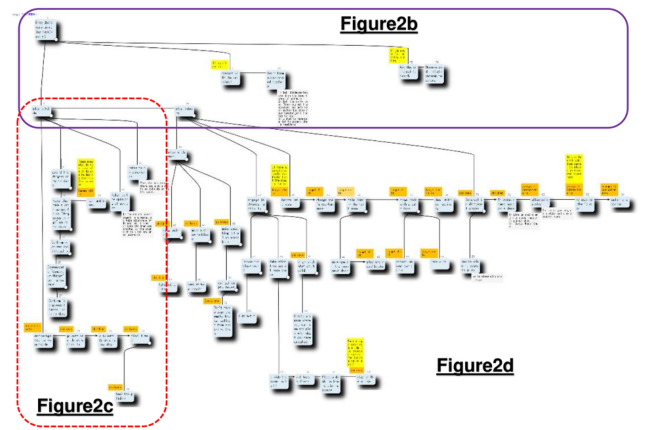
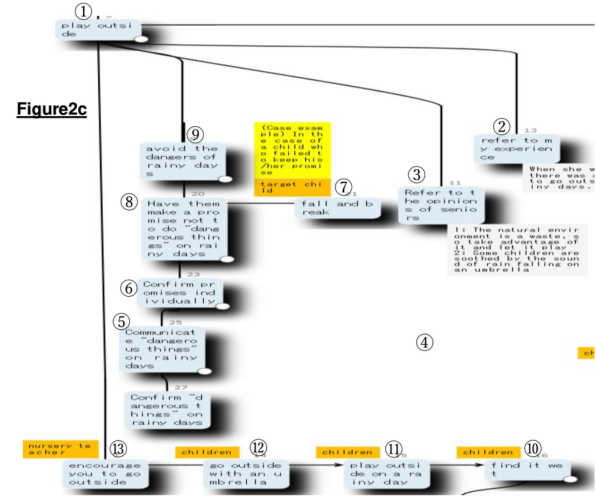
RESULTS OF STRUCTURE KNOWLEDGE By clarifying and structuring each action of childcare activities in a goal- oriented manner, we were able to visualize the strategies for achieving goals from beginners to advanced students. Beginner in the second year were first presented with specific child-rearing methods. As a beginner’s method, a spe- cific child-rearing method was also mentioned. Beginners tended to line up specific actions one by one in order to accomplish the tasks they should do. By performing specific actions, they were trying to find a direction toward problem solving (Figure 2a, b, c).
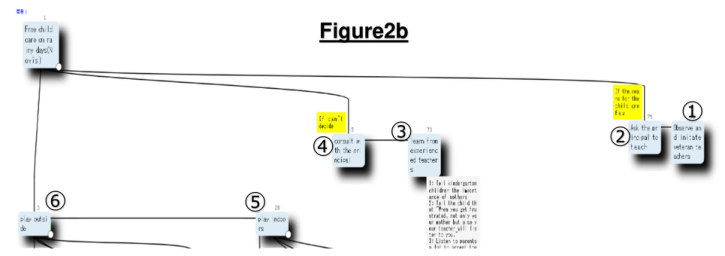
For free childcare on rainy days x play outside, or yplay indoors, or z If one can’t decide, consult with the principal and {learn from experienced
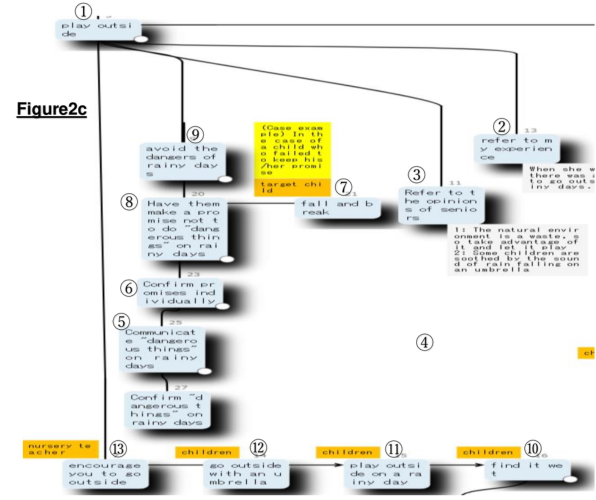
Figure 2a: Overall diagram of knowledge structuring for novice nursery teachers “Childcare on rainy days.”Figure 2b: Structure up to the second layer.Figure 2c: For x, y Encourage them to go outside, zGo outside with an umbrella, after that { play outside on a rainy day, after that, | the children themselves notice that they are wet, | causes the children to experience slipping, or } “Avoid the dangers on rainy days”, so ~ Rainy days are “dangerous” If the child fails to keep the promise, he or she will fall and break a bone. Confirm promises individually, 10⃝tell children about the dangers of rainy days, 11⃝refer to seniors’ opinions, or 12 ⃝refer to own experiences.
teachers, or | If the means for the child are few, ask the principal to teachand }observe and imitate veteran teachers.
Figure 2c: For xNaturally draw attention to “Kindergarteners who go outside”, xIn order to “focus on nature,” z “If the child wants to go,” go out to the forest, and then { “Broaden the child’s field of vision,” } “If you find a treasure,” put the treasure in a plastic bag, or For x, “play in the puddle in front of the classroom” and then “remove the mud after playing”.
Visualization of Nursery Teacher’s Tacit Knowledge Using Knowledge Structuring 201
Figure 3a: An overview of actions performed by a skilled nursery teacher to provide free childcare on a rainy day.
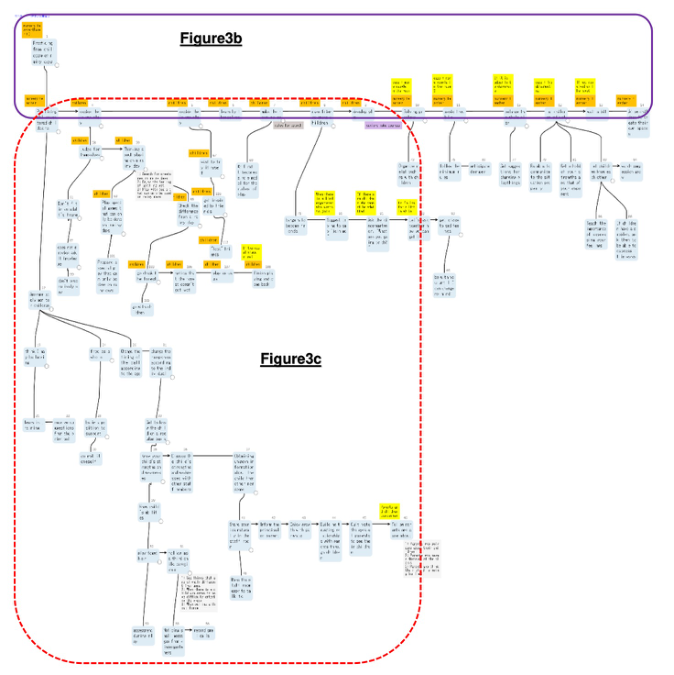
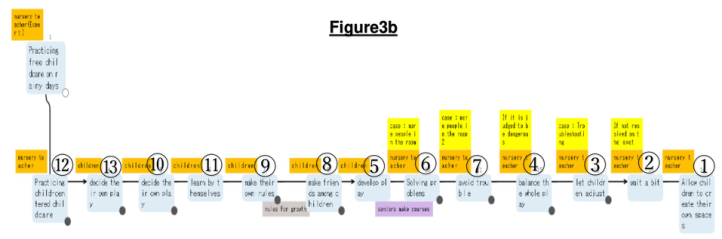
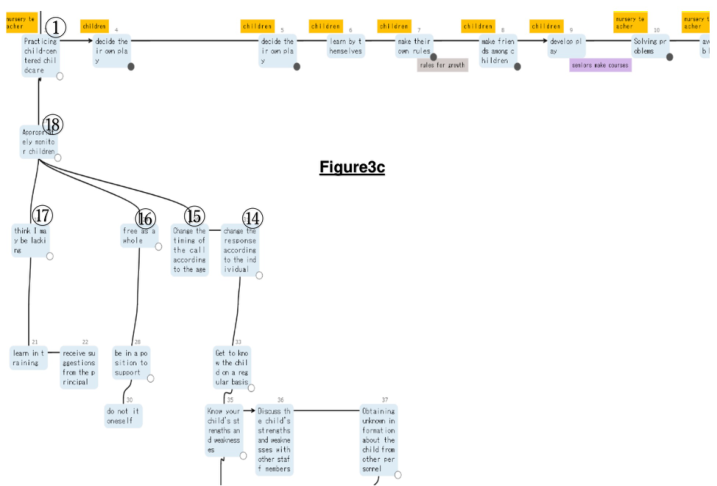
On the other hand, skilled nursery teachers played a large role in their own childcare. Assuming the way of thinking captured in the framework, I expressed the knowledge of childcare necessary for that, and the behaviour that children do as a result of using childcare based on that way of thinking. In addition, the structured knowledge of experts covered a wide range of child-rearing areas, such as child evaluation, how to deal with troubles, how to deal with parents, and kindergarten policies (Figure 3 a, b, c).
CONCLUSION
[Discussion] The content of the talks within a fixed time of 40 minutes sug- gests that experts have detailed knowledge in a wide range of areas. It was thought that the knowledge of experts was wide and abundant. Beginners, on the other hand, were limited to specific childcare methods and temporary problem-solving methods. Experts are thought to integrate knowledge (for- mal knowledge) and procedural knowledge (physical knowledge) that they have acquired from past experience, and adopt strategies to achieve their goals in a procedural manner. It is speculated that the strategy for problem
Figure 3b: For provide free childcare on rainy days, x practicing child-centered chil- dcare and ydecide their own play andzchildren decide their own play and{ learn by themselves and| children make their own rules and} children make friends among children and ~children develop play andsolving problems andavoid trouble and 10⃝ balance the whole play and 11⃝let children adjust and 12 ⃝wait a bit and 13 ⃝allow children to create their own spaces.Figure 3c: For x, 14⃝appropriately monitor children, for 14⃝, 15 ⃝think “I may be lacking”,for this, learn in training,and receive suggestions from the principal. For 14⃝, or 16 ⃝free as a whole, for this, be in a position to support,for this, do not it oneself. For 14⃝, or 17 ⃝ Change the timing of the call according to the age and 18 ⃝change the response accor- ding to the individual. For 18 ⃝, get to know the child on a regular basis, for this, know child’s strengths and weaknesses. For this, know child’s abilities. After that, discuss the child’s strengths and weaknesses with other staff members, and obtaining unknown information about the child from other personnel.
solving is being elaborated in this. On the other hand, it was speculated that newcomers tended to search for and implement concrete solutions to the problems in front of them. These suggest that novices follow the superficial similarities of problems, whereas experts focus on the structural features of
Visualization of Nursery Teacher’s Tacit Knowledge Using Knowledge Structuring 203
problems and make good use of analogies (Novick, 1988). Problem Solving (Chi et al., 1988) Experts reason forward from the information given in the problem, whereas novices reason backward (7Patel & Groen, 1986) are con- sistent with previous studies. In recent years, Kiernan et al. (Kiernan et al, 2020) reported the formation of new concepts through workshops by begin- ners and veterans. There is also a study comparing the philosophies of novice mental performance consultants and expert mental performance consultants in novices and philosophies (Castillo, E.A, et al., 2022). Castillo et al. repor- ted that by comparing the mental performance of novices and experts, they can periodically reflect on their consulting philosophy, continually hone their skills, and improve their competence and effectiveness. From the above rese- arch, it is considered very significant to clarify the difference in cognitive processes between beginners and experts.
[Future tasks] In the future, we plan to clarify the ingenuity and tricks of childcare workers by examining cognitive differences and the effects of automation, and to conduct concrete examinations of tacit knowledge. We aimed to establish the optimal description method (rule).
[Future Prospects] This is the first attempt to structure and compare kno- wledge extracted from individual interviews in a goal-oriented manner. As a long-term prospect, we aim to develop AI for tailor-made expert training, taking in account various information such as visualization and evaluation by structuring the knowledge of the expert training manual. When newcomers enter their current situation and items they do not understand, AI proposes original teaching methods that combine each action of goal-oriented kno- wledge. assess development. We would like to connect it to a system that does.
ACKNOWLEDGMENT
This research was supported by the Ministry of Education, Science, Sports and Culture, Grant-in Aid for Scientific Research(B).
REFERENCES
Bernstein, Richard J. (ed.) (1985). ”Habermas and Modernity”. MIT Press. Castillo, E. A., Block, C., Bird, M. D., & Chow, G. M. (2022). A qualitative analysis of novice and expert mental performance consultants’ professional philo- sophies. Journal of Applied Sport Psychology. https://doi.org/10.1080/10413200. 2022.2035849 Chi, M. T. H., Glaser, R., & Farr, M. J. (Eds.). (1988). The Nature of Expertise
(1st ed.). Psychology Press. https://doi.org/10.4324/9781315799681 G Leinhardt, DA Smith (1985) “Expertise in mathematics instruction: Subject matter knowledge.” Journal of educational psychology. Louise Kiernan, Ann Ledwith & Ray Lynch (2020). Comparing the dialogue of
experts and novices in interdisciplinary teams to inform design education. Inter- national Journal of Technology and Design Education volume 30, pages 187–206. Nishimura, S. et al. (2013). “CHARM as Activity Model to Share Knowledge and Transmit Procedual Knowledge and its Application to Nursing Guidelines Integration.” Journal of Advanced Computational Intelligence and Intelligent Informatics, (17)2, 208-220.
Nishimura, S. et al. (2017). Knowledge Explication: Current situation and future prospects. IJCAI Workshop on: Cognition and Artificial Intelligence for Human Centered Design. https://www.researchgate.net/publication/322571001_Knowle dge_Explication_Current_situation_and_future_prospects Novick, L. R. (1988). Analogical transfer, problem similarity, and expertise. Jour-
nal of Experimental Psychology: Learning, Memory, and Cognition, 14(3), 510–520. https://doi.org/10.1037/0278-7393.14.3.510 Shavelson, R. J., & Stern, P. (1981). Research on teachers’ pedagogical thoughts, judgments, decisions, and behavior. Review of Educational Research, 51(4), 455–498. https://doi.org/10.2307/1170362 Vimla L. Patel, Guy J. Groen (1986) “Knowledge Based Solution Strategies in
Medical Reasoning” (10)1. 91–116.
LISTED IN THE AHFE DIGITAL BOOKSTORE CATALOGUE
Explore the complete digital volume
The Human Side of Service Engineering
Read this individual research paper free through the original publisher, or explore the full digital proceedings book.
ISBN 978-1-958651-84-1
Explore this ISBN in the AHFE Bookstore ↗Listed in the July 2026 bookstore catalogue; search by ISBN to confirm current availability · Digital book purchase optional