Koki Ijuin, Takuichi Nishimura (2023). Knowledge Structuring by discussing purposes of each action in Procedure-based Knowledge Graph. In: The Human Side of Service Engineering. AHFE Open Access, vol. 108, pp. 152–160. https://doi.org/10.54941/ahfe1003116
The need to acquire knowledge at the manufacturing industry and service site are growing due to the aging society and the experts are retiring from employment. This may cause the loss of knowledge, so the need for assist collecting and maintaining expert knowledge.There are several trials to share the knowledge with work manual or instructions, although the knowledge of the experts such as purpose or decision-making rules of experts are still not obtained.We proposed a new method of collecting and articulating that knowledge using two separated knowledge graphs, procedure-based and purpose-oriented knowledge graphs.This method was aimed to link the multiple purposes to a single action node in procedure-based knowledge graph through the workshop.In this study, we proposed a method of expressing and structuring the purpose of actions in the work procedure. The first step is to structure the work procedure from the existing manual and other sources, and build up the work procedure knowledge.In this step, the purpose of an action in the procedure is considered and structured to build purpose-oriented knowledge. This step is done for all work procedures, and each purpose-oriented knowledge is fused.After that, look back on multiple tasks on a purpose-based basis and deepen a common understanding.After conducting a knowledge structuring workshop using the proposed method, we collected the questionnaires from the workers to evaluate the utility of the method and the knowledge.As a result, it was possible to construct work procedures and purpose-oriented knowledge, and to express and structure the purposes that the field members felt meaningful which they felt the importance from purpose-oriented knowledge.
In the manufacturing and service industries, it is important to construct manuals to standardize work procedures, improve the efficiency of human resource development, and prevent human errors. For this purpose, there are many manual construction systems that utilize videos and photographs and provide templates that are easy to understand and construct. These systems are organized hierarchically in folders and tagged to enhance search.
In the field of knowledge engineering, research has been conducted on computer-readable knowledge structuring utilizing knowledge engineering, knowledge representation or semantic technology techniques in order to
Structuring Knowledge by Discussing Purposes of Each Action 153
improve consistency and reusability (Nishimura et al., 2013). This know- ledge structuring method achieves computer readability by using an ontology to specify a notation that describes the actions in a task in a purpose-oriented and hierarchical manner. In doing so, each action is described with one noun and one verb, and the linking rules between actions are clarified, so that the structured knowledge is easy to read for on-site employees. Howe- ver, when the actually constructed knowledge, almost only work procedures were described, and there were few descriptions of the purpose of each action in the work. In addition, because the work procedures were purpose- oriented, there were some confusing situations where the field employees had difficulty writing the procedures when they constructed them around the purposes.
On the other hand, Kobayashi (1994) states that it is important to also state the purpose for the program. In particular, some literature suggests that it is more important to develop the ability to think situationally than to memorize a large amount of knowledge. In fact, in small-quantity, high- mix manufacturing and design work, as well as in nursing care services that require meticulous attention to various customers, the burden of constru- cting manuals is significant, and in some cases, manuals cannot be created because unknown situations cannot be assumed. In such cases, if the purpose of each action is described in addition to the procedure, it would be possi- ble to devise a different method depending on the situation. Although it is difficult to memorize complex tasks, if the purpose of each action is clearly understood, it is thought that omissions and omissions will be less likely to occur.
Therefore, this study proposes a method for representing and structu- ring the purpose of actions within work procedures. The method begins by structuring work procedures from existing manuals and other sources to construct procedure-based knowledge. Caregivers discuss and structure the purpose of each action in this work procedure to construct purpose-based knowledge. Then, multiple tasks are reviewed on an purpose basis to dee- pen common understanding. This makes it easier for frontline employees to surface and structure the purpose of the actions compared to the previous (Nishimura et al., 2019).
This paper proposed a method to implement the structuring of knowledge held by skilled caregivers in the nursing home. With the cooperation of skilled caregivers, work procedure-based knowledge and purpose-based knowledge are constructed for four caregiving tasks in accordance with the proposed method, respectively, and a subjective evaluation of the importance of the constructed knowledge to the skilled caregivers is conducted to examine the effectiveness of the proposed method and its practical potential in the field. The knowledge constructed using the proposed method is intended to be used to construct manuals more in line with the actual situation in the field and to educate new employees at nursing care facilities by structuring the contents of tasks not described in existing manuals and the sense of purpose that skilled caregivers value in performing the tasks, as well as by improving readability through structuring.
154 Ijuin and Nishimura
RELATED WORKS In the nursing care domain, there are manuals that cover general work proce- dures (Hiratate, 2012). However, when attempting to describe the knowledge and know-how implemented in actual nursing care settings, work procedu- res may differ from facility to facility and employee to employee. Based on this problem, a method called “knowledge expression” has been proposed to enable workers to acquire unique knowledge (tacit knowledge) on their own initiative by describing and providing knowledge about common nursing care activities based on manuals (Nishimura et al., 2019). The effectiveness of this method has been verified at several nursing care facilities, and it has shown usefulness in the quantitative and qualitative aspects of knowledge, such as the acquisition of unique knowledge that has not been sufficiently verbali- zed. Since this study also targets nursing homes, we will follow the knowledge expression method and adopt a method of acquiring and building knowledge directly from caregivers in the field.
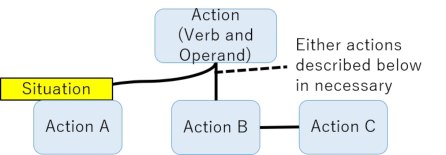
“CHARM” is a knowledge representation model that structurally descri- bes actions in a goal-oriented manner (Nishimura et al., 2013). CHARM describes the purpose-achievement relationship between actions by decompo- sing an action into a series of actions necessary to achieve it. Figure 1 shows the notation of CHARM, which is structured in such a way that lower-level action nodes are performed to achieve higher-level action nodes, and each node can describe conditions and actors as attributes. As a result, it is easy to understand the purpose of each action. However, due to the structure of CHARM, the constructed knowledge results in the creation of only one pur- pose for each action. In reality, multiple purposes exist, and it has been found that the understanding of these purposes is the difference between skilled and newcomers. Specifically, the lack of understanding of the meaning and rea- sons inherent in an act results in a lack of application, as the necessary acts are left out when the work is performed only mechanically. Based on these facts, this study proposes a knowledge structuring method to enable emplo- yees to share and build knowledge without discrepancies, and to enable the structuring of meaning and multiple “purposes” for actions, such as why the action or process is necessary.
Figure 1: Explanation of CHARM.
PROPOSED METHOD In this section, we propose a method for representing and structuring the purpose of each action of the work procedure. The method consists of six step.
Structuring Knowledge by Discussing Purposes of Each Action 155
Step 1: Structuring the procedure-based knowledge. In both manufacturing and service industries, there are often manuals that describe work procedures item by item. In this step, knowledge is structu- red from these manuals using the structuring method shown in Figure 1. An action is basically written as “noun + verb”. Both act B and act C are neces- sary. An action is basically written as “noun + verb”. A normal manual may contain multiple actions in a single sentence, or the subject may be omitted. Therefore, structuring in this way clarifies the work procedures.
If the existing manual deviates from the actual work at the site, the latest work procedures should be discussed among the experts who are familiar with the site (hereinafter referred to as “site members”) to construct the latest work procedures. If the procedure differs among the members, one agreed- upon work procedure may be constructed, or multiple procedure-based knowledge may be created depending on the conditions.
Step 2: Discuss the purpose of each action. Discuss the purpose of each action within the workflow. If the purpose is not immediately clear, share experiences related to each act or consider what would happen if the act were not performed. Specifically, for each act in the workflow, ask, “What is the purpose of this act?” What are the conseque- nces of not doing this action? What are your thoughts about this action? It is easier to see the purpose if you ask each other questions such as “What is the purpose of this action? In this step, members share their experiences and thoughts, deepen their understanding of the work, and in some cases, simulate the events of other members.
Step 3: Structuring the purpose-based knowledge. When multiple purposes emerge, all of which are necessary. As you proceed with this structuring, ask, “Does this purpose relate to the other purposes?” Are there broader purposes?” and so forth, and structure it in a way that is satisfactory to the members concerned.
Step 4: Linking between the two pieces of knowledge. In this step, we ask them to create a link between each action of the procedure-based knowledge constructed in Step 1 and the purpose-based knowledge constructed in Step 3. The work procedure describes the purpose of each action, which is difficult to write, and is linked to the action in the work procedure.
Step 5: Perform steps 1–4 with respect to multiple tasks. Field members typically perform multiple types of work. Therefore, steps 1–4 are performed for these multiple tasks to construct work procedures and purpose-based knowledge.
Step 6: Fuse multiple purpose-based knowledge. The multiple purpose-based knowledge constructed in step 5 is merged.
Experiments In order to verify the effectiveness of the proposed method, we conducted several tasks in accordance with the method described in the previous section with the cooperation of employees of the Tosenkai Wakoen social medical care foundation, a long-term care healthcare facility for the elderly. In this
156 Ijuin and Nishimura
Table 1. Experimental setup.
Table available in the original PDF paper.
Illumination conditions Duration 90min for each workshop Participants Care-giver:3-6 per workshop facilitator(researcher): 0 or 2 Topic Meal assistance, bathing assistance, transfer assistance and toileting assistance Task Modify procedure-base knowledge Create purpose-based knowledge Answering questionnaire
verification experiment, employees and facilitators constructed procedure- based knowledge and purpose-based knowledge in a workshop format. The four tasks targeted in this experiment were “meal assistance,” “bathing assistance,” “transfer assistance,” and “toileting assistance”. In addition, Step 1 through Step 4 were conducted for each of the assistance tasks in this verification experiment.
The setting of the validation experiment is shown in Table 1. The number of workshop participants ranged from three to six per workshop, including clerical employees who were observing, and some employees attended more than one workshop. Two researchers participated as external facilitators, who followed the aforementioned steps and asked questions of the emplo- yees to assist in knowledge building. For the two workshops, the workshops were also conducted solely by the employees without the intervention of an external facilitator. In those cases, the employees of the secretariat provided guidance to the external facilitators on the steps and questions in advance.
The number of times the workshops were conducted differed for each intervention service. This was because the time required to accomplish up to Step 4 differed, and the workshops were conducted multiple times until there was agreement on the knowledge built by the employees who partici- pated in the workshops. This was due to the fact that the existing manuals deviated from the procedures actually performed in the field, so it took time to revise the procedure-based knowledge, and employees commented that the objective-oriented knowledge constructed in the workshops was not sufficiently descriptive.
RESULTS
As a preliminary preparation for on-site knowledge acquisition and kno- wledge structuring, procedure-based knowledge was constructed by the research team based on the existing manuals constructed at the cooperating nursing care facility.
The pre-prepared knowledge of work procedures was modified with employees of nursing care facilities to suit the site. Even within a single nur- sing care facility, work procedures differ depending on the employees and the persons to be assisted. When modifying the procedure-based knowledge, a paper-based knowledge structuring workshop was conducted using post-its
Structuring Knowledge by Discussing Purposes of Each Action 157
and writing instruments on the enlarged A1-size printout of the previously constructed knowledge. In the workshops where knowledge structuring was conducted in multiple sessions, it was revised each time and printed out for use.
Table 2 shows the number of node changes before and after the modi- fication of the procedure-based knowledge for each of the assistance tasks. Although the amount of increase varied because the amount of text in the existing manuals differed for each task, it was clear that for all tasks, there were actions that were not described in the existing manuals.
Focusing on the act of procedure-based knowledge, the employees discus- sed the purpose or intent of performing the act and the experiences that accompanied it. In doing so, the facilitator asked questions similar to those described in the previous section to elicit the purpose each employee had. As a result, objectives such as “to sit in a position to watch over the care recipient,” “to enjoy eating,” and “to improve teamwork” were observed.
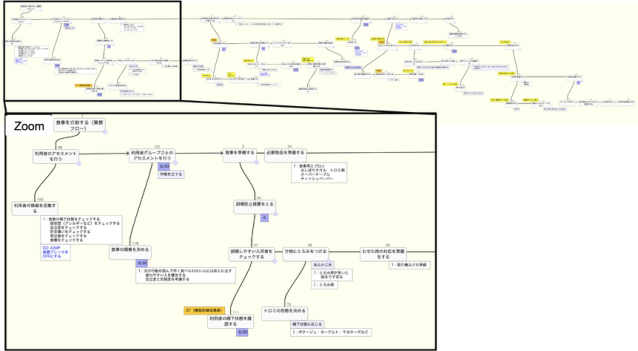
The hierarchical relationship between the obtained objectives was then discussed and structured. As a result, it was possible to structure the hie- rarchy in terms of higher-level objectives, such as “to manage the safety of the care recipient,” “to improve the care recipient’s motivation in life,” and “to realize team care. Figure 2 shows the constructed knowledge.
Table 2. Number of nodes in procedure-based knowledge.
Table available in the original PDF paper.
meal assistance
bathing assistance
transfer assistance
toileting assistance # of nodes before workshop 32 95 21 76 # of nodes after workshop 55 127 71 96 # of node added 29 35 56 24 # of node deleted 6 3 6 5 # of node moved 1 4 0 2
Figure 2: Procedure-based knowledge of meal assistance.
158 Ijuin and Nishimura
Table 3 shows the number of purpose-based knowledge nodes obtained through the validation experiment. For excretion assistance, the existing manuals were out of date and differed significantly from the equipment and environment used in nursing care facilities, and because we focused on modifying the procedure-based knowledge, we were not able to construct the purpose-based knowledge.
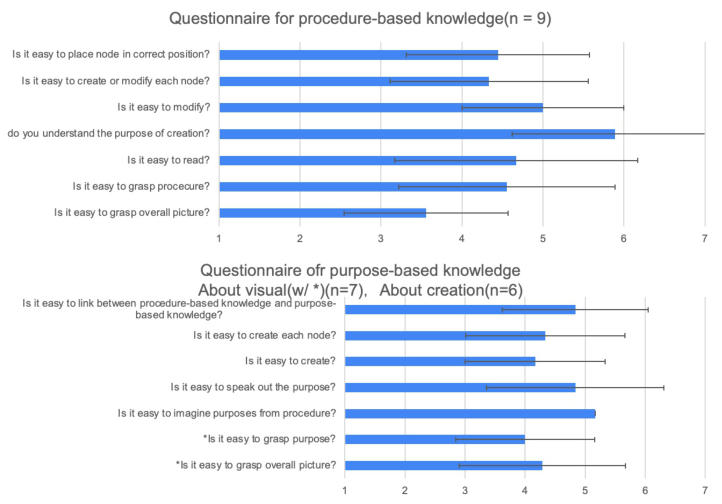
After the knowledge structuring workshop, a questionnaire was given to 9 workshop participants (6 of whom had experience in constructing purpose- based knowledge) to evaluate the readability and ease of construction of procedure-based knowledge and purpose-based knowledge, the trigger for voicing the purpose, and the use of knowledge. The questionnaire included 14 questions on a 7-point scale regarding readability and ease of constru- ction, and 10 open-ended questions regarding triggers for voicing objectives and utilization of knowledge, and a subjective evaluation of the workshop participants’ impressions. The 7-point rating question items and their results are shown in Figure 3.
From the results of the procedure-based knowledge questionnaire. The results obtained were about the median rating for all items except for the ease of understanding the overall picture. The high evaluation (about 5.9)
Table 3. Number of nodes in purpose-based knowledge.
Table available in the original PDF paper.
meal assistance bathing assistance transfer assistance toileting assistance # of nodes 19 17 9 -
Figure 3: Averages of each question item.
Structuring Knowledge by Discussing Purposes of Each Action 159
was seen in procedure-based knowledge, separating procedure-based kno- wledge and objective-oriented knowledge allows for a format that makes it easy to grasp the meaning of each type of knowledge. Regarding the ease of grasping the overall picture, this is likely due to the format of the knowledge structuring workshop, where the structured knowledge was printed in poster size, resulting in low physical readability.
The results of the questionnaire for the purpose-based knowledge showed an average rating of 4 to 5 for all question items. In addition, the results of the open-ended questionnaire regarding triggers for recalling purpose elicited responses such as “because (others’ purpose) was different from what I thou- ght” and “when reconfirming my own opinion”. In addition, these findings reveal that although there are still challenges in viewing and constructing purpose-based knowledge in a paper-based format, conducting workshops with multiple employees may contribute to the description of the purpose that each employee has.
DISCUSSION
A total of 10 knowledge structuring workshops were conducted by caregivers to study the ease of structuring procedure-based knowledge and purpose- based knowledge.
For the procedure-based knowledge, a more detailed description of the actions compared to the existing manual was observed from the increase in the number of action nodes. Compared to the existing knowledge, the newly added purpose-based knowledge was found to improve the quality of work, such as “to manage the safety of the care recipient,” “to improve the life motivation of the care recipient,” and “to realize team care. The question- naire evaluation also revealed that employees consider about 40% of the total number of purpose-based knowledge nodes to be important, and the open- ended questionnaire indicated that it is easy to further express each purpose as employees share these knowledge nodes with each other. These results indi- cate that knowledge structuring by multiple employees in a workshop format using the proposed method has the potential to construct knowledge that leads to improvement in the quality of work, which could not be described by conventional manuals or structured knowledge.
However, it was not possible to evaluate the importance of all the newly added knowledge. This could be attributed to differences in work proces- ses among the departments in charge of the nursing homes and to the fact that individual-specific objectives were extracted. It is clear from this verifi- cation that these knowledge are not knowledge with universal importance, but may be considered important in a particular organization or group, and that such knowledge can be described. However, since the proposed method has the potential to expand knowledge without limit, it is necessary to con- trol the granularity of information at each site and to consider how to present knowledge in actual situations where knowledge is used.
In addition, a subjective questionnaire survey of a small number of kno- wledge structuring workshop participants was conducted to determine the readability and ease of the constructed knowledge. As a result, the readability
160 Ijuin and Nishimura
of the procedure-based knowledge and the objective-oriented knowledge and the understanding of the knowledge of each structured knowledge were eva- luated about the median value of the questionnaire. As for readability, one of the reasons why the workshop participants did not give high marks to the readability was that the workshop was conducted while looking at the know- ledge printed on poster paper in this verification experiment, and therefore, when the number of action nodes in the procedure-based knowledge was large, it was necessary to check the knowledge over multiple pages. Similarly, the role of structured knowledge did not receive a high evaluation. However, the results of the free response questionnaire and the results of the questi- onnaire on the evaluation of knowledge showed that the proposed method was able to provide a trigger for expressing objectives and meaningful node descriptions for the expressed objective-oriented knowledge, indicating that although the caregivers did not fully understand the structure and role of kno- wledge, they were able to Although the caregivers did not fully understand the structure and role of knowledge, they were able to describe knowledge related to the objectives considered important in the field, which was the goal of the proposed method, for the knowledge they constructed. Based on these results, we will continue to study methods for knowledge structuring workshops that promote a deeper understanding of the role of knowledge, and will work to enable even higher quality descriptions of knowledge as a future issue.
SUMMARY In this paper, we proposed a method for representing and structuring the purpose of actions within a work procedure. As a result of a knowledge stru- cturing workshop using this method, the objectives that caregivers value or need to convey in the education of newcomers were represented, and work procedures and purpose-based knowledge were constructed. Future work is to apply this method to other caregiving tasks and to construct work procedures and purpose-based knowledge for caregiving as a whole.
ACKNOWLEDGMENT
This paper is based on results obtained from a project, JPNP18002, subsidi- zed by the New Energy and Industrial Technology Development Organiza- tion (NEDO).
REFERENCES
Hiratate, Ayako. Textbook for Home helper course 2nd grade Nichii. (In Japanese). Kobayashi, Atsushi. Methodology of creating mannuals. Nikkei McGraw-Hill. (In Japanese). Nishimura, S., Kitamura, Y., Sasajima, M., Williamson, A., & Kinoshita, C. (2013).
CHARM as activity model to share knowledge and transmit procedural know- ledge and its application to nursing guidelines integration. Journal of Advanced Computational Intelligence Vol, 17(2). Nishimura, S., Mori, Y., Yamanaka, I., Nakayama, M., Takayama, K., & Nishimura., T (2019). Improvement of knowledge expression through unification of nursing care manuals within social welfare corporations, 10(1), 244–266 (In Japanese).
LISTED IN THE AHFE DIGITAL BOOKSTORE CATALOGUE
Explore the complete digital volume
The Human Side of Service Engineering
Read this individual research paper free through the original publisher, or explore the full digital proceedings book.
ISBN 978-1-958651-84-1
Explore this ISBN in the AHFE Bookstore ↗Listed in the July 2026 bookstore catalogue; search by ISBN to confirm current availability · Digital book purchase optional