Teru Kawakita, Takuichi Nishimura (2023). Avatar design focusing on kawaii motions. In: Human-Centered Design and User Experience. AHFE Open Access, vol. 114, pp. 158–165. https://doi.org/10.54941/ahfe1004232
Avatars and agents are one of the important products in the metaverse. Kawaii value could potentially enhance the sales of avatars. This study aims to identify the kawaii motions of avatar and to examine the relationship between kawaii motions and purchase intention via Kansei (affective) engineering methodologies. We made the anime-like female avatar with six kawaii motions. The semantic differential (SD) method was used to measure their motions. As a result of principal component analysis (PCA), two PCs were extracted. PC1 has “enjoyable”, “kawaii”, and “charming.” PC2 has “elegant”, “beautiful”, and “stylish.” We visualized the relationship between the two PCs and each motion. Correlation analysis further indicated that kawaii motions were positively correlated with purchase intention (r = .67, p < .001). This study showed that the impression of avatar changes with kawaii motions. Designing the motions of avatar is likely to help them sell more. Avatar creators should design the kawaii motions to draw out the appeal of avatars.
Kansei engineering is being used to design better products for consumers. The avatars and agents are one of the important products in the metaverse. They serve as user interfaces. The creators involved in creating avatars should consider what kind of avatars design consumers like.
The development of technologies has increased digital product transac- tions. Virtual Market are held in the metaverse such as VRChat, where users and companies buy, sell, and promote digital products (Virtual market, 2023). The metaverse is a new area of business. Encouraging avatar sales could help the metaverse economy. One way to increase the value of avatars is to adjust their appearance. Some studies have shown that the appearance of avatars affects the impression evaluation (Kawakita et al., 2022; Kawakita and Kanai, 2023). Give the avatars a cool, beautiful, or other positive charac- teristic, and users will want to manipulate it. However, good-looking avatars are commonplace in the metaverse. Creators should consider not only the appearance of avatars, but also the motions, voice, and other designs.
In the Avatar Museum, after viewing various avatars, consumers can pur- chase the avatars they like through the electronic commerce site (Avatar Museum, 2023). Avatar creators can increase sales by devising ways to show
their avatars. For instance, avatars and agents can attract consumers’ atten- tion by singing, dancing, and talking like a self-promotion. Iwamoto et al. (2021) define self-recommending agents as the product promoting (recom- mender) themselves, indicating that they attract consumers’ attention. In addition, Iwamoto et al. (2022) have shown that even without a detailed description of the products, that increases the purchase rate when the prod- ucts behave enjoyably: it is called a playful recommendation. If avatars can behave attractively in the metaverse, and consumers can have a positive experience, that could increase their purchase intention.
What is the attractive behavior of an avatar? Japanese metaverse users often say “kawaii” for the motions of avatar. However, it is not clear what motions of avatar are kawaii. We consider the kawaii motions of avatar could provide a positive experience for consumers. Although the kawaii is conven- tionally translated in English as cute, its meaning is more nuanced than cute, and it is used for a wider variety of objects (Nittono et al., 2023). Kawaii design has become a popular consumer culture, especially in Asia (Urakami, Qie, Kang, and Patrick Rau, 2021). In Japan, there are many kawaii designs for product packaging, mascot characters (Yuru-chara), animation, manga, and virtual YouTubers (VTubers). Kawaii products win consumers’ hearts and sell well. Therefore, designing kawaii motions of avatar could increase their product value and provides consumers with a good experience. Incor- porating the concept of kawaii into product design is one of the Kansei engineering studies. It is also called kawaii engineering: a scientific verifi- cation of kawaii to the products. Kawaii engineering, born in 2007, analyses kawaii components of industrial products such as color, size, and shape (Ohkura, 2019). The semantic differential (SD) method is often used in Kansei engineering and kawaii engineering for the Kansei evaluation.
The purpose of this study is to identify the kawaii motions of avatar and to examine the relationship between kawaii motions and purchase intention. Revealing the characteristics of kawaii motions in avatars, creators can sell the avatars more attractively.
METHOD
Participants Kansei data of thirty-five graduate students were analyzed (M = 26.91, SD = 7.87, twenty males, twelve females, and three others). No participants had color vision abnormalities.
Design of Avatar and Motions Some Japanese VTubers choose a VTuber of different gender and sex because they want to be released from their physical gender identity and social norms, and they are reborn to bishôjo (Bredikhina, 2020). In the metaverse, users want to manipulate the kawaii avatars like bishôjo. Good-looking female avatars could tend to sell well. Also, metaverse users tend to use anime-like (cartoon) avatars rather than realistic ones. Therefore, we decided to design an anime-like female avatar.
160 Kawakita and Nishimura
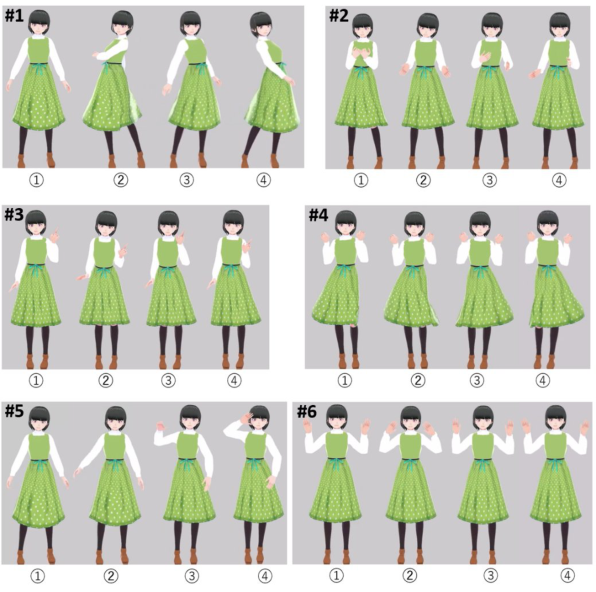
A female avatar was created by “VRoid Studio.” Six patterns of motions created by “3tene” were given to the avatar. The six motions are motion sets of 3tene. The description of each motion is shown in Table 1. Also, Figure 1 shows the six motions of avatar.
Table 1. Six motions of avatar.
Table available in the original PDF paper.
Number Motion description #1 twisting one’s body from side to side #2 introducing yourself with your hands #3 shaking one’s finger #4 expressing joy with one’s whole body #5 turning your hands and pose #6 waving one’s finger
Figure 1: Image of the six motions of avatar.
Materials
The semantic differential (SD) method from 1 to 5 (5-point scale) was used as the evaluation. There were twenty-four pairs of Kansei words to evaluate the motions of avatar (Check the Kansei words in Table 2 of the results).
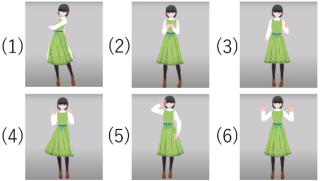
Participants were presented with Figure 2 and asked to answer the ques- tions. The survey items were as follows.
Avatar Design Focusing on Kawaii Motions 161
(1) What motion did you feel was a kawaii? (2) Which motions of avatar do you want most?
The first question identifies the most kawaii motion of avatar for par- ticipants. The second question measures participants’ purchase intention. Because few people buy avatars at present, we asked the question indirectly. Both questions answer only one of the best.
Procedure In this study, the survey was conducted using Google Forms. Participants were presented with six motions of avatar and responded to each survey item. Twenty-four pairs of Kansei words were presented randomly.
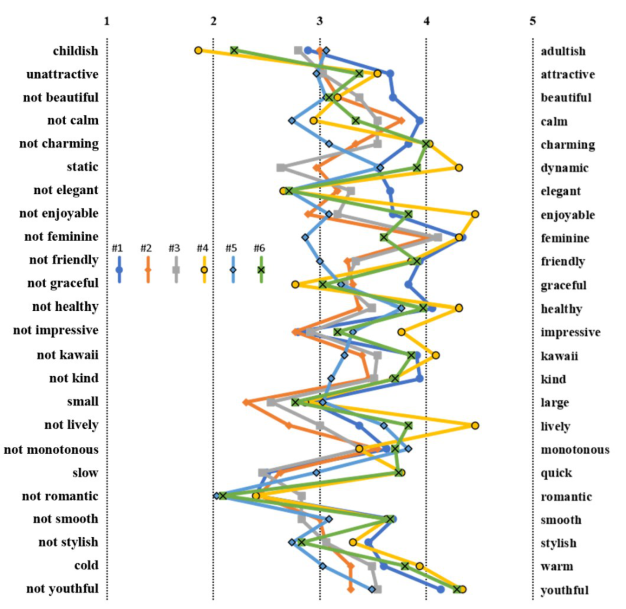
Figure 2: Six motions in this study.Figure 3: Semantic profile of Kansei words for each motion.
162 Kawakita and Nishimura
RESULTS
The semantic profile of Kansei words for each motion is shown in Figure 3.
In this study, we used twenty-four pairs of Kansei words. Therefore, twenty-four variables had to be reduced to a small number of variables by principal component analysis (PCA). The number of components was deter- mined based on parallel analysis. Table 2 shows the results of PCA. Also, Table 2 shows the principal component loading in descending order. As a result of PCA, two principal components were extracted. PC1 has “enjoy- able”, “kawaii”, “charming”, and “adultish (adults)”. It can be interpreted as a kawaii Kansei. PC2 has “elegant”, “calm”, “beautiful”, and “stylish”. It can be interpreted as a beautiful Kansei.
Table 2. Results of PCA.
Table available in the original PDF paper.
SD scales Principal Component
I II enjoyable - not enjoyable .99 −.03 youthful - not youthful .97 .05 kawaii - not kawaii .94 .32 healthy - not healty .93 −.12 charming - not charming .91 .25 warm - cold .89 .07 smooth - not smooth −.89 .20 adultish - childish .88 .40 friendly - not friendly .88 .40 attractive - unattractive .86 .40 lively - not lively .86 −.47 dynamic - static .85 −.42 quick - slow .75 −.60 large - small .46 −.39 elegant - not elegant −.29 .92 calm - not calm −.18 .91 beautiful - not beautiful .08 .89 feminine - not feminine .39 .82 stylish - not stylish .45 .77 kind - not kind .68 .70 romantic - not romantic −.19 .68 graceful - not graceful −.35 .68 impressive - not impressive .63 −.65 monotonous - not monotonous −.24 −.46 Contribution rate (%) 50.72 30.50 Cumulative contribution rate(%) 50.72 81.22
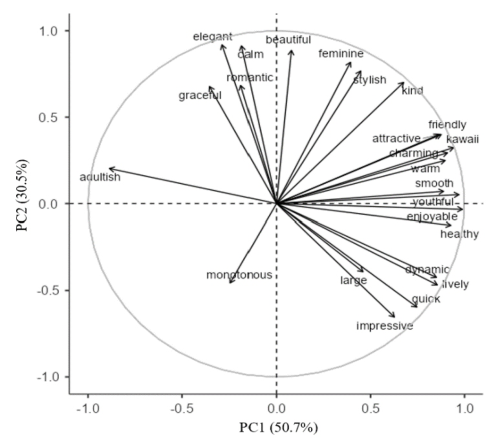
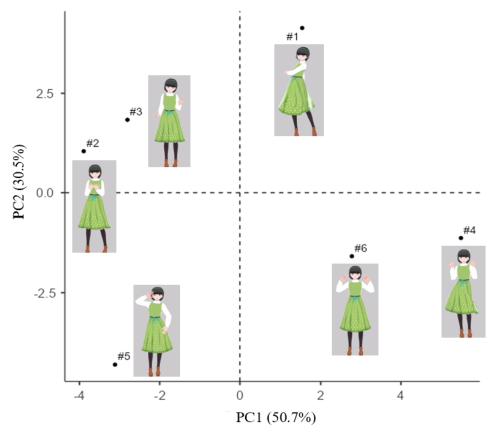
We created principal component loading plot (Figure 4) and principal com- ponent score of motions (Figure 5). From Figure 4 and Figure 5, kawaii Kansei toward #4 is highly rated. Also, beautiful Kansei toward #1 is highly rated.
Avatar Design Focusing on Kawaii Motions 163
Figure 4: Principal component loading plot.Figure 5: Principal component score of motions.
#1 (43%), #4 (26%), and #6 (11%) were highly evaluated as kawaii motions. Also, #1 (54%), #4 (11%), and #6 (11%) were highly evaluated as desired motions. Correlation analysis further indicated that kawaii motions were positively correlated with purchase intention (r = .67, p < .001).
Nittono (2016) found gender differences in the attitudes and behaviors regarding kawaii, and females are more likely to perceive kawaii than males. We considered gender comparisons of the motion data on “kawaii – not kawaii (Table 2)”, except for data on gender “other (small number of partici- pants)”. The Shapiro-Wilk test for each motion of kawaii showed significant
164 Kawakita and Nishimura
differences. Therefore, the Mann – Whitney U test was performed with the independent variable as gender (males / females) and the dependent variable as kawaii. The results are in Table 3.
Table 3. U-test for each motion of kawaii.
Table available in the original PDF paper.
Motions Mean Mann - Whitney U test
Male Female
#1 3.7 4.17 p = .16, d = .29 #2 3 4.08 p = .009, d = .54 #3 3.4 3.75 p = .189, d = .27 #4 3.9 4.42 p = .164, d = .28 #5 2.7 4.17 p <.001, d = .70 #6 3.4 4.58 p = .006, d = .55
In Table 3, we confirmed significant differences in #2, #5, and #6. The results showed that females had a higher rated of kawaii than males.
DISCUSSION
The purpose of this study is to identify the kawaii motions of avatar and to examine the relationship between kawaii motions and purchase intention. In Figures 4 and 5, #1 is given the impression of “beautiful,” “feminine,” and “stylish.” #4 is given the impression of “enjoyable,” “healthy,” “dynamic,” and “lively.” Also, #4 seems “childish” compared to #2 and #3. #6 is given the impression of “large,” “quick,” and “impressive.” The motions of #1 and #4 are considered to have the positive impression. These motions are qualita- tively different. #1 emphasized the woman’s beautiful motion and is mainly suited to beautiful Kansei (PC2). #4 emphasized the enjoyable motion and is mainly suited to kawaii Kansei (PC1). #1 and #4 were favorably evaluated by males and females. From #1 to #6 are the same avatars, however, the results show different impressions depending on the motions.
Figures 3, 4, 5, and Table 3 showed that the motion of #4 was rated as kawaii. In the end, however, #1 was rated as the most kawaii motion overall (43%). Also, #1 was the highest purchase intention (54%). Correlation anal- ysis indicated that kawaii motions were positively correlated with purchase intention. Why did participants evaluate #1 as a better motion than #4 and want it? The avatar used in this study was a female type, wearing a one-piece dress. The #1 was a body twisting motion from side to side, which made the outfit and body line look beautiful. The #1 was highly regarded because it was both kawaii and beautiful. Designing motions that match the avatars, including clothing, is necessary for a good impression.
CONCLUSION
We made the anime-like female avatar with six motions and verified the motions via Kansei engineering and kawaii engineering methodologies. Par- ticipants rated #1 (twisting one’s body from side to side) and #4 (expressing
Avatar Design Focusing on Kawaii Motions 165
joy with one’s whole body) highly as kawaii motions. Kawaii motions and purchase intention are positively correlated. Creators should consider the kawaii motions for their avatars when designing them. That will improve the impression of avatars and make consumers want to buy them. Creators can draw out the appeal of avatars by designing kawaii motions that match the way the appearance of avatars.
RESEARCH ETHICS This study was approved by Life Science Committee of Japan Advanced Institute of Science and Technology. The approved number is “⋏04-037.”
ACKNOWLEDGMENT
This work was partly supported by JST Moonshot JPMJMS2237.
REFERENCES
Avatar Museum (2023). HP: https://www.avatarmuseum.jp/ Bredikhina, L. (2020). Designing identity in VTuber era. ConVRgence (VRIC) Virtual Reality International Conference Proceedings, 182–184. Iwamoto, T., Baba, J., Nakanishi, J., Hyodo, K., Yoshikawa, Y., Ishiguro, H. (2022).
Playful Recommendation: Sales Promotion That Robots Stimulate Pleasant Feel- ings Instead of Product Explanation, IEEE robotics and automation letters, 7 (4), 11815–11822. Iwamoto, T., Baba, J., Nishi, K., Unokuchi, T., Endo, D., Nakanishi, J., Yoshikawa, Y., and Ishiguro, H. (2021). The Effectiveness of Self-Recommending Agents in Advancing Purchase Behavior Steps in Retail Marketing, Proceedings of the 9th International Conference on Human-Agent Interaction, 209–217. Kawakita, T., Kanai, H. (2023). Avatar Design for Bullying Prevention in the Metaverse: Avatar Appearances and the Presumption of Bullying. AHFE (2023) International Conference. AHFE Open Access, 101, 52–58. http://doi.org/10.54941/ahfe1002991 Kawakita, T., Onishi, G., Ishihara, S., Hashimoto, K., & Kanai, H. (2022). A
Study on the Effects of Different Counselor Avatar Appearances and Seriousness of Client Problems. Transactions of Japan Society of Kansei Engineering, 21 (3), 267–274 (in Japanese). https://doi.org/10.5057/jjske.TJSKE-D-22-00001 Nittono, H., Saito, H., Ihara, N., Fenocchio, D. N., & Andreau, J. M. (2023). English and Spanish Adjectives That Describe the Japanese Concept of Kawaii. SAGE Open, 13 (1), https://doi.org/10.1177/21582440231152415. Nittono, H. (2016). The two-layer model of ‘kawaii’: A behavioural science frame-
work for understanding kawaii and cuteness, East Asian Journal of Popular Culture, 2 (1), 79–95. https://doi.org/10.1386/eapc.2.1.79_1 Ohkura, M. (2019). Kawaii Engineering Measurements, Evaluations, and Applications of Attractiveness. Springer. Urakami, J., Qie, N., Kang, X., & Patrick Rau, P. L. (2021). Cultural adaptation of
“kawaii” in short mobile video applications: How the perception of “kawaii” is shaped by the cultural background of the viewer and the gender of the performer. Computers in Human Behavior Reports, 4, 100109. https://doi.org/10.1016/j.ch br.2021.100109 Virtual market (2023). HP: https://event.vket.com/
LISTED IN THE AHFE DIGITAL BOOKSTORE CATALOGUE
Explore the complete digital volume
Human-Centered Design and User Experience
Read this individual research paper free through the original publisher, or explore the full digital proceedings book.
ISBN 978-1-958651-90-2
Explore this ISBN in the AHFE Bookstore ↗Listed in the July 2026 bookstore catalogue; search by ISBN to confirm current availability · Digital book purchase optional