Teru Kawakita, Hideaki Kanai (2023). Avatar Design for Bullying Prevention in the Metaverse: Avatar Appearances and the Presumption of Bullying. In: Kansei Engineering. AHFE Open Access, vol. 101, pp. 52–58. https://doi.org/10.54941/ahfe1002991
Nowadays, people operate avatars in the metaverse to engage in social activity. While technology is making human society better, the bullying and harassment that occurs on the internet are still unresolved. Bullying is caused by a variety of influences, including psychological and environmental factors. Previous research has shown that the appearance of bullying victims is a cause of bullying. In the future, the appearance of the avatar could cause others to act aggressively. To prevent bullying in the metaverse, we create strong-impression and weak-impression avatars and investigate their association with the presumption of bullying. In this study, the presumption of bullying means that the participants answer whether an avatar is a victim or a perpetrator of bullying. The research method is described below.Participants: The participants were Forty-five graduate students (M = 24.49, SD = 4.48, Forty males, Four females, and one other).Avatars: Four avatars with a weak impression (e.g., fat/introverted) and Four avatars with a strong impression (e.g., good figure/extroverted) were created by VRoid Studio. We will describe the avatar images used in the experiment in the AHFE paper. Materials and procedure: Numerical Rating Scale (NRS) from 1 to 10 (10-point scale) was used as the evaluation method. The survey items are as follows. (1) The impression of avatars (weak impression to strong impression). (2) The attractiveness of avatars (unattractive to attractive). (3) The presumption of bullying (I think this avatar is: victim to perpetrator). Participants were asked to respond to each avatar and survey items using Google Forms. This study was approved by the Japan Advanced Institute of Science and Technology's life science committee.Results: We hypothesized that the impression of avatars and the attractiveness of avatars were related to the presumption of bullying. Then, A multilevel analysis was performed. The model is as follows. [bullying~1+ impression+ attractiveness+ (1|avatars)]. Singular fit results were obtained when participants were included in random effects. Therefore, there would be little difference between participants. R² = .52. The fixed effect omnibus tests are: The impression of avatars (p <. 001), The attractiveness of avatars (p = .575). The results have shown that the impression of avatars has a significant effect on the presumption of bullying.Discussion: The results of this study have shown that the avatars perceived as weak by the participants tend to be presumed the victim of bullying. It shows that people have the physical stereotype of the victim about avatars. Stereotypes do not cause bullying immediately. However, people in the metaverse should avoid using a weak impression avatar to protect themselves from potential harm. The multilevel analysis has shown that the attractiveness of avatars had no significant effect on the presumption of bullying. Participants who are attracted to a particular avatar may have psychological resistance to identifying that avatar as a victim or perpetrator. This study shows that designers should be careful not to subconsciously build the weak impressions into avatars.
The metaverse is a computer-generated world with functions such as fully immersive, hyper spatiotemporal, self-sustaining, and economical (Wang et al., 2022). In the metaverse, individuals manipulate a digital representation of themselves called avatars, which serve as their virtual incarnation. This enables individuals to participate in a diverse range of social activities regard- less of location and temporal constraints. Despite this technology’s ability to enhance the human experience, online harassment (Wolak et al., 2007) and bullying persist. In particular, sexual harassment in the metaverse is a nascent area that the law can not yet fully address (Wiederhold, 2022). Simi- larly, bullying can occur in the metaverse. For example, a first-time user can be ostracized or ignored by others in a virtual game. Users of head-mounted displays (HMDs) may experience a heightened sense of immersion compared with those utilizing personal computer interfaces. If HMD users are bullied or harassed, the experience is particularly invasive to them. There are not enough laws in place to deal with bullying.
Some children repeatedly attack robots in the physical world (called robot bullying) (Kidokoro et al., 2015). In addition, non-human entities such as non-player characters (NPCs) and artificial intelligent-controlled characters
Avatar Design for Bullying Prevention in the Metaverse 53
within the metaverse can be negatively stereotyped or targeted by individu- als with poor emotional regulation. We must consider manners for avoiding potential harm to individuals and non-human entities in the metaverse.
Bullying is caused by a variety of influences, including psychological and environmental factors. One cause of bullying is the impression of physi- cal appearance. Ono and Hasegawa (2000) conducted a sociopsychological experiment in which participants identified bullying victims using facial pho- tographs of 49 middle school students, and the results showed that people hold physical stereotypes of bullying victims. Individuals should not be bullied because of their physical appearance. However, children who are perceived as unattractive, overweight, or disabled are particularly vulnerable to bullying (Sweeting and West, 2001). Voss and Mulligan (2000) reported that short children tended to be bullied. The physical stereotypes of people with certain characteristics held by some individuals can lead to prejudice and discrimination. This type of discrimination based on appearance is commonly referred to as lookism (Tietje and Cresap, 2005). Individuals must not be subjected to discrimination based on unchangeable physical characteristics.
We considered how users and NPCs can avoid being bullied in the meta- verse. A simple solution involves adjusting the appearance of avatars. In the metaverse, users can adopt all types of avatars, similar to changing clothes. By designing avatars that are less likely to be bullied, users can reduce their likelihood of being targeted based on their physical appearance. Therefore, avatar appearances and the possibility of bullying must be considered.
This study aims to explore the relationship between avatar appearances and bullying in the metaverse. It examines the avatar characteristics that are unlikely to be bullied. However, quantitatively examining whether bullying is caused by avatar appearances is difficult. Hence, we examined whether people hold physical stereotypes of avatar victims via impression evaluations.
METHOD
Participants Forty-five graduate students participated in the evaluation (M = 24.49, SD = 4.48, forty males, four females, and one other). No participant had color vision abnormalities.
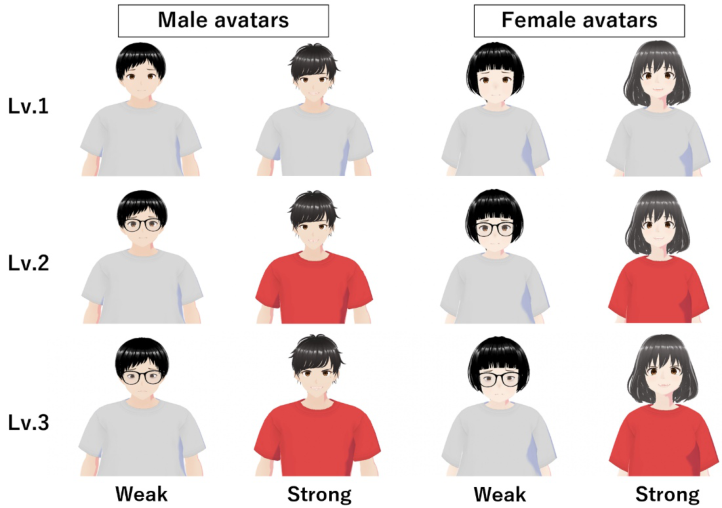
Design of Avatars Male and female avatars were created using VRoid Studio. Kawakita et al., (2022) analyzed eye-tracking data to determine that people look closely at the faces of avatars. Therefore, the face elements of the avatars were carefully designed. The avatars were characterized by elements relating to strong or weak impressions based on three levels (Figure 1).
Glasses and red clothing are simply items on their own. However, a cer- tain impression can be created by combining several items. As examples of the elements of weak impressions, Level 1 includes “fat + gloomy face,” Level 2 includes “fat + gloomy face + glasses,” and Level 3 includes “fat + glo- omy face + glasses + downcast eyes.” As examples of elements of strong
54 Kawakita and Kanai
Figure 1: Three levels of strong and weak impressions.
impressions, Level 1 includes “good figure + cheerful face,” Level 2 inclu- des “good figure + cheerful face + red clothing (color code is #04848),” and Level 3 includes “good figure + cheerful face + red clothing + sharp face (eyebrows).”
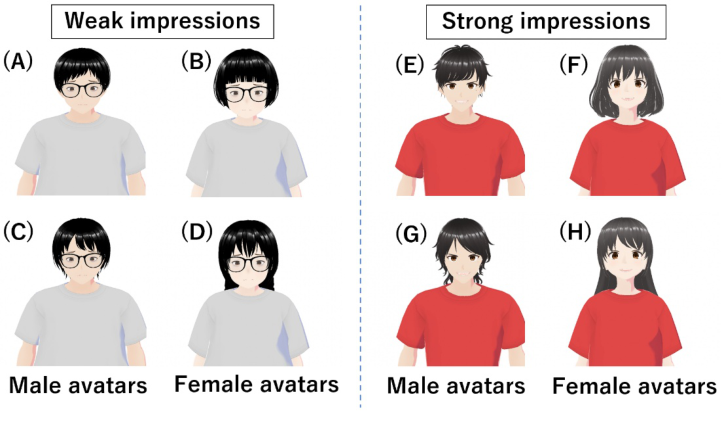
Level 3 avatars rated well as either strong or weak impressions. Therefore, we added avatars with different hairstyles based on Level 3. Figure 2 shows the eight avatars used in this study. Each avatar was assigned a letter: A-H.
Figure 2: Weak and strong impressions.
Avatar Design for Bullying Prevention in the Metaverse 55
Materials
A numerical rating scale (NRS) from 1 to 10 (10-point scale) was used for the evaluation. The survey items were as follows.
(1) Impression of avatars (weak to strong impression). (2) Attractiveness of avatars (unattractive to attractive). (3) The presumption of bullying (victim to perpetrator). In this study, the presumption of bullying meant that participants answered whether an avatar was a victim or perpetrator of bullying. Before responding to this question, participants were presented with the following situation: “Some avatars were bullied by other avatars in the game. We will show you some avatars. Please guess if the avatar is a victim or perpetrator of bullying.”
The rating of the presumption of bullying involved no criteria for deter- mining which avatars were victims or perpetrators of bullying. Therefore, participants answered this question based solely on avatar appearance.
Procedure This study used a within-subject design. Google Forms was used to record participants’ responses. The avatars (Figure 2) were randomly presented utilizing Google Forms.
RESULTS
Table 1 presents the descriptive statistics of the avatars shown in Figure 2.
Table 2 presents the descriptive statistics of the male and female avatars for strong and weak impressions.
Table 1. Means for each avatar.
Table available in the original PDF paper.
Item A B C D E F G H Impression 2.71 (1.46)
2.76 (1.65)
2.89 (1.61)
2.67 (1.67)
7.13 (2.03)
6.82 (1.96)
7.44 (2.08)
6.42 (1.92) Attractiveness 2.98 (1.47)
3.42 (1.57)
2.96 (1.36)
3.11 (1,67)
5.8 (1.91)
6.56 (1.94)
5.33 (1.89)
6.02 (1.8) Bullying 3.07 (1.86)
2.84 (1.85)
3.02 (1.79)
2.78 (1.94)
7.42 (1.84)
7.16 (1.85)
7.8 (1.97)
7.09 (1.9) Parentheses indicate the standard deviation
Table 2. Means of male and female avatars: weak / strong.
Table available in the original PDF paper.
Weak avatars Strong avatars Male Female Male Female
Table 2 indicated that male avatars were rated slightly higher than female avatars in terms of the impression and presumption of bullying. Female ava- tars were rated slightly higher than male avatars in terms of attractiveness. Because the forty participants were male, they may have rated female avatars more favorably. However, the difference between male and female avatars was not statistically significant.
We hypothesize that the impression and attractiveness of the ava- tars relate to the presumption of bullying. A multilevel analysis was performed. The data-sets are 45 (participants) × 8 (avatars) = 360. There were no missing values. The model was as follows: [bull- ying ∼1+impression+attractiveness+(1|avatars)]. R2 = .52. The fixed-effect omnibus tests were as follows: impression of avatars (p <. 001) and attractive- ness of avatars (p = .575). Table 3 lists the fixed-effects parameter estimates. The results in Table 3 show that the impression of avatars significantly affects the presumption of bullying.
The qualitative data from the participants were observed as follows. Participants expressed that:
The avatar’s impression changes with the eyebrows, colors, and glasses.
Different facial expressions changed the impression of the avatar.
DISCUSSION
This study aimed to explore the relationship between avatar appearances and bullying in the metaverse. It examined avatar characteristics that are unlikely to be bullied. The multilevel analysis revealed that the avatar impression can affect the presumption of bullying. Individuals tend to hold physical stere- otypes of avatars and classify them as victims or perpetrators based solely on their appearance. These stereotypes do not immediately cause bullying. How- ever, metaverse individuals should avoid using avatars with weak impressions to protect themselves from potential harm. In the metaverse, the probability of bullying arising from the physical stereotypes of the victim is not zero.
The multilevel analysis also indicated that the attractiveness of avatars does not significantly affect the presumption of bullying. Participants who are attracted to a particular avatar may be psychologically resistant to identifying the avatar as a victim or perpetrator.
Avatar Design for Bullying Prevention in the Metaverse 57
Some users may prefer to manipulate avatars with weak impressions. Moreover, avatars are virtual incarnations, and some users may be uncomfor- table using other avatars. In particular, users who associate their avatars more closely with themselves are more likely to be psychologically resistant to using other avatars. For such individuals, avoiding the use of avatars with weak impressions might not be a comprehensive solution. Ultimately, individuals who hold physical stereotypes of avatars must re-evaluate their presumptions. People must recognize their stereotypes and control them to avoid prejudice or discrimination. Several studies on perspective-taking have demonstrated that stereotypes can be changed (Yee and Bailenson, 2006; Banakou et al., 2016). Similar perspective-taking techniques may be applied to change the stereotypes of avatars in the metaverse.
As shown in Figure 1, a combination of several elements produces different impressions. Avatars with weak impressions are stereotyped as victims of bullying, and these carry potential risks. Therefore, this study shows that designers should be careful to not subconsciously build weak impressions into avatars to prevent potential risks.
LIMITATIONS AND SUGGESTIONS FOR FUTURE RESEARCH This study demonstrates that individuals tend to stereotype certain physi- cal traits of avatars. However, stereotypes hold not been demonstrated to be associated with actual bullying or aggressive behavior. We plan to fur- ther research the possibility of the physical stereotypes of avatars causing bullying in the metaverse. A limitation of this study is the small number of female participants. Because all participants were presented with male and female avatars, we believe that gender differences affected the perception of the avatar’s impressions. However, gender differences could not be verified because of an insufficient number of female participants.
RESEARCH ETHICS This study was approved by Life Science Committee of Japan Advanced Institute of Science and Technology.
REFERENCES
Banakou, D., Hanumanthu, P. D., & Slater, M. (2016). Virtual Embodiment of White People in a Black Virtual Body Leads to a Sustained Reduction in Their Implicit Racial Bias. Frontiers in Human Neuroscience, 10, 601. https://doi.org/10.3389/ fnhum.2016.00601 Kawakita, T., Onishi, G., Ishihara, S., Hashimoto, K., & Kanai, H. (2022). A
Study on the Effects of Different Counselor Avatar Appearances and Seriousness of Client Problems. Transactions of Japan Society of Kansei Engineering, 21 (3), 267–274. (in Japanese). Kidokoro, H., Suehiro, Y., Brscic, D., & Kanda, T. (2015). Robot Navigation Strategy for Escaping from Children’s Bullying. Transactions of Information Processing Society of Japan, 56 (4), 1203–1216. (in Japanese). Ono, T., & Hasegawa, Y. (2000). Physical Stereotypes of Ijime Victims. The Japanese
Journal of Experimental Social Psychology, 40 (2), 87–94. (in Japanese).
58 Kawakita and Kanai
Sweeting, H., & West, P. (2001). Being different: Correlates of the experience of teasing and bullying at age 11. Research Papers in Education, 16 (3), 225–246. Tietje, L., & Cresap S. (2005). Is lookism unjust? The ethics of aesthetics and public
policy implications. Journal of Libertarian Studies, 19 (2), 31–50. Voss, L. D., & Mulligan, J. (2000). Bullying in school: Are short pupils at risk?
Questionnaire study in a cohort. British Medical Journal, 320, 612–613. Wang, Y., Su, Z., Zhang, N., Xing, R., Liu, D., Luan, T. H., & Shen, X. (2022). A Survey on Metaverse: Fundamentals, Security, and Privacy. IEEE Communicati- ons Surveys & Tutorials. https://doi.org/10.1109/COMST.2022.3202047. Wiederhold, B. K. (2022). Sexual Harassment in the Metaverse. Cyberpsychology,
Behavior, and Social Networking, 25 (8), 479–480. Wolak, J., Mitchell, KJ., & Finkelhor, D. (2007). Does online harassment constitute bullying? An exploration of online harassment by known peers and online-only contacts. The Journal of Adolescent Health, 41(6), S51-S58. Yee, N., & Bailenson, J. (2006). Walk a mile in digital shoes: The impact of embodied
perspective-taking on the reduction of negative stereotyping in immersive virtual environments. Proceedings of PRESENCE 2006: The 9th Annual International Workshop on Presence, Cleveland, Ohio, USA.
LISTED IN THE AHFE DIGITAL BOOKSTORE CATALOGUE
Explore the complete digital volume
Kansei Engineering
Read this individual research paper free through the original publisher, or explore the full digital proceedings book.
ISBN 978-1-958651-77-3
Explore this ISBN in the AHFE Bookstore ↗Listed in the July 2026 bookstore catalogue; search by ISBN to confirm current availability · Digital book purchase optional